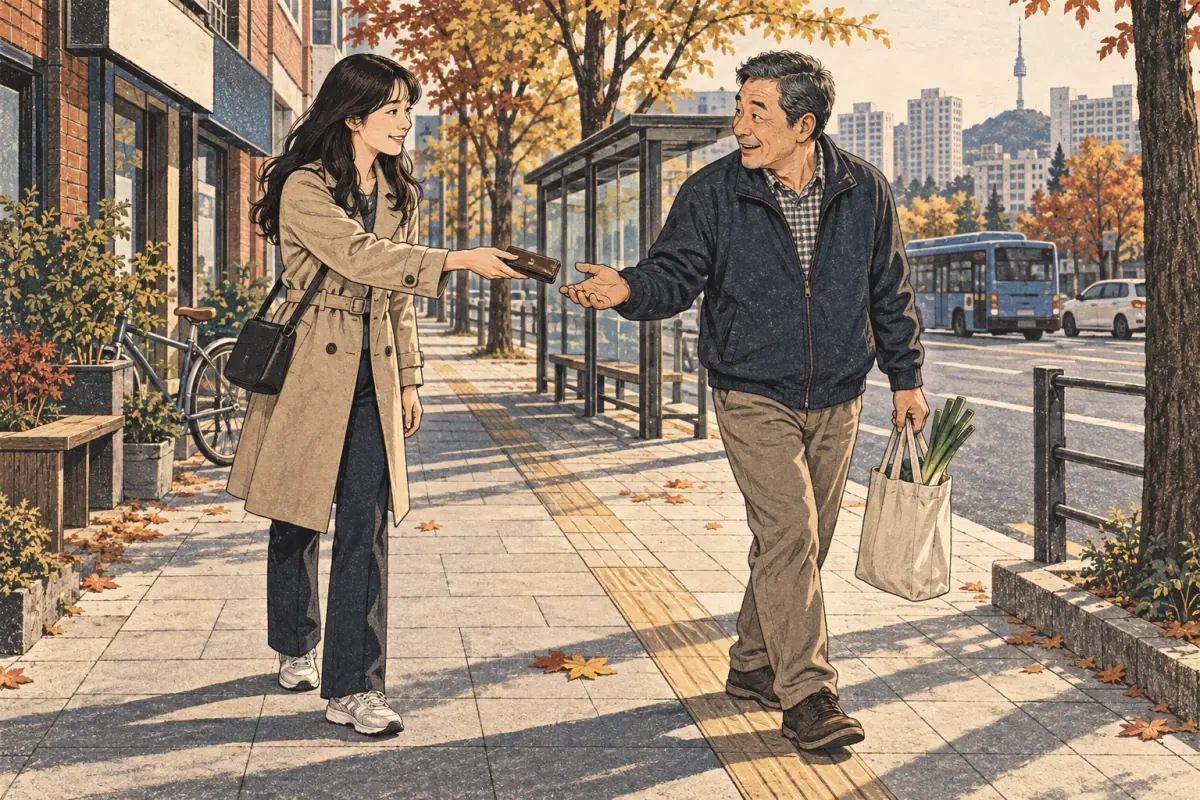
아저씨
아저씨
What you'll learn
- Say 아저씨 aloud with the tense ㅆ in the last syllable.
- Choose between 아저씨, 기사님, 사장님 and 삼촌 for a driver, a shop owner and a family friend.
- Call out to a man politely, and know when 저기요 is better.
- Avoid using 아저씨 for young men or very old men.
Before you start: you need to read Hangul; romanization is shown as an aid and can be hidden. Time: about 10 minutes. Audio plays only when you press a button.
What Does Ahjussi Mean in Korean?
Ahjussi means "mister" or "middle-aged man" in Korean. The Standard Korean Language Dictionary (표준국어대사전) gives two senses: a man of the parents' generation among relatives, and, between unrelated people, an ordinary adult man. The second sense is the one you hear on the street.
| Person | Polite word | Notes |
|---|---|---|
| Young man (20s-30s) | name + 씨, or 저기요 | 아저씨 can sound like "you look old" |
| Middle-aged man | 아저씨, or a job title | 기사님, 사장님, 선생님 |
| Middle-aged woman | 아주머니 | 아줌마 is casual and can sound blunt |
| Elderly man | 할아버지, 어르신 | 아저씨 sounds too young |
아저씨 is not a family word in daily use, unlike 오빠 or 형, so anyone can say it regardless of gender. The family words are covered in Korean family members. The next section shows each form in a sentence.
Which Forms of Ahjussi Should You Know?
아저씨 itself does not change for politeness, so the sentence around it carries the respect. A few related words cover family, jobs and women. The sentence endings follow the Korean speech levels.
Everyday: 아저씨 (ajeossi)
Polite · 해요체Used to talk about a man, 아저씨 is like "that man" or "the gentleman". Children say it to neighbours, parents' friends and shopkeepers, and adults say it when describing a stranger.
저 아저씨가 길을 알려 줬어요.
jeo ajeossiga gireul allyeo jwosseoyo
That man showed me the way.
Calling out: 아저씨 or 저기요
Polite · 해요체To get a man's attention, you can say 아저씨, followed by a polite sentence. With strangers, many adults prefer 저기요 (excuse me), which works for anyone and avoids guessing his age.
아저씨, 이거 떨어뜨리셨어요.
ajeossi, igeo tteoreotteurisyeosseoyo
Sir, you dropped this.
Family: 삼촌 (samchon)
Casual · 반말삼촌 means "uncle", especially a father's brother, and it sounds warm. Children and young people also call a friendly younger man 삼촌, because it sounds kinder and younger than 아저씨. The page on uncle in Korean lists every uncle word.
삼촌, 놀러 오세요.
samchon, nolleo oseyo
Uncle, come and visit.
Job Titles: 기사님 (gisanim) and 사장님 (sajangnim)
Formal · 합쇼체Korean often addresses people by their job plus the honorific -님. 기사님 means "driver" and suits taxi and bus drivers. 사장님 means "boss" or "owner" and suits shop and restaurant owners. Both sound more respectful than 아저씨 from an adult.
기사님, 여기서 세워 주세요.
gisanim, yeogiseo sewo juseyo
Driver, please stop here.
Female Counterpart: 아주머니 (ajumeoni)
Polite · 해요체아주머니 is the polite word for a middle-aged woman. Its short form 아줌마 is common but can sound blunt, so it is covered separately on the page for ajumma in Korean.
The forms are set. Saying 아저씨 with a clean tense ㅆ is the next step.
How Do You Pronounce 아저씨?
아저씨 is pronounced [아저씨], ajeossi, in three syllables. The first two are soft and open, and the last uses the double consonant ㅆ, a tense s said with more pressure and no breath.
- 아 (a): an open "ah".
- 저 (jeo): a soft j, then an open "uh".
- 씨 (ssi): a tight, hissing "shee", with the tongue tense.
Sound Changes to Listen For
아저씨 has no sound change inside the word, because the tense sound is written. The points to watch are the vowel and the ㅆ:
- ㅓ, not "oo". Fan spellings such as ahjussi and ajussi suggest "joo", but ㅓ is an open, unrounded "uh".
- Tense ㅆ before ㅣ. Before ㅣ, ㅆ sounds close to a tense "sh". A soft s makes 씨 sound like 시, which weakens the word.
- Written vs heard tension. In 아저씨, the tension is in the spelling. In other words, a plain letter becomes tense in speech, a rule called Korean tensification.
Revised Romanization, the official system for writing Korean in Latin letters, writes ㅓ as eo and ㅆ as ss, giving ajeossi. Fans write ahjussi, which explains the many spellings people search for. Knowing whom to call 아저씨 matters more than the spelling, as the next section shows.
When Should You Call Someone Ahjussi, and When Should You Not?
Call a man 아저씨 when he looks about forty or older, you do not know his name, and no job title fits. For drivers and shop owners use a title, for young men use 저기요, and for elderly men use 할아버지 or 어르신.
Situations Where It Fits
- As a child or teenager. Neighbours, security guards and parents' friends are all 아저씨.
- Describing a stranger. 어떤 아저씨가 도와줬어요 (Some man helped me).
- A delivery man or repairman you call to. 아저씨, 여기예요 (Over here, sir).
Situations to Avoid
- A man in his twenties or thirties. It can sound like "you look old"; use 저기요.
- A taxi driver or shop owner, as an adult. 기사님 and 사장님 are more respectful.
- A man in his seventies or older. 할아버지 or 어르신 shows the right respect.
These choices are easier to feel in real exchanges, so here are three.
How Is Ahjussi Used in Real Conversations?
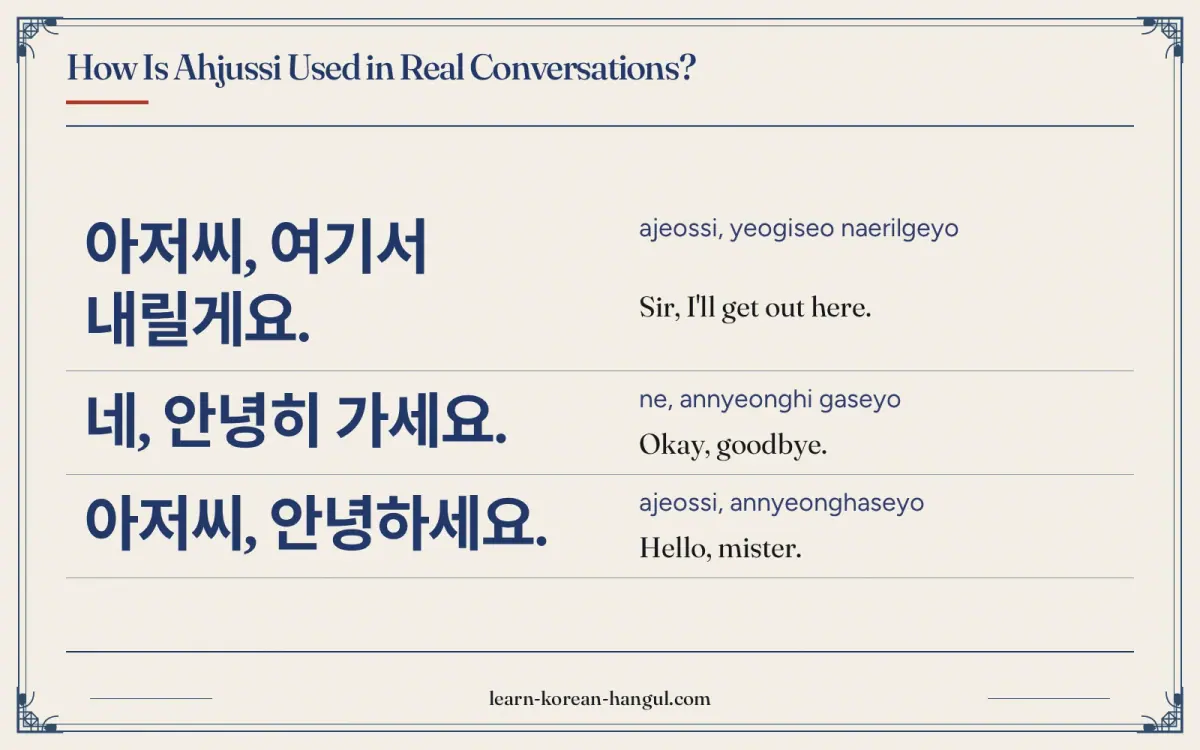
아저씨 usually opens a sentence, and the rest of the sentence stays polite. Listen for when speakers choose a title instead.
Getting out of a Taxi
Passenger
아저씨, 여기서 내릴게요.
ajeossi, yeogiseo naerilgeyo
Sir, I'll get out here.
Driver
네, 안녕히 가세요.
ne, annyeonghi gaseyo
Okay, goodbye.
What to notice: many passengers still say 아저씨 to drivers; 기사님 would be a little more respectful.
A Child Greets a Neighbour
Child
아저씨, 안녕하세요.
ajeossi, annyeonghaseyo
Hello, mister.
Neighbour
그래, 학교 가니?
geurae, hakgyo gani?
Hi there, off to school?
What to notice: the child uses 아저씨 with a polite greeting, and the adult answers in casual speech.
Buying Fruit at a Market Stall
Customer
사장님, 이 사과 얼마예요?
sajangnim, i sagwa eolmayeyo?
Excuse me, how much are these apples?
Owner
한 봉지에 오천 원이에요.
han bongjie ocheon wonieyo
Five thousand won a bag.
What to notice: the adult customer chooses the title 사장님 rather than 아저씨. These choices reflect how Korean addresses strangers.
What Should You Know about the Culture behind Ahjussi?
Korean rarely uses "you" or a bare name with strangers, so words such as 아저씨 fill that gap. Age and role decide the word, and getting the age right is a form of politeness.
- Age as respect. Choosing a word that makes someone sound older than they are can hurt, while one that sounds a little younger flatters.
- Job titles everywhere. Korean addresses people by role: 기사님, 사장님, 선생님. These titles avoid guessing age at all.
- Film and drama. The 2010 film 아저씨 (The Man from Nowhere) showed a quiet, protective older man, and the 2018 drama 나의 아저씨 (My Mister) gave the word a warm, human image.
- The 아저씨 image. Men in their thirties joke about "becoming an 아저씨" when they start hiking or talking about their back.
An expert insight: learners often think 아저씨 is the polite word for any man, as "sir" is in English. Actually, it is neutral rather than honorific, and it tells the man how old you think he looks. Adults who want to be safe use 저기요 to get attention and a job title once they know his role. The common mistakes below come from guessing age.
What Mistakes Do Learners Make with Ahjussi in Korean?
Most ahjussi mistakes come from age, from role, or from the tense ㅆ.
| Mistake | Why it is a problem | Fix |
|---|---|---|
| Calling a 25-year-old man 아저씨 | Implies he looks middle-aged | Say 저기요 |
| Calling an elderly man 아저씨 | Too young and too casual | Say 할아버지 or 어르신 |
| Calling a taxi driver 아저씨 as an adult | Fine, but less respectful | Say 기사님 |
| Calling a middle-aged woman 아저씨 | Wrong gender | Say 아주머니 |
| A soft s in 씨 | ㅆ must be tense | Say [씨] with pressure |
Learners often assume 아저씨 is slang from K-dramas. Actually, it is a standard dictionary word that every Korean child learns early, and its first dictionary sense is a family term.
Other Ways People Search for Ahjussi in Korean
People search for ahjussi in Korean in several spellings. The short answers below cover each one.
- Ajussi in Korean / ajeossi in Korean: the same word, 아저씨; ajeossi is the Revised Romanization, and ahjussi and ajussi are fan spellings. Romanization is an aid, not the real spelling.
- Ahjussi meaning: a middle-aged man, mister; in family use, a man of the parents' generation.
- Mister in Korean: 아저씨 for a stranger; with a surname, 김 선생님 or 김 사장님 are more common than a literal "Mr".
Reading the rules is one thing; producing the right word on cue is another, so practise now.
Practice: Say It Aloud
Play the slow clip of 아저씨, repeat it three times, then try 아주머니 and 기사님. Then choose a word for each situation. Answers follow.
- You are an adult, and you ask a taxi driver to stop.
- You are a child, and you greet your friend's father.
- A man of about twenty-five drops his card on the subway.
- You ask an elderly man in a park if he needs help.
Answers
- 기사님, 여기서 세워 주세요.
- 아저씨, 안녕하세요.
- 저기요, 카드 떨어뜨리셨어요.
- 어르신, 도와드릴까요?
Drill 아저씨 and the related terms with the phrase flashcards, which include audio for each form.
Related Terms to Learn Next
아저씨 is one of the address words Koreans use for people outside the family.
- Ajumma in Korean: 아줌마 and 아주머니, the female counterparts; learn them next.
- Oppa in Korean: 오빠, a woman's word for an older man she is close to.
- Unnie in Korean: 언니, a woman's word for an older woman.
This guide belongs to the Korean terms of address collection. What this page does not cover: the full system of in-law and relative terms, and regional dialect forms. Save 아저씨 for men around forty and older, prefer job titles at work, and you will use ahjussi in Korean politely.
Frequently Asked Questions
Is ahjussi rude?
No, 아저씨 is a neutral, everyday word, and children use it politely with any adult man. It can feel slightly casual from an adult to a working man, so job titles such as 기사님 for drivers and 사장님 for shop owners sound more respectful. It becomes rude only when it implies a young man looks old.
What is the difference between 아저씨 and 삼촌?
삼촌 is a family word for an uncle, especially a father's brother, and it sounds warm and close. 아저씨 is for men outside the family. Some young people and children call a friendly man in his twenties or thirties 삼촌 instead of 아저씨, because it sounds younger and kinder.
What is the female version of ahjussi?
The female counterpart is 아주머니 (ajumeoni), a polite word for a middle-aged woman, and its casual form 아줌마 (ajumma). 아줌마 can sound blunt or even rude to some women, so 아주머니, 사장님 or 저기요 are safer. The page on ajumma in Korean explains the details.
At what age does a man become an 아저씨?
There is no fixed age. Children call nearly every adult man 아저씨. Among adults, the word usually goes to men who look about forty or older, or who are married with children. Men in their thirties sometimes joke that they have become 아저씨, which shows how the word carries a feeling of middle age.
How do you write ahjussi in Hangul?
Ahjussi is written 아저씨 in Hangul, three blocks: 아, 저 and 씨. The first block uses the silent ㅇ, the second is ㅈ with ㅓ, and the third is the double consonant ㅆ with ㅣ. Ahjussi and ajussi are fan spellings; ajeossi is the official Revised Romanization.
What is the most common mistake with ahjussi in Korean?
The most common mistake is calling a young man 아저씨, which suggests he looks old; use 저기요 or his name. The second is calling a very old man 아저씨, when 할아버지 (grandfather) or 어르신 (respected elder) fits better. A third is a soft ㅅ in 씨; it must be tense.