아줌마
아줌마
What you'll learn
- Say 아줌마 aloud, with the double ㅁ across the middle.
- Choose between 아줌마, 아주머니, 이모 and 사장님 for a stranger, a worker and an older woman.
- Know when 아줌마 sounds blunt and what to say instead.
- Recognise the word in speech about a woman, and in jokes about oneself.
Before you start: you need to read Hangul; romanization is shown as an aid and can be hidden. Time: about 10 minutes. Audio plays only when you press a button.
Key facts
- 아주머니 (ajumeoni) is the more respectful form, and it is the safer word to call out.
- Fan spellings are ajumma and ahjumma; the official Revised Romanization is ajumma.
What Does Ajumma Mean in Korean?
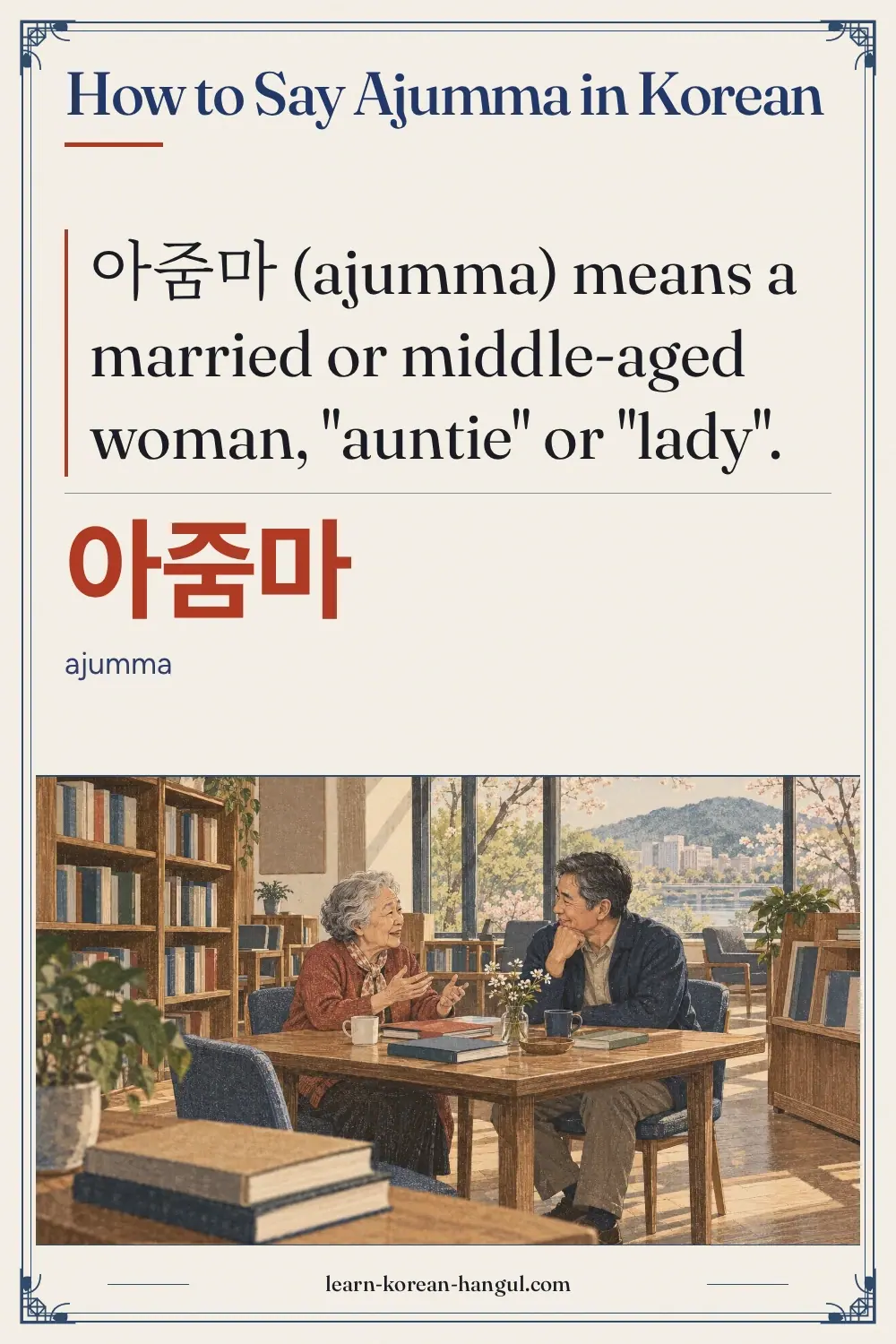
Ajumma means a married or middle-aged woman in Korean. The Standard Korean Language Dictionary (표준국어대사전) treats 아줌마 as a less respectful form of 아주머니, which is the more respectful word. In speech, 아줌마 is used for describing a woman, and as a way to call out to her.
| Person | Safer word | Notes |
|---|---|---|
| Young woman (20s) | 저기요, or her name + 씨 | 아줌마 suggests she looks middle-aged |
| Middle-aged woman, stranger | 아주머니, or a job title | 아줌마 is blunt from an adult |
| Woman who runs a shop | 사장님 | A title avoids guessing age |
| Woman in a restaurant | 이모, or 사장님 | 이모 sounds friendly and close |
| Elderly woman | 할머니, 어르신 | 아줌마 sounds too young |
The family words for aunts and uncles are covered in Korean family members. The next section shows each form in a sentence.
Which Forms of Ajumma Should You Know?
아줌마 does not change for politeness, so the word you choose carries the respect. The sentence endings follow the Korean speech levels.
Everyday: 아줌마 (ajumma)
Casual · 반말Used to talk about a woman, 아줌마 is like "that lady". It is neutral when you describe someone, and blunt when you shout it to a woman's face.
저 아줌마가 길을 알려 주셨어요.
jeo ajummaga gireul allyeo jusyeosseoyo
That woman showed me the way.
Polite: 아주머니 (ajumeoni)
Polite · 해요체아주머니 is the respectful word for a married or middle-aged woman, and it works for talking to her as well as about her. Use it when you want to be careful. In family use it can also name a relative of the parents' generation, which is why it is glossed as "aunt".
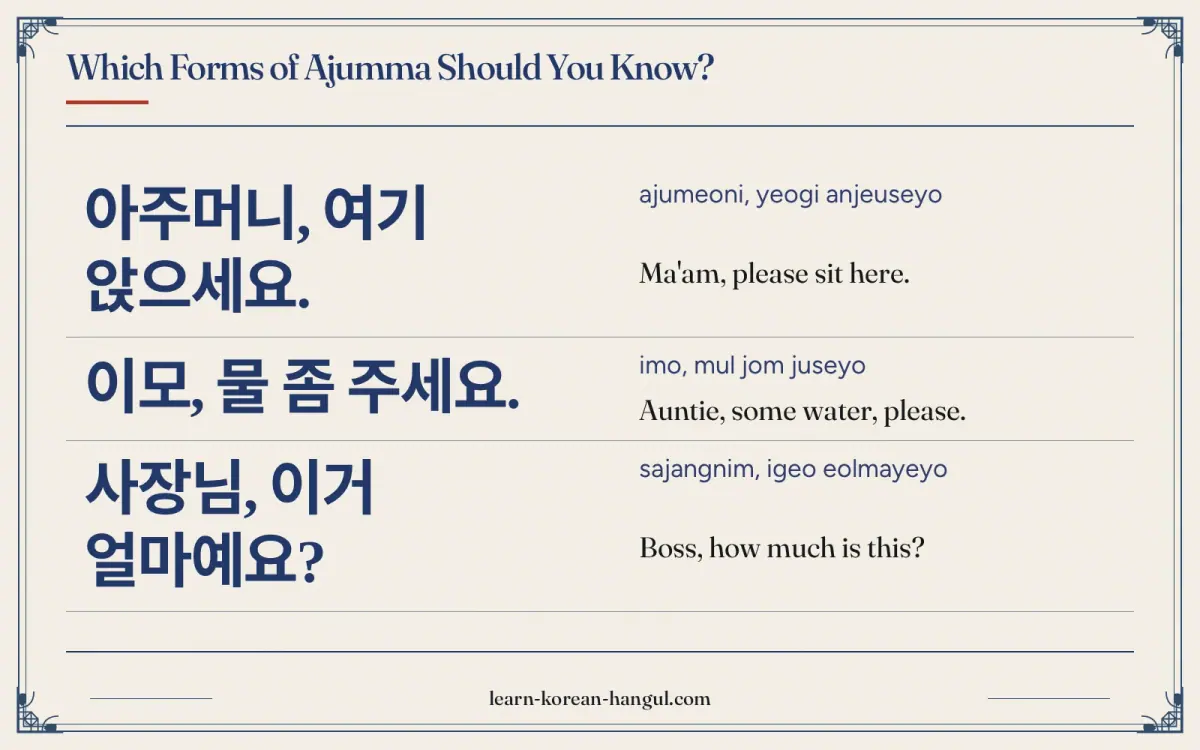
아주머니, 여기 앉으세요.
ajumeoni, yeogi anjeuseyo
Ma'am, please sit here.
Warm: 이모 (imo)
Casual · 반말이모 means "mother's sister" in a family. Customers also use it for women who work in restaurants and small shops, because it sounds friendly and close. It is a choice of tone, not a rule, and some workers prefer a title, so listen to what others say.
이모, 물 좀 주세요.
imo, mul jom juseyo
Auntie, some water, please.
Job Titles: 사장님 (sajangnim)
Formal · 합쇼체사장님 means "boss" or "owner", and it is used for shop and restaurant owners of either gender. It avoids guessing age, so it is the safest way to speak to a woman who runs a business.
사장님, 이거 얼마예요?
sajangnim, igeo eolmayeyo
Boss, how much is this?
Talking about Yourself: 아줌마
Casual · 반말Married women often call themselves 아줌마 with humour, as a way to say "I am no longer young". The same word is warm in a joke about yourself and sharp from a stranger.
저도 이제 아줌마예요.
jeodo ije ajummayeyo
I am an ajumma now too.
The forms are set. Saying 아줌마 with a clean ㅁ is the next step.
How Do You Pronounce 아줌마?
아줌마 is pronounced [아줌마], ajumma, in three syllables. All its consonants are plain. One ㅁ closes 줌 and another opens 마, so the m sound is held a little longer, and that is why the romanization has a double "mm".
- 아 (a): an open "ah".
- 줌 (jum): a soft j, then a rounded "oo", and a closed ㅁ.
- 마 (ma): the same ㅁ sound again, with an open "ah".
Sound Changes to Listen For
아줌마 has no sound change inside the word. The points to watch are the vowels and the ㅁ:
- ㅓ in 아주머니. It is an open, unrounded "uh", not "oo" or "oh". Fan spellings such as "ahjumeoni" can mislead.
- Plain ㅈ. The ㅈ in 줌 is plain, not tense. A tense ㅉ would turn the word into 아쭘마.
- A held ㅁ. The two ㅁ sounds sit on either side of the syllable break. Say 줌 and 마 as separate blocks, without a pause.
Revised Romanization, the official system for writing Korean in Latin letters, writes 아줌마 as ajumma and 아주머니 as ajumeoni. Fans also write ahjumma, which explains the many spellings people search for. Knowing whom to call 아줌마 matters more than the spelling, as the next section shows.
When Should You Call Someone Ajumma, and When Should You Not?
Use 아줌마 to talk about a middle-aged woman you do not know, and use a title or 아주머니 when you speak to her. Do not use it for a young woman or for a woman who has made it clear she dislikes it.
Situations Where It Fits
- Describing a woman. 저 아줌마가 도와줬어요 (That woman helped me).
- Joking about yourself. A married woman can say 저도 아줌마예요, as in the example above.
- A group word. In casual speech, 아줌마들 means "the women, the ladies" as a group.
Situations to Avoid
- Calling a woman by it. A bare "아줌마!" shouted at a stranger sounds blunt. Use 저기요 or 아주머니.
- Young women. It suggests that they look middle-aged.
- Staff in a restaurant or shop. 이모 or 사장님 sounds friendlier and more respectful.
These choices are easier to feel in real exchanges, so here are three.
How Is Ajumma Used in Real Conversations?
The word you choose usually opens the sentence, and the rest stays polite. Listen for when speakers choose a different form.
Asking a Restaurant Worker for Water
Customer
이모, 물 좀 더 주세요.
imo, mul jom deo juseyo
Auntie, more water, please.
Worker
네, 여기 있어요.
ne, yeogi isseoyo
Sure, here you are.
What to notice: 이모 sounds friendly in a restaurant, and the worker answers in the same polite style.
Buying Vegetables at a Market
Customer
아주머니, 이 채소 얼마예요?
ajumeoni, i chaeso eolmayeyo
Ma'am, how much are these vegetables?
Seller
이천 원이에요.
icheon wonieyo
They are two thousand won.
What to notice: the customer chooses 아주머니 rather than 아줌마 to ask a price, because it sounds more respectful.
Offering a Seat on the Bus
Student
아주머니, 여기 앉으세요.
ajumeoni, yeogi anjeuseyo
Ma'am, please sit here.
Woman
고마워요, 학생.
gomawoyo, haksaeng
Thank you, student.
What to notice: a young student offers a seat and uses 아주머니. The older woman answers with a warm 학생, "student".
What Should You Know about the Culture behind Ajumma?
Korean rarely uses "you" or a bare name with strangers, so words such as 아줌마 fill that gap. Age, family status and role decide the word.
- Marriage and age. The dictionary links the word to married women. In everyday use it is applied to women who look middle-aged, whether or not they are married.
- A stereotype. In popular media, 아줌마 can mean an energetic, strong-willed woman who bargains well and speaks her mind. Some women enjoy that image and some find it limiting.
- Titles at work. Korean addresses people by role: 사장님, 선생님. These titles avoid guessing age at all.
- Warm family words. Calling a restaurant worker 이모 borrows a family word. It makes a service meeting feel personal.
- Polite service words. Shop staff may address customers with titles such as 사모님 or 고객님. A learner does not need to copy them, but should recognise them.
An expert insight: learners often think 아줌마 is the Korean word for "ma'am". Actually, it is neutral to blunt, and it tells the woman how old you think she is. If you want to be safe, use 저기요 to get her attention and a title once you know her role. The common mistakes below come from guessing age.
What Mistakes Do Learners Make with Ajumma in Korean?
Most ajumma mistakes come from age, from role, or from the ㅈ in 줌.
| Mistake | Why it is a problem | Fix |
|---|---|---|
| Calling a 25-year-old woman 아줌마 | Implies she looks middle-aged | Say 저기요 |
| Shouting 아줌마! to a stranger | Sounds blunt | Say 저기요 or 아주머니 |
| Calling a restaurant worker 아줌마 | Less friendly than 이모 | Say 이모 or 사장님 |
| Calling an elderly woman 아줌마 | Too young and too casual | Say 할머니 or 어르신 |
| Saying a tense ㅉ in 줌 | Changes the word | Say a plain ㅈ |
Learners often assume 아줌마 is rude in every case. Actually, it is a standard dictionary word, and women use it about themselves with humour. It only becomes rude when it is aimed at someone who may not want it.
Other Ways People Search for Ajumma in Korean
People search for ajumma in Korean in several spellings. The short answers below cover each one.
- Ajumma meaning: a married or middle-aged woman; "auntie" or "lady" in English.
- Ahjumma in Korean: the same word, 아줌마; ahjumma is a fan spelling and ajumma is the Revised Romanization.
- Auntie in Korean: 이모 for a mother's sister, 고모 for a father's sister, and 아주머니 or 아줌마 for a woman outside the family.
- Aunt in Korean: the family words depend on which side: 이모 and 고모. The family page lists them all.
Reading the rules is one thing; producing the right word on cue is another, so practise now.
Practice: Say It Aloud
Play the slow clip of 아줌마, repeat it three times, then try 아주머니 and 이모. Then choose a word for each situation. Answers follow.
- You want water from a restaurant worker in a friendly place.
- You ask a woman at a market how much the vegetables are.
- A woman of about twenty-five drops her card on the subway.
- You want to offer an elderly woman your seat on the bus.
Answers
- 이모, 물 좀 주세요.
- 아주머니, 이 채소 얼마예요?
- 저기요, 카드 떨어뜨리셨어요.
- 할머니, 여기 앉으세요.
Drill 아줌마 and the related terms with the phrase flashcards, which include audio for each form.
Related Terms to Learn Next
아줌마 is one of the address words Koreans use for people outside the family.
- Ahjussi in Korean: 아저씨, the male counterpart; learn it next.
- Unnie in Korean: 언니, a woman's word for an older woman she is close to.
- Oppa in Korean: 오빠, a woman's word for an older man she is close to.
This guide belongs to the Korean terms of address collection. What this page does not cover: the full system of in-law and relative terms, and regional forms. Use 저기요 to call out, 아주머니 or a title to speak, and keep 아줌마 for talking about a woman, and you will use ajumma in Korean politely.
Frequently Asked Questions
How do you say ajumma in Korean?
Ajumma in Korean is 아줌마, said [아줌마] in three syllables. It means a married or middle-aged woman. The more respectful word is 아주머니 (ajumeoni). The Revised Romanization is ajumma, and ahjumma is a common fan spelling. Use 저기요 or a title when you call out to a woman directly.
How do you pronounce 아줌마?
Say 아-줌-마, with an open 아, a soft plain ㅈ and a rounded ㅜ in 줌, and an open 마. One ㅁ ends 줌 and another starts 마, which gives the double m in ajumma. The ㅈ is plain, not tense. Listen to the clip, and repeat three times.
What is the difference between 아줌마 and 아주머니?
아줌마 is the short, everyday form, and 아주머니 is the more respectful form. Both mean a married or middle-aged woman. Use 아주머니 when you speak to her, and keep 아줌마 for talking about a woman or for a joke about yourself. A title such as 사장님 is safer still.
Is 아줌마 rude?
It is not rude as a dictionary word, but it can sound blunt when shouted at a woman, and it is insulting for a young woman because it suggests she looks middle-aged. Many women use it about themselves with humour. When you are not sure, say 저기요 or use a job title.
Can I use 아줌마 with friends, elders and strangers?
With friends, you may use it in jokes about a mother or a married friend, but it is not a normal name for a friend. With elders, use 할머니 or 어르신 for the very old, and 아주머니 for the middle-aged. With strangers, prefer 저기요 or a title. Keep 아줌마 for describing someone.
What is the most common mistake with ajumma in Korean?
The most common mistake is calling a young woman 아줌마, which suggests she looks middle-aged. The second is calling a restaurant worker 아줌마 when 이모 or 사장님 sounds friendlier. A third is using a tense ㅉ in 줌; the ㅈ should be plain.