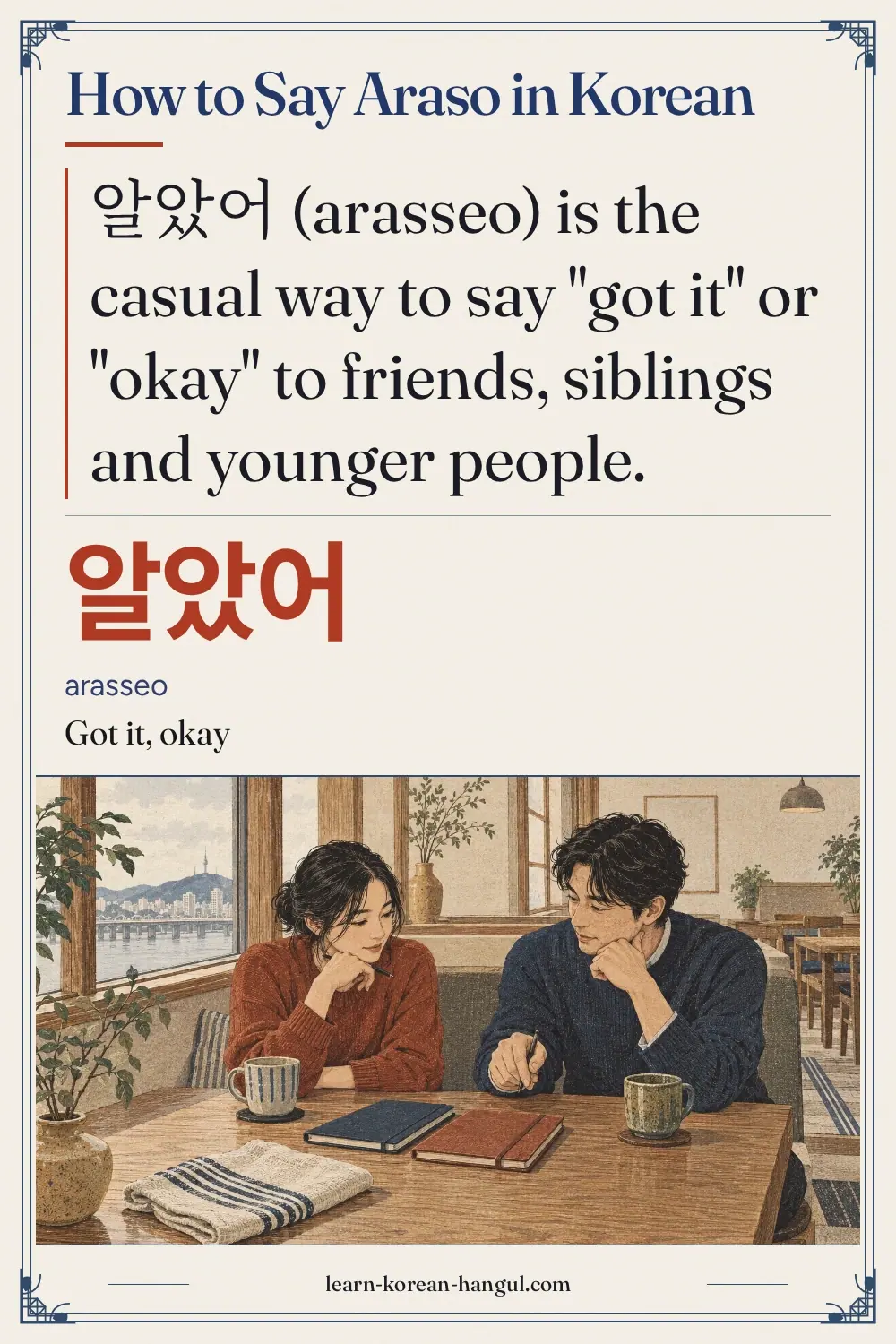
알았어
알았어
What you'll learn
- Say 알았어, 알았어요 and 알겠습니다 and pick the one that fits the listener.
- Spell the phrase correctly and see why "araso" is not the standard romanization.
- Pronounce 알았어 as [아라써], with the linked ㄹ and the tense ㅆ.
- Tell 알았어요 (I got it) apart from 알아요 (I know).
Before you start: the lesson on Korean speech levels explains the three endings used below. Time: about 12 minutes. Audio plays only when you press a button.
How Do You Say Araso in Korean?
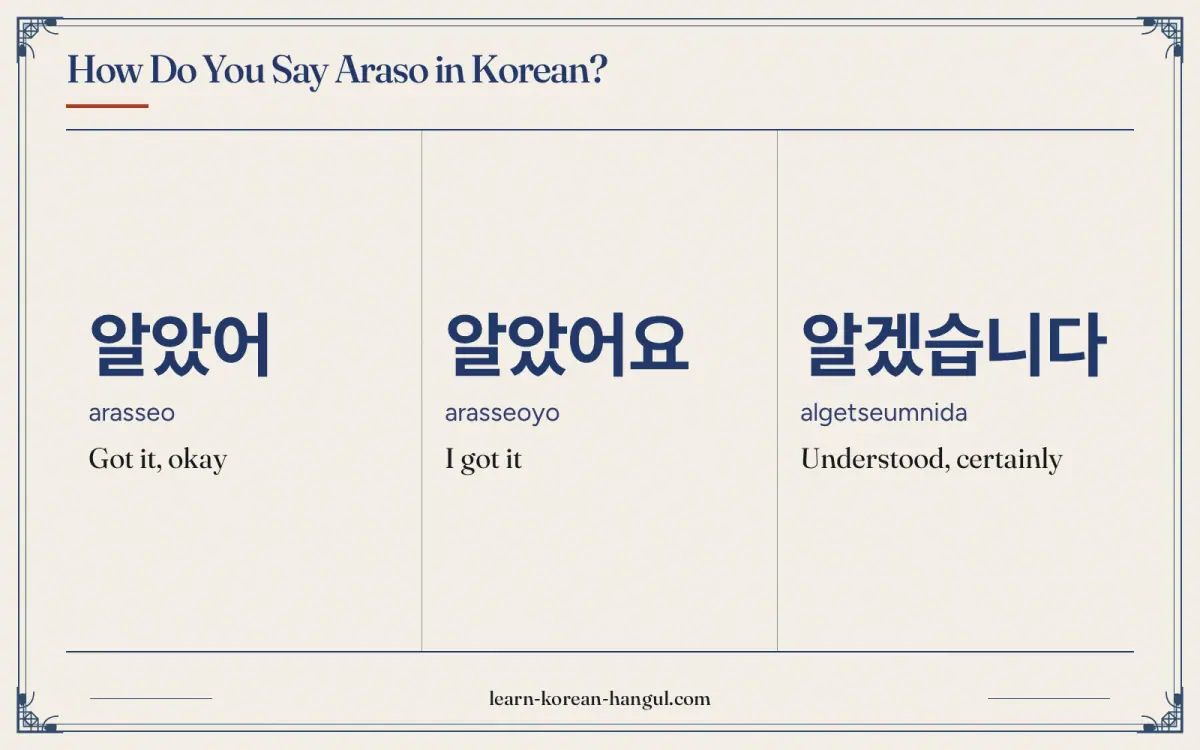
The standard way to say araso in Korean is 알았어, from the verb 알다 (to know, to realize). The past-tense form 알았- literally means "I came to know", so it fits the moment when you take in an instruction and accept it.
| Listener | Korean | Romanization | Meaning |
|---|---|---|---|
| Friend, sibling, younger person | 알았어 | arasseo | Got it, okay |
| Coworker, acquaintance | 알았어요 | arasseoyo | I got it |
| Boss, customer, teacher | 알겠습니다 | algetseumnida | Understood, certainly |
Revised Romanization (the South Korean government standard of 2000) is only a reading aid here. Learn the Hangul first. The next section explains the three forms one by one.
What Are the Formal, Polite and Casual Ways to Say Araso?
Araso has three common forms, and the listener decides which one to use. The endings come from the Korean speech levels, and the stem 알- stays recognizable in all of them.
Casual: 알았어 (arasseo)
Casual · 반말알았어 is for friends, siblings, classmates of the same age and anyone younger than you. It is short and quick, and it often comes with a nod. Add a promise to make it warmer: 알았어, 갈게 means "Okay, I'll go."
알았어, 갈게.
arasseo, galge
Okay, I'll go.
Polite: 알았어요 (arasseoyo)
Polite · 해요체알았어요 adds the polite ending -요. Use it with coworkers, older acquaintances, shop staff and neighbours. It sounds friendly but not stiff, which makes it the default for adults you do not know well.
알았어요. 지금 할게요.
arasseoyo. jigeum halgeyo
Okay. I'll do it now.
Formal: 알겠습니다 (algetseumnida)
Formal · 합쇼체알겠습니다 uses the formal ending -습니다 and the marker -겠-, which here signals readiness to act. It is the standard answer to a boss or customer, and it carries a nuance that 알았어요 lacks: "I understand, and I will act on it."
알겠습니다. 바로 처리하겠습니다.
algetseumnida. baro cheorihagetseumnida
Understood. I will handle it right away.
When you are unsure, choose the more respectful form, because a formal reply never offends. Spelling and sound are where learners trip next.
How Do You Pronounce 알았어?
알았어 is pronounced [아라써], a-ra-sseo, in three syllables. The final ㄹ of 알 moves onto the empty ㅇ of 았, and the ㅆ keeps its tense sound.
- 아 (a): an open "ah".
- 라 (ra): the ㄹ of 알 links to the next vowel and sounds like a quick "r/l" between vowels.
- 써 (sseo): the ㅆ of 았 moves onto the written 어, so you hear a tense, hissing s and the vowel ㅓ, which is "uh" or "aw", not "o".
Sound Changes to Listen For
Rules from the Standard Pronunciation (표준 발음법) of the National Institute of Korean Language shape this word and its formal form:
- Liaison (연음). A final consonant moves onto a following vowel, so 알았어 sounds like [아라써], not [알-았-어].
- Tense ㅆ. 았 is the past-tense marker, and its ㅆ is a tense letter in its own right. Liaison carries it onto 어, which is why the word has the hissing "sseo". Plain consonants can also turn tense, as in 할게 [할께]; that rule is covered in Korean tensification.
- Formal form. 알겠습니다 is [알겓씀니다]: the ㅆ of 겠 becomes [ㄷ] at the end of a syllable, the ㅅ after it becomes tense [ㅆ], and ㅂ before ㄴ becomes [ㅁ].
The most common spelling, "araso", hides the vowel: the last syllable is ㅓ, so "arasseo" is closer to the sound.
When Should You Use 알았어, and When Should You Not?
Use 알았어 when you accept an instruction, a request or a fact from someone younger or equal in age. Avoid it with anyone who deserves respect, because the short ending can sound dismissive.
Situations Where It Fits
- A friend asks you to bring something. 알았어, 가져갈게.
- A sibling reminds you of a deadline. 알았어, 알았어.
- Your child asks you to check a message. 알았어, 이따 볼게.
- A younger colleague confirms a time with you. 알았어, 그때 보자.
Situations to Avoid
- Teachers and bosses. 알았어 sounds blunt. Say 알겠습니다.
- Customers and strangers. Use 알겠습니다 or 네, 알았어요.
- Serious instructions. In a safety or work situation, the formal 알겠습니다 shows that you will act, which a casual 알았어 does not.
Seeing the forms in conversation shows how the tone works.
What Does Araso Sound Like in a Real Conversation?
알았어 appears in short, quick exchanges, and the tone carries the feeling. Listen for a relaxed, falling tone when the speaker agrees willingly.
Homework between Friends
Min-Su
숙제 내일까지 내야 돼.
sukje naeilkkaji naeya dwae
We have to hand in the homework by tomorrow.
Ji-Woo
알았어, 오늘 밤에 할게.
arasseo, oneul bame halge
Okay, I'll do it tonight.
What to notice: 알았어 accepts the information, and 할게 adds a promise.
A Request at Work
Manager
이 자료 오후까지 보내 주세요.
i jaryo ohukkaji bonae juseyo
Please send these materials by the afternoon.
Employee
알겠습니다. 두 시까지 보내겠습니다.
algetseumnida. du sikkaji bonaegetseumnida
Understood. I'll send them by two o'clock.
What to notice: the employee repeats the commitment with 보내겠습니다, which is the formal habit.
Impatient Okay-Okay
Mother
빨리 일어나!
ppalli ireona
Get up quickly!
Son
알았어, 알았어.
arasseo, arasseo
Okay, okay.
What to notice: repeating 알았어 twice with a falling tone means "I heard you, stop nagging". That tone leads to the culture behind the phrase.
What Should You Know about the Culture behind Araso?
알았어 is one of the most frequent replies in Korean homes, schools and offices, and its meaning depends on tone as much as on words.
- Tone shifts the meaning. A soft 알았어요~ with a lengthened ending sounds friendly. A sharp, repeated 알았어, 알았어 sounds annoyed. K-dramas use both, which is why many learners hear the phrase before they study it.
- Parents and teachers ask it. 알았어? or the softer 알았지? checks that a child understood. Children answer 네 (yes) or 응 (casual yes), often followed by 알았어요 or 알았어.
- Acknowledgement is expected. In Korean workplaces, a quick 알겠습니다 shows you received the instruction, even before you start the task.
An expert insight: learners often copy the drama version 알았어 and use it everywhere. Real conversations switch to 알겠습니다 or 알았어요 the moment the listener is a senior, so the casual form has a narrow range. The next section covers the mistakes this causes.
What Mistakes Do Learners Make with Araso in Korean?
Most araso mistakes come from the spelling "araso" and from using the casual form with the wrong person.
| Mistake | Why it is a problem | Fix |
|---|---|---|
| Writing "araso" and saying it with a final "o" | The vowel is ㅓ, so the sound is wrong | Say [아라써], romanized arasseo |
| 알았어 to a teacher or boss | Casual and blunt | Say 알겠습니다 |
| 알아요 to mean "got it" | It means "I know", not "I understood" | Say 알았어요 |
| Pronouncing a separate [ㄹ] after 알 | Misses the liaison | Link the ㄹ: [아라써] |
| Using a plain 알았어 for a promise | The action is missing | Add a promise: 알았어, 할게 |
Learners often assume 알았어 and 알아 are the same because both come from 알다. Actually, 알아 is present tense, "I know", and 알았어 is the past form that reports a new realization, "I got it".
Are Araso, Arasso and Arasseo the Same Word?
Yes. "Araso", "arasso" and "arasseo" all point to 알았어, and the short answers below cover each related search.
- Araso meaning: "got it", "okay" or "I understand", said when you accept something.
- Arasso in Korean: a fan spelling of the same word; the Revised Romanization is arasseo.
- Understood in Korean: 알겠습니다 for formal use. More options are on understood in Korean.
- I understand in Korean: 이해해요 (ihaehaeyo) for comprehension. See I understand in Korean.
- Okay in Korean: 알았어 also works as "okay". The general word is on okay in Korean.
Now practise the three forms with your own voice.
Practice: Say It Aloud
Play the slow clip and repeat 알았어 three times, linking the ㄹ each time. Then choose the right form for each listener. Answers follow.
- Your best friend tells you to call back tonight.
- Your manager asks you to send a file.
- A shop owner you meet for the first time asks you to wait.
- Write the standard romanization of 알았어.
Answers
- 알았어, 전화할게.
- 알겠습니다.
- 네, 알았어요.
- arasseo, with the tense ss and the vowel eo.
The phrase flashcards drill all three forms with audio.
Related Phrases to Learn Next
Araso belongs to a small family of acknowledgement phrases.
- Understood in Korean: the formal and polite ways to confirm that you understood.
- I understand in Korean: how to say you follow what someone means.
- Okay in Korean: the short agreement words used in everyday talk.
This guide belongs to the kdrama Korean phrases collection. What this page does not cover: the full grammar of -겠- and -ㄹ게 endings, and regional or generational slang for agreement. Choose the ending that fits the listener, and you can say araso in Korean the way native speakers do.
Frequently Asked Questions
How is 알았어 different from 알아요?
알아요 means "I know" and describes what you already know. 알았어요 is the past form, and in conversation it means "I got it" or "okay, understood", said when you take in new information or accept a request. If a friend gives you directions, answer 알았어, not 알아.
Is it arasso or araso?
Both are fan spellings of the same word. The Revised Romanization of 알았어 is arasseo, with ss for the tense ㅆ and eo for the vowel ㅓ. The final vowel is not o. Learn the Hangul 알았어 and the sound [아라써], and any romanized spelling will map to it.
Can I say 알았어 to my teacher?
No. 알았어 is casual speech and sounds blunt to a teacher or a boss. Use 알겠습니다 for a formal answer or 알았어요 for a softer polite one. To a teacher you know well, 네, 알겠습니다 is the safest choice because the formal ending shows respect.
What does 알았어? with a rising tone mean?
With a rising tone, 알았어? asks "got it?" or "understood?" Parents, older siblings and teachers say it to confirm that a child or junior heard the instruction. 알았지? is the softer, friendlier version. Between peers, a sharp 알았어? can sound bossy, so it is mostly said by an older person to a younger one.
How do I say "okay, I will" in Korean?
Add the action, as in 알았어, 할게 (okay, I'll do it) for friends and 알겠습니다, 하겠습니다 for formal speech. The -ㄹ게 and -겠- endings state a promise, so they turn plain understanding into agreement. Pronounce 할게 as [할께] with a tense ㄲ-like sound.