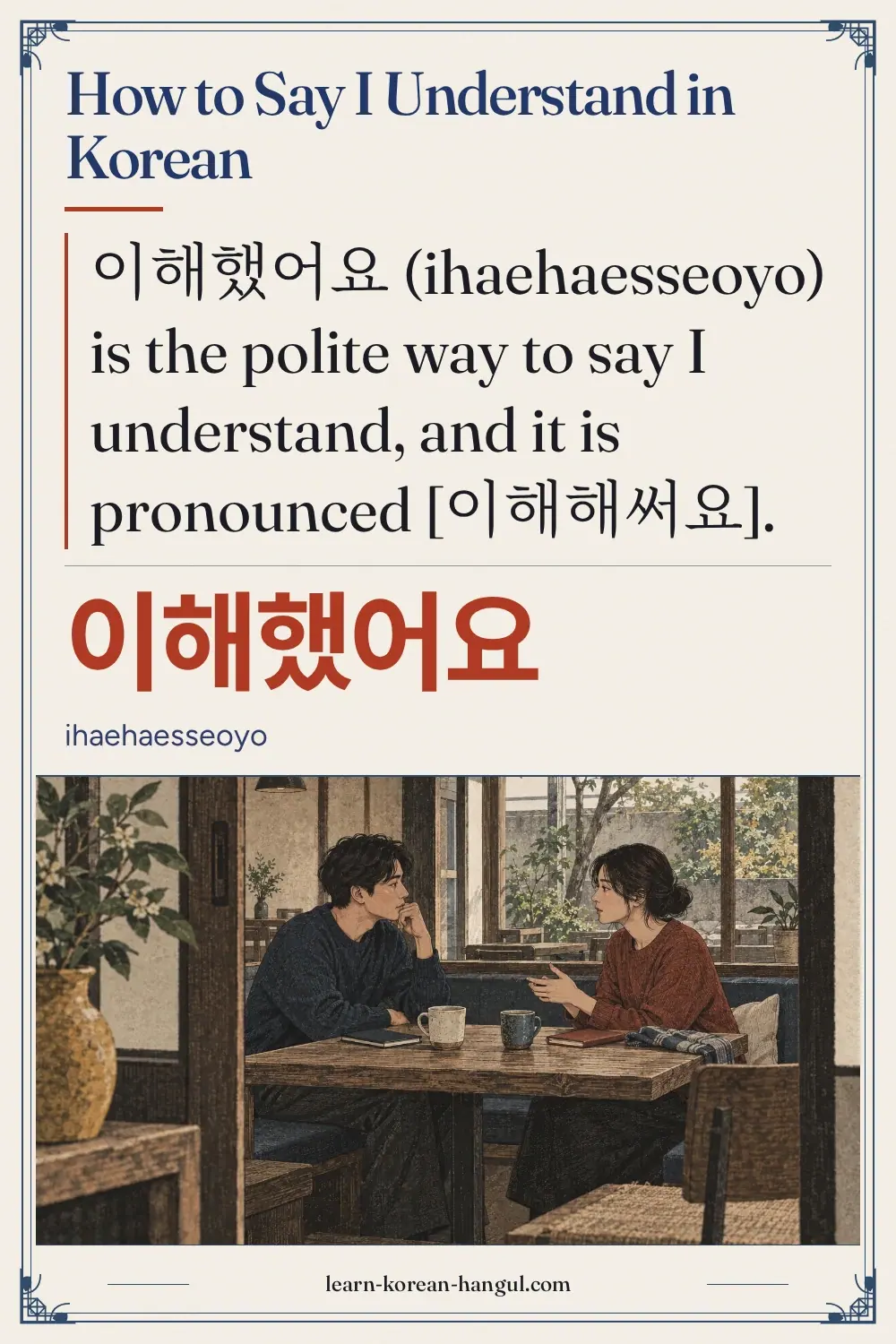
이해했어요
이해했어요
What you'll learn
- Say I understand with 이해했어요, 이해했습니다, 알겠어요 or 알겠습니다.
- Tell 이해하다 (to understand) apart from 알다 (to know).
- Pronounce the tense ㅆ in 이해했어요.
- Choose the form for a teacher, a boss or a friend.
Before you start: you only need to read Hangul. The next page in the set is I don't understand in Korean. Time: about 8 minutes. Audio plays only when you press a button.
How Do You Say I Understand in Korean?
The standard way to say I understand in Korean is 이해했어요. The verb 이해하다 (ihaehada) means "to understand", and the past tense -했어요 shows that the understanding has arrived: "I have understood".
| Situation | Best form | Romanization | Why |
|---|---|---|---|
| A teacher explains a rule | 이해했어요 | ihaehaesseoyo | Polite, clear |
| A manager gives an instruction | 알겠습니다 | algetseumnida | Formal, standard at work |
| A friend gives directions | 알았어 | arasseo | Casual, got it |
| A friend tells a sad story | 이해해요 | ihaehaeyo | Present, empathy |
| A customer explains a request | 이해했습니다 | ihaehaetseumnida | Formal and careful |
Notice that the verb is in the past tense, but the meaning is "I understand now". The next section sorts the forms by level.
What Are the Formal, Polite and Casual Ways to Say I Understand?
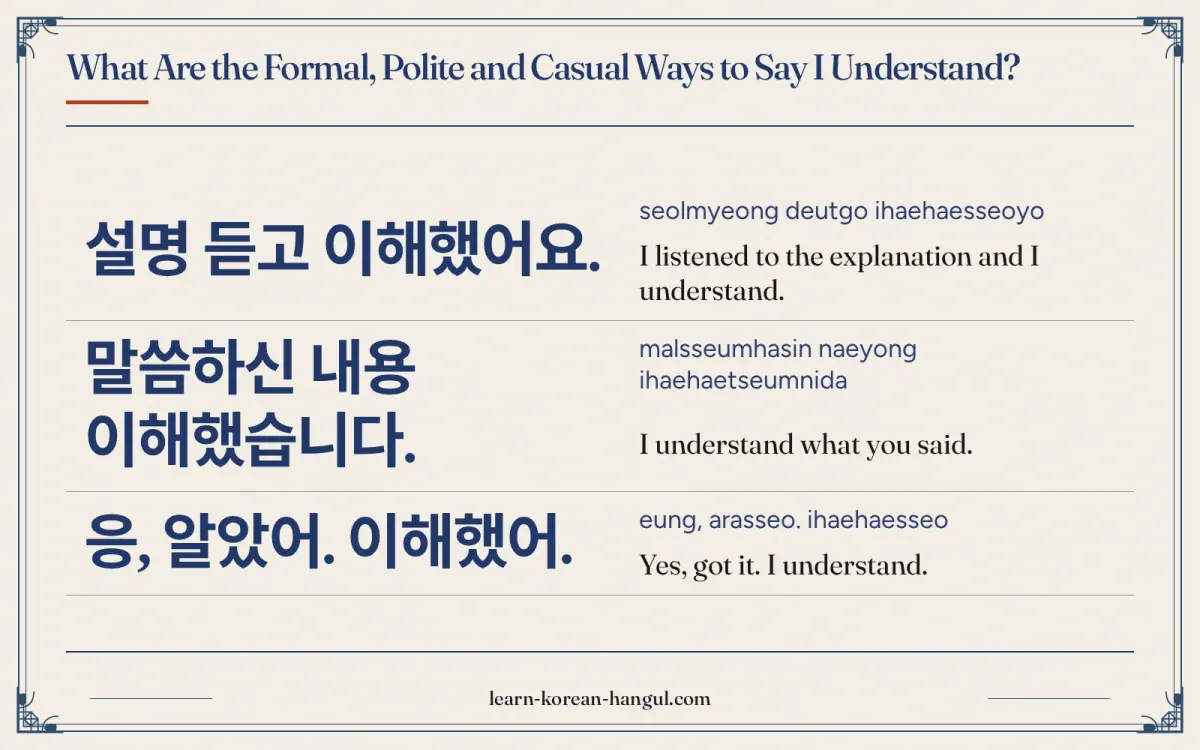
The forms follow the Korean speech levels, explained in the guide to Korean speech levels. Here the verb choice matters as well as the ending.
Polite: 이해했어요 (ihaehaesseoyo)
Polite · 해요체이해했어요 is the everyday default. Use it with teachers, colleagues and acquaintances after someone explains an idea.
설명 듣고 이해했어요.
seolmyeong deutgo ihaehaesseoyo
I listened to the explanation and I understand.
Formal: 이해했습니다 (ihaehaetseumnida)
Formal · 합쇼체이해했습니다 is the formal version. Use it in meetings, with customers and in writing. It is pronounced [이해핻씀니다].
말씀하신 내용 이해했습니다.
malsseumhasin naeyong ihaehaetseumnida
I understand what you said.
Polite: 알겠어요 (algesseoyo)
Polite · 해요체알겠어요 is built from 알다 (to know) and -겠-, an ending of intention or realisation. It means "I have got it" or "understood, I will do it". It answers instructions, directions and requests.
네, 알겠어요. 내일까지 할게요.
ne, algesseoyo. naeilkkaji halgeyo
Yes, understood. I'll do it by tomorrow.
Formal: 알겠습니다 (algetseumnida)
Formal · 합쇼체알겠습니다 is the formal "understood" used with a boss or a customer. In a Korean workplace it is probably the most common reply to an instruction. It is pronounced [알겓씀니다].
Casual: 알았어 and 이해했어 (arasseo, ihaehaesseo)
Casual · 반말With close friends, drop the polite ending: 알았어 (got it) or 이해했어 (I understood). The polite 알았어요 [아라써요] sits between them and is common with colleagues of the same age.
응, 알았어. 이해했어.
eung, arasseo. ihaehaesseo
Yes, got it. I understand.
Present: 이해해요 (ihaehaeyo)
Polite · 해요체이해해요 is the present tense. It says "I understand (your position or feelings)". It is a kind answer to a friend who is upset: 그 마음 이해해요 (I understand that feeling).
The past-tense ㅆ is the hard part of the sound, so listen carefully.
How Do You Pronounce 이해했어요?
이해했어요 is pronounced [이해해써요], i-hae-hae-sseo-yo, in five syllables. The ㅆ in 했 moves to the next syllable and sounds tense.
- 이 (i): "ee".
- 해 (hae): a clear h and "eh".
- 했 (haet): the ㅆ moves over and joins 어.
- 써 (sseo): tense "ssuh", said with firm lips.
- 요 (yo): "yo".
Sound Changes to Listen For
These changes follow the National Institute of Korean Language standard pronunciation rules (표준 발음법):
- A final consonant moves to a vowel. 이해했어요 is [이해해써요] and 알겠어요 is [알게써요] (Article 13).
- Final ㅆ becomes ㄷ before a consonant. 이해했습니다 is [이해핻씀니다] and 알겠습니다 is [알겓씀니다]. The ㅆ is said as ㄷ (Article 9), the next ㅅ turns tense (Article 23) and ㅂ before ㄴ becomes ㅁ (Article 18). See Korean tensification.
Knowing the sound, you need to know the right moment.
When Should You Use 이해했어요, and When Should You Not?
Use 이해했어요 after an explanation, and 알겠어요 after an instruction. Do not use 알아요 for either, because it means "I know".
Situations Where It Fits
- A teacher explains grammar. 이해했어요.
- A manager says to send a file by five. 알겠습니다.
- A friend explains why they were late. 이해해요.
Situations to Avoid
- You only know the word, not the idea. Say 알아요, not 이해했어요.
- Pretending. If you do not understand, say 다시 설명해 주세요 (please explain again).
- A boss with the casual 알았어. Say 알겠습니다.
Two short conversations show the difference.
What Does I Understand Sound Like in a Real Conversation?
In real conversation, an answer to an instruction is short and clear. Notice the nod and the follow-up.
In a Korean Class
Teacher
이해했어요?
ihaehaesseoyo?
Did you understand?
Student
네, 이해했어요. 그런데 한 번 더 말해 주세요.
ne, ihaehaesseoyo. geureonde han beon deo malhae juseyo
Yes, I understand. But please say it one more time.
Teacher
좋아요. 다시 설명할게요.
joayo. dasi seolmyeonghalgeyo
Okay. I'll explain again.
What to notice: the student combines I understand with a polite request, which is common and not rude.
At the Office
Manager
오늘 오후까지 보고서 부탁해요.
oneul ohukkaji bogoseo butakaeyo
Please give me the report by this afternoon.
Employee
네, 알겠습니다.
ne, algetseumnida
Yes, understood.
What to notice: the employee uses 알겠습니다, the standard formal acknowledgement.
What Should You Know about the Culture behind I Understand?
In Korean offices and classes, saying 알겠습니다 or 이해했어요 shows respect and attention. Silence can be read as confusion or disagreement, so a clear reply helps. At the same time, some Koreans say 알겠습니다 even when they have doubts, to avoid disappointing a senior. If you are the senior, ask a follow-up question to check real understanding.
- Nodding. A small nod goes with the reply and shows you are listening.
- Acknowledging orders. 알겠습니다 does not always mean agreement. It means "I have received the message".
- Asking again is fine. 죄송한데 다시 한번 말씀해 주시겠어요? (sorry, could you say it once more?) is polite and expected.
An expert tip: when you want to show real comprehension, repeat the key point in your own words, such as 그러니까 내일까지 하면 되는 거죠? (so I just need to do it by tomorrow, right?). This is more convincing than a bare 알겠습니다.
What Mistakes Do Learners Make with I Understand in Korean?
Most mistakes come from mixing 알다 and 이해하다 or from the sound of the past tense.
| Mistake | Why it is a problem | Fix |
|---|---|---|
| 알아요 for "I understand" | Means "I know" | Say 이해했어요 |
| 이해해요 for "I got it now" | Present tense, empathy | Say 이해했어요 |
| [이해해서요] | Not the standard sound | Say [이해해써요] |
| 알았어 to a boss | Too casual | Say 알겠습니다 |
| 알겠어요 when you only followed an idea | Sounds like a promise to act | Say 이해했어요 |
Learners often assume 알다 and 이해하다 are the same. Actually, 알다 is about knowing a fact or a person, while 이해하다 is about grasping an idea.
Is It the Same as Understand or I Got It?
Mostly. The short answers below cover the other searches folded into this page.
- I understand formal in Korean: 이해했습니다 or 알겠습니다.
- Understand in Korean: the verb 이해하다; the polite present is 이해해요.
- I got it in Korean: 알겠어요 or 알았어요; casual 알았어.
The link between the ideas is covered in I know in Korean. Now practise aloud.
Practice: Say It Aloud
Play the slow clip of 이해했어요 three times and keep the tense ㅆ firm. Then choose a reply. Answers follow.
- A teacher explains the rule and you follow.
- A manager asks you to send an email.
- A friend asks if you got the directions.
- A friend is sad, and you want to be kind.
Answers
- 이해했어요.
- 알겠습니다.
- 응, 알았어.
- 그 마음 이해해요.
The phrase flashcards drill these lines with audio.
Related Phrases to Learn Next
Understanding goes with asking and knowing.
- I don't understand in Korean: 이해 못 했어요 and its polite requests.
- I know in Korean: 알아요 and 알고 있어요.
- Everyday conversation: more phrases for daily talk.
This guide belongs to the Korean conversation collection. What this page does not cover: business email wording and all uses of -겠-. Pick the right verb for the situation, mind the tense ㅆ, and you can say i understand in Korean clearly.
Frequently Asked Questions
How do you say I understand in Korean?
Say 이해했어요 (ihaehaesseoyo) in polite speech, 이해했습니다 in formal speech and 이해했어 to a close friend. These forms use the past tense to mean I have understood. To acknowledge an instruction, 알겠어요 or 알겠습니다 is more common. Both are pronounced with a tense ㅆ.
How do you say I understand formally in Korean?
Use 이해했습니다 (ihaehaetseumnida) when you explain that you followed an idea, or 알겠습니다 (algetseumnida) when you accept an instruction. Both are formal, and both are very common at work and with customers. In email, write them out in full and avoid the casual 알았어.
How do you say I got it in Korean?
Say 알겠어요 (algesseoyo) or 알았어요 (arasseoyo) for polite speech, and 알았어 (arasseo) for casual speech. They mean got it, okay or understood. 알겠어요 sounds more careful and promises to act. 알았어요 is lighter and fits a peer or a younger colleague; to a boss it can sound curt, so use 알겠습니다 there.
What is the difference between 이해했어요 and 알겠어요?
이해했어요 says that you followed an explanation, as in I understand now. 알겠어요 says understood, and often means I will do it. For a lecture or story, choose 이해했어요. For instructions, directions or a request, choose 알겠어요. In daily talk both can often be used, and Koreans will not mind.
Is 이해해요 the same as 이해했어요?
Not quite. 이해해요 is the present tense and means I understand your point or your feelings, often with empathy. 이해했어요 is the past tense and says I have just got it. For example, after hearing a friend's story, 이해해요 is kind. After a teacher explains a rule, 이해했어요 is more natural.
What is the most common mistake with I understand in Korean?
Learners say 알아요 (I know) when they mean I understand, or 이해해요 for I got it. 알아요 says that you know a fact. Another slip is the sound: 이해했어요 is [이해해써요], not [이해해서요] with a soft s. A final mistake is the casual 알았어 with a boss, which can sound too relaxed.