
좋아요
좋아요
What you'll learn
- Say 좋아요 and its linked sound [조아요], and pronounce 괜찮아요 as [괜차나요].
- Choose between 좋아요, 괜찮아요, 알겠어요, 그래요 and 오케이 for a stranger, a senior and a friend.
- Answer offers without accidentally refusing them.
- Recognise the formal 알겠습니다 and the chat shorthand ㅇㅋ.
Before you start: you need to read Hangul; romanization is shown as an aid and can be hidden. Time: about 10 minutes.
Key facts
- 좋아요 (joayo) is the polite "okay, sounds good", used to agree to a plan or an offer; it is pronounced [조아요].
- 알겠어요 (algesseoyo) and the formal 알겠습니다 (algetseumnida) mean "okay, I understand" and accept an instruction.
- 오케이 (okei) and the chat shorthand ㅇㅋ are casual and come from English.
- Korean has no single word for okay, so the right word depends on whether you agree, accept or say it is fine.
How Do You Say Okay in Korean?
The standard way to say okay in Korean is 좋아요, because it is polite and works for agreeing. Other situations call for other words, since English "okay" covers at least four different jobs in Korean.
| Job | Form | Romanization | Register |
|---|---|---|---|
| Agree to a plan or an offer | 좋아요 | joayo | Polite |
| Say it is fine, or decline softly | 괜찮아요 | gwaenchanayo | Polite |
| Accept an instruction, "got it" | 알겠어요 | algesseoyo | Polite |
| Accept an instruction, formally | 알겠습니다 | algetseumnida | Formal |
| Sure, why not | 그래요 | geuraeyo | Polite |
| Okay, borrowed from English | 오케이 / ㅇㅋ | okei | Casual |
Notice that the first column is a job, not a word. Ask yourself whether you are agreeing, accepting or reassuring, and the right word follows. The next section shows each form in use.
What Are the Polite and Casual Ways to Say Okay?
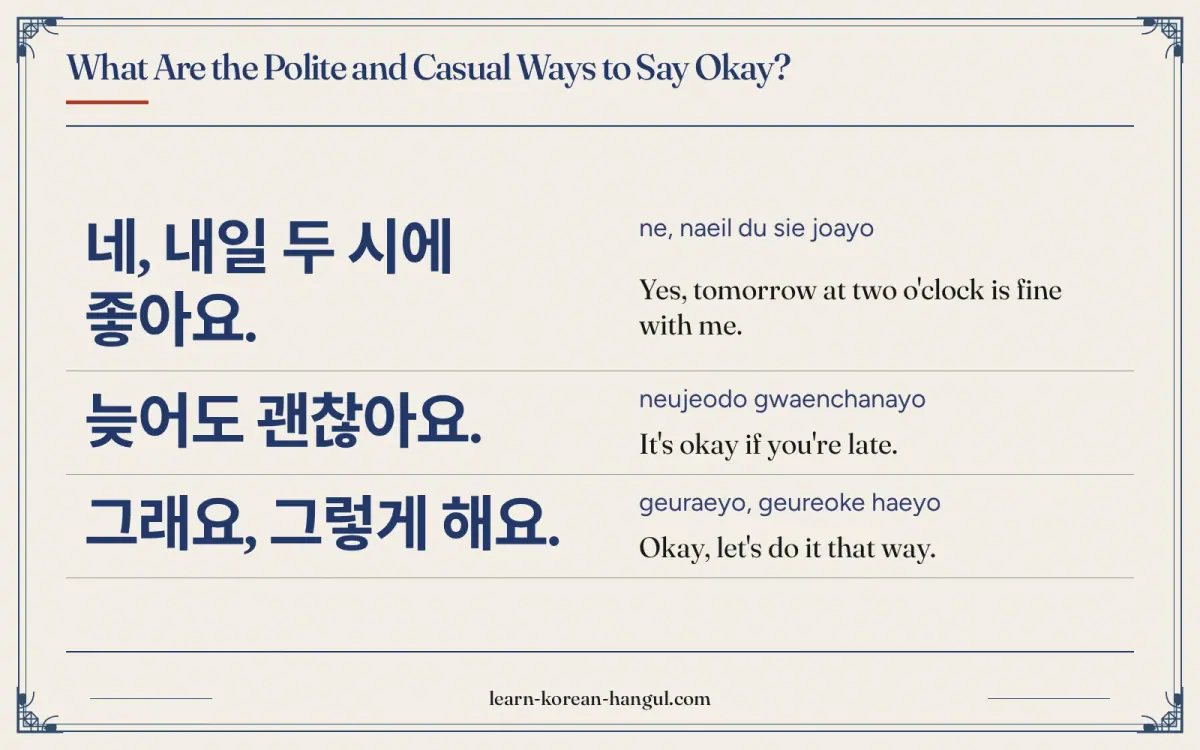
Okay in Korean follows the Korean speech levels, the endings that change with the listener's age, status and closeness, explained in the guide to Korean speech levels. The meaning stays "okay" while the ending shifts, and the job decides the verb.
Polite: 좋아요 (joayo)
Polite · 해요체좋아요 literally means "it's good" or "I like it". When a colleague proposes a time or a restaurant, 좋아요 is the natural way to say "okay, sounds good". It is warm, so it suits plans, suggestions and offers you want to accept.
네, 내일 두 시에 좋아요.
ne, naeil du sie joayo
Yes, tomorrow at two o'clock is fine with me.
Polite: 괜찮아요 (gwaenchanayo)
Polite · 해요체괜찮아요 means "it's fine", "I'm okay" or "no problem". It reassures people after an accident or a small mistake. In reply to an offer it usually means "no thanks, I'm fine", which makes it the biggest trap for learners. The page for it's okay in Korean covers it in depth.
늦어도 괜찮아요.
neujeodo gwaenchanayo
It's okay if you're late.
Polite: 알겠어요 (algesseoyo)
Polite · 해요체알겠어요 means "okay, I understand" and, by extension, "I'll do it". Use it when someone gives you an instruction, a direction or a request, not when you are agreeing to a plan. The element -겠- adds a sense of "I got it, and I will act on it".
네, 알겠어요. 바로 할게요.
ne, algesseoyo. baro halgeyo
Okay, got it. I'll do it right away.
Formal: 알겠습니다 (algetseumnida)
Formal · 합쇼체알겠습니다 is the formal version of 알겠어요. It is the standard answer to a manager, a customer or a senior in the workplace, and in the army. The formal ending -습니다 is explained in the guide to polite speech beside the polite -요.
알겠습니다. 오늘까지 보내겠습니다.
algetseumnida. oneulkkaji bonaegetseumnida
Understood. I will send it by today.
Polite: 그래요 (geuraeyo)
Polite · 해요체그래요 means "okay, sure" or "I see", depending on tone. It accepts a statement lightly, without the commitment of 알겠어요. Its casual version 그래 is used with friends.
그래요, 그렇게 해요.
geuraeyo, geureoke haeyo
Okay, let's do it that way.
Casual: 좋아, 알았어 and 오케이 (okei)
Casual · 반말With close friends, drop -요: 좋아 (joa, okay), 알았어 (arasseo, got it) and 그래 (geurae, sure). Friends also say 오케이, the English word written in Hangul and pronounced much like the original, or the short 오케. In chat messages, the shorthand ㅇㅋ is common, and it uses only the first consonants of 오케이.
오케이, 이따 봐.
okei, itta bwa
Okay, see you later.
Six forms cover almost every okay. A few of them also hide sound changes, so pronunciation comes next.
How Do You Pronounce 좋아요?
좋아요 is pronounced [조아요], jo-a-yo, in three short, even syllables. The ㅎ at the bottom of 좋 is silent, so the word has no "t" or "h" sound.
- 좋 (jo): a plain "joh", with the ㅈ light and the vowel rounded.
- 아 (a): an open "ah", starting straight on the vowel, because the ㅎ adds no sound.
- 요 (yo): "yo", with rounded lips. Keep the pitch level or falling when you agree; a rise turns it into the question 좋아요? ("Is it good?").
Sound Changes to Listen For
Three small rules shape the okay words:
- A silent ㅎ. When ㅎ at the end of a syllable meets a vowel, it is not pronounced and the next syllable starts with the vowel sound. So 좋아요 is [조아요], and 괜찮아요 is [괜차나요]. This follows the standard pronunciation rules (표준 발음법), Article 12, and is covered in Korean ㅎ batchim. In 괜찮아요 only the ㄴ of ㄶ remains, and it links onto the next syllable.
- A final ㅆ linking forward. In 알겠어요, the ㅆ at the end of 겠 moves onto the next syllable, so the word is [알게써요], with a tense ㅆ.
- Tense and nasal sounds in 알겠습니다. The ㅆ at the end of 겠 is said as [ㄷ] before 습, and the ㅅ of 습 turns tense, giving [알겓씀니다]. The ㅂ then becomes ㅁ before ㄴ, as explained in Korean nasalization.
Revised Romanization, the official system for writing Korean in Latin letters, writes joayo, gwaenchanayo, algesseoyo and algetseumnida. It follows the sound in most cases, so joayo has no h, but it does not mark tense consonants such as the [씀] in algetseumnida. Romanization is only a guide; the Hangul is the real spelling. Knowing which word to choose matters more than a perfect accent, as the next section shows.
When Should You Use 좋아요, and When Should You Not?
Use 좋아요 when you accept a plan, an offer or a suggestion and want to sound warm. For an order from a boss, 알겠습니다 is the better fit, and for reassurance, 괜찮아요 is the right word.
Situations Where It Fits
- Accepting an invitation. "Shall we eat together?" gets 좋아요.
- Choosing between options. "Is Saturday okay?" gets 토요일 좋아요.
- Agreeing to a price or a deal. A shop owner offers a discount and you say 좋아요.
- Giving a thumbs-up to an idea. A teacher suggests a new seat and you say 좋아요.
Situations to Avoid
- 좋아요 to a manager's order. It sounds like you approve the plan. Say 알겠습니다 to show you accept it.
- 괜찮아요 when you mean yes. In reply to 커피 드릴까요?, it means "no thanks".
- 오케이 with a senior at work. It can sound too playful, so save it for friends and peers.
Three real conversations show these choices in action.
What Does Okay Sound Like in a Real Conversation?
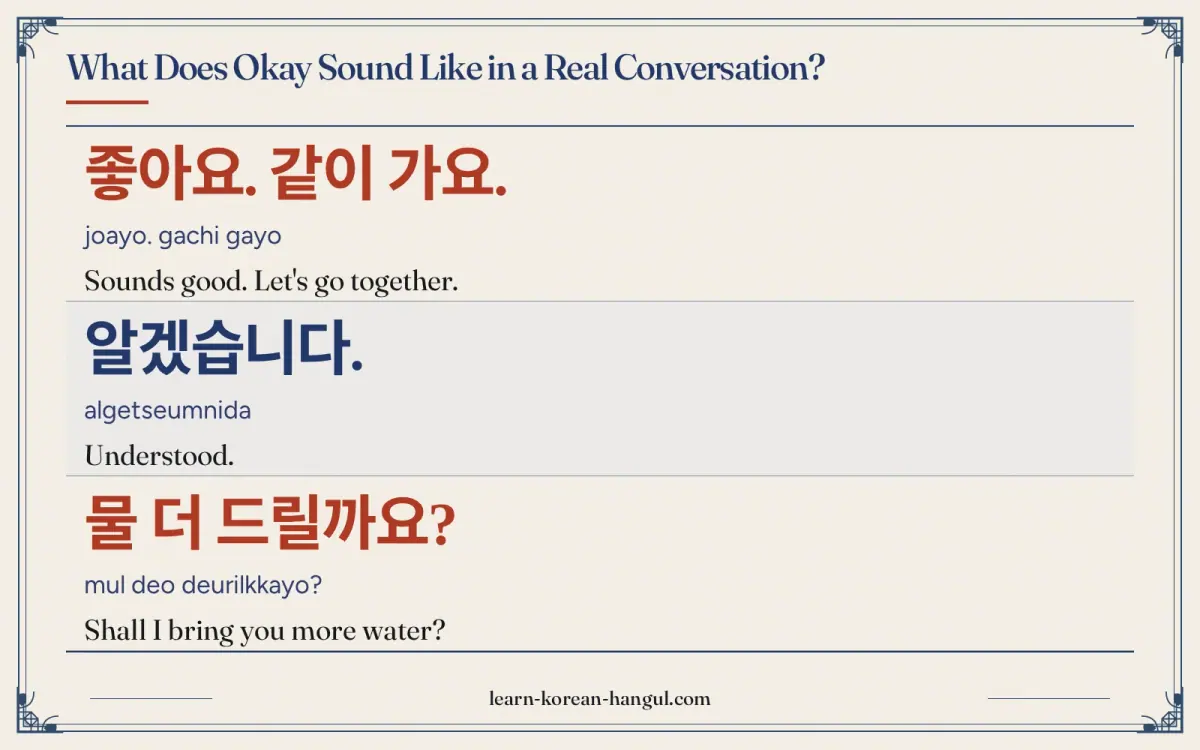
In a real exchange, the okay word follows the question and tells the other person what happens next. Listen for how each answer matches its job.
Agreeing to a Lunch Plan
Coworker
오늘 점심에 김치찌개 어때요?
oneul jeomsime gimchijjigae eottaeyo?
How about kimchi stew for lunch today?
You
좋아요. 같이 가요.
joayo. gachi gayo
Sounds good. Let's go together.
What to notice: 좋아요 answers a suggestion, and the next sentence moves the plan on.
Accepting an Instruction from a Manager
Manager
이 서류를 오늘까지 보내 주세요.
i seoryureul oneulkkaji bonae juseyo
Please send this document by today.
You
알겠습니다.
algetseumnida
Understood.
What to notice: 알겠습니다 does not say whether the plan is good. It says that you heard the order and will carry it out.
A Waiter Offers More Water
Waiter
물 더 드릴까요?
mul deo deurilkkayo?
Shall I bring you more water?
Customer
괜찮아요, 충분해요.
gwaenchanayo, chungbunhaeyo
I'm fine, I have enough.
What to notice: 괜찮아요 is a refusal here, and the reason after it makes the no friendly.
Friends Settle a Time by Text
Minsu
7시에 볼까?
ilgop sie bolkka?
Shall we meet at seven?
Sua
오케이, 7시 좋아.
okei, ilgop si joa
Okay, seven is good.
What to notice: friends use 오케이 and 좋아 with no -요. Behind these choices sits a cultural habit of agreeing in small, clear steps.
What Should You Know about the Culture behind Okay?
Koreans often agree with a plain 네 (yes) or 좋아요, and they add a short follow-up rather than a long answer. Agreement is usually spoken, clear and brief, so a vague "okay" without a job can feel unfinished.
- Agreeing and accepting are different acts. At work, answering an instruction with 좋아요 can sound as if you are grading the idea. 알겠습니다 shows that you accept it.
- A soft no hides inside 괜찮아요. Hosts and servers know that guests say 괜찮아요 to decline politely, so they may offer twice before they accept it as a real no.
- 오케이 is a friendly loanword. Many Koreans use 오케이 and 오케 in casual talk and text, and the style feels playful. With older people at work, many speakers prefer 알겠습니다 or 좋아요.
- Short is fine. A single 네 or 좋아요 with a nod is a complete answer, and there is no need to repeat the question.
An expert insight: learners expect one Korean word for okay and look for a "right" translation. In practice, Korean asks what the okay is for. The word choice tells the listener whether you agree, accept or reassure, so the job should come first and the word second. The mistakes below come from skipping that step.
What Mistakes Do Learners Make with Okay in Korean?
Most okay mistakes come from using one word for every job.
| Mistake | Why it is a problem | Fix |
|---|---|---|
| Answering an offer with 괜찮아요 to mean yes | Sounds like no thanks | Say 좋아요 or 네, 주세요 |
| Answering a manager's order with 좋아요 | Sounds like approval of the plan | Say 알겠습니다 |
| Pronouncing the ㅎ in 좋아요 | The ㅎ is silent before a vowel | Say [조아요] |
| Using 오케이 with a senior | Too playful | Use 알겠어요 or 좋아요 |
| Dropping -요 when speaking to a stranger | Casual 좋아 sounds rude | Add -요: 좋아요 |
Learners often assume that the English-style 오케이 is the safest, most international choice. Actually, a polite Korean word such as 좋아요 is safer, because it carries both the meaning and the respect.
Other Ways People Search for Okay in Korean
People search for okay in Korean in several forms. The short answers below cover each one.
- Ok in Korean: the same as okay. 오케이 is the loanword, ㅇㅋ is the chat shorthand, and 좋아요 is the polite word.
- Okay Korean: Korean has several okay words: 좋아요, 괜찮아요, 알겠어요 and 그래요. See the table above for the job of each.
- Ok Korean: the same family of words, written without the letter a. Learners often type this in search boxes.
- Alright in Korean: 그래요 or 좋아요, depending on whether you mean "sure" or "sounds good". 괜찮아요 means "I'm alright" as in "I'm fine".
Seeing the forms is one thing, and answering on cue is another, so practise now.
Practice: Say It Aloud
Play the slow clip of 좋아요, repeat it three times, then try 괜찮아요 and 알겠습니다. Then choose a form for each situation. Answers follow.
- A coworker suggests a lunch place that you like.
- Your manager asks you to send a report today.
- A waiter offers to refill your water, and you do not need more.
- A close friend texts, "Seven o'clock?"
Answers
- 좋아요.
- 알겠습니다 (or 알겠어요 for a friendly manager).
- 괜찮아요.
- 오케이 or ㅇㅋ, or 좋아.
Drill 좋아요 and the related phrases with the phrase flashcards, which include audio for each form.
Related Phrases to Learn Next
Okay sits in a small group of short replies that every beginner needs.
- Yes in Korean: 네, 예 and 응, the simplest agreement.
- It's okay in Korean: 괜찮아요 in all its uses, from reassurance to refusal.
- I understand in Korean: the full set of ways to say you got it.
- Of course in Korean: stronger agreement, from 물론이죠 to 당연하죠.
This guide belongs to the korean filler words collection. What this page does not cover: the full grammar of the ending -겠-, regional forms, and written business replies. Use 좋아요 to agree, 알겠습니다 to accept and 괜찮아요 to reassure, and you can say okay in Korean in the way that fits each moment.
Frequently Asked Questions
How do you say okay in Korean?
The usual polite okay is 좋아요 (joayo), meaning sounds good. Use 알겠어요 (algesseoyo) when you accept an instruction and 괜찮아요 (gwaenchanayo) when something is fine. With friends, say 좋아, 알았어 or 오케이. Korean has no single word for okay, so the choice depends on what you are agreeing to.
How do you pronounce 좋아요?
좋아요 is pronounced [조아요], in three even syllables. The ㅎ at the bottom of 좋 is silent before the vowel 아, so you say jo-a-yo and never jot-a-yo. The related 괜찮아요 follows the same rule and is pronounced [괜차나요]. Keep the pitch level or falling when you agree; a rise turns it into the question "Is it good?".
What is the difference between 좋아요 and 괜찮아요?
좋아요 means "good, I like it", so it accepts a plan or an offer. 괜찮아요 means "it's fine" or "I'm okay", so it reassures someone or turns an offer down. Asked 커피 드릴까요? (shall I bring you coffee?), 좋아요 means yes, while 괜찮아요 usually means no thanks.
Is 좋아요 formal or casual?
좋아요 is polite, because it ends in -요. It suits colleagues, teachers, shop staff and strangers. The formal form is 좋습니다 (joseumnida), used in meetings and speeches. The casual form is 좋아, kept for close friends and younger people. Only the ending changes, and the meaning stays "okay, sounds good".
Can I use 좋아요 with friends, elders and strangers?
Yes with elders and strangers, where 좋아요 is a safe polite choice. With close friends, 좋아요 can sound a little stiff, so they say 좋아 or 오케이. With a boss giving an order, 알겠습니다 sounds more respectful than 좋아요, because 좋아요 sounds like you are approving the plan rather than accepting it.
What is the most common mistake with okay in Korean?
The most common mistake is saying 괜찮아요 to mean yes. When someone offers coffee, 괜찮아요 sounds like no thanks. Say 좋아요 or 네, 주세요 (yes, please) instead. The second mistake is using the English-style 오케이 with an elder at work, which can sound too playful.