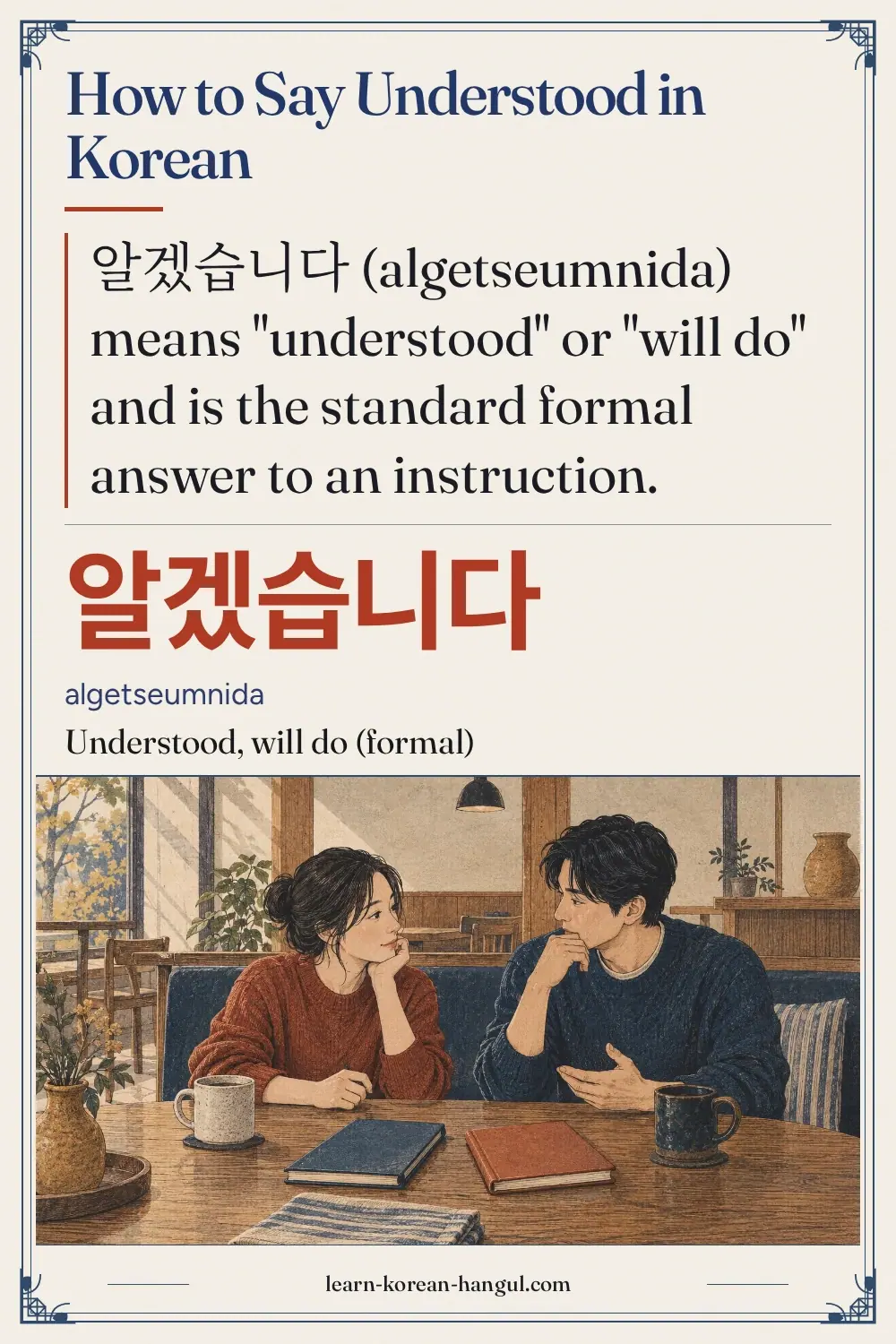
알겠습니다
알겠습니다
What you'll learn
- Say 알겠습니다, 알겠어요, 알았어요 and 알았어 and choose the one that fits the listener.
- Pronounce 알겠습니다 as [알겓씀니다], with its three sound changes.
- Tell 알겠습니다 ("understood, will do") apart from 알아요 ("I know").
- Use 확인했습니다 ("confirmed") in work messages.
Before you start: if you only need to say you follow, see i understand in Korean. Time: about 12 minutes. Audio plays only when you press a button.
How Do You Say Understood in Korean?
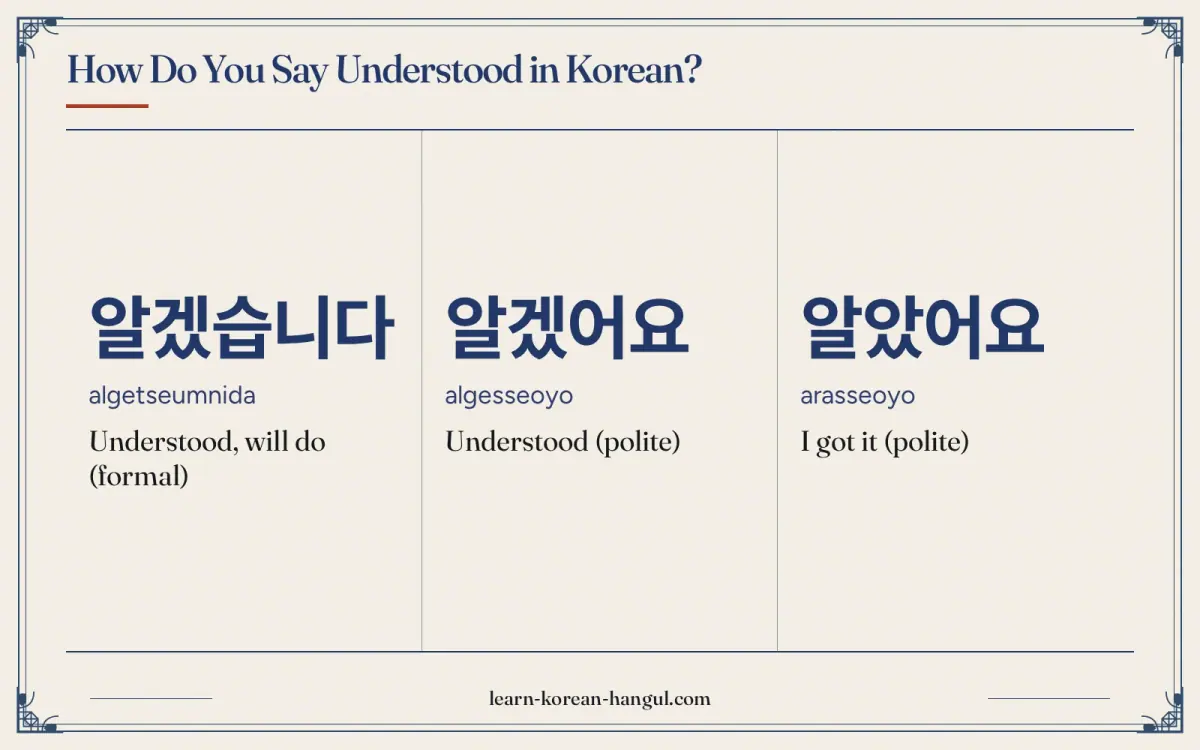
The standard way to say understood in Korean is 알겠습니다. The stem 알- comes from 알다, "to know" or "to understand". The ending -겠- here does not mean the future. It shows that you have taken in the message and are ready to act. The ending -습니다 is the formal style. Together, the word says "I've understood, and I'll act on it".
| Korean | Romanization | Meaning | Where you hear it |
|---|---|---|---|
| 알겠습니다 | algetseumnida | Understood, will do (formal) | Work, service jobs, seniors |
| 알겠어요 | algesseoyo | Understood (polite) | Colleagues, acquaintances |
| 알았어요 | arasseoyo | I got it (polite) | Everyday, new information |
| 알았어 | arasseo | Got it (casual) | Friends, family |
| 확인했습니다 | hwaginhaetseumnida | Confirmed (formal) | Emails, work chat |
| 이해했습니다 | ihaehaetseumnida | I have understood (formal) | Explanations, lessons |
Revised Romanization (the South Korean government standard of 2000) is only a reading aid here. Learn the Hangul first. Next, the register ladder.
What Are the Formal, Polite and Casual Ways to Say Understood?
Understood in Korean has formal, polite and casual choices. The verb 알다 stays the same, and the ending and the tense marker change.
Formal: 알겠습니다 (algetseumnida)
Formal · 합쇼체알겠습니다 is the default for work. Use it to answer a boss, a client or a teacher. It also works in writing, such as in an email reply. Because it promises action, it is a stronger word than "I heard you".
네, 알겠습니다.
ne, algetseumnida
Yes, understood.
Polite: 알겠어요 (algesseoyo)
Polite · 해요체알겠어요 is the same message in the everyday polite style. It suits colleagues of similar rank, shop staff and neighbours. Say it as [알게써요].
Polite: 알았어요 (arasseoyo)
Polite · 해요체알았어요 uses the past tense of 알다, so it literally says "I came to know". It means "I got it" or "okay, I see", and it often answers new information instead of an instruction. Say it as [아라써요].
Casual: 알았어 (arasseo)
Casual · 반말알았어 is how friends and family say "got it". Parents and children use it all the time. Friends can also say 알겠어 (algesseo), which is a little firmer. Never use these with a boss or an elder.
Formal Confirmation: 확인했습니다 (hwaginhaetseumnida)
Formal · 합쇼체확인했습니다 means "I have checked" and is common in work messages. Use it when you read a document or a request and want to confirm. Say it as [화긴핻씀니다].
The forms share one core. The next section shows how to say it out loud.
How Do You Pronounce 알겠습니다?
알겠습니다 is pronounced [알겓씀니다], in five syllables: al-get-seum-ni-da. It has three sound changes, and each one follows a rule in the Standard Pronunciation Rules (표준 발음법).
- 알 (al): a clear "l" at the end, with the tongue touching the ridge behind the upper teeth.
- 겠 (get): a plain g, the vowel ㅔ, and a final sound like [ㄷ].
- 씀 (seum): a tense s with ㅡ, and a final [ㅁ].
- 니 (ni): n plus a short ㅣ.
- 다 (da): a plain d and ㅏ.
Sound Changes to Listen For
- Final ㅆ becomes [ㄷ]. At the end of a syllable before a consonant, ㅆ sounds like [ㄷ]. So 겠 is [겓].
- Tensing of ㅅ. After the [ㄷ] sound, the ㅅ of 습 becomes tense: [씀]. The Revised Romanization writes algetseumnida, so it keeps the ts and does not show the tensing. See Korean tensification.
- Nasal [ㅁ] before ㄴ. The ㅂ of 습 turns into [ㅁ] before the ㄴ of 니: [씀니다].
- Tense [써] in 알겠어요. The ㅆ in 겠어요 is part of the ending, so it sounds like [알게써요], with the ㅆ moving to the next syllable.
- Tense [써] in 알았어요. In the same way, 알았어요 is [아라써요]. The ㄹ of 알 moves over to make [라].
- No rising pitch in a statement. 알겠습니다. ends calmly. A sharp rise would turn it into a question.
Say the five syllables evenly and hold the [ㄷ] before the tense [씀] briefly. Next, when does each form fit?
When Should You Use 알겠습니다, and When Should You Not?
Use 알겠습니다 when someone gives you an instruction, a request or a schedule and you will follow it. Use 알겠어요 or 알았어요 with peers, and 알았어 with friends. The choice depends on rank and closeness, not on how simple the message is.
Situations Where It Fits
- After an instruction. A boss says 내일까지 보내 주세요, and you reply 네, 알겠습니다.
- Customer service. A customer gives a request and the staff answer 알겠습니다.
- Formal writing. 확인했습니다 or 알겠습니다 closes a work message.
Situations to Avoid
- 알아요 as a reply to an instruction. It means "I know", so it can sound as if you are saying "you do not need to tell me".
- 알겠습니다 to share sympathy. If a friend tells you something sad, 알겠습니다 sounds cold. Use 이해해요 ("I understand how you feel") instead.
- 알았어 with a boss. Without a polite ending, it sounds disrespectful.
Three short scenes show the forms in use.
What Does Understood Sound Like in a Real Conversation?
Replies are short. Listen for the ending of each sentence.
A Boss Gives an Instruction
Manager
내일까지 자료 보내 주세요.
naeilkkaji jaryo bonae juseyo
Please send the materials by tomorrow.
Staff
네, 알겠습니다.
ne, algetseumnida
Yes, understood.
What to notice: The staff member answers with the formal 알겠습니다 [알겓씀니다]. 내일까지 sounds like [내일까지], with a tense 까지. The word 네 comes first to confirm.
A Parent and a Child
Mom
늦지 말고 일찍 와.
neutji malgo iljjik wa
Don't be late, come early.
Child
알았어, 엄마.
arasseo, eomma
Okay, Mom.
What to notice: Both lines drop 요, because they are family. 늦지 sounds like [늗찌], with a tense ㅈ after the [ㄷ] sound, and 일찍 is [일찍], with a tense ㅉ in the word itself.
Colleagues Share News
Ha-Na
회의실 예약했어요.
hoeuisil yeyakaesseoyo
I booked the meeting room.
Min-Su
아, 알았어요. 고마워요.
a, arasseoyo. gomawoyo
Oh, got it. Thanks.
What to notice: 예약했어요 sounds like [예야캐써요], because the ㄱ meets the ㅎ and they merge into an aspirated ㅋ. Min-su uses 알았어요 because Ha-na is giving information, not an order.
What Should You Know about the Culture behind Understood?
These are general patterns, not rules.
- A promise to act. At work, 알겠습니다 usually means more than "I heard you". It signals that you accept the task. If you do not agree or cannot do it, say so politely instead of using it automatically.
- Chat shortcuts. In work chat, short replies such as 넵 (nep) or 네 are common, and 알겠습니다 is used for more formal messages.
- Teachers and parents. A teacher or parent may say 알겠어요? ("Understood?") to check. Said by a senior, it can sound like a mild scolding. Peers use 이해했어요? or 괜찮아요? instead.
- Reading the room. Look at the speaker's rank before you choose between 알겠습니다 and 알겠어요.
An expert tip: The -겠- in 알겠습니다 usually shows a future or a guess, as in 비가 오겠어요 ("it will probably rain"). In 알겠습니다 it carries a different meaning: the speaker's readiness. This is why the sentence says "understood, and will do". It is also why 모르겠습니다 ("I don't know") and 잘 먹겠습니다 ("I will eat well") use the same ending. For how endings carry politeness, see Korean speech levels.
What Mistakes Do Learners Make with Understood in Korean?
Most errors come from mixing "know" and "understand", or from the wrong register.
| Mistake | Why it is a problem | Fix |
|---|---|---|
| Answering with 알아요 | It means "I know" and can sound dismissive | Say 알겠습니다 or 알겠어요 |
| Using 알았어 with a boss | The casual form sounds disrespectful | Use 알겠습니다 |
| Using 알겠습니다 for sympathy | It sounds cold, like receiving an order | Say 이해해요 |
| Saying 알겠어요? to a senior | It sounds like checking their understanding | Ask 혹시 궁금하신 점 있으세요? (any questions?) instead |
| Writing 알겠읍니다 | Old spelling | Write 알겠습니다 |
Learners often translate "understood" word for word and reach for 이해하다. In daily life, 알다 with -겠- is much more common than 이해하다, which is used for deeper understanding.
Is It the Same as Roger, Understood Formal or Arasseo?
Mostly. Each English phrase is covered by the forms above, with a small difference in tone.
- Roger in Korean: 알겠습니다 is the closest, or 확인했습니다 ("confirmed"). In chat, 넵 is a quick "yes, got it".
- Understood formal in Korean: 알겠습니다 for an instruction, and 이해했습니다 for an explanation.
- Arasseo in Korean: 알았어 is the casual spelling of the sound [아라써]. For the K-pop-style spelling, see araso in Korean.
- I know in Korean: 알아요, which is different. See i know in Korean.
Practice: Say It Aloud
Play the slow clip and repeat 알겠습니다 three times. Then choose the best reply for each scene. Answers follow.
- A manager asks you to send a file by tomorrow.
- A colleague tells you the room is booked.
- Your mother tells you to be home early.
- You read a request and want to confirm in an email.
Answers
- 네, 알겠습니다.
- 아, 알았어요.
- 알았어, 엄마.
- 확인했습니다.
The phrase flashcards drill these replies with audio.
Related Phrases to Learn Next
Understanding leads to other reply phrases.
- i understand in Korean: a plain statement that you follow.
- i know in Korean: the difference between knowing and understanding.
- yes in Korean: the simple answer that often comes first.
This guide belongs to the business korean phrases collection. What this page does not cover: military replies, long email templates and polite refusals. Learn 알겠습니다 and 알았어요, and you can say understood in Korean to anyone.
Frequently Asked Questions
How do you say understood in Korean?
Say 알겠습니다 (algetseumnida) for "understood" in formal or work settings. In everyday polite speech, use 알겠어요 or 알았어요. With friends and family, say 알았어. The verb is 알다, "to know", and the -겠- in 알겠습니다 shows that you accept the message and will act on it.
How do you pronounce 알겠습니다?
It has five syllables: al-get-seum-ni-da. It is pronounced [알겓씀니다]. The ㅆ in 겠 sounds like [ㄷ], the ㅅ of 습 becomes tense, and the ㅂ of 습 turns into [ㅁ] before ㄴ. Revised Romanization writes algetseumnida.
What is the difference between 알겠습니다 and 알았어요?
알겠습니다 is formal and means "I understand and will do it". It is the standard answer to an instruction from a senior. 알았어요 is polite and means "I got it", often as a response to new information. Between colleagues, both are normal. With a boss, 알겠습니다 is safer.
Is 알겠습니다 formal or casual?
It is formal. The ending -습니다 is the formal style, used at work, in service jobs and with elders. The polite style is 알겠어요, and the casual styles are 알았어 and 알겠어. Use the formal form in meetings and when you answer a senior in writing.
What is the most common mistake with understood in Korean?
Saying 알아요 (I know) to a boss who has just given an instruction. It sounds like "I already know that", which can be rude. Another mistake is using 알겠습니까? to ask a colleague whether they understood, which can sound like a scolding.