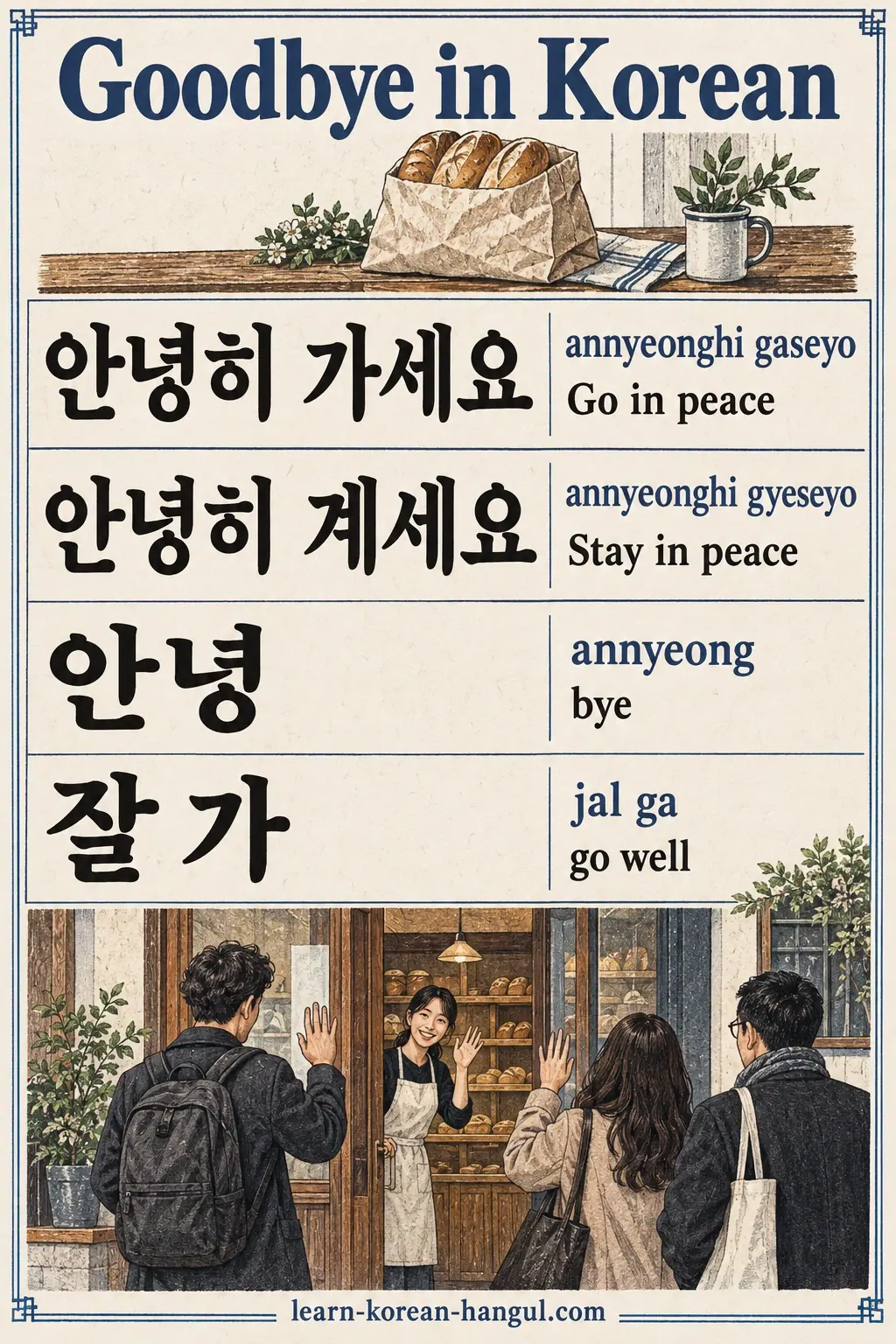
안녕히 가세요
안녕히 가세요
What you'll learn
- Decide in one second whether to say 안녕히 가세요 or 안녕히 계세요.
- Choose between polite, formal and casual goodbyes for a stranger, a senior and a friend.
- Pronounce 안녕히 with a light h and say the formal 안녕히 가십시오 as [안녕히 가십씨오].
- Handle the tricky cases: both people leaving, phone calls and text messages.
Before you start: it helps to know hello in Korean first, because 안녕히 is built from the same word 안녕. Time: about 12 minutes. Audio plays only when you press a button.
How Do You Say Goodbye in Korean?
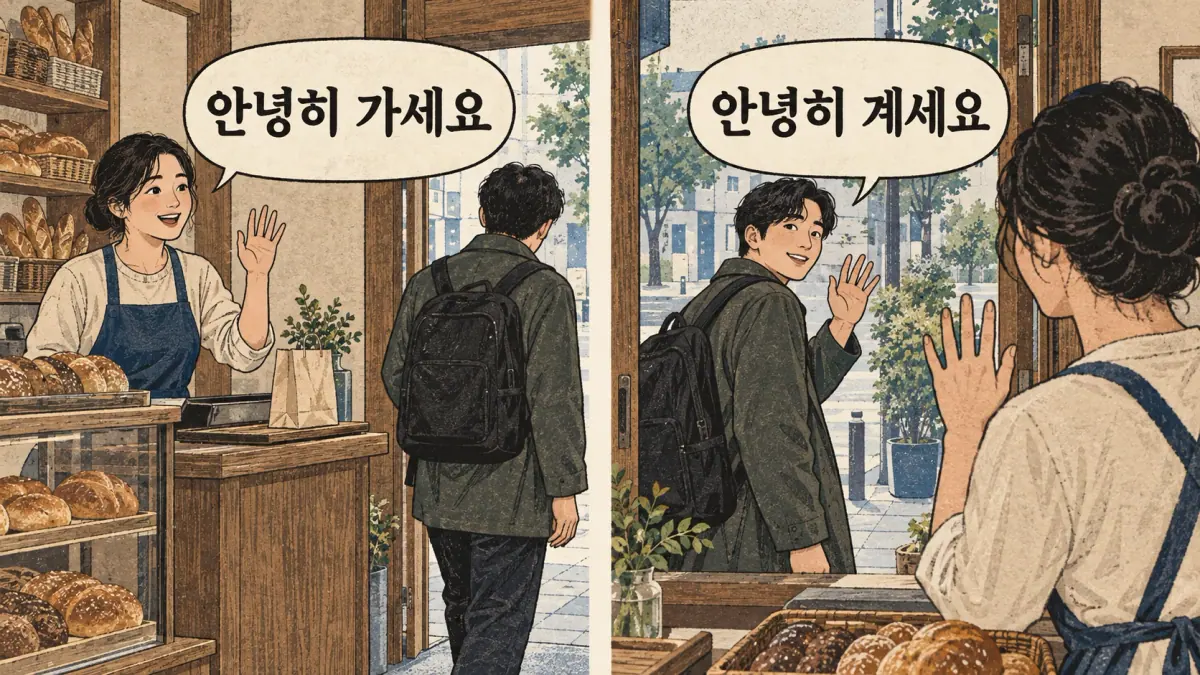
Korean has two polite goodbyes, and you pick one by asking a single question: who is leaving? English uses "goodbye" for everyone, but Korean describes what the other person is about to do.
- They leave, you stay: say 안녕히 가세요, "go in peace."
- You leave, they stay: say 안녕히 계세요, "stay in peace."
| Situation | You say | Romanization | Literal meaning |
|---|---|---|---|
| A customer leaves your shop | 안녕히 가세요 | annyeonghi gaseyo | Go in peace |
| You leave a shop, the staff stay | 안녕히 계세요 | annyeonghi gyeseyo | Stay in peace |
| You and a coworker part at the station | 안녕히 가세요 | annyeonghi gaseyo | Go in peace (both are going) |
| A close friend leaves your flat | 잘 가 or 안녕 | jal ga / annyeong | Go well / bye |
Both polite phrases share 안녕히, the adverb form of 안녕 (peace, well-being). Only the verb changes: 가다 means to go, and 계시다 is the honorific verb for to stay or to be somewhere. With the core choice made, the next section adds the formal and casual forms.
What Are the Polite and Casual Ways to Say Goodbye?
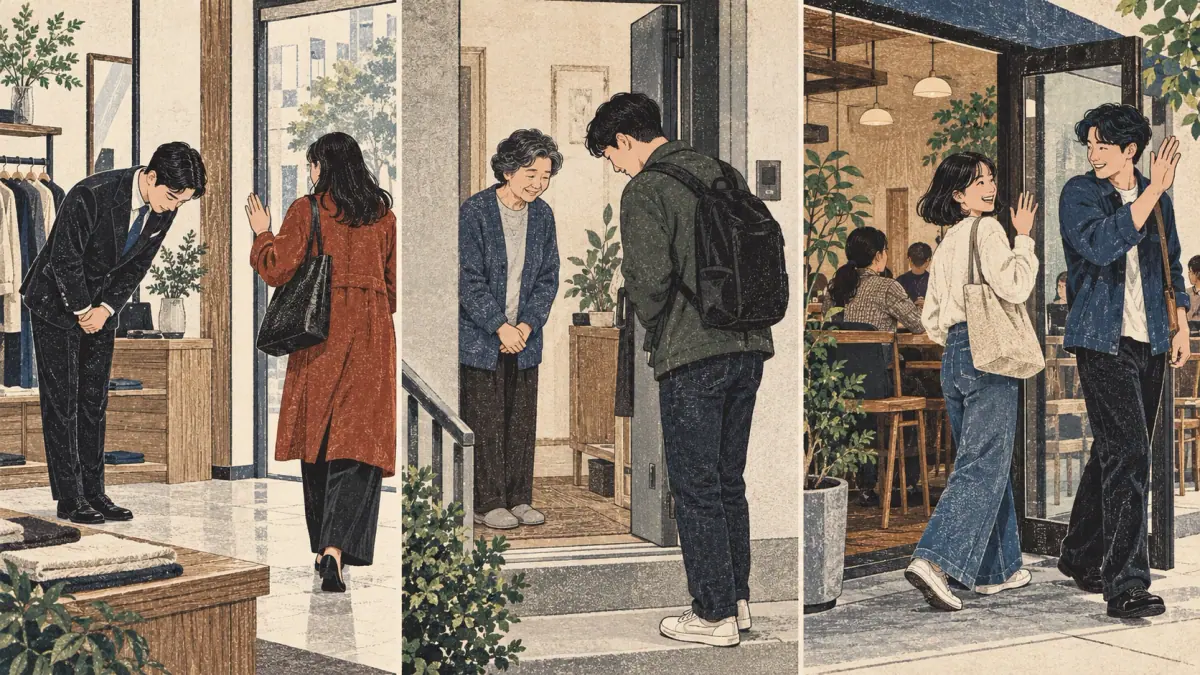
Korean goodbyes change with the listener, just like greetings. The verb ending follows the Korean speech levels, a system of polite, formal and casual endings explained in the guide to Korean speech levels.
Polite: 안녕히 가세요 (annyeonghi gaseyo)
Polite · 해요체안녕히 가세요 uses the polite style (해요체) with the honorific -시- inside -세요, so it respects the listener. Shop staff, hosts, teachers and anyone staying put say it to the person walking away.
안녕히 가세요. 조심히 가세요.
annyeonghi gaseyo. josimhi gaseyo
Goodbye. Get home safely.
Following it with 조심히 가세요 (go carefully, get home safely) is common when someone goes out into the night or the rain. The two sentences stay separate; 조심히 does not go in front of 안녕히.
Polite: 안녕히 계세요 (annyeonghi gyeseyo)
Polite · 해요체안녕히 계세요 is what the leaving person says. Use it when you walk out of a shop, a clinic, a classroom or a friend's parents' home. The verb 계시다 is the respectful version of 있다 (to stay, to be), so it honours the person who remains.
선생님, 안녕히 계세요.
seonsaengnim, annyeonghi gyeseyo
Goodbye, teacher. (said by a student leaving the classroom)
Formal: 안녕히 가십시오 (annyeonghi gasipsio)
Formal · 합쇼체안녕히 가십시오 and its partner 안녕히 계십시오 use the formal style (합쇼체). You hear them from department-store staff, airline crews, bank tellers and in announcements. In daily life the polite -세요 versions are enough.
감사합니다. 안녕히 가십시오.
gamsahamnida. annyeonghi gasipsio
Thank you. Goodbye.
Casual: 안녕 (annyeong)
Casual · 반말안녕 is the casual bye, the same word as the casual hi. It is the easiest goodbye because it works whether you leave or stay, but it is only for close friends, children and people clearly younger than you.
안녕, 내일 봐.
annyeong, naeil bwa
Bye, see you tomorrow.
Casual: 잘 가 (jal ga)
Casual · 반말잘 가 means "go well" and is the casual partner of 안녕히 가세요. The friend who stays says it. The friend who leaves can answer 잘 있어 (jal isseo), "stay well", which mirrors 안녕히 계세요.
잘 가. 도착하면 연락해.
jal ga. dochakamyeon yeollakae
Bye. Text me when you get there.
Five forms may look like a lot, but they reduce to one choice of verb and one choice of politeness. Saying them clearly is the next step.
How Do You Pronounce 안녕히 가세요?
안녕히 가세요 is pronounced [안녕히 가세요], annyeonghi gaseyo, in six even syllables with a short pause after 안녕히. Korean has no strong word stress, so let each syllable carry about the same weight.
- 안 (an): "ahn", ending with the tongue behind the top teeth.
- 녕 (nyeong): start from the same n, so the n is held a little longer, then "yuh-ng".
- 히 (hi): a soft h and a short "ee".
- 가 (ga): an unaspirated g, softer than English "go".
- 세 (se): "seh".
- 요 (yo): short and level, fading out rather than rising.
Sound Changes to Listen For
No spelling-based sound change applies to 안녕히 가세요. Three points still matter:
- The light ㅎ in 히. After the ng of 녕, the h is soft in normal speech and can almost disappear when people speak fast. Keep it gentle rather than breathy.
- 계 can sound like 게. Under the Standard Pronunciation rules of the National Institute of Korean Language (표준 발음법, article 5), the vowel ㅖ after a consonant other than ㅇ or ㄹ may be pronounced [ㅔ]. So 계세요 is heard as [계세요] or [게세요], and both are standard.
- Tensing in the formal form. In 가십시오, the ㅂ of 십 makes the following ㅅ tense, so you say [가십씨오]. The same happens in 계십시오 [계십씨오]. This is tensification, explained further in Korean tensification.
Pronunciation is the easy half. The harder half is choosing the right phrase in the moment, which the next section covers.
When Should You Use 안녕히 가세요, and When Should You Not?

Use 안녕히 가세요 whenever another person walks away and you remain, provided you would speak politely to them. Do not use it when you are the one leaving, and do not use it with close friends, where it sounds distant.
Situations Where It Fits
- You run a stall or shop. Every customer who leaves hears 안녕히 가세요.
- Guests leave your home. Walk them to the door and say 안녕히 가세요, often with 조심히 가세요 (go safely).
- You and a colleague part outside. When both of you are heading off, each says 안녕히 가세요.
- A teacher leaves the classroom before you. The students say 안녕히 가세요.
Situations to Avoid
- You leave a shop or office. The staff stay, so you say 안녕히 계세요.
- A close friend your age. Switch to 안녕 or 잘 가.
- The end of a phone call. Nobody is walking away, so adults usually close with 네, 들어가세요 instead.
- A child. 안녕히 가세요 to a small child sounds oddly stiff; 잘 가 is warmer.
The three conversations below show how the two phrases bounce between speakers.
What Does Goodbye Sound Like in a Real Conversation?
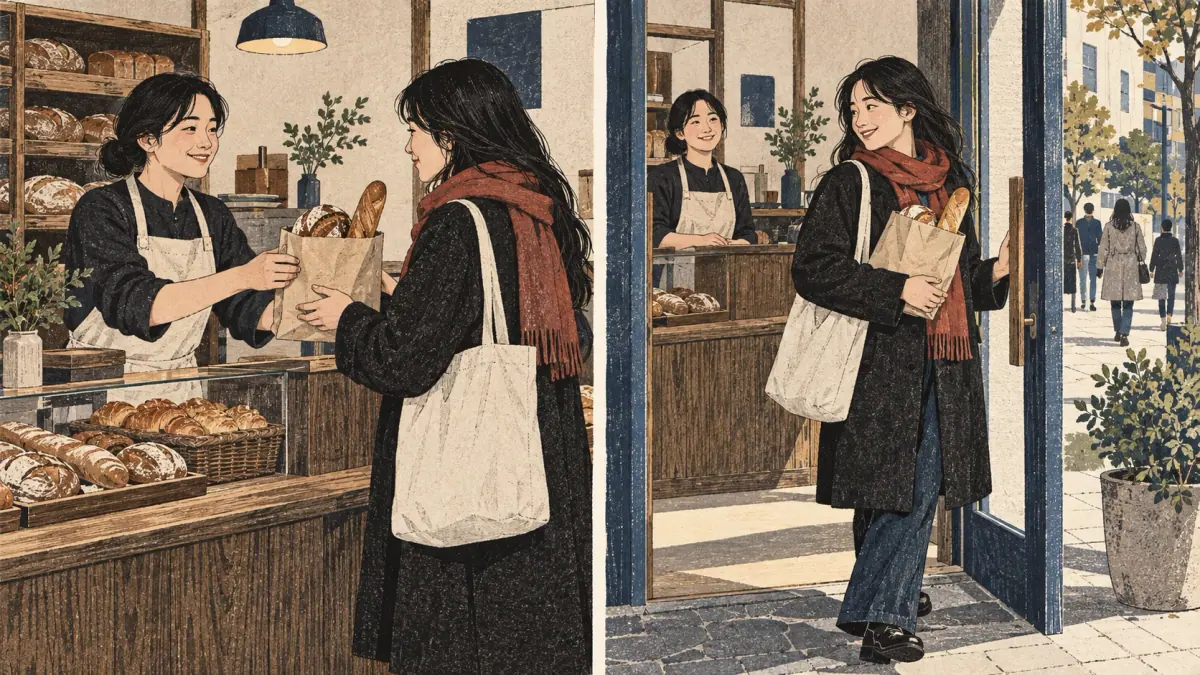
A Korean goodbye is often a short exchange in which each person says the phrase that matches the other person's movement. Listen for the switch between 가세요 and 계세요.
Leaving a Bakery
Staff
감사합니다. 안녕히 가세요.
gamsahamnida. annyeonghi gaseyo
Thank you. Goodbye.
Customer
네, 안녕히 계세요.
ne, annyeonghi gyeseyo
Yes, goodbye.
What to notice: the staff stay, so they say 가세요; the customer leaves, so they say 계세요.
Two Friends at a Bus Stop
Hana
버스 왔다. 나 갈게.
beoseu watda. na galge
The bus is here. I'm off.
Joon
그래, 잘 가. 내일 봐.
geurae, jal ga. naeil bwa
Okay, bye. See you tomorrow.
Hana
응, 안녕.
eung, annyeong
Yeah, bye.
What to notice: Joon stays at the stop, so he says 잘 가; Hana uses the all-purpose 안녕.
Leaving a Friend's Parents' Home
Guest
오늘 감사했습니다. 안녕히 계세요.
oneul gamsahaetseumnida. annyeonghi gyeseyo
Thank you for today. Goodbye.
Mother
그래요, 조심히 가요.
geuraeyo, josimhi gayo
All right, get home safely.
What to notice: the older host uses the plainer 가요 without -시-, which is normal from a senior to a younger guest. Seniority shapes the choice, and that is the culture behind it.
What Should You Know about the Culture behind Goodbye?
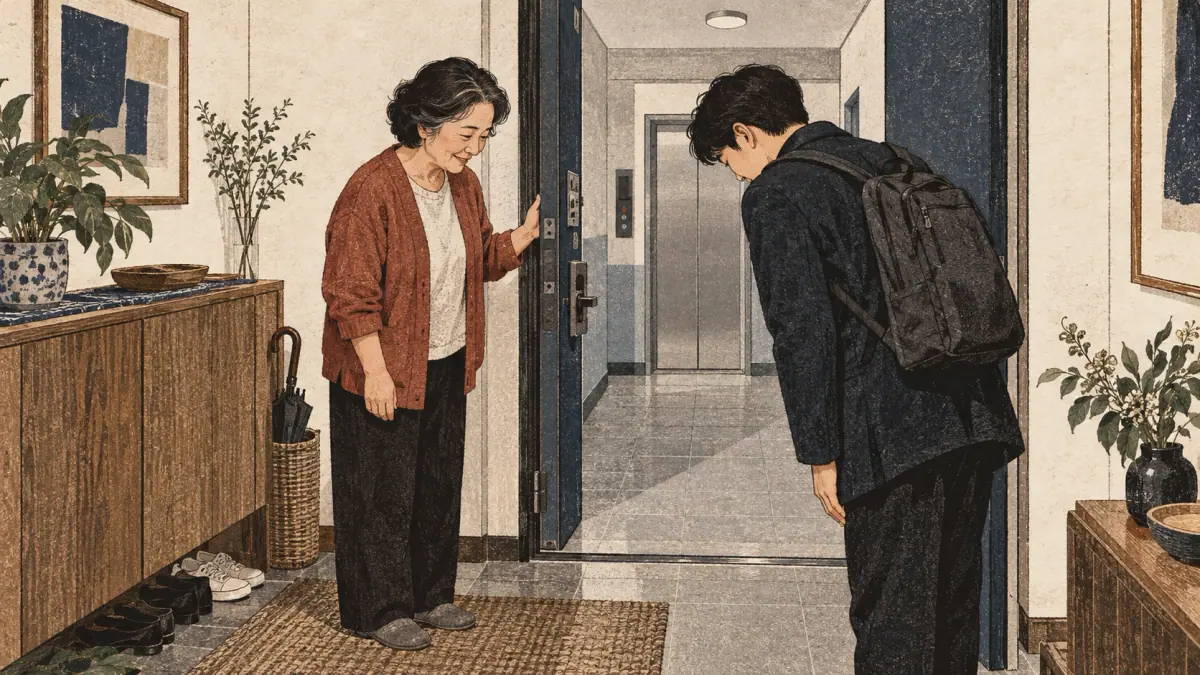
A Korean goodbye is a small ritual of seeing someone off, and the movement often matters as much as the words.
- Hosts walk guests out. It is polite to walk a guest to the door, the lift or even the street, and to stay until they are out of sight.
- A second bow. People often bow when they say goodbye, just as they did at the greeting. A nod suits peers; a deeper bow suits elders.
- Staff see you off. In shops and restaurants, staff call 안녕히 가세요 as you leave, often with 또 오세요 (please come again).
- The two-way goodbye. The 가세요 and 계세요 pair shows how Korean marks who moves and who stays, a distinction English never needs.
One rule of thumb: when you cannot tell who is leaving, for example when you both step out of a meeting room, 안녕히 가세요 is the safer choice, because it is correct whenever the other person is going anywhere. Even with this rule, learners repeat a few typical errors.
What Mistakes Do Learners Make with Goodbye in Korean?
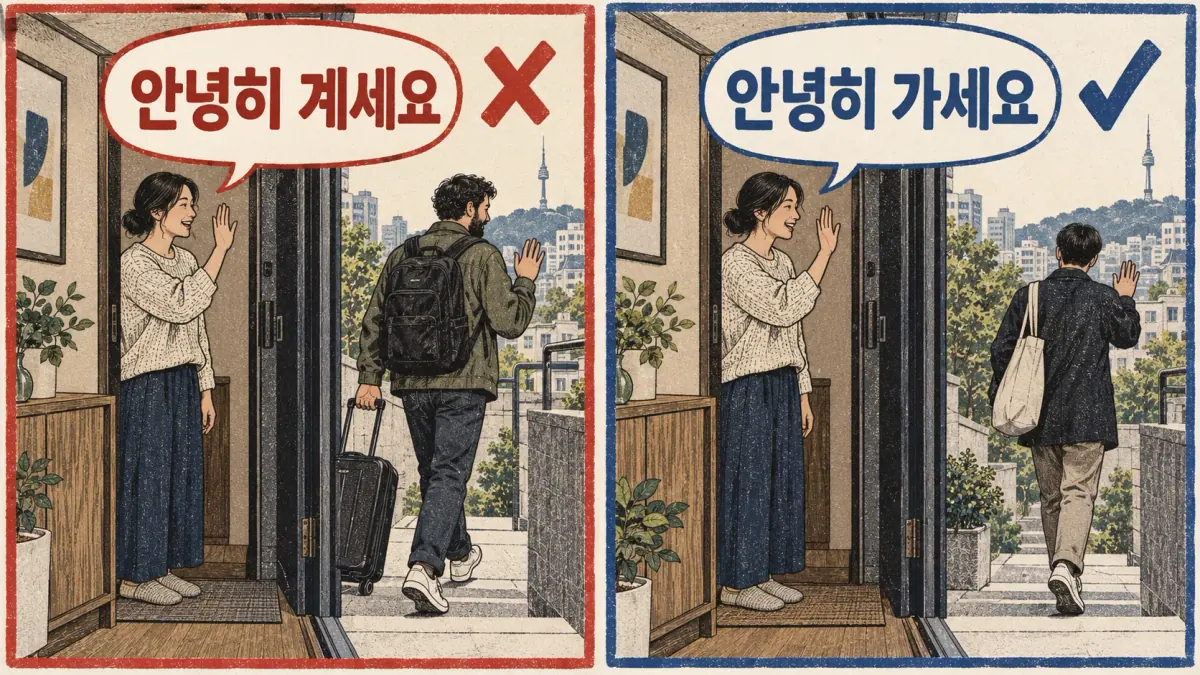
The most common goodbye mistakes come from treating the two polite phrases as one. The table lists each error and the fix.
| Mistake | Why it is a problem | Fix |
|---|---|---|
| Saying 안녕히 계세요 to someone walking away | It literally tells them to stay | Say 안녕히 가세요 to anyone leaving |
| Saying 안녕하세요 when leaving | That is the meeting greeting | Use 안녕히 계세요 or 안녕히 가세요 |
| Saying 잘 가 to a teacher or older stranger | 잘 가 is casual | Use 안녕히 가세요 |
| Using 안녕히 가세요 at the end of a phone call | Nobody is walking anywhere | Say 네, 들어가세요 or 네, 감사합니다 |
| Pronouncing 히 with a strong English h | It sounds heavy and choppy | Keep the h soft: annyeong-hi |
Learners often assume 안녕히 계세요 is the more polite of the two. Actually, the two are equally polite, because both use the honorific -시-; they differ only in who is moving. A memory hook: 가 is "go", so 가세요 goes with the person going.
Is It the Same as Bye?
Not exactly. "Bye" in Korean is 안녕 (annyeong) or 잘 가 (jal ga), the casual forms. 안녕히 가세요 is closer to a polite "goodbye". The short answers below cover the other ways people search for this phrase.
- Bye in Korean: 안녕 for anyone close to you; 잘 가 to a friend who is leaving.
- Good bye in Korean: 안녕히 가세요 or 안녕히 계세요, depending on who leaves.
- Bye formal in Korean: 안녕히 가십시오 or 안녕히 계십시오.
- Bye casual in Korean: 안녕, 잘 가, 잘 있어, or 또 봐 (see you again).
- Bye bye: young friends sometimes say 바이바이, borrowed from English; it is playful, never polite.
- See you later: 나중에 봐요 and related phrases are explained in see you later in Korean.
Knowing the forms is not the same as using them under pressure, so practise the choice aloud.
Practice: Say It Aloud
Play the slow clip of 안녕히 가세요, repeat it three times, then do the same with 안녕히 계세요. Then decide what you would say in each case. Answers follow.
- You pay at a convenience store and walk out.
- Your grandmother leaves after visiting your flat.
- You and your manager both leave the office and walk in different directions.
- Your best friend gets out of your car.
Answers
- 안녕히 계세요, because the staff stay.
- 안녕히 가세요, often with 조심히 가세요.
- 안녕히 가세요, because both of you are going.
- 잘 가 or 안녕.
The phrase flashcards include both polite goodbyes with audio, so you can drill the choice until it is automatic.
Related Phrases to Learn Next
Goodbyes rarely stand alone; Koreans add a wish or a plan to meet again.
- See you tomorrow in Korean: 내일 봐요 and 내일 뵙겠습니다 for coworkers and classmates.
- Take care in Korean: 조심히 가세요 and other caring send-offs.
- Good night in Korean: the goodbye you use at bedtime, which changes the verb for elders.
- Hello in Korean: the greeting that starts every exchange this page ends.
This guide belongs to the Korean greetings collection. What this page does not cover: dialect farewells, very old-fashioned forms, and the full honorific system, which lives in the speech levels guide. Ask who is leaving, check who you are talking to, and you can say goodbye in Korean correctly every time.
Frequently Asked Questions
What does 안녕히 가세요 literally mean?
안녕히 가세요 literally means go in peace. 안녕히 is the adverb form of 안녕 (peace, well-being), and 가세요 is the polite, respectful form of 가다 (to go). The partner phrase 안녕히 계세요 means stay in peace, from 계시다, the honorific verb for to stay or to be somewhere.
Is it okay to say bye bye in Korea?
Among young friends, yes. Many young Koreans say 바이 or 바이바이, borrowed from English, in casual chat and text messages. It sounds playful and childish, so never use it with elders, teachers, staff or anyone you address politely. For a safe casual goodbye, 안녕 or 잘 가 is always natural.
How do you say goodbye on the phone in Korean?
Phone calls usually end with 네, 들어가세요 (deureogaseyo) between adults, which literally means go on in and works as a polite goodbye. Friends say 끊을게 (I will hang up) or 안녕. 안녕히 가세요 and 안녕히 계세요 are less usual on the phone, because nobody is physically leaving.
How do you say goodbye in Korean in a text message?
Text messages rarely use 안녕히 가세요. With polite contacts, people end with 좋은 하루 보내세요 (have a good day) or 다음에 뵐게요 (see you next time). With friends, 잘 자, 안녕, 내일 봐 or a simple ㅂㅂ, an internet shorthand for bye bye, is common. Match the closing to the speech level of the chat.
What do Korean shop staff say when you leave?
Shop staff usually say 안녕히 가세요 or the formal 안녕히 가십시오 as you walk out, often with 또 오세요 (come again). You can reply with a short 감사합니다 (thank you) or 안녕히 계세요, since they stay and you leave. A small nod is enough; no long reply is expected.