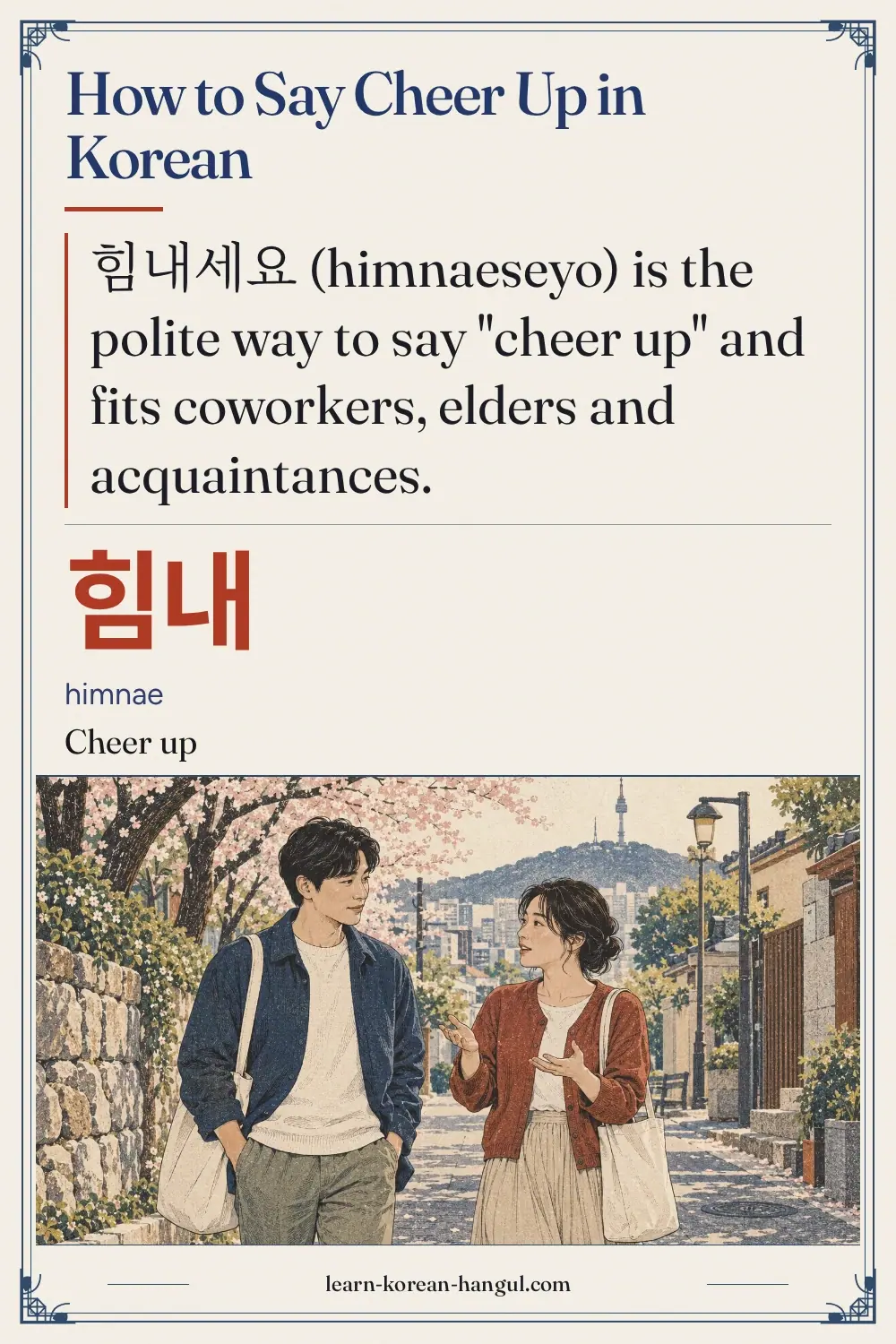
힘내세요
힘내세요
What you'll learn
- Choose between 힘내세요, 힘내 and 기운 내세요 for different listeners.
- Reassure someone with 괜찮을 거예요 and say it as [괜차늘꺼예요].
- Explain why 행복하세요 and 힘들어요 are not translations of "cheer up".
- Answer the folded searches "stay strong in Korean" and "hang in there in Korean".
Before you start: the three endings below follow the levels explained in Korean speech levels. The word 파이팅 is a close cousin, covered in fighting in Korean. Time: about 12 minutes. Audio plays only when you press a button.
How Do You Say Cheer up in Korean?
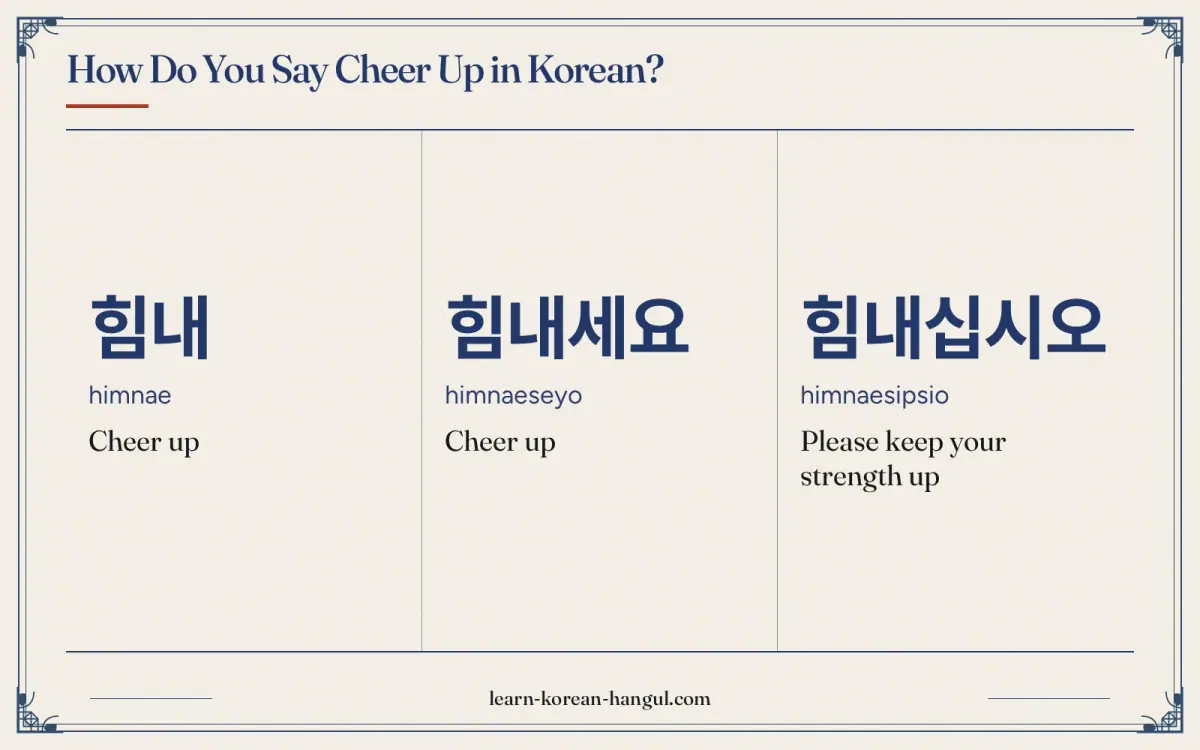
The everyday way to say cheer up in Korean is 힘내세요, from the verb 힘내다 (to cheer up, literally to bring out strength). It is a polite request, so it works in most situations. The table shows the form for each listener.
| Listener | Korean | Romanization | Meaning |
|---|---|---|---|
| Friend, sibling, younger person | 힘내 | himnae | Cheer up |
| Coworker, elder, acquaintance | 힘내세요 | himnaeseyo | Cheer up |
| Speech or announcement | 힘내십시오 | himnaesipsio | Please keep your strength up |
| Someone who needs warmth | 기운 내세요 | giun naeseyo | Keep your spirits up |
| Reassuring someone | 괜찮을 거예요 | gwaenchaneul geoyeyo | It will be fine |
Revised Romanization (the South Korean government standard of 2000) is a reading aid here. Learn the Hangul first. The next section explains when each form fits.
What Are the Polite and Casual Ways to Say Cheer Up?
Cheer up has four everyday forms, and the listener decides which one to use. The three forms of 힘내다 differ only in the ending, while 기운 내세요 and 괜찮을 거예요 add a different idea.
Polite: 힘내세요 (himnaeseyo)
Polite · 해요체힘내세요 is the default. The ending -(으)세요 is the honorific request ending, so the phrase respects the listener while staying friendly. It is safe with coworkers, neighbours, teachers and elders.
요즘 많이 힘드시죠? 힘내세요.
yojeum mani himdeusijyo? himnaeseyo
You must be having a hard time lately. Cheer up.
The first sentence names the problem, and 힘내세요 then offers support. That order sounds caring, while a bare 힘내세요 can sound like an order.
Casual: 힘내 (himnae)
Casual · 반말힘내 drops the polite ending. Use it with close friends, siblings, partners and children. Add 넌 할 수 있어 ("you can do it") to make the support concrete.
힘내! 넌 할 수 있어.
himnae! neon hal su isseo
Cheer up! You can do it.
Warm and Polite: 기운 내세요 (giun naeseyo)
Polite · 해요체기운 means energy or spirit, so 기운 내세요 asks the person to raise their spirits. It is gentler than 힘내세요, which is why people use it with someone who is visibly tired or sad.
기운 내세요. 다 잘될 거예요.
giun naeseyo. da jaldoel geoyeyo
Keep your spirits up. It will all go well.
Reassuring and Polite: 괜찮을 거예요 (gwaenchaneul geoyeyo)
Polite · 해요체괜찮을 거예요 does not ask for anything. It predicts that things will turn out fine, using the future ending -(으)ㄹ 거예요 on 괜찮다 (to be all right). Pair it with 힘내세요 when a person is worried about a result.
시험 잘 볼 수 있을 거예요. 괜찮을 거예요.
siheom jal bol su isseul geoyeyo. gwaenchaneul geoyeyo
You will do well on the test. It will be fine.
For a speech, a toast or a written message to a group, the formal 힘내십시오 is available.
Four forms cover most situations. Pronunciation is the next question, because one of them hides a sound change.
How Do You Pronounce 힘내세요?
힘내세요 is pronounced [힘내세요], him-nae-se-yo, in four syllables. It is read exactly as it is spelled.
- 힘 (him): a short "him", with the lips closing on the final ㅁ.
- 내 (nae): "neh", with the tongue tip behind the upper teeth.
- 세 (se): "seh". Most Seoul speakers pronounce ㅐ and ㅔ the same, so 내 and 세 rhyme.
- 요 (yo): a short "yo".
Sound Changes to Listen For
The main phrase has no sound change, but three related forms do:
- Tense ㄲ after the -(으)ㄹ ending. In 괜찮을 거예요, the ㄱ of 거 turns tense after the ㄹ future ending, so it is said [괜차늘꺼예요]. Revised Romanization writes gwaenchaneul geoyeyo and does not show the tensing. The rule is covered in Korean tensification.
- Silent ㅎ before a vowel. The ㅎ in 괜찮을 is silent before the vowel of 을, and the ㄴ links forward, giving [괜차늘].
- Tense ㅆ in the formal form. In 힘내십시오, the ㅅ after the ㅂ is tense, so it is said [힘내십씨오].
Say the future form slowly three times, and then at normal speed. A warm, falling tone suits encouragement. The tone matters most when you decide whether to use the phrase at all.
When Should You Use 힘내세요, and When Should You Not?
Use 힘내세요 when someone faces a setback they can still overcome. Avoid it when the situation is a loss, because encouragement can sound like an instruction to stop feeling sad.
Situations Where It Fits
- A coworker has a long week. 힘내세요. 거의 다 됐어요.
- A friend has an exam tomorrow. 힘내! 괜찮을 거야.
- A neighbour lost a job or a game. 기운 내세요.
- You say goodbye to someone starting a hard task. 힘내세요 works as a send-off.
Situations to Avoid
- Someone is grieving a death. 힘내세요 can feel dismissive at a funeral or after a loss. Koreans use set condolence phrases there, which belong to a different lesson.
- A boss or an elder, with 힘내. The bare form is too familiar.
- A person who says 힘들어요 and wants to be heard. Listen first, then encourage.
Three short dialogues show how the forms sound together.
What Does Cheer up Sound Like in a Real Conversation?
Cheer up usually follows a complaint or a worry, and the listener replies with thanks. Listen for the warm, falling tone on 힘내세요.
A Heavy Workday
Ji-Ho
오늘 일이 너무 많아요.
oneul iri neomu manayo
I have so much work today.
Su-Jin
힘내세요. 거의 다 됐어요.
himnaeseyo. geoui da dwaesseoyo
Cheer up. It's almost done.
What to notice: Su-jin adds a fact, 거의 다 됐어요, which makes the encouragement believable.
Before an Exam
Min
내일 시험이야. 너무 떨려.
naeil siheomiya. neomu tteollyeo
I have an exam tomorrow. I'm so nervous.
Ara
힘내! 괜찮을 거야.
himnae! gwaenchaneul geoya
Cheer up! It will be fine.
What to notice: between friends, both lines drop the polite ending, and 괜찮을 거야 is the casual twin of 괜찮을 거예요.
A Neighbour Having a Hard Time
Neighbour
요즘 많이 힘들어요.
yojeum mani himdeureoyo
Things have been really hard lately.
Hana
기운 내세요. 곧 괜찮아질 거예요.
giun naeseyo. got gwaenchanajil geoyeyo
Keep your spirits up. You'll be fine soon.
What to notice: the neighbour says 힘들어요 to describe a feeling, and Hana answers with the softer 기운 내세요.
What Should You Know about the Culture behind Cheer Up?
Koreans encourage each other openly, often with a short phrase before a test, a match or a hard day.
- The literal image. 힘내 comes from 힘 (strength) and 내다 (to bring out), so it asks the person to find strength they already have.
- Cheering at events. At sports matches and group events, people shout 파이팅 instead. The two overlap, and the page on fighting in Korean explains the shout.
- Encouragement plus a reason. Koreans often add a fact, such as 거의 다 됐어요, so the support does not sound empty.
- Less is more after a loss. After a death, quiet presence and set condolence phrases are more appropriate than a cheer.
An expert insight: 힘내세요 is a request, not a statement about the listener. That is why it sounds natural with the honorific ending and why 힘내 feels so direct with an elder.
What Mistakes Do Learners Make with Cheer up in Korean?
Most mistakes come from translating the English word for word.
| Mistake | Why it is a problem | Fix |
|---|---|---|
| 행복하세요 for "cheer up" | It means "be happy", a wish, not encouragement | Say 힘내세요 |
| 힘들어요 for "cheer up" | It means "I am struggling" | Say 힘내세요 |
| 힘내 to a boss or elder | Too familiar | Say 힘내세요 or 기운 내세요 |
| 힘내요 to a boss | Polite but without the honorific | Say 힘내세요 |
| 힘내세요 at a funeral | Sounds dismissive | Use a condolence phrase |
Learners often assume "cheer up" is a fixed phrase, but Korean builds it from 힘 and 내다, so the verb takes endings like any other verb.
Is It the Same as Stay Strong in Korean and Hang in There in Korean?
Yes, for most conversations. The searches "cheer up korean", "stay strong in Korean" and "hang in there in Korean" all lead to the same family of phrases.
- Cheer up Korean: 힘내세요, the form on this page.
- Stay strong in Korean: 힘내세요 or 기운 내세요. Korean usually uses the same phrases for this idea.
- Hang in there in Korean: 조금만 더 힘내세요 (jogeumman deo himnaeseyo), "just a little more strength".
Now practise the forms with your own voice.
Practice: Say It Aloud
Play the slow clip and repeat 힘내세요 three times. Then pick the right phrase for each listener. Answers follow.
- Your coworker has stayed late three nights in a row.
- Your best friend has a driving test tomorrow.
- An older neighbour looks tired and sad.
- Which word means "be happy", not "cheer up"?
Answers
- 힘내세요
- 힘내! 괜찮을 거야.
- 기운 내세요
- 행복하세요
The phrase flashcards drill these forms with audio.
Related Phrases to Learn Next
Cheer up connects to the phrases for reassurance and support.
- Fighting in Korean: the shout used at matches and before challenges.
- Don't worry in Korean: the calming phrase that often follows.
- It's okay in Korean: the reply when someone thanks you for the support.
This guide belongs to the Korean feelings phrases collection. What this page does not cover: condolence phrases and the full set of sports cheers. Match the ending to the listener, and you can say cheer up in Korean with real warmth.
Frequently Asked Questions
How do you say cheer up in Korean?
Say 힘내세요 (himnaeseyo) to coworkers, elders and people you do not know well. To a friend or someone younger, say 힘내 (himnae). If you want a softer, more caring tone, say 기운 내세요 (giun naeseyo). All three come from the idea of bringing out strength or spirit.
How do you pronounce 힘내세요?
Say him-nae-se-yo, written [힘내세요]. Nothing changes in the sound, so it is read as it is spelled. Most Seoul speakers pronounce ㅐ and ㅔ the same, so 내 and 세 share almost the same vowel. Use a warm, steady tone.
What is the difference between 힘내세요 and 힘내?
힘내세요 is polite and includes the honorific ending -(으)세요, so it respects the listener. 힘내 drops that ending and is casual. Use 힘내세요 with coworkers, elders and strangers, and 힘내 with close friends and younger people. Saying 힘내 to a boss would sound too familiar.
Is 힘내세요 formal or casual?
힘내세요 is polite, not formal and not casual. It sits in the middle level used in everyday speech. A formal version, 힘내십시오 (himnaesipsio), exists for speeches and announcements, while the casual version is 힘내. Most daily situations call for 힘내세요.
Can I say 힘내세요 to someone who is grieving?
It is better not to. 힘내세요 asks someone to find strength, which can sound dismissive when a person has lost a family member. Koreans use set condolence phrases at a funeral instead. 힘내세요 fits setbacks such as a hard week, a failed test or a stressful job.
What is the most common mistake with cheer up in Korean?
Learners translate "cheer up" as 행복하세요, which means "be happy", or as 힘들어요, which means "I am struggling". Neither encourages the listener. A second mistake is using 힘내 with a boss or an elder, who should hear 힘내세요.