괜찮아요
괜찮아요
What you'll learn
- Use 괜찮아요 to reassure, to say you are fine and to decline politely.
- Choose between 괜찮습니다, 괜찮아요 and 괜찮아 for a senior, an acquaintance and a friend.
- Ask are you okay with 괜찮아요? or, to an elder, 괜찮으세요?
- Pronounce 괜찮아요 as [괜차나요] with a silent ㅎ.
Before you start: knowing sorry in Korean helps, because 괜찮아요 is the usual answer to an apology. Time: about 12 minutes. Audio plays only when you press a button.
How Do You Say It's Okay in Korean?
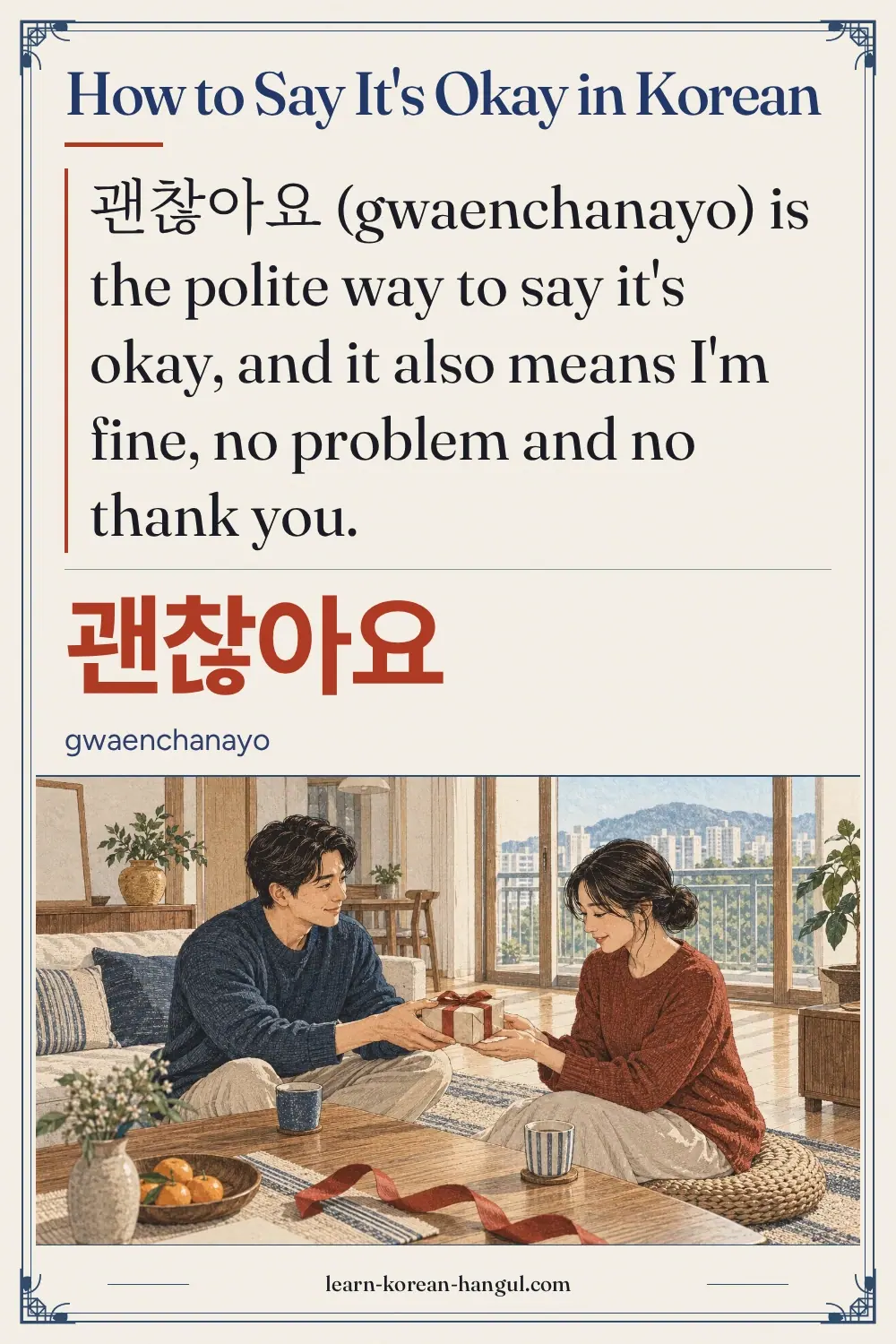
The everyday way to say it's okay in Korean is 괜찮아요, from the adjective 괜찮다 (to be fine, to be all right). Because it describes a state rather than a single situation, one word covers several English phrases.
| Situation | What 괜찮아요 means | Tone |
|---|---|---|
| Someone apologises to you | It's okay, no problem | Warm, falling |
| Someone asks if you are hurt | I'm fine | Calm, falling |
| Someone offers you something | No, thank you | Light, often with a small wave |
| You check on someone | Are you okay? | Rising, as a question |
| You ask if something is allowed | Is it okay? | Rising: 여기 앉아도 괜찮아요? (Is it okay if I sit here?) |
The structure is simple: 괜찮- (stem) + -아요 (polite ending). The next section shows how the ending changes with the listener.
What Are the Formal, Polite and Casual Ways to Say It's Okay?
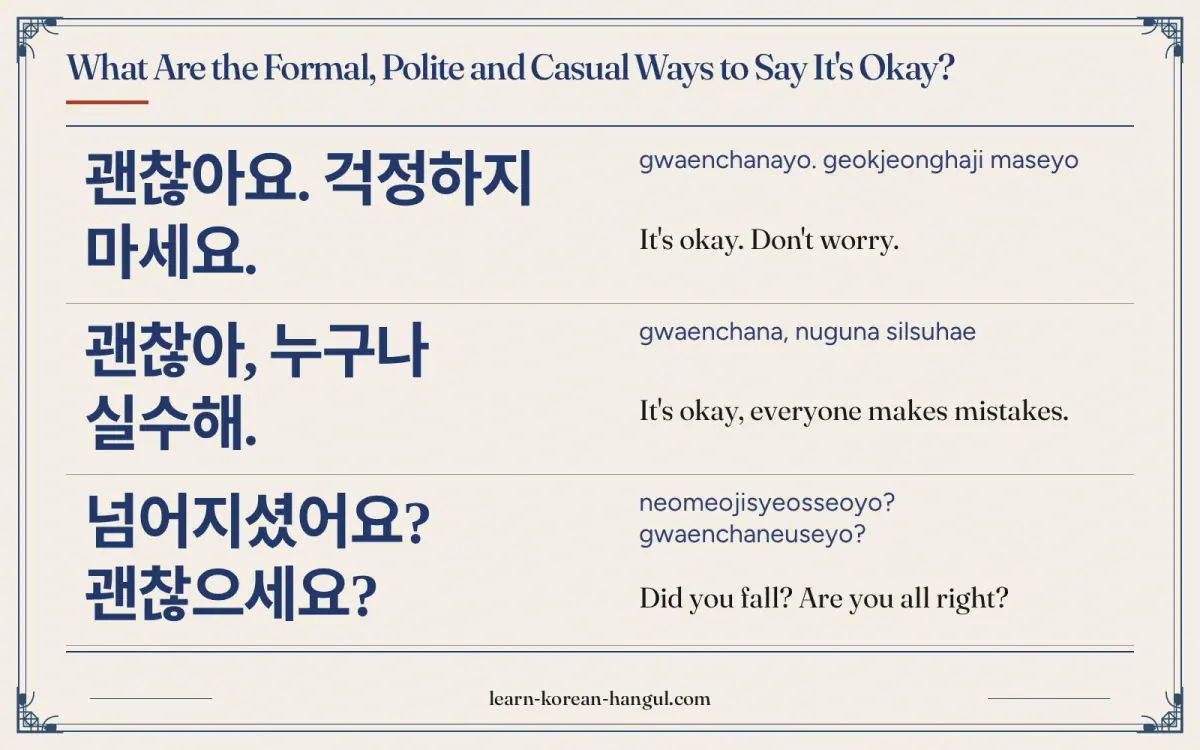
It's okay follows the Korean speech levels, the endings that change with the listener, explained in the guide to Korean speech levels. The stem 괜찮- stays the same in every form.
Polite: 괜찮아요 (gwaenchanayo)
Polite · 해요체괜찮아요 is the default: polite, warm and safe with almost anyone. It answers apologies, reassures worried people and declines offers.
괜찮아요. 걱정하지 마세요.
gwaenchanayo. geokjeonghaji maseyo
It's okay. Don't worry.
Formal: 괜찮습니다 (gwaenchanseumnida)
Formal · 합쇼체괜찮습니다 uses the formal ending -습니다. You hear it at work, in service settings and when a junior answers a senior's concern. It is also the formal way to decline, which is covered in no thank you in Korean.
네, 괜찮습니다. 신경 써 주셔서 감사합니다.
ne, gwaenchanseumnida. singyeong sseo jusyeoseo gamsahamnida
Yes, I'm fine. Thank you for your concern.
Casual: 괜찮아 (gwaenchana)
Casual · 반말괜찮아 is the casual form for friends, partners, siblings and children. It is the line Korean drama characters say while hugging a crying friend, and it can be repeated softly: 괜찮아, 괜찮아.
괜찮아, 누구나 실수해.
gwaenchana, nuguna silsuhae
It's okay, everyone makes mistakes.
Polite: 괜찮아요? as a Question
Polite · 해요체괜찮아요? with a rising tone means "are you okay?" To an elder or a stranger you want to honour, add -으시- and ask 괜찮으세요? (gwaenchaneuseyo). The full set of check-in questions is on are you okay in Korean.
넘어지셨어요? 괜찮으세요?
neomeojisyeosseoyo? gwaenchaneuseyo?
Did you fall? Are you all right?
Four forms built on one stem cover most situations. The tricky part is the spelling, because 괜찮아요 is not pronounced the way it looks.
How Do You Pronounce 괜찮아요?
괜찮아요 is pronounced [괜차나요], gwaen-cha-na-yo, in four syllables. The ㅎ in the double final ㄶ is silent, and the ㄴ moves forward to start the next syllable.
- 괜 (gwaen): a soft g gliding into "weh", ending in n.
- 차 (cha): written 찮, but said "cha" because the ㄴ moves on and the ㅎ drops.
- 나 (na): the moved ㄴ joins 아 to make "na".
- 요 (yo): short and level, or rising for a question.
Sound Changes to Listen For
The double final ㄶ follows two rules in the National Institute of Korean Language Standard Pronunciation (표준 발음법, article 12):
- Before a vowel, ㅎ is silent. 괜찮아요 becomes [괜차나요] and 괜찮아 becomes [괜차나]. The rule is explained with more examples in ㅎ batchim pronunciation.
- Before ㅅ, ㅎ + ㅅ becomes ㅆ. In 괜찮습니다, the ㅎ joins the ㅅ of 습 to make a tense ㅆ, and ㅂ before ㄴ becomes ㅁ: [괜찬씀니다].
- Before ㄱ, ㄷ or ㅈ, ㅎ adds aspiration. 괜찮지 is [괜찬치] and 괜찮다 is [괜찬타].
For a slower drill of every sound, see how to pronounce 괜찮아요.
Getting the sound right helps. The next step is using 괜찮다 inside longer sentences.
How Do You Use 괜찮다 in Longer Sentences?
괜찮다 combines with a few common endings, and four patterns cover most of what beginners need. Each keeps the stem 괜찮- and changes only what follows.
- Asking permission: verb + -아/어도 괜찮아요? 사진 찍어도 괜찮아요? means "Is it okay if I take a photo?" The answer is 네, 괜찮아요 (yes, go ahead) or 아니요, 안 돼요 (no, you can't).
- Comfort about the future: 괜찮을 거예요. "It will be okay." Friends say 괜찮을 거야.
- Checking the past: 괜찮았어요? 어제 괜찮았어요? asks "Were you okay yesterday?"
- Describing things: 괜찮은 + noun. 괜찮은 방법 is "a good way", and 괜찮은 가격 is "a reasonable price".
The permission pattern is the one you will use most as a visitor, because it lets you ask before acting in shops, temples and homes. Knowing which meaning you are sending matters even more, which is the next topic.
When Should You Use 괜찮아요, and When Should You Not?
Use 괜찮아요 to accept an apology, to say you are fine and to decline politely. Be careful when declining, because 괜찮아요 can be heard as "it's fine, go ahead", and avoid casual 괜찮아 with elders.
Situations Where It Fits
- Someone bumps into you and apologises. 아, 괜찮아요.
- A friend asks if you are cold. 괜찮아, 안 추워 (I'm fine, I'm not cold).
- A shop clerk offers a bag. 괜찮아요, with a small wave of the hand.
- Checking on a stranger who tripped. 괜찮으세요?
Situations to Avoid
- Declining when the meaning could flip. If a server asks "Shall I add ice?", 괜찮아요 could mean "no thanks" or "that's fine, go ahead". Add 아니요 (no): 아니요, 괜찮아요.
- Elders with 괜찮아. Use 괜찮아요 or 괜찮습니다.
- Asking an elder 괜찮아요? Use the honorific 괜찮으세요?
- Serious apologies. After a real wrong, a bare 괜찮아요 can sound dismissive; 괜찮아요, 이해해요 (it's okay, I understand) is warmer.
The conversations below show the main meanings in action.
What Does It's Okay Sound Like in a Real Conversation?
괜찮아요 often appears twice in one exchange, once as a question and once as an answer. Listen for the change in tone.
A Spilled Drink
Customer A
어머, 죄송해요. 괜찮으세요?
eomeo, joesonghaeyo. gwaenchaneuseyo?
Oh no, I'm sorry. Are you all right?
Customer B
괜찮아요. 조금밖에 안 묻었어요.
gwaenchanayo. jogeumbakke an mudeosseoyo
It's okay. It only got on me a little.
What to notice: the rising 괜찮으세요? asks; the falling 괜찮아요 reassures.
Comforting a Friend
Eunji
시험 망쳤어.
siheom mangchyeosseo
I bombed the exam.
Ha-Eun
괜찮아. 다음에 잘하면 돼.
gwaenchana. daeume jalhamyeon dwae
It's okay. You just need to do well next time.
What to notice: 괜찮아 here is comfort, and the follow-up gives the reason.
Declining a Bag
Clerk
봉투 필요하세요?
bongtu piryohaseyo?
Do you need a bag?
Customer
아니요, 괜찮아요.
aniyo, gwaenchanayo
No, I'm fine, thanks.
What to notice: 아니요 before 괜찮아요 removes any doubt about the meaning. That double role points to the culture around the phrase.
What Should You Know about the Culture behind It's Okay?
괜찮아요 is one of the most-used words in Korean daily life because it smooths over small problems without fuss.
- Reassurance first. When someone apologises, Koreans often answer 괜찮아요 immediately, even before thinking about the problem, to save the other person's face.
- Polite refusal. 괜찮아요 is the gentlest way to say no to an offer, so it often appears where English uses "no, thank you".
- Comfort in dramas. 괜찮아 is a classic comfort line in Korean dramas and songs, which is why many learners know it before any other phrase.
- Not always fine. People may say 괜찮아요 when they are not okay, to avoid burdening others.
An expert insight: learners often treat 괜찮아요 as a pure "yes, okay". It leans toward "no need" more often than toward agreement, so when you mean "yes, please do", say 네, 해 주세요 instead. The mistakes below come from this mismatch.
What Mistakes Do Learners Make with It's Okay in Korean?
Most it's okay mistakes come from the word's many meanings and its tricky spelling.
| Mistake | Why it is a problem | Fix |
|---|---|---|
| Saying 괜찮아요 to accept an offer | Often heard as "no thanks" | Say 네, 주세요 or 네, 좋아요 |
| Declining with an unclear 괜찮아요 | Could mean "go ahead" | Say 아니요, 괜찮아요 |
| Asking an elder 괜찮아? | Casual ending | Ask 괜찮으세요? |
| Pronouncing the ㅎ: "gwaen-chan-ha-yo" | ㅎ is silent before a vowel | Say [괜차나요] |
| Spelling 괜찬아요 | Drops the ㅎ of ㄶ | Write 괜찮아요 |
Learners often assume 괜찮아요 is a weak, half-hearted answer. Actually, said with a smile and a falling tone, it is a full, warm reassurance; the weakness comes only from a flat tone after bad news.
Is It the Same as Its Okay?
Yes. "It's okay", "its okay", "it's ok", "its ok" and "it is okay" are all the same English phrase, and all are 괜찮아요 in Korean. The short answers below cover the romanized spellings people search for.
- Gwaenchana / gwenchana / gwaenchanha: informal romanizations of 괜찮아; the standard Revised Romanization is gwaenchana.
- It's fine in Korean: 괜찮아요, or 됐어요 when you mean "that's enough".
- Not a problem in Korean: 괜찮아요 or 문제없어요 (munjeeopseoyo), "no problem".
- I'm fine in Korean: 괜찮아요 when asked if you are hurt; other answers are on I'm fine in Korean.
- It's okay formal: 괜찮습니다.
Now practise the meanings with your voice.
Practice: Say It Aloud
Play the slow clip of 괜찮아요 and repeat it three times, first falling, then rising as a question. Then choose the best reply. Answers follow.
- A stranger steps on your foot and says 죄송합니다.
- A server offers more side dishes, and you have had enough.
- Your grandfather coughs badly at dinner. Ask if he is all right.
- How is 괜찮습니다 pronounced, and why?
Answers
- 괜찮아요.
- 아니요, 괜찮아요. (or 괜찮습니다)
- 할아버지, 괜찮으세요?
- [괜찬씀니다]: ㅎ + ㅅ becomes ㅆ, and ㅂ before ㄴ becomes ㅁ.
The phrase flashcards drill 괜찮아요 in its different meanings with audio.
Related Phrases to Learn Next
It's okay sits at the centre of a small family of reassurance and refusal phrases.
- No thank you in Korean: 괜찮습니다 and 아니요, 괜찮아요 for clear refusals.
- Are you okay in Korean: check-in questions for friends, strangers and elders.
- Sorry in Korean: the apologies that 괜찮아요 answers.
This guide belongs to the polite Korean phrases collection. What this page does not cover: the full grammar of 괜찮다 as an adjective, and emotional support phrases beyond the basics. Watch the tone and the context, and you can say it's okay in Korean to comfort, reassure or politely decline.
Frequently Asked Questions
Is it gwenchana or gwaenchana?
The Revised Romanization of 괜찮아 is gwaenchana, with wae for the vowel ㅙ. Spellings such as gwenchana, gwenchanha and kwenchana are informal fan romanizations of the same word. None of them is the real spelling; the Hangul 괜찮아 is. Search engines treat them as one phrase, and so does this page.
Can 괜찮아요 mean good?
Yes. 괜찮다 also means decent or pretty good. 그 식당 괜찮아요 means that restaurant is pretty good, and 괜찮은 사람 is a decent, likeable person. The meaning is warm but modest, closer to not bad than to excellent. Context makes the sense clear, so listen for whether someone is reassuring or rating.
How do you say it's okay, don't worry in Korean?
Say 괜찮아요, 걱정하지 마세요 (it's okay, don't worry) in polite speech or 괜찮아, 걱정하지 마 to a friend. Both are common after an apology or bad news. The comforting 괜찮을 거예요 (it will be okay) looks ahead, and 괜찮아질 거야 (it'll get better) is the casual version friends use.
Why do Koreans say 괜찮아요 when they are not okay?
괜찮아요 is a polite way to avoid burdening others, so people sometimes say it even when they are hurt or upset. Friends may answer 진짜 괜찮아? (are you really okay?) to check. If you hear a flat 괜찮아요 after obvious bad news, a gentle second question shows care.
How do you spell 괜찮아요 correctly?
The standard spelling is 괜찮아요, with the double final ㄶ under 찮. Common errors are 괜찬아요 and 괜챦아요, which drop or change the ㅎ. The ㅎ is silent in this word but matters in spelling, because it shows up in pronunciation as tensing in 괜찮습니다 [괜찬씀니다] and aspiration in 괜찮지 [괜찬치].