How Do You Say Don't Worry in Korean?
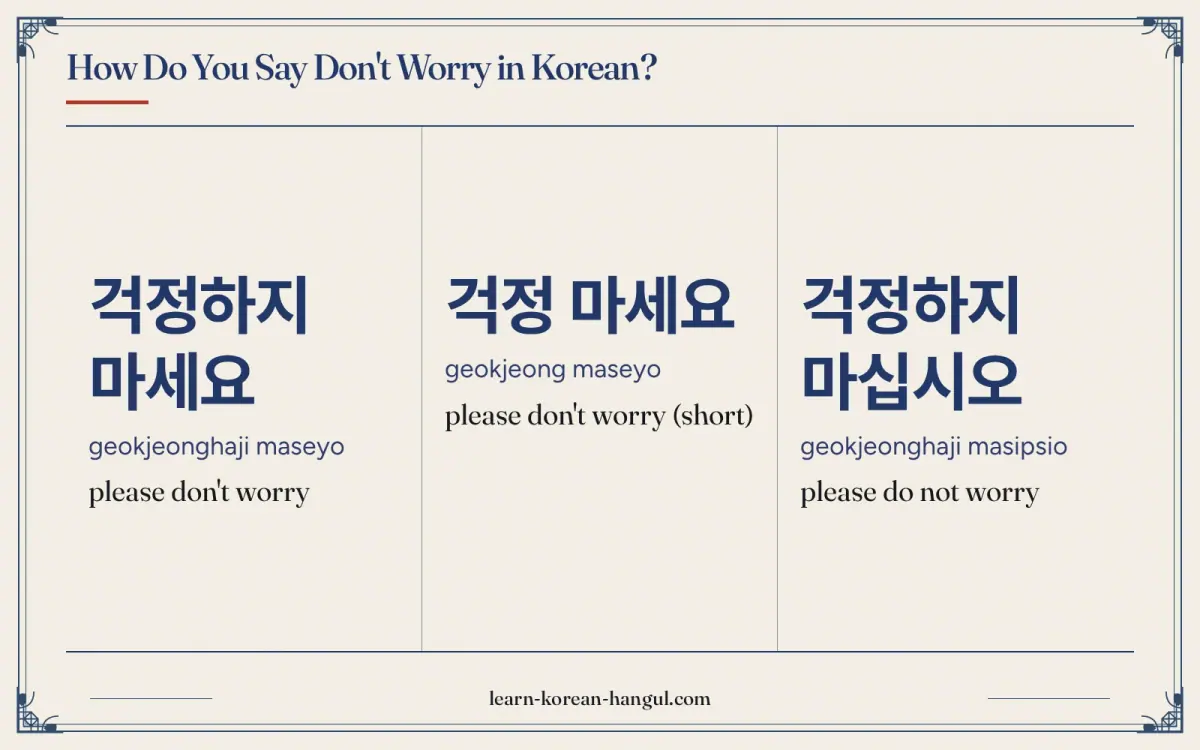
The standard polite way to say don't worry in Korean is 걱정하지 마세요 (geokjeonghaji maseyo). The phrase has two layers. 걱정하지 (geokjeonghaji) comes from the verb 걱정하다 (geokjeonghada, "to worry"), which is the noun 걱정 plus 하다 ("to do"). 마세요 (maseyo) comes from 말다 (malda, "to stop, to refrain") and turns the verb into a polite "please don't."
Because 걱정 is a noun, Korean also lets you attach 마세요 straight to it. 걱정 마세요 (geokjeong maseyo) means the same thing and is shorter. In practice, people use the short form more often when they want to sound relaxed, and the full form when they want to sound careful.
Four forms cover most situations.
| Korean | Revised Romanization | Meaning | Register |
|---|---|---|---|
| 걱정하지 마세요 | geokjeonghaji maseyo | please don't worry | polite (해요체) |
| 걱정 마세요 | geokjeong maseyo | please don't worry (short) | polite, relaxed |
| 걱정하지 마십시오 | geokjeonghaji masipsio | please do not worry | formal (합쇼체) |
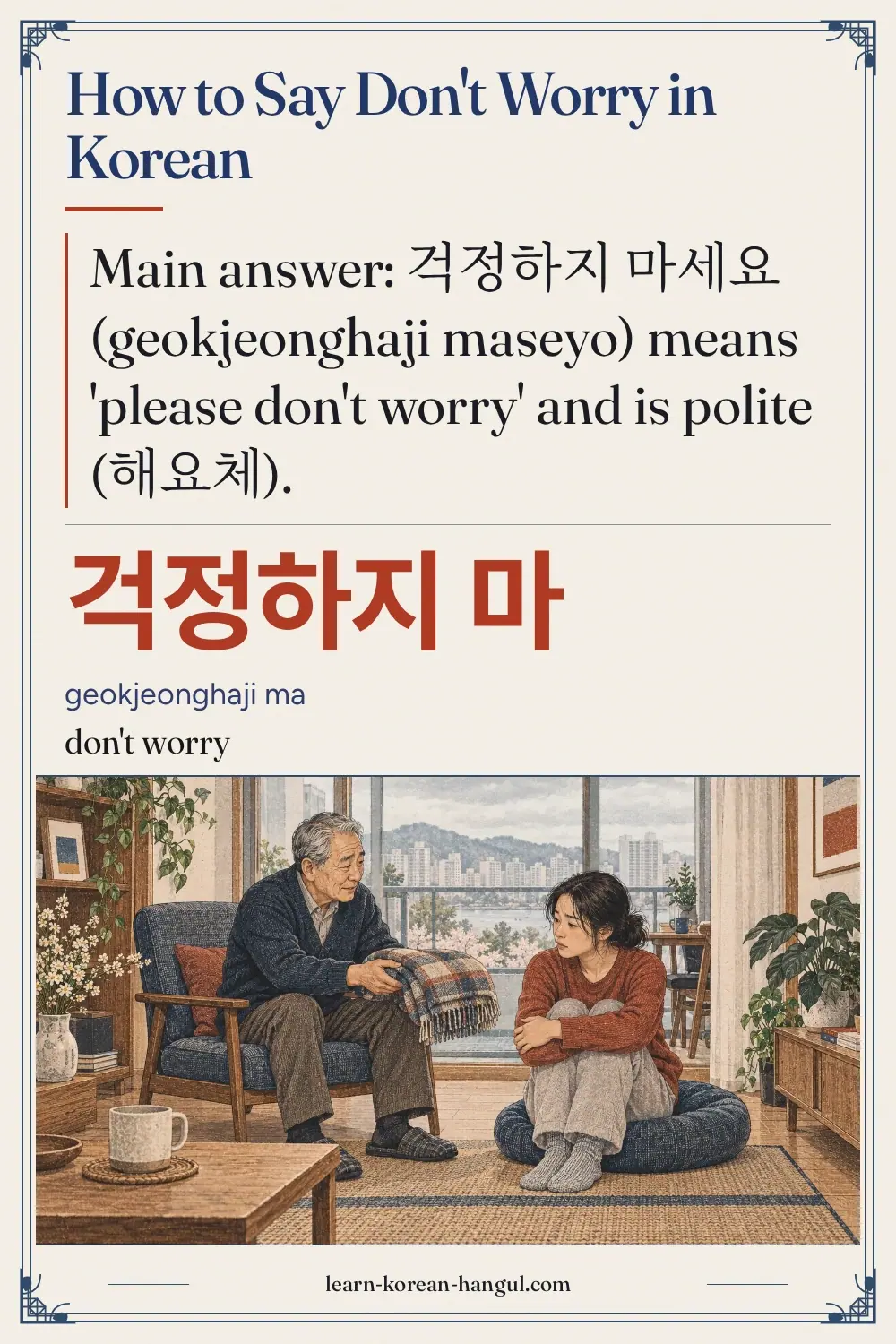
| 걱정하지 마 | geokjeonghaji ma | don't worry | casual (해체) |
Revised Romanization (the South Korean government standard of 2000) is a reading aid only. The Hangul is the real spelling. The next section shows who each form fits.
What Are the Formal, Polite and Casual Ways to Say Don't Worry?
Korean adjusts the sentence ending to the listener, and the Korean speech levels explain the system. For "don't worry," the level depends on who you are reassuring and what you are promising. Reassurance from a person in charge sounds more formal, and reassurance between friends sounds light.
Polite: 걱정하지 마세요 (geokjeonghaji maseyo)
걱정하지 마세요 is the form to learn first. It suits a coworker, a customer, a neighbour, a teacher or an older relative. The phrase often carries a promise: "I will take care of it."
Example: 걱정하지 마세요. 제가 확인할게요. (geokjeonghaji maseyo. jega hwaginhalgeyo.) "Please don't worry. I'll check it."
Short and Relaxed: 걱정 마세요 (geokjeong maseyo)
걱정 마세요 drops 하지 and is just as polite. Shopkeepers, taxi drivers and friendly strangers say it when they want to ease a worry quickly. A common follow-up pattern is 걱정 말고 (geokjeong malgo, "don't worry, and..."), as in 걱정 말고 가세요 (geokjeong malgo gaseyo, "don't worry, go ahead").
Formal: 걱정하지 마십시오 (geokjeonghaji masipsio)
걱정하지 마십시오 uses the formal ending -십시오 (합쇼체). It appears in announcements, in business statements and in service speech. The tone is firm and professional.
Example: 걱정하지 마십시오. 책임지고 처리하겠습니다. (geokjeonghaji masipsio. chaegimjigo cheorihagetseumnida.) "Please do not worry. I will take responsibility and handle it."
Casual: 걱정하지 마 (geokjeonghaji ma)
걱정하지 마 drops the 요 and is casual (해체). Friends, partners, siblings and parents use it. A shorter 걱정 마 (geokjeong ma) is also common.
Example: 걱정하지 마. 넌 잘할 거야. (geokjeonghaji ma. neon jalhal geoya.) "Don't worry. You'll do well."
Choosing a Form by Listener
The table gives one clear choice per situation.
| Situation | Best choice | Why |
|---|---|---|
| Customer or client | 걱정하지 마십시오 | formal and professional |
| Coworker, neighbour, teacher | 걱정하지 마세요 | polite and clear |
| Quick ease to a stranger | 걱정 마세요 | short and relaxed |
| Friend, partner, sibling | 걱정하지 마 | warm and casual |
| Someone younger or a child | 걱정 마 | light and kind |
Once the choice is clear, the next step is to hear the words.
How Do You Pronounce 걱정하지 마세요?
걱정하지 마세요 is pronounced [걱쩡하지 마세요], roughly "geok-jjeong-ha-ji ma-se-yo," with seven syllables in two word groups. Play the slow clip, then the normal clip, and repeat each one aloud.
| Word | Spelled | Spoken | Revised Romanization |
|---|---|---|---|
| 걱정하지 | 걱-정-하-지 | [걱쩡하지] | geokjeonghaji |
| 마세요 | 마-세-요 | [마세요] | maseyo |
| 마십시오 | 마-십-시-오 | [마십씨오] | masipsio |
What Sound Changes Happen in the Don't-Worry Phrases?
The key change is in the first word. The final ㄱ of 걱 is a stop sound, and the Standard Pronunciation Rules (표준 발음법) of the National Institute of Korean Language (국립국어원) make a plain consonant tense after a stop (Article 23). So the ㅈ of 정 is tense, and 걱정 is spoken [걱쩡]. The same tensing appears in 걱정돼요 [걱쩡돼요], "I'm worried." Revised Romanization writes geokjeong, because it does not show tensing that comes from a neighbouring sound.
The ㄱ at the end of 걱 is also unreleased. Close the back of the tongue against the soft palate to stop the sound, then move straight to the tense "jj." Do not add an extra vowel after the ㄱ.
In the formal 마십시오, the ㅅ of 시 is tense, so the word is read [마십씨오]. The ㅂ does not turn into ㅁ, because the sound after it is ㅅ and not a nasal. The page on tensification lists the other cases.
The example 잘할 거야 is spoken [잘할꺼야], because the ㄱ of 거 turns tense after the -(으)ㄹ ending. Intonation is gentle: the sentence falls at the end, since it is a request, not a question. With the sounds clear, the next question is when to say it.
When Should You Use 걱정하지 마세요, and When Should You Not?
Use 걱정하지 마세요 when you can offer help or evidence that things will be fine. The phrase works best when the speaker follows it with a promise, a plan or a fact: 제가 할게요 ("I'll do it"), 괜찮을 거예요 ("it will be fine"). On its own, it can sound like a brush-off.
Situations Where 걱정하지 마세요 Fits
- A customer is unsure about a delivery. Say 걱정하지 마세요, then state the date.
- A friend is nervous before an exam. Say 걱정하지 마, then add 넌 잘할 거야.
- A parent worries about a child abroad. The child says 걱정하지 마세요, and the parent hears care in it.
Situations to Avoid
- A real emergency. If someone is frightened for a good reason, 걱정하지 마세요 can sound careless. Ask 무슨 일이에요? (museun irieyo?, "What happened?") first.
- A senior in the casual form. Dropping the 요 is too familiar.
- A grieving person. Use 힘내세요 or a quiet 괜찮아요? instead, as in cheer up in Korean.
If unsure, give a reason with the phrase. The dialogues below show how that sounds.
What Does Don't Worry Sound Like in a Real Conversation?
Read each dialogue, play the clip, and say one role aloud.
Dialogue 1: At the office
- A: 걱정하지 마세요. 제가 확인할게요. (geokjeonghaji maseyo. jega hwaginhalgeyo.) "Please don't worry. I'll check it."
- B: 네, 걱정해 주셔서 감사합니다. (ne, geokjeonghae jusyeoseo gamsahamnida.) "Yes, thank you for being concerned."
걱정하지 마세요. 제가 확인할게요. 네, 걱정해 주셔서 감사합니다.
Dialogue 2: Two friends before an exam
- A: 시험 때문에 너무 떨려. (siheom ttaemune neomu tteollyeo.) "I'm so nervous about the exam."
- B: 걱정하지 마. 넌 잘할 거야. (geokjeonghaji ma. neon jalhal geoya.) "Don't worry. You'll do well."
시험 때문에 너무 떨려. 걱정하지 마. 넌 잘할 거야.
In Dialogue 1, the reply thanks the speaker for caring, which is the polite way to close the exchange.
In Dialogue 2, both friends use casual endings, and the encouragement after the phrase matters more than the phrase. The guide to it's okay in Korean shows more ways to reassure. The phrase also carries a cultural idea.
What Should You Know about the Culture behind Don't Worry?
In Korean, worry is a way of showing care. A parent who says 걱정돼요 or 걱정했어요 ("I was worried") is saying "I love you," and the reply 걱정하지 마세요 means "you do not need to carry that for me." That is why children, students and workers say it so often to elders and bosses.
There is also a friendly idiom, 걱정 붙들어 매세요 (geokjeong butdeureo maeseyo), which literally says "tie your worries down." It tells the listener to leave the problem with the speaker, and it sounds warm and a little playful. Use it with people you know, not in formal settings. These shades of meaning explain why learners fall into some typical traps.
What Mistakes Do Learners Make with Don't Worry in Korean?
The most common mistake is saying the first word with a plain ㅈ. Five mistakes appear again and again:
- Reading 걱정 as [걱정]. Fix: tense it, [걱쩡].
- Saying 걱정하지 말세요. The ㄹ of 말다 drops before ㅅ. Fix: 마세요.
- Using 걱정하지 마 with a senior. Fix: add 세요.
- Using the phrase with no follow-up. A bare 걱정하지 마세요 may sound dismissive. Fix: add a reason or a plan.
- Confusing it with a statement. 걱정하지 않아요 means "I don't worry." It does not ask anyone to stop. Fix: use 마세요 when you speak to the person.
All five come from translating "don't worry" without its grammar. A few related searches ask the same thing in other words, so they are answered next.
Short Answers on Stop Worrying and Please Don't Worry
Two searches lead to this page, so each gets a short answer.
- Stop worrying in Korean: Say 그만 걱정하세요 (geuman geokjeonghaseyo) for a polite "stop worrying," or 걱정 그만해 (geokjeong geumanhae) among friends. The word 그만 adds "enough," so it sounds firmer than 걱정하지 마세요.
- Please don't worry in Korean: The word "please" is already inside the 세요 ending, so 걱정하지 마세요 covers it.
To say you are the worried one, use I'm worried in Korean. The related page don't cry in Korean uses the same -지 마세요 pattern.
Related Phrases to Learn Next
Three pages follow the same layout and pair well with this one:
- It's okay in Korean: the everyday reassurance.
- Cheer up in Korean: encouragement for a low moment.
- I'm worried in Korean: the feeling that triggers this phrase.
The complete list sits in the Korean feelings phrases cluster.
Practice: Say It Aloud
Spend five minutes on this routine.
- Play the slow clip of 걱정하지 마세요 and repeat it three times, tensing the ㅈ.
- Say 걱정하지 마세요, then 걱정 마세요, and notice the shorter rhythm.
- Add a promise: 걱정하지 마세요. 제가 할게요.
- Hide the Romanization with the toggle and read the four forms from Hangul only.
- Drill the cluster with the phrase flashcards.
When the first word comes out as [걱쩡], you can say don't worry in Korean in a way that sounds natural.
Frequently Asked Questions
The answers below add details about how to say don't worry in Korean beyond the sections above.
What is the difference between 걱정하지 마세요 and 걱정 마세요?
Both mean "please don't worry." 걱정하지 마세요 uses the full verb 걱정하다 plus the command pattern. 걱정 마세요 drops 하지 and attaches 마세요 to the noun 걱정. Both are polite and correct, and the short form is very common in speech because it is quicker and sounds relaxed.
Why is 걱정 pronounced [걱쩡] and not [걱정]?
The final ㄱ of 걱 is a stop sound, and the Standard Pronunciation Rules make a plain ㅈ tense after a stop (Article 23). So 걱정 is spoken [걱쩡]. Revised Romanization still writes geokjeong, because it does not show tensing that comes from a neighbouring sound.
Is 걱정하지 마 rude?
No, but it is casual (해체). It is fine with friends, partners, siblings and children. With a boss, a teacher or an older stranger, add 세요 and say 걱정하지 마세요. Dropping the 요 with a senior makes you sound too familiar, even when your words are kind.
What can I say back when someone tells me not to worry?
Say 고마워요 (gomawoyo, "thank you") or 걱정해 주셔서 감사합니다 ("thank you for worrying about me"), which is more formal. If you still feel unsure, 알겠어요 (algesseoyo, "I understand") works. A friend only needs 응, 고마워 (eung, gomawo).
Does 걱정하지 마세요 mean the same as 괜찮아요?
Not exactly. 걱정하지 마세요 asks the listener to stop worrying and often promises that you will handle things. 괜찮아요 means "it's fine" or "I'm fine" and describes the situation. Together they sound natural: 걱정하지 마세요, 괜찮아요.
What is the most common mistake with don't worry in Korean?
Learners often read 걱정 as [걱정] with a plain ㅈ. Native-sounding speech tenses it to [걱쩡]. Another slip is saying 걱정하지 말세요 for 마세요, because the ㄹ of the verb 말다 drops before ㅅ. Say 마세요 and tense the ㅈ in 걱정.