
건배
건배
What you'll learn
- Say 건배, 위하여, 원샷 and 짠 and choose the one that fits the table.
- Run a toast in order, from raising the glass to the first sip.
- Pronounce 건배 and 건배합시다 correctly.
- Follow the basic pouring and drinking manners that elders notice.
Before you start: knowing the words for a meal helps, so see thank you for the meal in Korean first if you are new to restaurant phrases. Time: about 14 minutes. Audio plays only when you press a button.
How Do You Say Cheers in Korean?
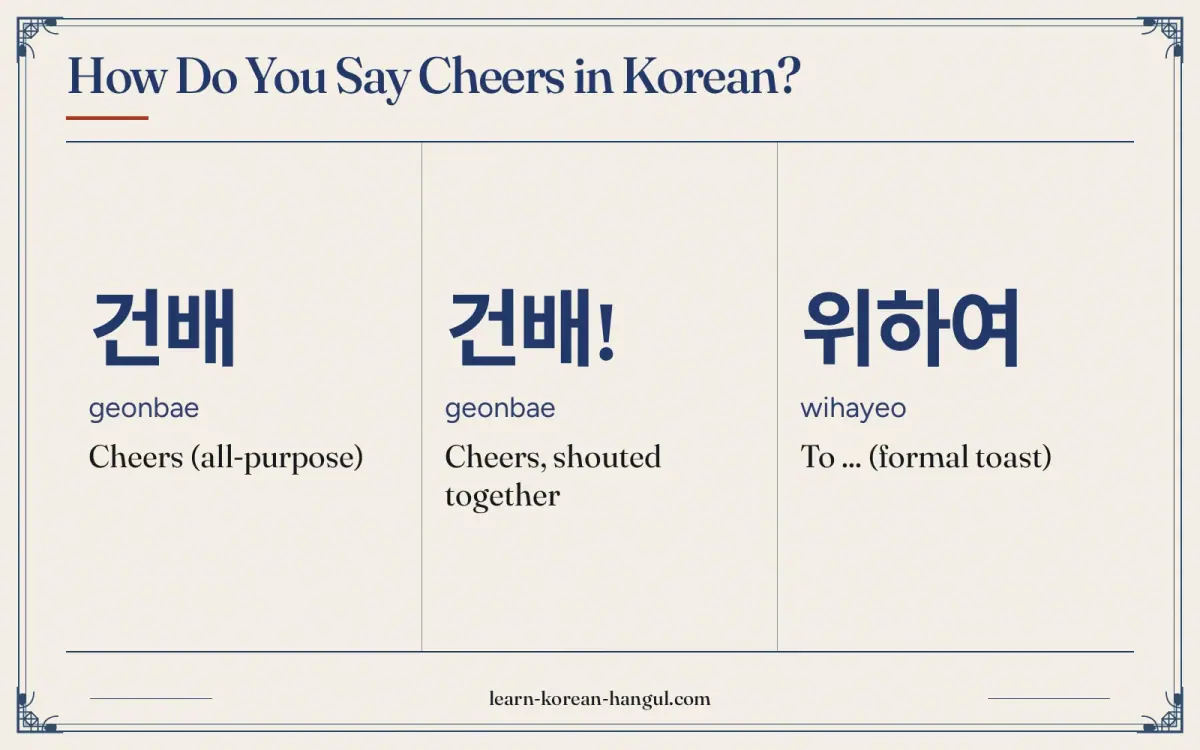
The standard way to say cheers in Korean is 건배. The word comes from the Chinese-character roots 乾 (empty, dry) and 杯 (cup), so it literally means "empty the cup". That origin explains why it fits the moment glasses are raised.
| Korean | Romanization | Meaning | Where you hear it |
|---|---|---|---|
| 건배 | geonbae | Cheers (all-purpose) | Everywhere |
| 건배! | geonbae | Cheers, shouted together | Group toasts |
| 위하여 | wihayeo | To ... (formal toast) | Work dinners, speeches |
| 원샷 | wonsyat | Bottoms up | Drinking games, friends |
| 짠 | jjan | Clink | Friends, casual |
Revised Romanization (the South Korean government standard of 2000) is only a reading aid here. Learn the Hangul first. The next section sorts the five words by setting.
What Are the Formal and Casual Ways to Say Cheers?
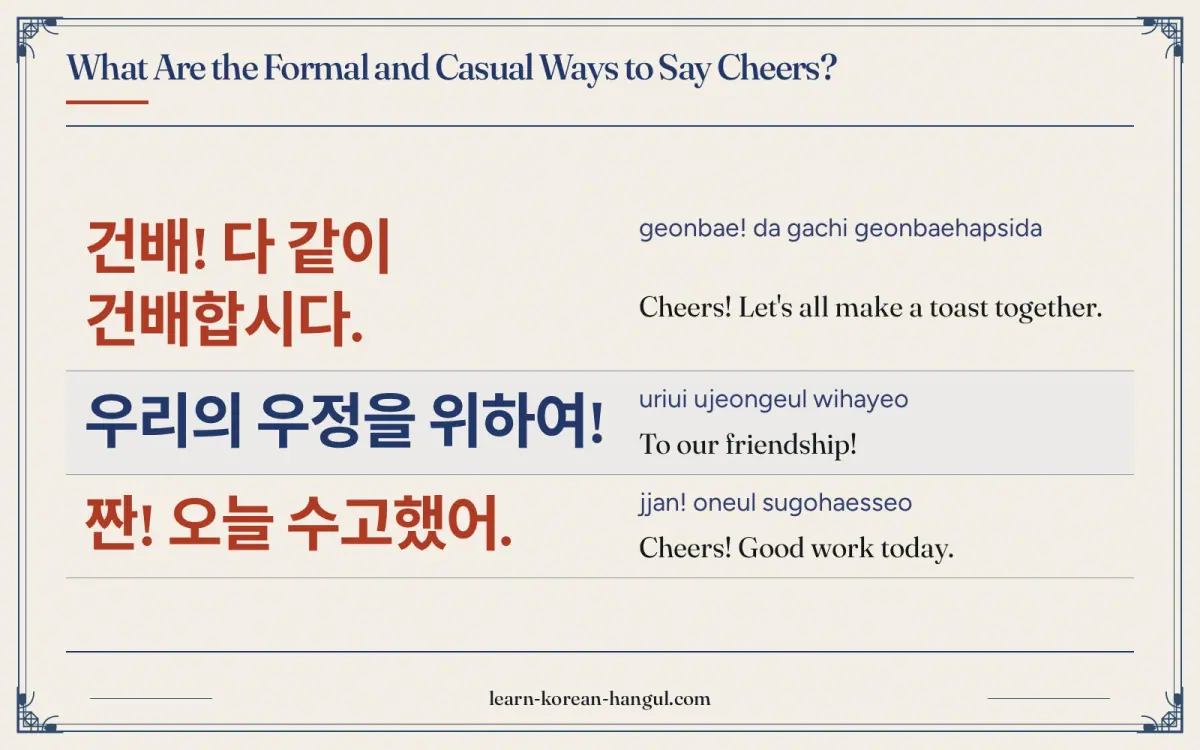
Cheers in Korean has formal and casual choices, and the setting decides. The core word 건배 is neutral, so the formal or casual feeling comes from what surrounds it.
Everyday: 건배 (geonbae)
Polite · 해요체건배 is the safe all-purpose choice. Say it when someone raises a glass, or announce it yourself with 건배합시다 ("let's make a toast").
건배! 다 같이 건배합시다.
geonbae! da gachi geonbaehapsida
Cheers! Let's all make a toast together.
Formal: 위하여 (wihayeo)
Formal · 합쇼체위하여 means "for the sake of ...". The toast leader names a subject, then says 위하여, and the group repeats it. It suits company dinners, weddings and speeches.
우리의 우정을 위하여!
uriui ujeongeul wihayeo
To our friendship!
Casual: 짠 (jjan)
Casual · 반말짠 imitates the sound of glasses meeting. Friends say it as the glasses touch, and you can add a sentence, as in 짠! 오늘 수고했어 ("Cheers! You worked hard today").
짠! 오늘 수고했어.
jjan! oneul sugohaesseo
Cheers! Good work today.
Casual: 원샷 (wonsyat)
Casual · 반말원샷 is the English loanword "one shot". It tells everyone to finish the glass in one go. It appears in drinking games among friends, so it is not the word for a formal toast.
원샷 하자!
wonsyat haja
Bottoms up!
The words are short. A toast has an order, which the next section lists.
How Does a Korean Toast Work, Step by Step?
A Korean toast has five steps, and following them in order is what makes you look at ease. The steps assume a table with mixed ages.
- Wait for everyone's glass to be filled. Pour for the people beside you, and let someone else fill your glass. You will know it worked when each person has a full glass.
- Let the eldest or the host start. They raise a glass and may give a short line, called a 건배사.
- Raise your glass. Hold it with your right hand and support it with your left, or touch your right wrist.
- Say the toast together. Call 건배! or the leader's closing word, such as 위하여, with the group.
- Drink after the clink. Juniors lower their glass slightly and turn their head to the side when they take the first sip in front of elders.
A common mistake at step 3 is clinking above an elder's glass, so keep your rim a little lower than theirs. Customs vary by family and workplace, and younger people often relax them. The next question is how to pronounce the words.
How Do You Pronounce 건배?
건배 is pronounced [건배], geon-bae, in two syllables. The word has no hidden sound change on its own.
- 건 (geon): a clear g, the vowel ㅓ (an open "uh" or "aw", not "o") and a short n.
- 배 (bae): a plain b and the vowel ㅐ, close to "eh" in most Seoul speakers' pronunciation.
Sound Changes to Listen For
Standalone 건배 stays the same. The change appears when it takes an ending:
- Tense ㅆ after ㅂ. In 건배합시다, the ㅅ of -시다 becomes tense after ㅂ: [건배합씨다]. This is the rule of Korean tensification.
- Soft ㅎ. The ㅎ of 합 comes right after the vowel of 배, so it is light and hardly sounds breathy.
- Tense 짠. 짠 starts with the tense ㅉ, which is tighter than ㅈ. The sound is firm and has no puff of air.
Wrong vowels are the typical issue: "gunbae" with a "u" misses the open ㅓ sound. The right sound is only half of a good toast, because the table customs matter just as much.
When Should You Use 건배, and When Should You Not?
Use 건배 whenever people raise their glasses, and add 위하여 at formal events. Avoid 원샷 unless the group has agreed to it, because it pushes people to drink fast.
Situations Where It Fits
- A team dinner. The leader calls 건배, and everyone repeats it.
- A birthday. Raise a glass after the song. The phrase is covered in happy birthday in Korean.
- A drink with water or juice. 건배 works with any glass, so you can join without alcohol.
- Friends meeting. 짠 with a smile.
Situations to Avoid
- Pressuring someone to finish a drink. Not everyone wants 원샷.
- Pouring your own drink first at a table with elders. Let someone pour for you.
- Casual 짠 or 원샷 with a boss. Use 건배 and keep it calm.
- Toasting with an empty or unfilled glass. Wait until all glasses are filled.
Three short dialogues show how the words and the manners fit together.
What Does Cheers Sound Like in a Real Conversation?
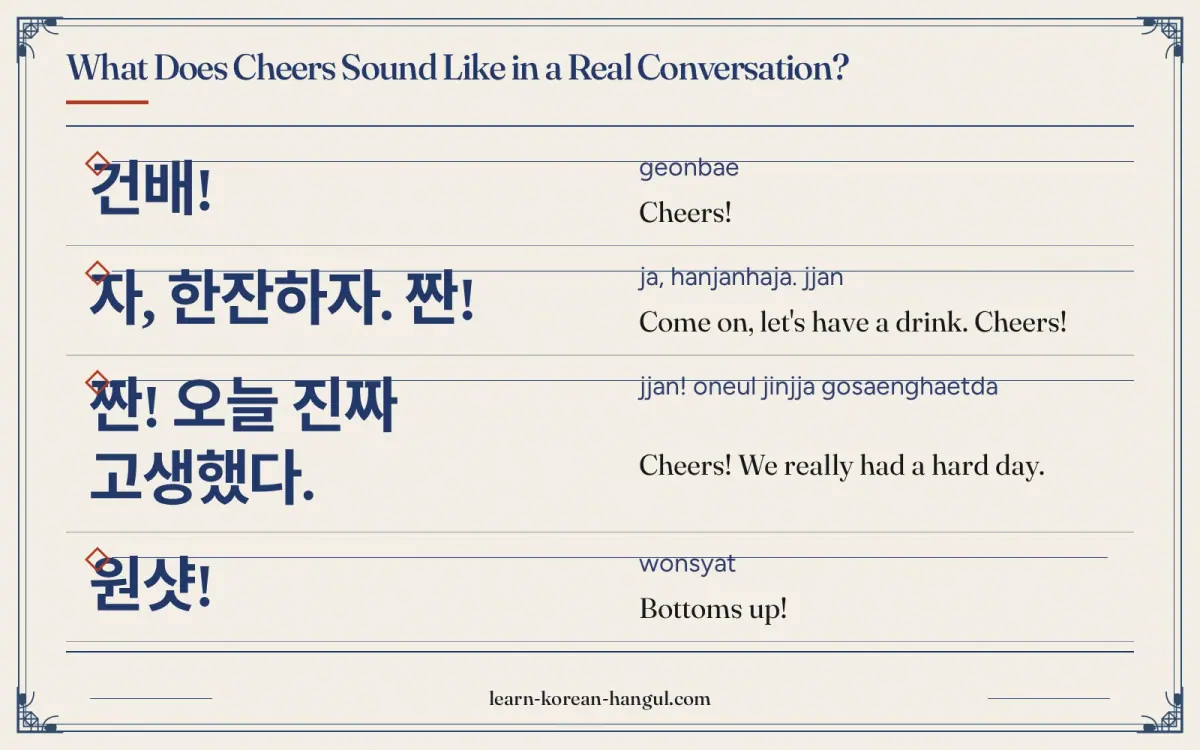
Toasts follow a call-and-response pattern: one person speaks and everyone repeats. Listen for the loud group answer.
A Company Dinner
Team Leader
자, 다들 잔 드세요. 건배!
ja, dadeul jan deuseyo. geonbae
Right, everyone, raise your glasses. Cheers!
Everyone
건배!
geonbae
Cheers!
What to notice: the leader uses the polite 드세요 (please raise), and the group answers with one word.
Friends Clink Glasses
Ji-Ho
자, 한잔하자. 짠!
ja, hanjanhaja. jjan
Come on, let's have a drink. Cheers!
Su-Bin
짠! 오늘 진짜 고생했다.
jjan! oneul jinjja gosaenghaetda
Cheers! We really had a hard day.
What to notice: 짠 repeats back, and the casual ending -자 invites the other person.
Declining One Shot
Colleague
원샷!
wonsyat
Bottoms up!
You
저는 천천히 마실게요.
jeoneun cheoncheonhi masilgeyo
I'll drink slowly.
What to notice: 천천히 마실게요 is a gentle, polite way to say no. If you do not drink at all, say 술을 못 마셔요 (I can't drink alcohol). Both lines lead into the culture behind the toast.
What Should You Know about the Culture behind a Korean Toast?
Drinking at a Korean table is a social ritual, and a few habits show respect. These are general customs, and families and workplaces differ.
- Pour for others. Pouring your own glass first is seen as impolite, and someone usually fills it for you.
- Two hands for elders. Use both hands, or one hand supported at the wrist or elbow, when you pour or receive a glass from an elder.
- Turn away to drink. Juniors often turn their head slightly aside when they drink in front of seniors.
- Soju and beer. Soju (소주) is the classic drink at casual dinners, and 건배 is used with beer, wine and non-alcoholic drinks too.
- No pressure. Many Koreans today accept a refusal if you say it kindly.
An expert insight: the phrase matters less than the timing. Saying 건배 together with the group, with your glass slightly below a senior's, makes a better impression than a perfect accent said alone. For thanks before the meal, see enjoy your meal in Korean. Mistakes usually come from skipping these habits.
What Mistakes Do Learners Make with Cheers in Korean?
Most cheers mistakes are about manners and register, not pronunciation.
| Mistake | Why it is a problem | Fix |
|---|---|---|
| Pouring your own drink first | Breaks table custom with elders | Let someone pour for you and pour for them |
| Clinking above a senior's glass | Seen as less respectful | Hold your glass slightly lower |
| Using 원샷 as a formal toast | It is a casual drinking-game word | Use 건배 or 위하여 |
| Saying "gunbae" with a u | Misses the vowel ㅓ | Say geon-bae |
| Drinking before the toast ends | Others are still waiting | Wait for the call and the clink |
Learners often assume 건배 is only for alcohol. Actually, the word also works with water, juice and tea, so you can join a toast without drinking.
Is It the Same as Cheers Drinking, Toast and Bottoms Up?
Mostly yes. "Cheers Korean", "toast in Korean" and "drinking toast in Korean" all point to 건배. "One shot" and "bottoms up" point to 원샷. The short answers below cover each search.
- Cheers drinking in Korean: 건배 or 짠 while the glasses touch.
- Toast in Korean: 건배 for the act and 건배사 for the toast speech.
- Drinking toast in Korean: 건배, with 위하여 at formal events.
- One shot in Korean: 원샷, the English loanword written in Hangul.
- Bottoms up in Korean: 원샷 or 다 마셔 (drink it all) among friends.
- Soju toast in Korean: 건배 with a short pour, often with both hands.
For the restaurant setting as a whole, see Korean restaurant phrases. Now practise with your own voice.
Practice: Say It Aloud
Play the slow clip and repeat 건배 three times. Then choose the best toast for each scene. Answers follow.
- A company dinner where the boss raises a glass.
- Friends meet after exams.
- A colleague pushes you to finish a drink.
- How is 건배합시다 pronounced, and why?
Answers
- 건배! or 위하여!
- 짠!
- 저는 천천히 마실게요.
- [건배합씨다]: the ㅅ becomes tense after ㅂ.
The phrase flashcards drill toast words with audio.
Related Phrases to Learn Next
Cheers is one of several table phrases.
- Delicious in Korean: praise the food after the first bite.
- Enjoy your meal in Korean: what hosts say as dishes arrive.
- Thank you for the meal in Korean: the thanks before and after eating.
This guide belongs to the Korean restaurant phrases collection. What this page does not cover: drinking-game rules, the full list of toast lines, and health advice about alcohol. Learn the toast words and the table manners, and you can say cheers in Korean at any gathering.
Frequently Asked Questions
How do you say cheers in Korean?
Say 건배 (geonbae) while raising your glass. It works at dinners, parties and weddings, and with any drink. For a formal speech toast, use 위하여, and with friends you can add the clink sound 짠. Say it together with the others, because a toast is a shared moment.
How do you pronounce 건배?
Say geon-bae in two syllables. The first has a clear g, the vowel ㅓ (close to "uh" or "aw") and a short n. The second has a plain b and the vowel ㅐ. There is no hidden sound change in the word alone. In 건배합시다 (let's toast), the last part becomes [합씨다].
What is the difference between 건배 and 건배!?
The word is the same. Without the mark, 건배 names the toast or is said calmly by one person. With the mark, 건배! is shouted by everyone together at the moment the glasses meet. In writing, the exclamation point simply signals volume and energy. In speech, the group usually repeats the leader's call.
Is 건배 formal or casual?
건배 is neutral, so it fits formal and casual settings. The register changes in the words around it. At a company dinner, the leader may say 건배사 (toast speech) and end with 위하여. Among friends, people say 짠 or 원샷. When unsure, 건배 is safe with everyone.
What is the most common mistake with cheers in Korean?
Pouring your own drink first at a table with elders. Custom says someone else should pour for you, and you pour for them. A second mistake is clinking higher than a senior's glass. Hold your glass slightly lower than theirs when you toast, and use both hands or support your wrist.