How Do You Say Enjoy Your Meal in Korean?
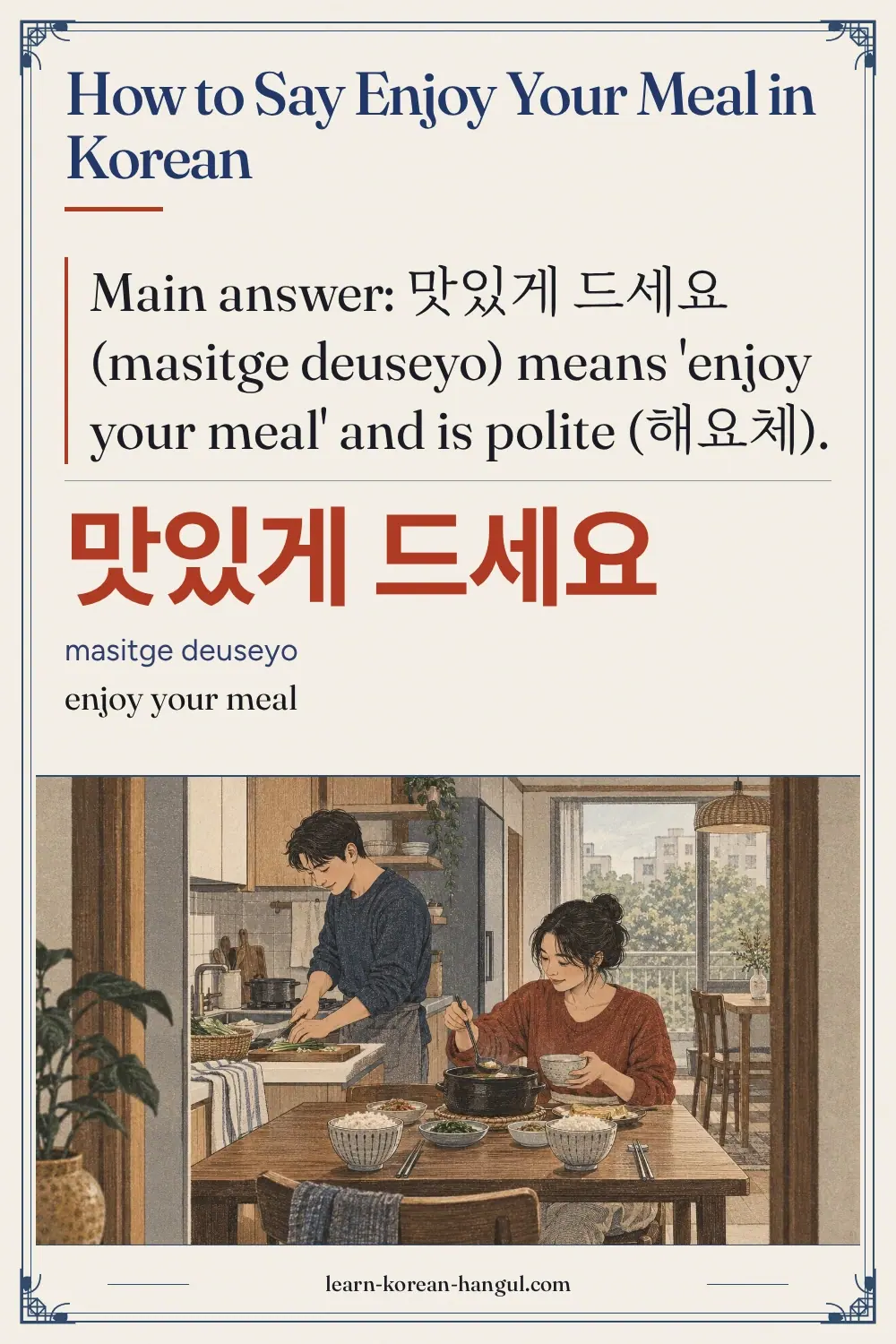
The standard polite way to say enjoy your meal in Korean is 맛있게 드세요 (masitge deuseyo). The phrase has two parts. 맛있게 (masitge) is the adverb form of 맛있다 (masitda, "to be delicious"), made with the ending -게, so it means "deliciously." 드세요 (deuseyo) is the polite request form of 드시다 (deusida), the respectful verb for "to eat," so the whole phrase asks the listener to eat well.
Hosts at home often say a longer line, 많이 드세요 (mani deuseyo, "please eat a lot"), which keeps inviting the guest to take more.
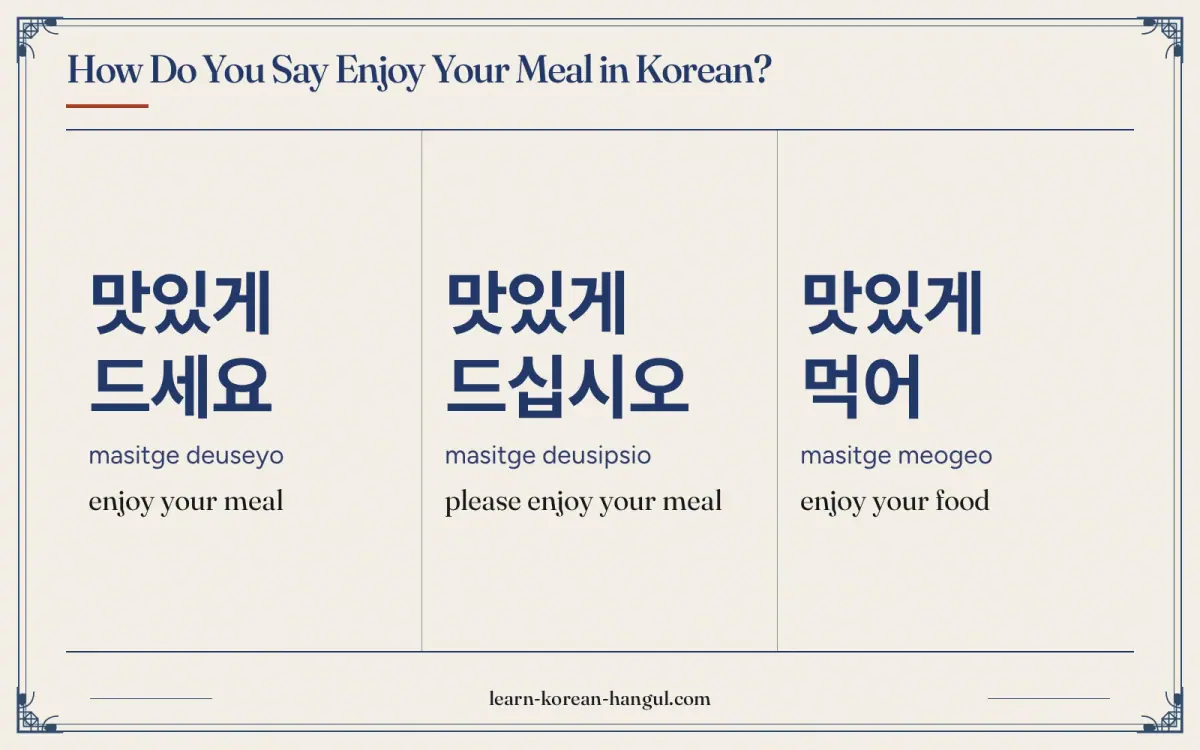
Four forms cover most situations.
| Korean | Revised Romanization | Meaning | Register |
|---|---|---|---|
| 맛있게 드세요 | masitge deuseyo | enjoy your meal | polite (해요체) |
| 맛있게 드십시오 | masitge deusipsio | please enjoy your meal | formal (합쇼체) |
| 맛있게 먹어 | masitge meogeo | enjoy your food | casual (해체) |
| 많이 드세요 | mani deuseyo | please eat a lot | polite, host line |
Revised Romanization (the South Korean government standard of 2000) is a reading aid only. The Hangul is the real spelling. The next section shows who each form fits.
What Are the Formal, Polite and Casual Ways to Say Enjoy Your Meal?
Korean changes the verb ending to match the listener, and the Korean speech levels explain how. For "enjoy your meal," the verb 먹다 ("to eat") has a respectful partner 드시다, and the ending decides the rest. Choose by who sits across the table.
Polite: 맛있게 드세요 (masitge deuseyo)
맛있게 드세요 is the form to learn first. It suits a server, a neighbour, a coworker, a teacher and an older relative. Say it with a small smile and a nod as the food arrives or as you hand someone a dish.
Example: 맛있게 드세요. 국은 더 있어요. (masitge deuseyo. gugeun deo isseoyo.) "Enjoy your meal. There is more soup."
Formal: 맛있게 드십시오 (masitge deusipsio)
맛있게 드십시오 uses the formal ending -십시오 (합쇼체). It appears in hotels, in department-store restaurants and in announcements, where staff speak in a careful voice.
Example: 주문하신 음식 나왔습니다. 맛있게 드십시오. (jumunhasin eumsik nawatseumnida. masitge deusipsio.) "Your order is ready. Please enjoy your meal."
Casual: 맛있게 먹어 (masitge meogeo)
맛있게 먹어 swaps 드세요 for the plain verb 먹다 and drops the polite ending. Close friends, partners, siblings and children hear it. Between friends, the plain 먹다 replaces the respectful 드시다, because a friend does not need the extra respect.
Example: 맛있게 먹어. 천천히 먹어. (masitge meogeo. cheoncheonhi meogeo.) "Enjoy your food. Eat slowly."
Choosing a Form by Listener
The table gives one clear choice per situation.
| Situation | Best choice | Why |
|---|---|---|
| Hotel or department-store restaurant | 맛있게 드십시오 | formal service tone |
| Café, restaurant, any guest | 맛있게 드세요 | polite and standard |
| Guest at your home | 많이 드세요 | invites more food |
| Friend, partner, sibling | 맛있게 먹어 | warm and casual |
| Younger child | 맛있게 먹어 | plain and friendly |
Once the choice is clear, the next step is to hear the words.
How Do You Pronounce 맛있게 드세요?
맛있게 드세요 is pronounced [마싣께 드세요], roughly "ma-sit-kke deu-se-yo," with six syllables in two word groups. Play the slow clip, then the normal clip, and repeat each one aloud.
| Word | Spelled | Spoken | Revised Romanization |
|---|---|---|---|
| 맛있게 | 맛-있-게 | [마싣께] | masitge |
| 드세요 | 드-세-요 | [드세요] | deuseyo |
| 드십시오 | 드-십-시-오 | [드십씨오] | deusipsio |
What Sound Changes Happen in the Enjoy-Your-Meal Phrases?
The main change is in 맛있게. The 맛 links to 있 with a ㅅ sound, then the final ㅆ of 있 closes the syllable as a ㄷ-type stop, so the word sounds like "ma-sit." The ㄱ of 게 that follows turns tense, and the result is [마싣께]. The Standard Pronunciation Rules (표준 발음법) of the National Institute of Korean Language (국립국어원) give [마딛께] as the basic form and also accept [마싣께], which is what most speakers say. Revised Romanization writes masitge and does not show tensing that comes from a sound change.
In the formal 드십시오, the ㅅ of 시 becomes tense, so the word is [드십씨오]. The ㅂ does not turn into ㅁ, because ㅅ is not a nasal sound. The page on tensification lists the other cases.
The vowel ㅡ in 드 is unrounded: keep the lips spread, as if smiling slightly, and do not round them as for "oo." Many learners round the lips and say "doo-seh-yo." For intonation, the phrase falls gently at the end, since it is a friendly wish and not a question. With the sounds clear, the next question is when to say it.
When Should You Use 맛있게 드세요, and When Should You Not?
Use 맛있게 드세요 at the moment food arrives or is offered to someone else: a server setting a bowl down, a host passing a plate, a friend sharing a snack. The phrase belongs to the person who is not eating yet, or who is serving.
Situations Where 맛있게 드세요 Fits
- A server places your order on the table. Staff say 맛있게 드세요, and you answer 감사합니다.
- A host serves a guest at home. Say 맛있게 드세요 or 많이 드세요, and offer more.
- You hand a coworker a lunchbox or a snack. Say 맛있게 드세요 with a small nod.
Situations to Avoid
- Before your own meal. The 세요 ending is for the other person. Say 잘 먹겠습니다 (jal meokgetseumnida) instead.
- After the meal. Say 잘 먹었습니다 (jal meogeotseumnida), as in thank you for the meal in Korean.
- A very close friend, in the polite form. It can sound distant; 맛있게 먹어 is warmer.
If unsure, use the polite form with a smile. The dialogues below show how real meals sound.
What Does Enjoy Your Meal Sound Like in a Real Conversation?
Read each dialogue, play the clip, and say one role aloud.
Dialogue 1: Server and customer
- A: 맛있게 드세요. (masitge deuseyo.) "Enjoy your meal."
- B: 네, 감사합니다. 잘 먹겠습니다. (ne, gamsahamnida. jal meokgetseumnida.) "Yes, thank you. I will eat well."
맛있게 드세요. 네, 감사합니다. 잘 먹겠습니다.
Dialogue 2: Host and guest at home
- A: 많이 드세요. (mani deuseyo.) "Please eat a lot."
- B: 네, 잘 먹겠습니다. 우와, 맛있어 보여요. (ne, jal meokgetseumnida. uwa, masisseo boyeoyo.) "Yes, I'll eat well. Wow, it looks delicious."
많이 드세요. 네, 잘 먹겠습니다. 우와, 맛있어 보여요.
In Dialogue 1, the customer replies with a short thank you and 잘 먹겠습니다, which is the standard answer. In Dialogue 2, the guest adds a compliment, and the guide to delicious in Korean gives more words for it. The phrase also reflects table culture.
What Should You Know about the Culture behind Enjoy Your Meal?
Meals in Korea are shared, so the phrases around the table matter. A host usually keeps offering food with 많이 드세요, and a guest who leaves a bowl empty often finds it filled again. Saying 잘 먹겠습니다 before eating is the guest's side of the exchange, and 잘 먹었습니다 closes the meal.
Many families also wait until the eldest person lifts a spoon before the others begin. In that setting, 맛있게 드세요 doubles as an invitation to start: the host says it, and everyone lifts their chopsticks. If you want to share a drink at the same table, see cheers in Korean. A few typical mistakes come from missing these roles.
What Mistakes Do Learners Make with Enjoy Your Meal in Korean?
The most common mistake is saying the phrase to yourself. Five mistakes appear again and again:
- Saying 맛있게 드세요 before your own meal. The phrase is for others. Fix: say 잘 먹겠습니다.
- Saying 맛있는 드세요. 맛있는 is the adjective form. Fix: use the adverb 맛있게.
- Using 먹어 with a senior. The plain casual verb sounds too familiar. Fix: use 드세요.
- Reading it as [맛이게]. Fix: read it as [마싣께].
- Rounding the lips on ㅡ. Fix: spread the lips for 드.
All five come from translating "enjoy" word for word. A few related searches ask the same thing in other words, so they are answered next.
Short Answers on Eat Well, Eat a Lot and Come Eat
Four searches lead to this page, so each gets a short answer.
- Enjoy your food in Korean: The same phrase works, 맛있게 드세요. A casual version is 맛있게 먹어.
- Eat well in Korean: Say 잘 드세요 (jal deuseyo) to wish someone a good meal, or 잘 먹겠습니다 for yourself.
- Eat a lot in Korean: Say 많이 드세요 (mani deuseyo), spoken [마니 드세요].
- Come eat in Korean: Say 와서 드세요 (waseo deuseyo) to invite someone to the table.
The reply for the eater is the next clip.
To invite someone to join you, see let's eat together in Korean, and to say you have had enough, see I'm full in Korean.
Related Phrases to Learn Next
Three pages follow the same layout and pair well with this one:
- Thank you for the meal in Korean: what to say before and after eating.
- Delicious in Korean: praise for the food.
- I'm full in Korean: how to politely say you have had enough.
The complete list sits in the Korean restaurant phrases cluster.
Practice: Say It Aloud
Spend five minutes on this routine.
- Play the slow clip of 맛있게 드세요 and repeat it three times, tensing the ㄱ in [마싣께].
- Say 맛있게 드세요, then 많이 드세요, and imagine passing a dish.
- Answer each one with 잘 먹겠습니다.
- Hide the Romanization with the toggle and read the four forms from Hangul only.
- Drill the cluster with the phrase flashcards.
When the phrase comes out with a warm voice and spread lips on the ㅡ, you can say enjoy your meal in Korean at any table.
Frequently Asked Questions
The answers below add details about how to say enjoy your meal in Korean beyond the sections above.
What does 맛있게 드세요 literally mean?
Literally, it means "please eat deliciously." 맛있게 is the adverb form of 맛있다 ("to be delicious"), and 드세요 is the polite request form of 드시다, the respectful verb for "to eat." Korean uses it where English says "enjoy your meal" or French says "bon appétit."
Do I say 맛있게 드세요 to myself before eating?
No. The 세요 ending shows respect to the person you speak to, so it is for others and never for yourself. Before you eat, say 잘 먹겠습니다 (jal meokgetseumnida, "I will eat well"). After eating, say 잘 먹었습니다 (jal meogeotseumnida, "I ate well").
What is the difference between 드세요 and 먹으세요?
Both are polite requests that mean "please eat." 먹으세요 uses the plain verb 먹다 with the honorific -(으)세요. 드세요 uses the special respectful verb 드시다, so it shows a little more respect. For a stranger, an elder or a customer, 드세요 is the safer, more natural choice.
How do I reply when someone says 맛있게 드세요?
A server or host hears 네, 감사합니다 (ne, gamsahamnida, "yes, thank you") or 잘 먹겠습니다 (jal meokgetseumnida). With a friend, 너도 (neodo, "you too") is a quick reply. At a table of elders, wait until the eldest person begins before you start eating.
Why does 맛있게 sound like [마싣께]?
The ㅆ in 있 closes the syllable as a ㄷ-type sound, and the ㄱ after it turns tense. So 맛있게 is spoken [마싣께], not [맛이게]. The Standard Pronunciation Rules give [마딛께] as the basic form and also accept [마싣께], which is what most speakers say. Revised Romanization writes masitge and does not show the tensing.
What is the most common mistake with enjoy your meal in Korean?
Learners often say 맛있는 드세요 with the adjective form, or tell themselves 맛있게 드세요 before eating. The word before 드세요 must be the adverb 맛있게, and the phrase is for the other person. Use 잘 먹겠습니다 for your own meal.