
맛있어요
맛있어요
What you'll learn
- Say delicious in the polite, formal and casual forms and pick the right one for each listener.
- Pronounce 맛있어요 as [마디써요] or [마시써요] and know why both are heard.
- Praise food in the past tense with 맛있었어요 and say "not tasty" without being rude.
- Avoid the common mistake of using 맛있어요 for people.
Before you start: you need to read Hangul and know the polite ending 요. Knowing thank you for the meal in Korean helps, because the two phrases come together at the table. Time: about 15 minutes. Audio plays only when you press a button.
Key facts
- 맛있습니다 (masitseumnida) is the formal form, 맛있다 (masitda) is the plain form for writing or talking to yourself, and 맛있어 (masisseo) is the casual form.
- 맛 (mat) means "taste" and 있다 (itda) means "to have", so the word literally means "has taste".
- The opposite is 맛없어요 (madeopseoyo), "it's not tasty", which is blunt, so most people soften it.
- The standard pronunciation rules list 맛있다 as [마딛따] and also allow [마싣따], so 맛있어요 is [마디써요] or [마시써요].
How Do You Say Delicious in Korean?
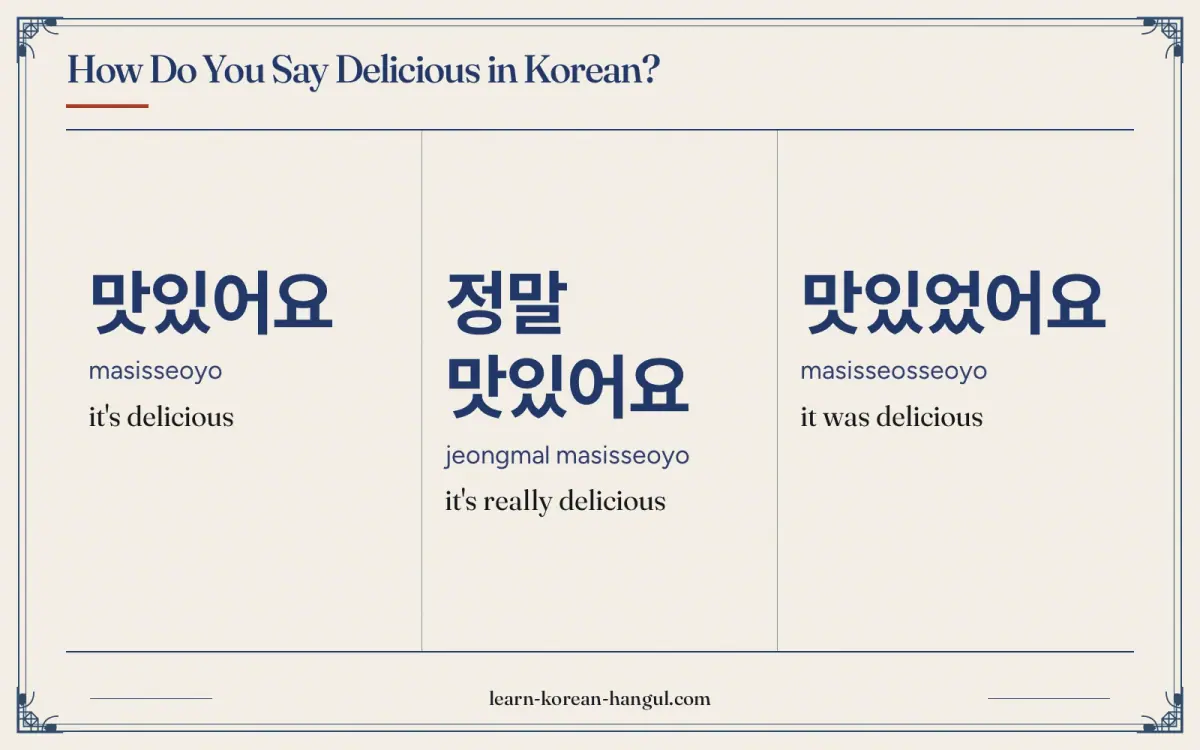
The everyday way to say delicious in Korean is 맛있어요. It joins 맛 (taste) and 있다 (to have), so the literal idea is "it has taste". Korean has no separate word "to be" here: the adjective 맛있다 carries the whole meaning, and the ending shows the politeness.
| Form | Korean | Romanization | Meaning | Style |
|---|---|---|---|---|
| Polite | 맛있어요 | masisseoyo | it's delicious | everyday, safe with anyone |
| Polite, stronger | 정말 맛있어요 | jeongmal masisseoyo | it's really delicious | everyday praise |
| Polite, past | 맛있었어요 | masisseosseoyo | it was delicious | after the meal |
| Formal | 맛있습니다 | masitseumnida | it is delicious | speeches, reviews, service |
| Plain | 맛있다 | masitda | delicious | writing or talking to yourself |
| Casual | 맛있어 | masisseo | yummy | close friends |
| Opposite | 맛없어요 | madeopseoyo | it's not tasty | blunt, use with care |
Building the polite form takes three steps:
- Take the dictionary form 맛있다 and remove 다 to get the stem 맛있-.
- Add the connector 어 (the stem's last vowel is ㅣ, so the form is 어, not 아): 맛있어.
- Add 요 for politeness: 맛있어요.
For the formal form, add -습니다 to the stem, because it ends in a consonant: 맛있습니다. To switch to the past, change 어요 to 었어요, which gives 맛있었어요.
The next section sets the forms out by listener.
What Are the Formal, Polite and Casual Ways to Say Delicious?
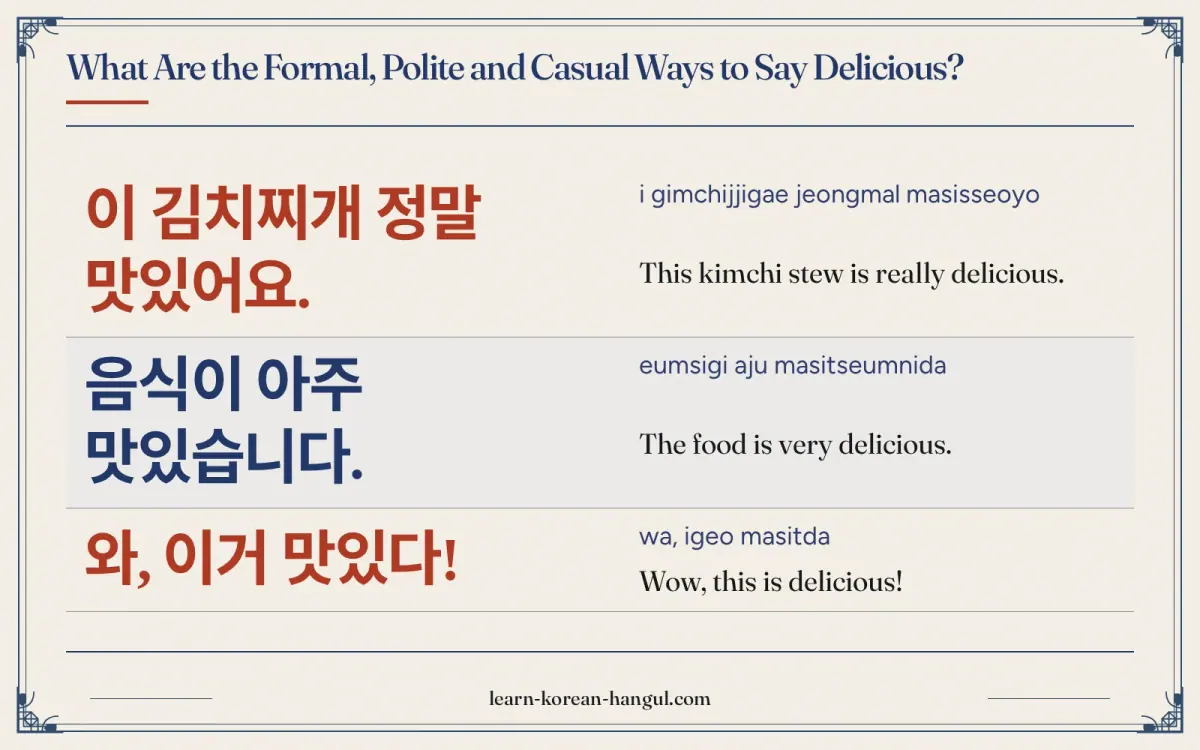
The right form depends on who is listening, a system called speech levels (존댓말 and 반말). The guide to Korean speech levels explains it. In short: use 맛있어요 for strangers and elders, 맛있습니다 for formal talk, and 맛있어 for friends.
Polite: 맛있어요 (masisseoyo)
Polite · 해요체맛있어요 is the form you will use most. It is safe with a restaurant owner, a host, a coworker or a stranger. Add 정말 or 진짜 (jinjja, "really") before it to sound warmer, and name the dish if you want to praise it directly.
이 김치찌개 정말 맛있어요.
i gimchijjigae jeongmal masisseoyo
This kimchi stew is really delicious.
Formal: 맛있습니다 (masitseumnida)
Formal · 합쇼체맛있습니다 is the formal polite form. It fits a toast, a business dinner, a customer review that is written politely, or a reply to a senior at work. It sounds careful, so it can feel stiff at a family table.
음식이 아주 맛있습니다.
eumsigi aju masitseumnida
The food is very delicious.
Plain: 맛있다 (masitda)
Casual · 반말맛있다 is the plain form. Learners meet it as the dictionary form, and Koreans use it in writing, in captions and as an exclamation to themselves. When you taste something and say 와, 맛있다!, you are not addressing anyone, so no politeness is needed.
와, 이거 맛있다!
wa, igeo masitda
Wow, this is delicious!
Casual: 맛있어 (masisseo)
Casual · 반말맛있어 drops the final 요 and is for close friends, siblings and people younger than you who have agreed to casual speech. Do not use it with a teacher or an elder you have just met.
이 떡볶이 진짜 맛있어.
i tteokbokki jinjja masisseo
This tteokbokki is really tasty.
Pronunciation comes next, because the spelling of 맛있어요 hides a sound change.
How Do You Pronounce 맛있어요?
맛있어요 is pronounced [마디써요] or [마시써요], masisseoyo in Revised Romanization, in four even syllables with no strong stress. Both sounds are accepted. The standard pronunciation rules (표준 발음법) list [마딛따] first for the dictionary form 맛있다 and allow [마싣따] as a second option, and speakers treat 맛있어요 the same way.
- 마 (ma): an open "ma".
- 디 or 시 (di or si): a soft "dee" in the first reading, or "shee" in the second.
- 써 (sseo): a tense s, said with a firm tongue and no puff of air.
- 요 (yo): short and level.
Sound Changes to Listen For
Four changes explain the difference between the spelling and the sound:
- 맛 + 있 links across the syllables. The ㅅ at the end of 맛 is first read as a [ㄷ] sound, and it then moves into the next syllable, giving [마디]. Many speakers keep the ㅅ sound and say [마시]. The page on how to pronounce 맛있어요 drills this liaison in detail.
- 있어요 is [이써요]. The ㅆ at the end of 있 moves to the next syllable and keeps its tense sound, which is the usual pattern when a final consonant meets a vowel.
- 맛있습니다 is [마딛씀니다] or [마싣씀니다]. The ㅅ of -습니다 turns tense after a final consonant, and the ㅂ becomes [ㅁ] before ㄴ, so the ending sounds like [씀니다].
- 맛없어요 is [마덥써요]. The ㅂ of 없 stays, and the ㅅ moves forward as a tense [ㅆ]. Unlike 맛있어요, there is only one standard reading: [마섭써요] is a common mispronunciation, not an accepted variant.
Revised Romanization follows the [마시써요] reading, so masisseoyo is a reading aid; the [마디써요] reading would be written madisseoyo. With the sounds in place, the next question is when each form fits.
When Should You Use 맛있어요, and When Should You Not?
Use 맛있어요 whenever you want to praise food to someone you speak politely to, and avoid it for people, for things that are not eaten, and in very casual talk with elders. The lists below show where it fits and where it does not.
Situations Where It Fits
- After the first bite at a friend's home. 정말 맛있어요 tells the host that the effort worked.
- To a restaurant owner. 사장님, 정말 맛있어요 is a common compliment on the way out.
- In a review or message. 맛있었어요 (it was delicious) fits a polite message after a meal.
- When you eat alone. 맛있다 is a natural reaction to yourself.
Situations to Avoid
- For a person. 맛있어요 means tasty to eat. For "cool" say 멋있어요 (meosisseoyo), and for "pretty" say 예뻐요 (yeppeoyo).
- For a bad meal, bluntly. 맛없어요 sounds harsh to the cook. Most people say 별로예요 (byeolloyeyo, "it's not great") or stay quiet and smile.
- With a stranger or elder in casual form. 맛있어 sounds too close. Keep the 요.
- As a thank-you alone. After a meal, add 잘 먹었습니다 (jal meogeotseumnida, "I ate well") to thank the host.
The dialogues below show these rules in real settings.
What Does Delicious Sound Like in a Real Conversation?
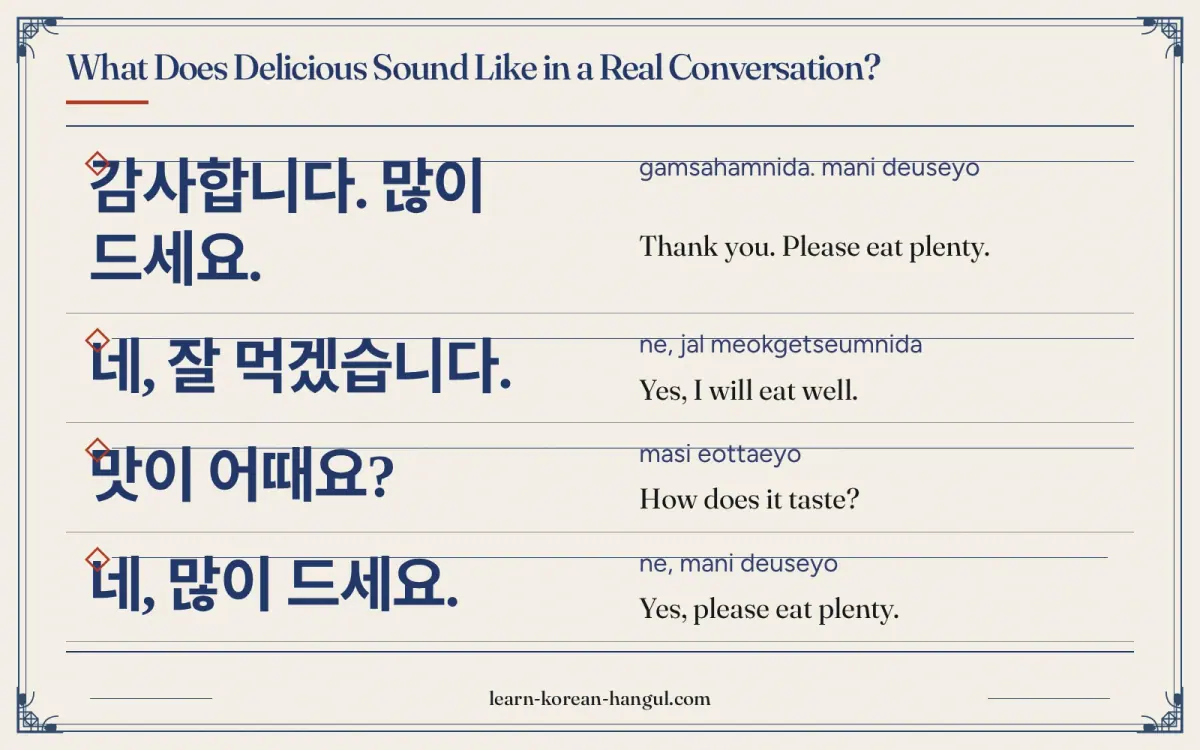
A Korean food compliment is short and warm, and the host usually answers with an invitation to eat more. Listen for the polite ending in the first two dialogues and the casual ending in the third.
Praising the Stew
Customer
사장님, 이 김치찌개 정말 맛있어요.
sajangnim, i gimchijjigae jeongmal masisseoyo
Boss, this kimchi stew is really delicious.
Owner
감사합니다. 많이 드세요.
gamsahamnida. mani deuseyo
Thank you. Please eat plenty.
Customer
네, 잘 먹겠습니다.
ne, jal meokgetseumnida
Yes, I will eat well.
What to notice: 사장님 (sajangnim) is the respectful word for an owner, and 잘 먹겠습니다 ("I will eat well") is the set phrase said before eating. The guide to enjoy your meal in Korean covers the host's side.
At a Friend's Home
Friend's Mother
맛이 어때요?
masi eottaeyo
How does it taste?
Guest
정말 맛있어요. 어머님이 만드셨어요?
jeongmal masisseoyo. eomeonimi mandeusyeosseoyo
It is really delicious. Did you make it?
Friend's Mother
네, 많이 드세요.
ne, mani deuseyo
Yes, please eat plenty.
What to notice: the guest adds the honorific -시- to the host's verb (만드셨어요), because the question is about the host's action. 많이 드세요 means "eat plenty", a normal host phrase.
Sharing Street Food
Jimin
이 떡볶이 어때?
i tteokbokki eottae
How is this tteokbokki?
Sujin
진짜 맛있어! 한번 먹어 봐.
jinjja masisseo! hanbeon meogeo bwa
It is really good! Try it.
Jimin
와, 대박! 맛있다.
wa, daebak! masitda
Wow, amazing! It is delicious.
What to notice: friends drop the 요 and use 맛있어, and 맛있다 is a free exclamation. 대박 (daebak) is slang for "amazing", covered in daebak in Korean.
What Should You Know about the Culture behind Delicious?
In Korea, praising the food is part of the table ritual, and it pleases the host. Hosts often answer with 많이 드세요 or 더 드세요 ("have more") and may serve a second helping before you finish.
- Say it early. A compliment after the first bite shows appreciation, and a second one after the meal closes the exchange.
- Pair it with set phrases. Say 잘 먹겠습니다 before the meal and 잘 먹었습니다 after it. The guide on thank you for the meal in Korean explains both.
- Refusing more food needs a reason. If you are full, say 배불러요 (baebulleoyo, "I'm full"), as in I'm full in Korean.
- Table talk is part of a bigger set. Look at the whole group of Korean restaurant phrases for ordering and paying.
An expert insight: the opposite of 맛있다 is 맛없다, not 안 맛있다. Speakers do say 안 맛있어요 in casual talk, but the dictionary form is 맛없어요, and a polite speaker softens it with 별로예요 instead. The mistakes below follow from this kind of literal thinking.
What Mistakes Do Learners Make with Delicious in Korean?
Most mistakes come from using the word for the wrong target or the wrong listener. The table collects the five most common ones.
| Mistake | Why it is a problem | Fix |
|---|---|---|
| Calling a person 맛있어요 | It means tasty to eat | Use 멋있어요 (cool) or 예뻐요 (pretty) |
| Saying 맛없어요 to the cook | It sounds harsh | Say 별로예요 or praise another dish |
| Using 맛있어 with an elder | Casual speech is too close | Say 맛있어요 |
| Writing 맛있어요 as 맛이써요 | Spelling follows the grammar, not the sound | Write 맛있어요 and say [마디써요] |
| Using only 맛있어요 for every dish | It sounds flat | Add 정말, 진짜 or the dish name |
Learners often assume that the spelling must follow the sound, so they write 맛이써요. Actually Korean spelling keeps the grammar visible: 맛있어요 is the standard single-word spelling, and the spelled-out phrase 맛이 있어요 ("it has taste") is also correct and close in meaning. Neither is written the way it sounds.
Is It the Same as Yummy, Tasty or so Delicious?
Yes, in almost every case: Korean uses one word, 맛있다, for all of them, and only the strength and the style change. The list gives the answer to each related search.
- Yummy in Korean: 맛있어 with friends, or 맛있다 as an exclamation. Slang such as 꿀맛이에요 (kkulmasieyo, "it's honey-sweet, heavenly") praises a dish in a playful way.
- Tasty in Korean: 맛있어요 again. You may also hear 맛이 좋아요 ("the taste is good").
- It's delicious in Korean: 맛있어요. Korean drops the subject, so no word for "it" is needed.
- So delicious in Korean: 정말 맛있어요, 진짜 맛있어요 or 너무 맛있어요 (neomu masisseoyo).
- This is delicious in Korean: 이거 맛있어요 (igeo masisseoyo), where 이거 means "this".
- Delicious food in Korean: 맛있는 음식 (masinneun eumsik). Before a noun, the adjective takes -는.
- Delicious casual in Korean: 맛있어 or 맛있다.
Now practise the phrases aloud.
Practice: Say It Aloud
Play the slow clip of 맛있어요 and repeat it three times, then add 정말 and say it again. Then choose the right form for each listener. Answers follow.
- Praise the stew to a restaurant owner.
- Tell a friend that the street food is great.
- Write a formal thank-you to a senior colleague after a business dinner.
- Tell your friend's mother that the meal was delicious, after you finish.
Answers
- 사장님, 정말 맛있어요.
- 이거 진짜 맛있어!
- 음식이 아주 맛있었습니다. (the formal past form)
- 정말 맛있었어요. 잘 먹었습니다.
The phrase flashcards drill these food phrases with audio.
Related Phrases to Learn Next
Delicious is one half of a meal; the other phrases finish it.
- Enjoy your meal in Korean: 맛있게 드세요, said by the host or server.
- Thank you for the meal in Korean: 잘 먹었습니다, said when you finish.
- I'm full in Korean: 배불러요, for when you cannot eat more.
- Cheers in Korean: 건배, for the toast before the first bite.
This guide belongs to the Korean restaurant phrases collection. What this page does not cover: the full liaison rules for batchim, which are in the pronunciation lessons, and dish names. Say 맛있어요 after the first bite, add 정말 for warmth, and you can say delicious in Korean at any table.
Frequently Asked Questions
What is the difference between 맛있어요 and 맛있습니다?
Both mean "it is delicious". 맛있어요 is the polite everyday form and fits a host, an owner or a coworker. 맛있습니다 is the formal polite form, used in speeches, reviews and with senior people at work. The meaning is the same, but 맛있습니다 sounds more careful and can feel stiff at a relaxed family table.
Is 맛있어요 formal or casual?
It is polite, which sits in the middle. The ending 요 makes it respectful without the stiffness of the formal -습니다 form. You can say it to strangers, elders and coworkers. Only with close friends or younger people do Koreans drop the 요 and say 맛있어, and only after both sides agree to speak casually.
Can I use 맛있어요 with friends, elders and strangers?
Yes for strangers and elders: 맛있어요 is polite and safe. With friends, 맛있어 is natural, but 맛있어요 is also fine and never rude. Do not use 맛있어 with a teacher, a boss or an older relative unless they asked you to relax your speech. When in doubt, keep the 요.
How do I say "it was delicious" in Korean?
Say 맛있었어요 (masisseosseoyo), the polite past form, or 정말 맛있었어요 for extra praise. Use it when the meal is over and you thank the host. The formal past form is 맛있었습니다. Add 잘 먹었습니다 ("I ate well") to close the meal, because this phrase is the standard thanks.
How do I say a dish is not tasty politely?
Avoid 맛없어요, which is blunt. Say 별로예요 ("it's not great"), or 제 입맛에는 조금 안 맞아요 ("it's not quite to my taste"). With a host, you can also praise another dish instead. Being direct about a bad meal is rare in Korean social settings, so a small, kind comment works best.