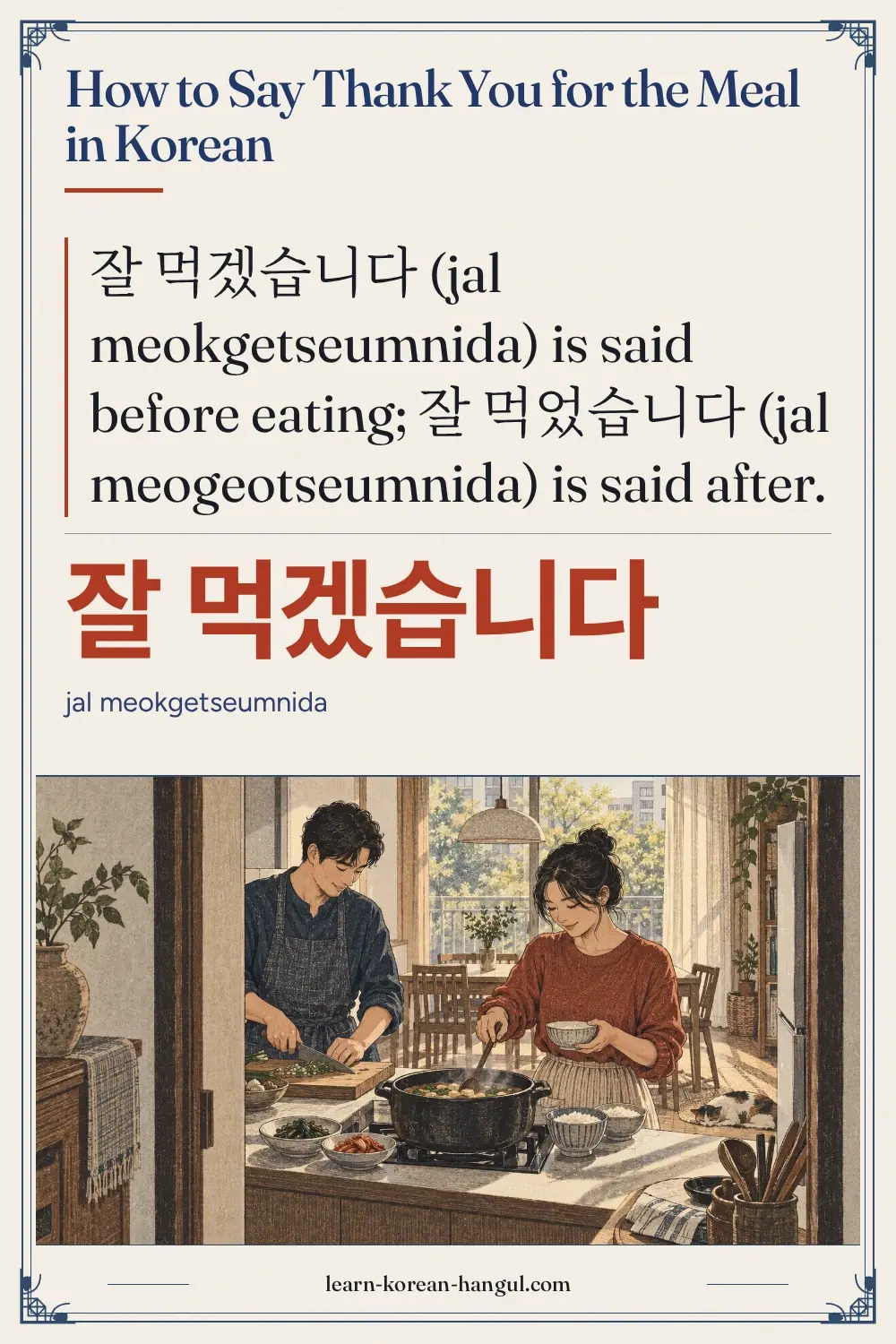
잘 먹겠습니다
잘 먹겠습니다
What you'll learn
- Say 잘 먹겠습니다 aloud as [잘 먹껟씀니다], with the tense sounds in 먹겠습니다.
- Know when to say 잘 먹겠습니다 (before eating) and 잘 먹었습니다 (after eating).
- Choose between the formal, polite and casual forms for a boss, an elder and a friend.
- Avoid using a plain 감사합니다 where Koreans expect the meal phrases.
Before you start: you need to read Hangul; romanization is shown as an aid and can be hidden. Time: about 10 minutes. Audio plays only when you press a button.
How Do You Say Thank You for the Meal in Korean?
Koreans thank a host for a meal with two set phrases, not one. Before the first bite they say 잘 먹겠습니다, and when they finish they say 잘 먹었습니다. The word 잘 means well, and 먹다 means to eat. Four forms cover almost every table.
| Form | Romanization | Register | Say it to |
|---|---|---|---|
| 잘 먹겠습니다 | jal meokgetseumnida | Formal (합쇼체), before eating | Hosts, bosses, elders, restaurants where someone treats you |
| 잘 먹었습니다 | jal meogeotseumnida | Formal (합쇼체), after eating | Hosts, bosses, elders, restaurant staff |
| 잘 먹었어요 | jal meogeosseoyo | Polite (해요체), after eating | Colleagues, acquaintances, friends you speak politely to |
| 잘 먹었어 | jal meogeosseo | Casual (반말), after eating | Close friends, siblings, partners, younger people |
The table lists the choices. The next section shows each one in a sentence you can use.
What Are the Formal, Polite and Casual Ways to Say Thank You for the Meal?
Korean changes the sentence ending to match the listener's age, status and closeness. These endings are called speech levels, and the guide to Korean speech levels explains them in full. The meal phrases keep their meaning while the ending shifts, and the tense changes with the moment: before or after the meal.
Formal before Eating: 잘 먹겠습니다 (jal meokgetseumnida)
Formal · 합쇼체잘 먹겠습니다 uses the formal ending -ㅂ니다 and the future-intention ending -겠-. It says "I will eat well" before you start. Say it to the person who invited you or is paying, and to the elders at the table. The polite version is 잘 먹을게요 (jal meogeulgeyo) and the casual version is 잘 먹을게.
초대해 주셔서 감사합니다. 잘 먹겠습니다.
chodaehae jusyeoseo gamsahamnida. jal meokgetseumnida
Thank you for inviting me. I will eat well.
Formal after Eating: 잘 먹었습니다 (jal meogeotseumnida)
Formal · 합쇼체잘 먹었습니다 uses the past tense -었-, so it says "I ate well" when the meal is over. It is the formal thanks for the food, and Koreans say it to hosts, bosses and restaurant staff when they stand up. Adding a comment about the taste, such as 정말 맛있었습니다, makes it warmer.
정말 맛있었습니다. 잘 먹었습니다.
jeongmal masisseotseumnida. jal meogeotseumnida
It was really delicious. Thank you for the meal.
Polite after Eating: 잘 먹었어요 (jal meogeosseoyo)
Polite · 해요체잘 먹었어요 puts the same phrase into the soft polite style (해요체). It suits colleagues, neighbours or friends you still address politely. Many Koreans say it with a smile after a casual lunch.
잘 먹었어요. 정말 맛있었어요.
jal meogeosseoyo. jeongmal masisseosseoyo
Thank you for the meal. It was really delicious.
Casual after Eating: 잘 먹었어 (jal meogeosseo)
Casual · 반말잘 먹었어 drops the polite -요. It is 반말 (casual speech) for close friends, siblings, partners and younger people. It is also the form searched as "thanks for the meal" or "thanks for the food" with friends.
잘 먹었어. 다음엔 내가 살게.
jal meogeosseo. daeumen naega salge
Thanks for the meal. Next time I'll pay.
These four phrases cover most meals. The sounds are the part learners usually miss, so listen to the main phrase next.
How Do You Pronounce 잘 먹겠습니다?
잘 먹겠습니다 is pronounced [잘 먹껟씀니다] in six syllables. Three changes happen inside 먹겠습니다: ㄱ becomes tense, ㅅ becomes tense and ㅂ becomes ㅁ.
- 잘 (jal): a soft j, "ah" and a light l.
- 먹 (meok): "muhk", ending with a closed, unreleased k.
- 겠 (kket): said tense, "kkeht", with a short stop at the end.
- 습 (sseum): said tense, "ssuhm", with the lips closing on m.
- 니 (ni): "nee".
- 다 (da): "dah" with a soft d.
Sound Changes to Listen For
Three rules from the National Institute of Korean Language Standard Pronunciation (표준 발음법) shape the meal phrases.
- Tensification after a stop. After the unreleased ㄱ of 먹, the ㄱ of 겠 is said tense, so 먹겠 is [먹껟]. The ㅅ of 습 is also tense, because the ㅆ of 겠 closes as an unreleased [ㄷ] stop, giving [씀]. See Korean tensification.
- Nasalization in -ㅂ니다. ㅂ becomes ㅁ before ㄴ, so 습니다 is [슴니다], and the whole word is [먹껟씀니다]. See ㅂ-to-ㅁ nasalization.
- Liaison in 먹었습니다. The ㄱ of 먹 moves onto the vowel of 었, so 먹었습니다 is [머걷씀니다]. The romanization jal meogeotseumnida follows spelling and does not show the tense sounds.
With the sounds in place, the next question is when to say each phrase.
When Should You Use 잘 먹겠습니다, and When Should You Not?
Say 잘 먹겠습니다 before you start eating and 잘 먹었습니다 when you finish. Use 잘 먹었어요 or 잘 먹었어 only when the relationship allows it.
Situations Where It Fits
- A boss or senior treats you. Say 잘 먹겠습니다 as the food arrives and 잘 먹었습니다 as you leave the table.
- A family dinner. Say 잘 먹겠습니다 to the cook and the elders before you pick up your spoon.
- A friend pays for lunch. 잘 먹었어 after the meal, and often 다음엔 내가 살게 (next time I'll pay).
- Leaving a restaurant. Many people tell the staff 잘 먹었습니다 at the door.
Situations to Avoid
- Silence at a host's table. Starting to eat with no phrase can feel curt, especially with elders.
- The casual form with an elder. 잘 먹었어 skips the respect they expect.
- Saying 잘 먹겠습니다 after the meal. The ending -겠- looks forward, so it belongs before the food.
These choices are easier to feel in real exchanges, so here are three.
What Does Thank You for the Meal Sound Like in a Real Conversation?
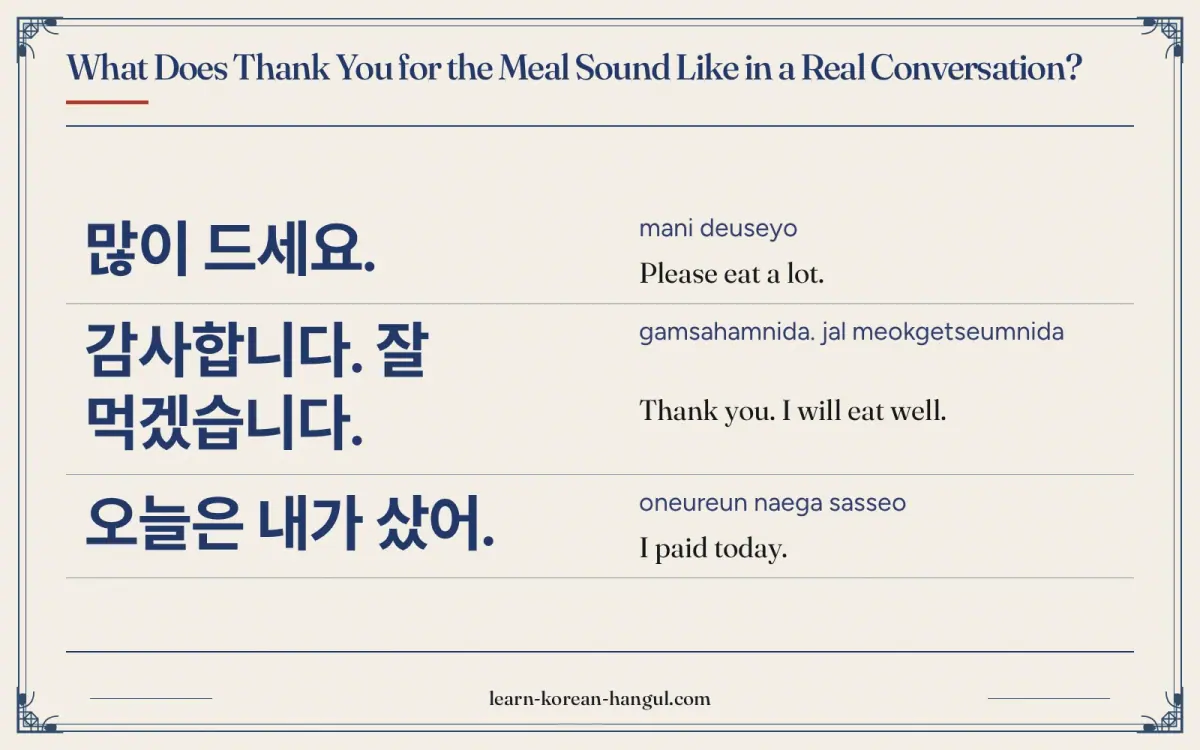
A Korean meal exchange has a rhythm: the host invites, the guest says the before-meal phrase, and at the end the guest says the after-meal phrase.
A Dinner with Your Boss
Boss
많이 드세요.
mani deuseyo
Please eat a lot.
Employee
감사합니다. 잘 먹겠습니다.
gamsahamnida. jal meokgetseumnida
Thank you. I will eat well.
Employee
정말 맛있었습니다. 잘 먹었습니다.
jeongmal masisseotseumnida. jal meogeotseumnida
It was really delicious. Thank you for the meal.
What to notice: the boss uses 드세요, the honorific of 먹다. The employee never uses 먹다 for the boss, only for himself.
Friends after Lunch
Min
오늘은 내가 샀어.
oneureun naega sasseo
I paid today.
Yuna
잘 먹었어. 고마워.
jal meogeosseo. gomawo
Thanks for the meal. Thank you.
Min
응, 다음엔 네가 사.
eung, daeumen nega sa
Yes, you pay next time.
What to notice: friends use the casual form and tease about who pays next. Thanks and reciprocity go together.
At a Grandmother's Table
Grandmother
많이 먹어.
mani meogeo
Eat a lot.
Yuna
네, 할머니. 잘 먹겠습니다.
ne, halmeoni. jal meokgetseumnida
Yes, Grandma. I will eat well.
What to notice: the grandmother speaks casually to her grandchild, but Yuna answers with the formal phrase, which leads to the culture around the table.
What Should You Know about the Culture behind Thank You for the Meal?
At a Korean table, the meal phrases show respect for the person who prepared or paid for the food. The words come with manners.
- Wait for the eldest. The eldest person at the table usually starts, and the others follow after saying 잘 먹겠습니다.
- Say it to the host, not the food. The phrase is aimed at the person who cooked, invited or paid, not at the dishes.
- Say it twice. One phrase before eating and one after is the usual rhythm, and a short comment on the taste is welcome.
- The host's reply. The host often answers 맛있게 드세요 (enjoy your meal) before and 많이 드셨어요? (did you eat plenty?) afterwards.
- Restaurant staff. Many diners say 잘 먹었습니다 at the door as thanks to the staff.
An expert tip: 잘 먹겠습니다 is often translated as bon appétit, but it is not the same. Bon appétit is said to the eaters by the host, while 잘 먹겠습니다 is said by the eater to the host. The host's phrase is 맛있게 드세요, covered in enjoy your meal in Korean. This page covers everyday meals. Etiquette for ceremonial dinners, drinking customs and business banquets is not covered here.
What Mistakes Do Learners Make with Thank You for the Meal in Korean?
Most mistakes with these phrases come from timing, level or using a plain thank you.
| Mistake | Why it is a problem | Fix |
|---|---|---|
| Saying only 감사합니다 at the table | Polite, but skips the meal ritual | Say 잘 먹겠습니다 and 잘 먹었습니다 |
| Saying 잘 먹겠습니다 after eating | -겠- looks forward in time | Use 잘 먹었습니다 after the meal |
| Saying 맛있게 드세요 as your thanks | That is the host's phrase to the guest | Use 잘 먹겠습니다 |
| Saying 잘 먹었어 to a boss or elder | Casual ending | Use 잘 먹었습니다 or 잘 먹었어요 |
| Pronouncing 먹겠 with a plain g, as [먹겓] | The ㄱ after the stop in 먹 must be tense | Say [먹껟] with a closed stop |
Learners often think a plain thank you is always safe. At a meal where someone treats you, 잘 먹겠습니다 and 잘 먹었습니다 are the safer choice, because they show you understand the table ritual.
Is It the Same as Thank You for the Food?
Mostly yes. Korean has no separate phrase for food and meal. The short answers below cover the other ways people search for this phrase.
- Thank you for the food in Korean: 잘 먹겠습니다 before and 잘 먹었습니다 after.
- Thanks for the meal or thanks for the food in Korean: 잘 먹었어 with friends, 잘 먹었어요 in polite speech.
- Thank you for the meal formal in Korean: 잘 먹었습니다, or 감사히 먹겠습니다 (gamsahi meokgetseumnida), "I will eat gratefully", before the meal.
- Bon appetit in Korean: the host says 맛있게 드세요; the guest says 잘 먹겠습니다.
- I will eat well in Korean: the literal meaning of 잘 먹겠습니다.
Reading the forms is one thing; producing them on cue is another, so practise now.
Practice: Say It Aloud
Play the slow clip of 잘 먹겠습니다, repeat it three times, then try 잘 먹었습니다 and 잘 먹었어. Then choose a phrase for each situation. Answers follow.
- Your boss has just ordered food for the table.
- You finish a lunch that your friend paid for.
- You are leaving a restaurant and want to thank the staff.
- Why does 먹겠습니다 sound like [먹껟씀니다]?
Answers
- 잘 먹겠습니다.
- 잘 먹었어.
- 잘 먹었습니다.
- The ㄱ and ㅅ become tense after stop sounds, and ㅂ turns into ㅁ before ㄴ.
The phrase flashcards drill all four forms with audio.
Related Phrases to Learn Next
The meal phrases sit with other table and thanks phrases.
- Enjoy your meal in Korean: 맛있게 드세요, the host's phrase.
- Delicious in Korean: 맛있어요, the comment that follows the meal.
- Thank you in Korean: 감사합니다 and 고마워 for other situations.
- I'm full in Korean: 배불러요, for when you cannot eat more.
This guide belongs to the polite Korean phrases collection. What this page does not cover: drinking customs and formal banquet rules. Pick 잘 먹겠습니다 before and 잘 먹었습니다 after, and you can thank for the meal in Korean at almost any table.
Frequently Asked Questions
What is the difference between 잘 먹겠습니다 and 잘 먹었습니다?
잘 먹겠습니다 means "I will eat well" and is said before the meal. 잘 먹었습니다 means "I ate well" and is said after. Both are formal and thank the host. The difference is timing: -겠- looks forward, while -었- marks the past. Say both for the best manners.
Is 잘 먹겠습니다 formal or casual?
It is formal. The ending -ㅂ니다 belongs to the formal speech level (합쇼체). With friends, the casual before-meal form is 잘 먹을게, and the polite form is 잘 먹을게요. After the meal, friends say 잘 먹었어 and the polite form is 잘 먹었어요. Use the formal pair with hosts and elders.
Can I use 잘 먹겠습니다 with friends, elders and strangers?
Yes with elders, hosts and bosses, where it is expected. With close friends it can sound stiff, so use 잘 먹을게. You say it to someone who cooked, hosted or paid, so at a restaurant where you pay yourself it is optional.
How do you pronounce 잘 먹겠습니다?
It is pronounced [잘 먹껟씀니다]. The ㄱ in 겠 and the ㅅ in 습 are said tense, and the ㅂ in 습 sounds like ㅁ. Say six even syllables and close your lips on the final m. Revised Romanization writes jal meokgetseumnida. Practise the slow clip first, then speed up to a natural pace.
What is the most common mistake with thank you for the meal in Korean?
The most common mistake is using only 감사합니다 and skipping the meal phrases. The second is saying 잘 먹겠습니다 after eating. Say 잘 먹겠습니다 before the food and 잘 먹었습니다 after, and use the formal forms with elders. Also remember to say the phrase to the host, not to the food.