How Do You Say Come in in Korean?
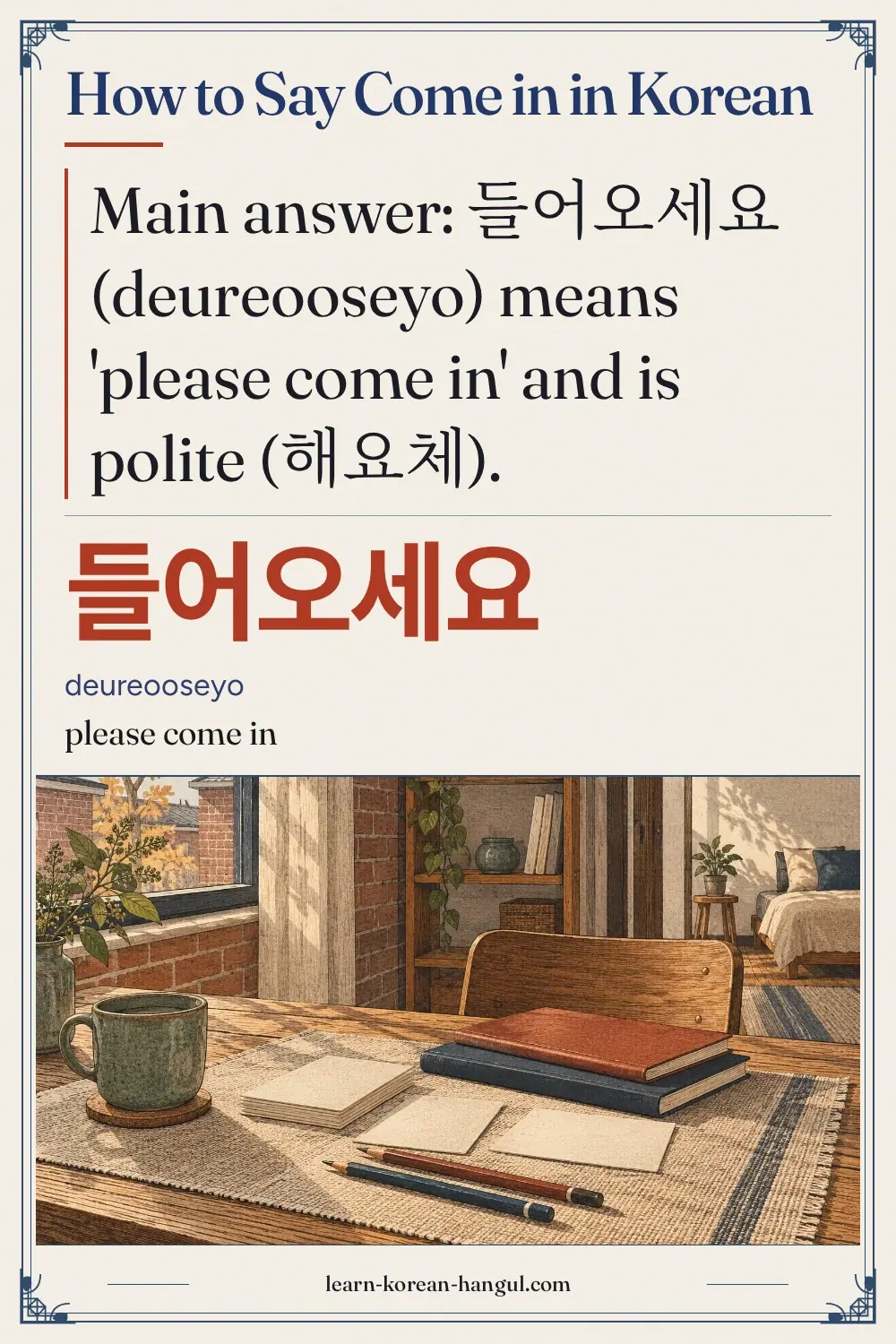
The standard polite way to say come in in Korean is 들어오세요 (deureooseyo). The phrase is built from the verb 들어오다 (deureooda, "to come in"), the honorific marker -(으)시- and the polite ending -요. Together they invite a guest politely, whether the guest stands at a door or knocks on it.
Four forms cover most doorways.
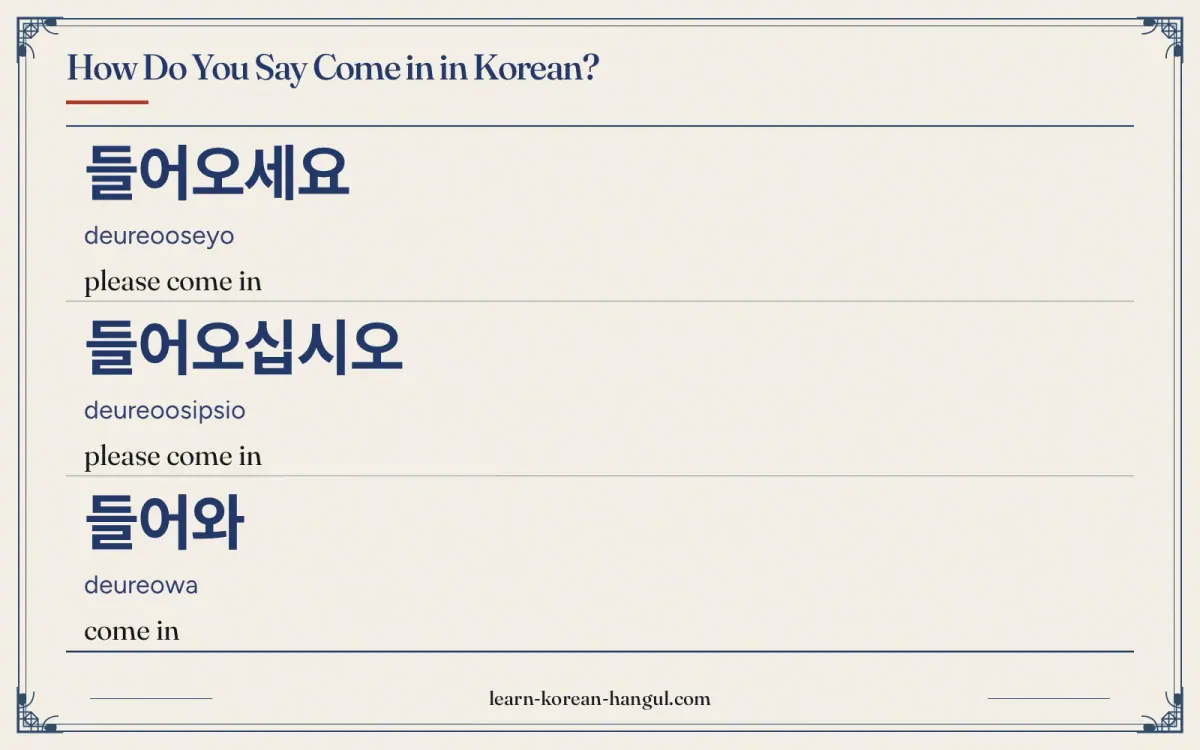
| Korean | Revised Romanization | Meaning | Register |
|---|---|---|---|
| 들어오세요 | deureooseyo | please come in | polite (해요체) |
| 들어오십시오 | deureoosipsio | please come in | formal (합쇼체) |
| 들어와 | deureowa | come in | casual (해체) |
| 안으로 들어오세요 | aneuro deureooseyo | please come on inside | polite, inviting |
Revised Romanization (the South Korean government standard of 2000) is a reading aid only. The Hangul is the real spelling. The next section shows how the four forms differ by guest.
What Are the Formal, Polite and Casual Ways to Say Come In?
Every Korean invitation chooses one of three levels, and the Korean speech levels explain the whole system. For "come in," the level is set by the guest's age and rank. Hosts rarely say the casual form to someone older, and the formal form is kept for ceremonies and notices.
Polite: 들어오세요 (deureooseyo)
들어오세요 means "please come in" and is the form you will use and hear most. It suits visitors, coworkers, neighbours and older relatives. A host can say it at the door of a home, an office or a shop.
Example: 어서 오세요. 들어오세요. (eoseo oseyo. deureooseyo.) "Welcome. Please come in."
Formal: 들어오십시오 (deureoosipsio)
들어오십시오 means "please come in" in the formal style (합쇼체). It appears on signs, in announcements and in very respectful speech, such as a receptionist inviting a visitor into a manager's office. The ending -십시오 is the formal request ending.
Example: 사장님, 들어오십시오. (sajangnim, deureoosipsio.) "Please come in, sir." (사장님 is the title for a company head or business owner.)
Casual: 들어와 (deureowa)
들어와 means "come in" and has no 요, which makes it casual. Friends, siblings and younger people hear it. The sentence is short and warm, and it is rude to an elder.
Example: 문 열려 있어. 들어와. (mun yeollyeo isseo. deureowa.) "The door is open. Come in."
Polite: 안으로 들어오세요 (aneuro deureooseyo)
안으로 들어오세요 means "please come on inside." The added 안으로 (aneuro, "to the inside") makes the invitation more inviting, which helps when a guest hesitates at the threshold. The word order matters: 안으로 comes first, and 들어오세요 follows.
Example: 안으로 들어오세요. 앉으세요. (aneuro deureooseyo. anjeuseyo.) "Please come inside. Please sit."
Choosing a Form by Guest
The table gives one clear choice per guest.
| Guest | Best choice | Why |
|---|---|---|
| Stranger, customer | 들어오세요 | polite and safe |
| Older relative or teacher | 들어오세요 | respectful |
| Manager at an office door | 들어오십시오 | formal |
| Friend, sibling, younger person | 들어와 | casual |
| Hesitant guest | 안으로 들어오세요 | extra welcome |
When two guests are present, speak to the one with higher rank. Once the form is chosen, the next step is the sound.
How Do You Pronounce 들어오세요?
들어오세요 is pronounced [드러오세요], roughly "deu-reo-o-se-yo," with five syllables and a smooth join in the middle. Play the slow clip, then the normal clip, and repeat each one aloud.
| Syllable group | Spelled | Spoken | Revised Romanization |
|---|---|---|---|
| 들어 | 들-어 | [드러] | deureo |
| 오세요 | 오-세-요 | [오세요] | oseyo |
What Sound Change Happens in 들어오세요?
One sound change appears. The final ㄹ of 들 moves to the empty ㅇ of 어, so the two syllables sound like [드러]. The Standard Pronunciation Rules (표준 발음법) of the National Institute of Korean Language (국립국어원) call this liaison (연음), and Article 13 describes it. Spelled out, 들 + 어 becomes "deu-reo," not "deul-eo." The page on liaison lists more examples.
In Revised Romanization, the vowels 어 and 오 sit side by side, which gives "deureoo-seyo" with "eoo" in the middle. The reading looks odd in Latin letters, but in Hangul it is simply 어 followed by 오, and the clip sounds smooth. With the sound clear, the next question is when to use the phrase.
When Should You Use 들어오세요, and When Should You Not?
Say 들어오세요 when someone knocks or stands at the door, and combine it with 앉으세요 (anjeuseyo, "please sit") to invite them to sit. The phrase invites someone to enter a room or a home. For a general welcome, the phrase welcome in Korean is a better match.
Situations Where 들어오세요 Fits
- A knock at the door. At home or in an office, say 들어오세요 as soon as you hear the knock.
- A guest standing at the threshold. Add 안으로 to make the invitation warmer.
- A visitor to a shop or studio. Use 들어오세요 as a polite alternative to waiting in silence.
Situations to Avoid with 들어오세요
- Using 오세요 alone. Saying 오세요 for "come in" is the main trap, because 오세요 only means "come": it asks someone to come to you, not to step inside.
- Using 들어와 with an elder. The casual form is rude to a teacher, a boss or a grandparent.
- Using the formal 들어오십시오 with a friend. The formal form sounds like a joke or a stage line.
How Do You Say Do Not Come In?
To ask someone to stay out, replace the verb ending with -지 마세요: 들어오지 마세요 (deureooji maseyo), "please do not come in." The phrase is firm, so many people soften it with 죄송한데요 (joesonghandeyo, "excuse me, but...") or with a reason, such as 지금 회의 중이에요 (jigeum hoeui jungieyo, "we are in a meeting now"). A plain refusal without a reason can sound sharp.
When unsure, use 들어오세요. The dialogues below show the phrase in place.
What Does Come in Sound Like in a Real Conversation?
Read each dialogue, play the clip, and say one role aloud.
Dialogue 1: A knock at an office door
- A: 똑똑똑. (ttokttokttok.) "Knock knock knock."
- B: 네, 들어오세요. (ne, deureooseyo.) "Yes, please come in."
- A: 실례합니다. (sillyehamnida.) "Excuse me (for coming in)."
똑똑똑. 네, 들어오세요. 실례합니다.
Dialogue 2: A friend arrives at a home
- A: 어서 와. 들어와. (eoseo wa. deureowa.) "Welcome. Come in."
- B: 응, 고마워. (eung, gomawo.) "Yeah, thanks."
어서 와. 들어와. 응, 고마워.
In Dialogue 1, the visitor says 실례합니다 (sillyehamnida), a polite phrase that literally says "I am being discourteous" and is used when stepping into someone's room. The guide to excuse me in Korean covers related phrases. In Dialogue 2, both friends use the casual forms, and 어서 와 (eoseo wa) is the casual "welcome." A custom at the door adds one more thing to know.
What Should You Know about the Culture behind Come In?
At a Korean home, the host often adds 신발 벗으세요 (sinbal beoseuseyo, "please take off your shoes") or points to slippers, since shoes stay at the entrance. A guest steps out of the shoes, leaves them at the door and walks in on the floor in socks or slippers. The sentence 들어오세요 is the invitation, and the shoes are the first custom of entering.
Many Korean hosts will also say 편하게 앉으세요 (pyeonhage anjeuseyo, "please sit comfortably") after the invitation, and offer a drink. Accepting a first offer politely is normal, and a small thank-you such as 감사합니다 (gamsahamnida) is welcome. The guide to thank you in Korean explains its forms. The same door also trips up learners, as the next section shows.
What Mistakes Do Learners Make with Come in in Korean?
Learners most often use 오세요 alone for "come in," which means "come." Five mistakes appear again and again:
- Saying 오세요 for "come in." Fix: use 들어오세요, with 들어 for "into."
- Using 들어와 with an elder. Fix: say 들어오세요 instead.
- Dropping the liaison. Saying "deul-eo" in two hard pieces sounds like reading. Fix: say [드러].
- Forgetting the shoes. Walking in without taking shoes off is a social slip. Fix: wait for 신발 벗으세요, or check the entrance.
- Using 들어오세요 where a welcome is meant. Fix: use 어서 오세요 ("welcome") for a general greeting at a shop.
All five come from translating word by word. Several related searches ask the same thing in other words, so they are answered next.
Short Answers on Come in Please, Come inside and Enter
Four searches lead to this page, so each gets a short answer.
- Come in please in Korean: 들어오세요 already includes the polite request, so the word "please" has no separate Korean word here.
- Please come in in Korean: The same phrase, 들어오세요, is the answer. For a more formal "please come in," use 들어오십시오.
- Come inside in Korean: Add 안으로: 안으로 들어오세요.
- Enter in Korean: The verb is 들어가다 (deureogada, "to go in"), as in a sign reading 들어가지 마세요 (deureogaji maseyo, "do not enter").
The difference between 들어오다 and 들어가다 matters: 들어오다 means coming in toward the speaker, and 들어가다 means going in away from the speaker. After the answers, practice is next.
Related Phrases to Learn Next
Three pages follow the same layout and pair well with this one:
- Welcome in Korean: the greeting for a shop or a home.
- Thank you in Korean: the reply a guest gives.
- Excuse me in Korean: the phrase for entering and passing.
The complete list sits in the Korean greetings cluster.
Practice: Say It Aloud
Spend five minutes on this routine.
- Play the slow clip of 들어오세요 and repeat it three times, keeping 드러 joined and letting the pitch fall gently at the end, as in a friendly invitation.
- Say 들어오세요, 들어오십시오 and 들어와, and name the guest each one fits.
- Say 어서 오세요. 들어오세요. 앉으세요. as if welcoming a guest.
- Hide the Romanization with the toggle and read the four forms from Hangul only.
- Drill the cluster with the phrase flashcards.
When the phrase comes out smoothly, you can say come in in Korean in the right form for each guest.
Frequently Asked Questions
The answers below add details about how to say come in in Korean beyond the sections above.
What is the difference between 들어오세요 and 오세요?
들어오세요 means "please come in," with 들어 meaning "into." 오세요 means only "please come," so it asks the listener to come toward you without saying where. Use 들어오세요 at a door and 오세요 when you call someone over from across a room.
What is the difference between 들어오세요 and 들어오십시오?
Both mean "please come in." 들어오세요 is polite (해요체) and fits most daily situations. 들어오십시오 is formal (합쇼체) and fits signs, announcements and very respectful speech, such as a receptionist inviting a visitor into a manager's office. Between the two, polite speech is the default for guests.
Is 들어오세요 formal or casual?
들어오세요 is polite, in the 해요체 style, between formal and casual. The formal version is 들어오십시오, and the casual version is 들어와. Pick the ending by the age and rank of the guest rather than by the room, and use 들어오세요 whenever you are unsure of the relationship.
Can I use 들어오세요 with friends, elders and strangers?
With elders and strangers, 들어오세요 is the right choice. With close friends and younger people, the casual 들어와 sounds warmer. Never use 들어와 with a teacher, a boss or a grandparent, because dropping the 요 is rude to someone senior.
How do I reply when someone says 들어오세요?
Say 감사합니다 (gamsahamnida, "thank you") or 실례합니다 (sillyehamnida, "excuse me") as you step in, with a small nod. In a home, add 신발은 어디에 둘까요? (sinbareun eodie dulkkayo, "where shall I put my shoes?") if you are unsure about the entrance.
What is the most common mistake with come in in Korean?
Learners use 오세요 alone for "come in," which means only "come." The fix is 들어오세요, with 들어 for "into," so the listener knows to cross the threshold. A second common mistake is using the casual 들어와 with an elder, which sounds rude even when the tone is friendly.