How Do You Say Get Well Soon in Korean?
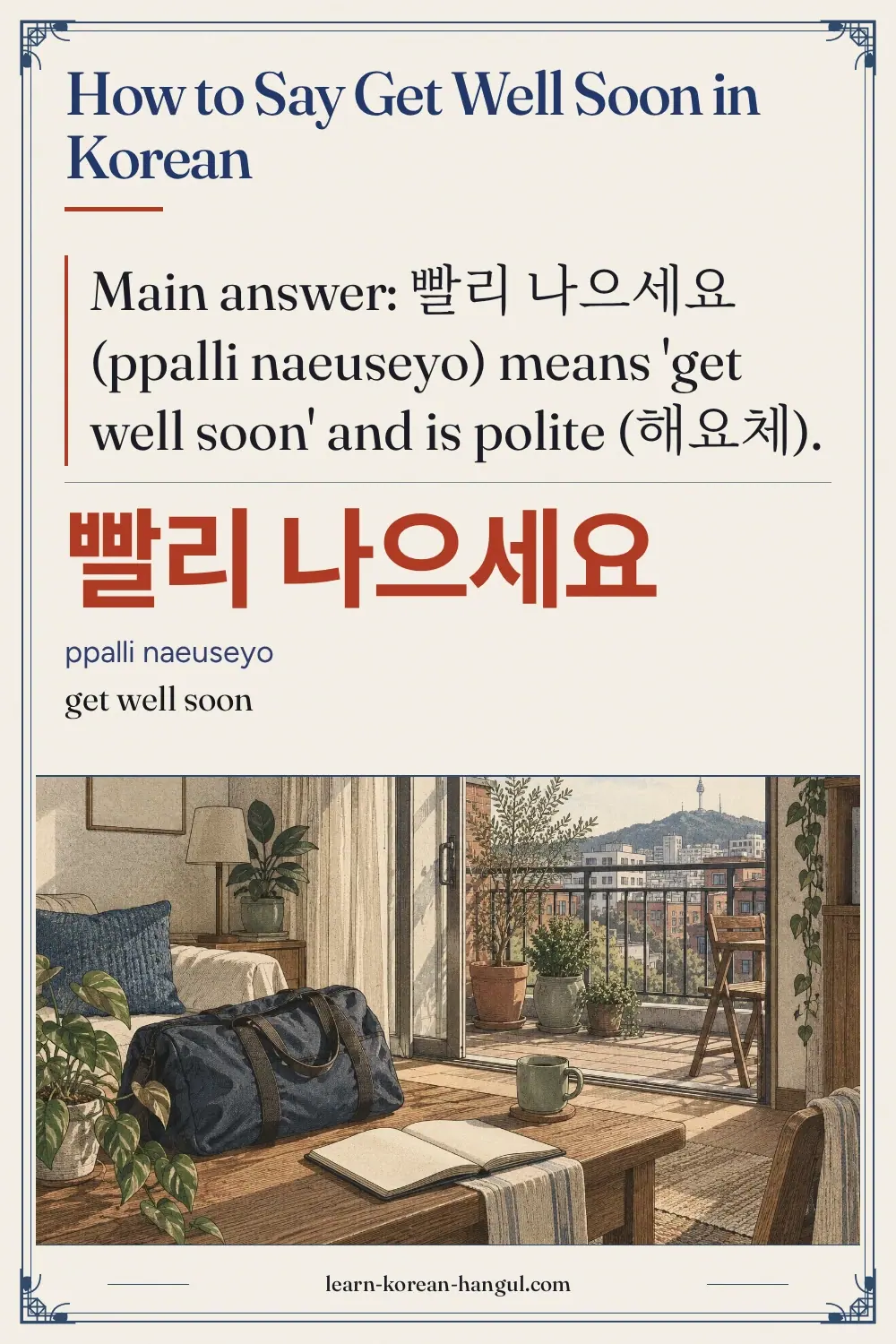
The standard polite way to say get well soon in Korean is 빨리 나으세요 (ppalli naeuseyo). The phrase has three parts: 빨리 (ppalli, "quickly"), 나 (na, the stem of 낫다 after its ㅅ drops) and 으세요 (euseyo, the polite honorific request ending). Together they ask the listener to recover quickly.
The verb is the interesting part. 낫다 is a ㅅ-irregular verb: its ㅅ drops when a vowel follows. So 낫 + 으세요 becomes 나으세요, and 낫 + 아요 becomes 나아요. Before a consonant the ㅅ stays, as in 낫습니다 (natseumnida). The guide to ㅅ-irregular verbs lists the other verbs that behave the same way.
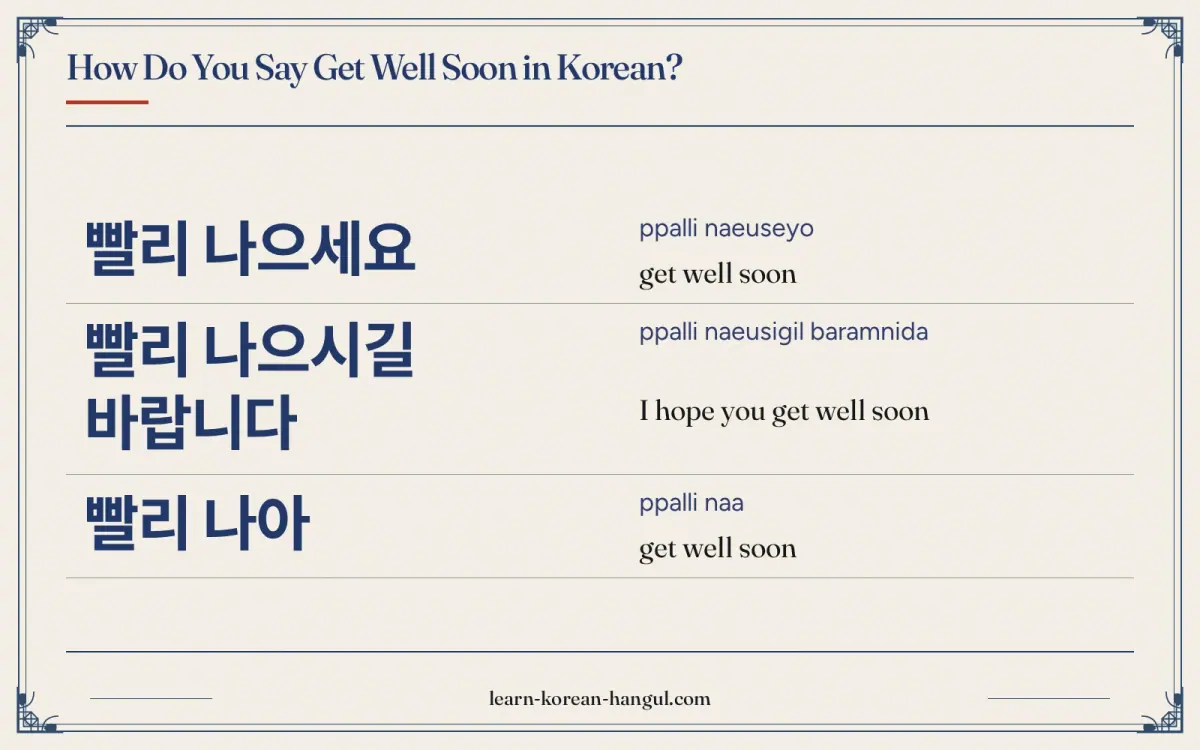
Four forms cover most situations.
| Korean | Revised Romanization | Meaning | Register |
|---|---|---|---|
| 빨리 나으세요 | ppalli naeuseyo | get well soon | polite (해요체) |
| 빨리 나으시길 바랍니다 | ppalli naeusigil baramnida | I hope you get well soon | formal (합쇼체) |
| 빨리 나아 | ppalli naa | get well soon | casual (해체) |
| 쾌유를 빕니다 | kwaeyureul bimnida | I wish you a speedy recovery | formal, cards and messages |
Revised Romanization (the South Korean government standard of 2000) is a reading aid only. The Hangul is the real spelling. The next section shows who each form fits.
What Are the Formal, Polite and Casual Ways to Say Get Well Soon?
Korean changes the sentence ending to match the listener, and the Korean speech levels explain how. A wish for someone's health is also a sign of respect, so the honorific ending -(으)세요 is the default for anyone older or senior to you.
Polite: 빨리 나으세요 (ppalli naeuseyo)
빨리 나으세요 is the form to learn first. It suits a coworker, a teacher, a neighbour, a friend's parent or an older relative. The honorific 으세요 shows respect for the person who is ill.
Example: 감기 걸리셨다고 들었어요. 빨리 나으세요. (gamgi geollisyeotdago deureosseoyo. ppalli naeuseyo.) "I heard you caught a cold. Get well soon."
Formal: 빨리 나으시길 바랍니다 (ppalli naeusigil baramnida)
빨리 나으시길 바랍니다 means "I hope you get well soon" and uses the formal ending -ㅂ니다 (합쇼체). It appears in messages to a client, in a company notice or in a speech. In a card, the shorter 쾌유를 빕니다 (kwaeyureul bimnida) is common. Adding 빠른 (ppareun, "quick") gives 빠른 쾌유를 빕니다.
Example: 빨리 나으시길 바랍니다. 푹 쉬십시오. (ppalli naeusigil baramnida. puk swisipsio.) "I hope you get well soon. Please rest well."
Casual: 빨리 나아 (ppalli naa)
빨리 나아 drops the honorific and the 요, which makes it casual (해체). Friends, partners, siblings and younger people hear it. A common variant is 얼른 나아 (eolleun naa), with 얼른 meaning "quickly, soon."
Example: 빨리 나아. 푹 쉬어. (ppalli naa. puk swieo.) "Get well soon. Get some rest."
Choosing a Form by Listener
The table gives one clear choice per situation.
| Situation | Best choice | Why |
|---|---|---|
| Client, company notice, speech | 빨리 나으시길 바랍니다 | formal and respectful |
| Get-well card | 쾌유를 빕니다 | standard written wording |
| Coworker, teacher, older relative | 빨리 나으세요 | polite and honorific |
| Friend, partner, sibling | 빨리 나아 | warm and casual |
Once the choice is clear, the next step is to hear the words.
How Do You Pronounce 빨리 나으세요?
빨리 나으세요 is pronounced [빨리 나으세요], roughly "ppal-li na-eu-se-yo," with six syllables in two word groups. Play the slow clip, then the normal clip, and repeat each one aloud.
| Word | Spelled | Spoken | Revised Romanization |
|---|---|---|---|
| 빨리 | 빨-리 | [빨리] | ppalli |
| 나으세요 | 나-으-세-요 | [나으세요] | naeuseyo |
| 바랍니다 | 바-랍-니-다 | [바람니다] | baramnida |
What Sound Changes Happen in the Get-Well Phrases?
The first sound is the tense consonant ㅃ, written with a doubled letter. To say it, press the lips together, hold the pressure and release without a puff of air. The page on tensification compares plain, tense and aspirated sounds. The double ㄹ in 빨리 is pronounced as a long "l" sound, so the word is [빨리], with the tongue touching the ridge behind the upper teeth.
In 나으세요, the vowel ㅡ in 으 is unrounded. Keep the lips spread, as in a slight smile, and do not round them as for "oo." The ㅅ that belonged to 낫다 is gone, so the sounds run on as "na-eu-se-yo." Be careful not to insert a "s" sound between 나 and 으.
In the formal 바랍니다, the ㅂ of 랍 meets the ㄴ of 니, and the Standard Pronunciation Rules (표준 발음법) of the National Institute of Korean Language (국립국어원) turn the ㅂ into ㅁ. So the word is [바람니다]. Revised Romanization shows this change, so it writes baramnida. For intonation, the phrase falls gently, since it is a wish. With the sounds clear, the next question is when to say it.
When Should You Use 빨리 나으세요, and When Should You Not?
Use 빨리 나으세요 when the person is ill or hurt right now: a cold, a hospital stay, a broken leg. The phrase wishes a quick end to the trouble. For general good health, such as at New Year or a farewell, 건강하세요 (geonganghaseyo, "stay healthy") is the better wish.
Situations Where 빨리 나으세요 Fits
- A coworker is absent with a cold. Send a message: 빨리 나으세요.
- A friend's parent is in hospital. Say 빨리 나으시길 바랍니다 with a bow.
- A friend has a stomach bug. Say 빨리 나아, then 푹 쉬어.
Situations to Avoid
- A person who is only tired. Use 푹 쉬세요 (puk swiseyo, "rest well") instead.
- A serious or terminal illness. Quick-recovery wishes can feel empty. Ask how the person is, or say you are thinking of them.
- A senior in the casual form. 빨리 나아 is too familiar for a boss or a teacher.
If unsure, choose the polite form and keep the message short. The dialogues below show how it sounds.
What Does Get Well Soon Sound Like in a Real Conversation?
Read each dialogue, play the clip, and say one role aloud.
Dialogue 1: Coworkers at the office
- A: 오늘 몸이 안 좋아서 일찍 갈게요. (oneul momi an joaseo iljjik galgeyo.) "I don't feel well, so I'll leave early today."
- B: 네, 푹 쉬세요. 빨리 나으세요. (ne, puk swiseyo. ppalli naeuseyo.) "Yes, rest well. Get well soon."
- A: 고마워요. (gomawoyo.) "Thank you."
오늘 몸이 안 좋아서 일찍 갈게요. 네, 푹 쉬세요. 빨리 나으세요. 고마워요.
Dialogue 2: Two friends
- A: 나 감기 걸렸어. (na gamgi geollyeosseo.) "I caught a cold."
- B: 많이 아파? 얼른 나아. (mani apa? eolleun naa.) "Does it hurt a lot? Get well soon."
나 감기 걸렸어. 많이 아파? 얼른 나아.
In Dialogue 1, the speaker adds 푹 쉬세요, a practical wish, before the main phrase. The guide to take care in Korean covers that kind of line. In Dialogue 2, 많이 아파? is a question with a rising tone, while 얼른 나아 falls. To say that you are the one who is ill, see I'm sick in Korean. The phrase also connects to a custom.
What Should You Know about the Culture behind Get Well Soon?
Visiting a sick person, called 병문안 (byeongmunan, "hospital visit"), is a common way to show care. Visitors often bring fruit or a drink, and a short wish like 빨리 나으세요 is the usual goodbye at the bedside. When a visit is not possible, a message or a card with 쾌유를 빕니다 does the same job.
After surgery or childbirth, the usual wish is 몸조리 잘하세요 (momjori jalhaseyo, "take good care of yourself while you recover"). 몸조리 means looking after your body during recovery, so it is not used for a cold. For example, a coworker going home after an operation hears 몸조리 잘하세요.
Koreans also say 아프지 마세요 (apeuji maseyo, "please don't be sick") as a warm wish, even though 마세요 normally attaches to action verbs. It expresses love more than instruction, and friends often send it in messages. These customs explain several typical mistakes.
What Mistakes Do Learners Make with Get Well Soon in Korean?
The most common mistake is using 나아요 as the wish. Five mistakes appear again and again:
- Saying 빨리 나아요 as the wish. It can sound like a statement, and with a senior it lacks the honorific. Fix: say 빨리 나으세요.
- Writing 낫세요. The ㅅ drops before a vowel. Fix: 나으세요.
- Writing 낳으세요. 낳다 means "to give birth," and it sounds the same, [나으세요]. Fix: use 낫다 for recovery.
- Using 건강하세요 for an illness. It is a general wish. Fix: use 나으세요 when the person is sick now.
- Wishing recovery to someone who is only tired. The phrase assumes an illness. Fix: say 푹 쉬세요.
All five come from translating "get well soon" without the verb's behaviour. A few related searches ask the same thing in other words, so they are answered next.
Short Answers on Feel Better, Recover Soon and Speedy Recovery
Three searches lead to this page, so each gets a short answer.
- Feel better in Korean: Say 빨리 나으세요 for the wish, or 기분이 나아지길 바라요 (gibuni naajigil barayo, "I hope your mood gets better") for a low mood.
- Recover soon in Korean: Say 빨리 회복하세요 (ppalli hoebokaseyo), spoken [빨리 회보카세요]. The verb 회복하다 sounds a little more formal than 낫다.
- Speedy recovery in Korean: Write 빠른 쾌유를 빕니다 in a card or message.
To tell someone to rest, add 푹 쉬세요.
If the person caught a cold, the guide to I caught a cold in Korean shows what they might say.
Related Phrases to Learn Next
Three pages follow the same layout and pair well with this one:
- Take care in Korean: a general parting wish.
- I'm sick in Korean: how the patient can describe the problem.
- I caught a cold in Korean: a common reason to hear this phrase.
The complete list sits in the Korean celebration phrases cluster.
Practice: Say It Aloud
Spend five minutes on this routine.
- Play the slow clip of 빨리 나으세요 and repeat it three times, releasing the ㅃ without a puff of air.
- Say 빨리 나으세요, then 빨리 나아, and name the listener for each.
- Conjugate 낫다 aloud: 나아요, 나았어요, 나으세요, 낫습니다.
- Hide the Romanization with the toggle and read the four forms from Hangul only.
- Drill the cluster with the phrase flashcards.
When the verb comes out as a smooth "na-eu-se-yo," you can say get well soon in Korean with the right level of respect.
Frequently Asked Questions
The answers below add details about how to say get well soon in Korean beyond the sections above.
Why is it 나으세요 and not 낫세요?
The verb 낫다 ("to recover") is a ㅅ-irregular verb. Its ㅅ disappears when a vowel follows, so 낫 + 으세요 becomes 나으세요 and 낫 + 아요 becomes 나아요. Before a consonant, the ㅅ stays, as in 낫습니다 (natseumnida). So 낫세요 is not a correct form.
What is the difference between 빨리 나으세요 and 건강하세요?
빨리 나으세요 wishes a sick person a quick recovery. 건강하세요 (geonganghaseyo) wishes someone good health in general and is common at farewells, such as at New Year or when parting. Use 나으세요 when the person is ill now, and 건강하세요 when you only hope they stay well.
Is 빨리 나아 casual or rude?
It is casual (해체), not rude. Friends, partners, siblings and younger people hear it. Do not use it with a boss, a teacher or an older relative. Add the honorific and say 빨리 나으세요, because the honorific -(으)세요 shows respect for the sick person.
How do I reply when someone says 빨리 나으세요?
Say 고마워요 (gomawoyo, "thank you") or 감사합니다 (gamsahamnida), then add 푹 쉴게요 (puk swilgeyo, "I'll rest well") if you like. With a friend, 응, 고마워 (eung, gomawo) is enough. A short 걱정해 주셔서 감사합니다 also fits a boss or teacher.
Can I write 나으세요 as 낳으세요?
No. 낳다 (nata) means "to give birth," and 낫다 (natda) means "to recover." The two forms 낫 + 으세요 and 낳 + 으세요 sound the same, [나으세요], but only 나으세요 wishes someone well. Writing 낳으세요 changes the meaning, so check the spelling.
What is the most common mistake with get well soon in Korean?
Learners often use 나아요 as the wish. 나아요 is the plain polite form, so it can sound like a statement ("it gets better"), and it has no honorific. To wish someone well, use the honorific 나으세요 with a person you respect, or the casual 나아 with a close friend.