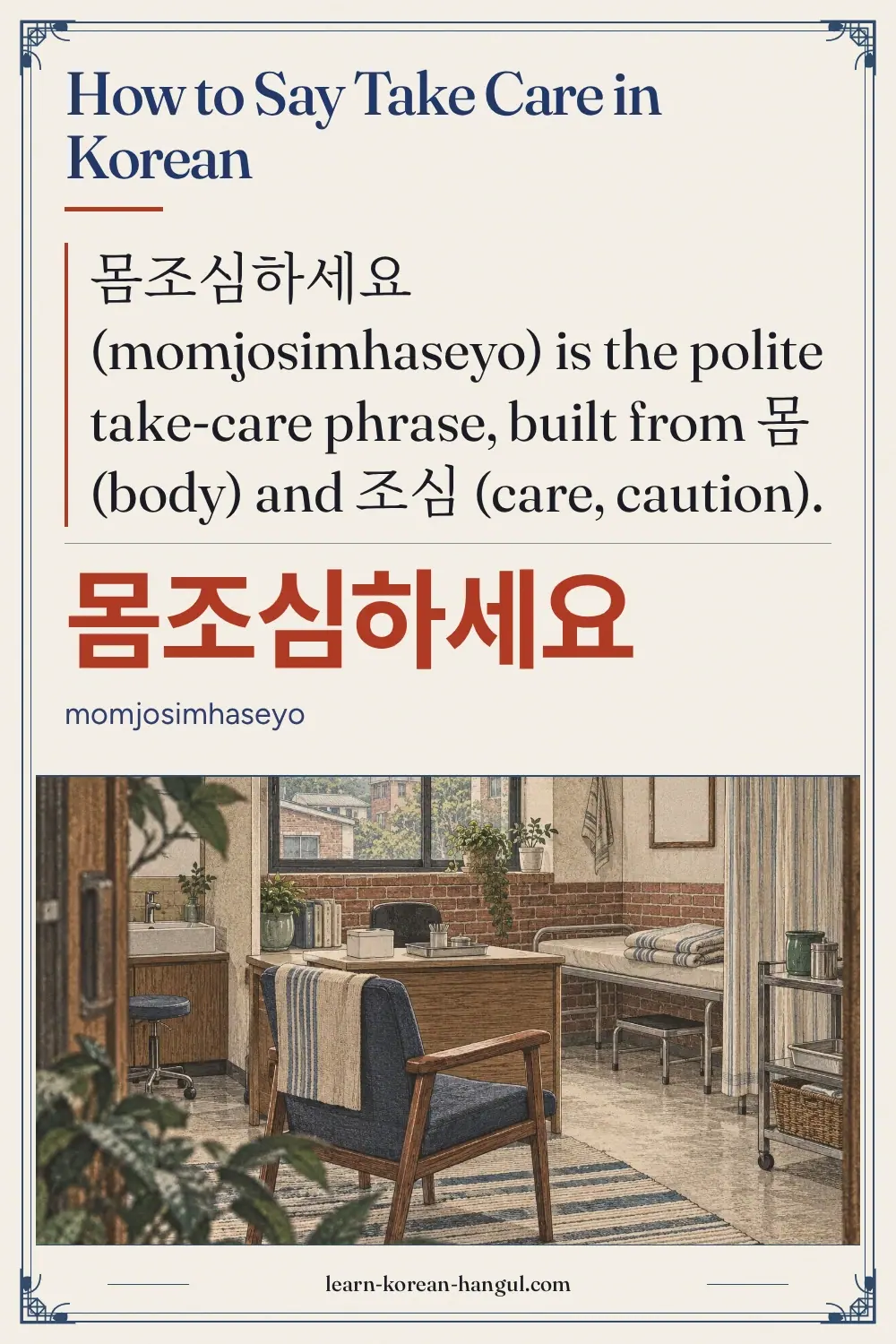
몸조심하세요
몸조심하세요
What you'll learn
- Say 몸조심하세요 aloud, with a closed-lips m at the end of 몸 and a soft ㅎ in 하세요.
- Choose between 몸조심하세요, 건강 조심하세요, 잘 지내세요 and 조심해 for different listeners.
- Tell 몸조심하세요 (take care of yourself) apart from 조심하세요 (watch out).
- Use the right phrase when someone is sick, travelling or leaving.
Before you start: you need to read Hangul; romanization is shown as an aid and can be hidden. Time: about 9 minutes. Audio plays only when you press a button.
How Do You Say Take Care in Korean?
The most natural way to say take care in Korean is 몸조심하세요. It uses the honorific ending -세요, so it is polite to nearly everyone. Korean has several take-care phrases, and each fits a different moment.
| Form | Romanization | Register | Say it to |
|---|---|---|---|
| 몸조심하세요 | momjosimhaseyo | Polite (해요체, honorific) | Elders, colleagues, strangers; someone sick or travelling |
| 건강 조심하세요 | geongang josimhaseyo | Polite (해요체, honorific) | Anyone; colds, seasons, busy periods |
| 잘 지내세요 | jal jinaeseyo | Polite (해요체, honorific) | Anyone you will not see for a while |
| 조심해 | josimhae | Casual (반말) | Close friends, family, younger people |
The table lists the options. The next section shows each one in a real sentence.
What Are the Formal, Polite and Casual Ways to Say Take Care?
Korean changes the sentence ending to match the listener's age, status and closeness, which are called speech levels. The guide to Korean speech levels explains them. The phrase for take care shifts with the ending but keeps the same warmth.
Polite: 몸조심하세요 (momjosimhaseyo)
Polite · 해요체몸조심하세요 combines 몸 (body) and 조심하다 (to be careful) with the honorific -세요. It is the standard phrase for a sick colleague, a relative leaving on a trip or anyone facing hard weather. It sounds caring without being formal.
날씨가 추워요. 몸조심하세요.
nalssiga chuwoyo. momjosimhaseyo
It's cold. Take care of yourself.
Polite: 건강 조심하세요 (geongang josimhaseyo)
Polite · 해요체건강 조심하세요 swaps 몸 (body) for 건강 (health). Koreans use it at a change of season, during flu season or when someone looks tired. It is a little more formal in tone than 몸조심하세요 and is common in messages and cards.
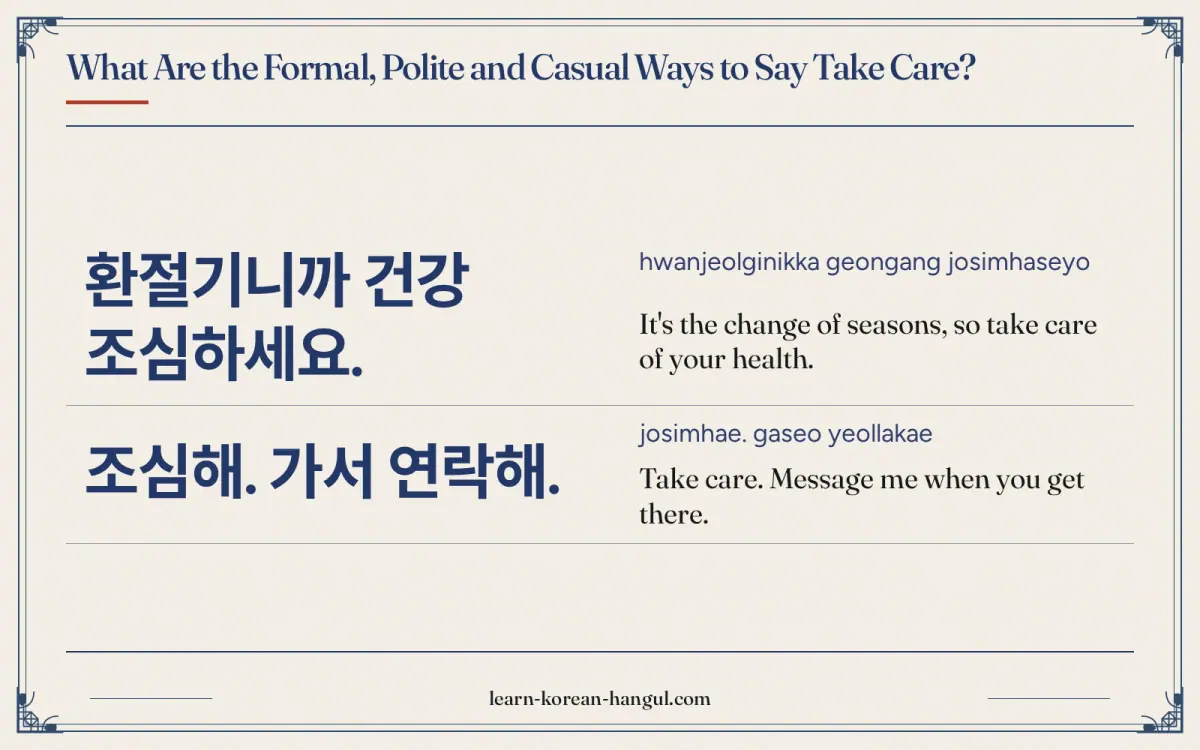
환절기니까 건강 조심하세요.
hwanjeolginikka geongang josimhaseyo
It's the change of seasons, so take care of your health.
Polite: 잘 지내세요 (jal jinaeseyo)
Polite · 해요체잘 지내세요 means "live well" or "be well". It is the take-care phrase for a farewell when you will not meet for weeks or months, such as before a move or a semester abroad. It looks forward to the person's life rather than guarding against danger.
다음에 또 만나요. 잘 지내세요.
daeume tto mannayo. jal jinaeseyo
See you again. Take care.
Casual: 몸조심해 (momjosimhae) and 조심해 (josimhae)
Casual · 반말몸조심해 is the casual form of the main phrase. 조심해 alone is also casual, and it can mean either "take care" or "be careful", so context decides. Close friends, siblings and younger people hear these forms. Parents also use them with children.
조심해. 가서 연락해.
josimhae. gaseo yeollakae
Take care. Message me when you get there.
Each phrase carries the same care at a different distance. Saying the main one cleanly comes next.
How Do You Pronounce 몸조심하세요?
몸조심하세요 is pronounced close to its spelling: momjosimhaseyo, in six syllables. The two points to watch are the closed-lips ㅁ and the soft ㅎ.
- 몸 (mom): the final ㅁ closes the lips; do not add a vowel after it.
- 조 (jo): a soft j and "oh".
- 심 (sim): "sheem" with a closing m.
- 하 (ha): a light breathy h.
- 세 (se): "seh".
- 요 (yo): "yoh", and finish with a gentle falling tone.
Sound Changes to Listen For
Two points from the National Institute of Korean Language Standard Pronunciation (표준 발음법) help here.
- Closed batchim ㅁ. The final ㅁ in 몸 and 심 closes the lips. Do not release it into a vowel.
- Weak ㅎ in 하세요. After ㅁ, as in 심하, and between vowels, ㅎ is said very lightly, and in fast speech it nearly disappears. This is covered under h-weakening.
- Romanization matches the sound. Revised Romanization writes momjosimhaseyo, which is close to the sound because no sound change alters the letters, so the romanized form is a reliable guide for this phrase.
With the sound set, the next question is who should hear which phrase.
When Should You Use 몸조심하세요, and When Should You Not?
Use 몸조심하세요 when you want to show care to someone sick, tired, travelling or leaving. Avoid it as a plain warning.
Situations Where It Fits
- A colleague with a cold. 몸조심하세요 or 건강 조심하세요 shows you noticed.
- A parent or grandparent in winter. 건강 조심하세요 in a phone call or message is common.
- Someone travelling or moving away. 잘 지내세요 for a long goodbye, and 몸조심하세요 for a trip.
- A friend heading home late. 조심해 and 가서 연락해 is natural.
Situations to Avoid
- A warning in the street. 조심하세요 alone means watch out, so it can sound like a warning of danger.
- The casual form with elders. 조심해 without -요 or -세요 skips the respect they expect.
- After someone gives bad news. A cheerful 잘 지내세요 may sound dismissive; use 몸조심하세요 or ask what they need.
These choices are easier to feel in real exchanges, so here are three.
What Does Take Care Sound Like in a Real Conversation?
A Korean take-care exchange is short and warm. The listener usually thanks you and answers with the same wish.
A Coworker Leaves on a Business Trip
Sumi
내일부터 출장이에요.
naeilbuteo chuljangieyo
I'm on a business trip from tomorrow.
Jun
그래요? 몸조심하세요.
geuraeyo? momjosimhaseyo
Really? Take care.
Sumi
네, 감사합니다. 잘 다녀올게요.
ne, gamsahamnida. jal danyeoolgeyo
Yes, thank you. I'll go and come back well.
What to notice: Sumi answers with 잘 다녀올게요, a set phrase for leaving on a trip.
Friends before a Trip
Min
나 내일 여행 가.
na naeil yeohaeng ga
I'm going on a trip tomorrow.
Yuna
조심해. 가서 연락해.
josimhae. gaseo yeollakae
Take care. Message me when you get there.
Min
응, 알았어.
eung, arasseo
Yes, got it.
What to notice: friends use the casual 조심해, and the message-me request is part of the care.
Calling a Grandmother
Yuna
할머니, 날씨가 추워졌어요. 건강 조심하세요.
halmeoni, nalssiga chuwojyeosseoyo. geongang josimhaseyo
Grandma, it has gotten cold. Take care of your health.
Grandmother
그래, 너도 몸조심해.
geurae, neodo momjosimhae
Yes, you take care too.
What to notice: the elder answers in casual speech, which is normal when speaking to someone younger. This habit points to the culture behind take care.
What Should You Know about the Culture behind Take Care?
Asking after someone's body is a common way to show closeness in Korean, so these phrases are about relationship as much as safety.
- Care for the body. Mentioning 몸 or 건강 shows you notice the person, and it often appears in messages and cards.
- Seasons and weather. Changes of season and cold snaps are standard moments to say 건강 조심하세요.
- Closing a message. Korean texts and emails often end with 몸조심하세요 or 건강하세요 (be healthy).
- Care before a parting. Friends pair 조심해 with 도착하면 연락해 (contact me when you arrive).
An expert tip: 몸조심 and 몸조리 (momjori) are different. 몸조심 is general caution for your health, while 몸조리 means recovering after illness or childbirth. This page covers everyday goodbyes; written wishes on cards, the full health vocabulary and sick-room phrases are not covered here.
What Mistakes Do Learners Make with Take Care in Korean?
Most mistakes come from using 조심하세요 alone or from picking the wrong level.
| Mistake | Why it is a problem | Fix |
|---|---|---|
| Saying 조심하세요 to mean take care | It usually means watch out | Use 몸조심하세요 or 건강 조심하세요 |
| Saying 조심해 to an elder | Casual ending | Use 몸조심하세요 |
| Saying 잘 지내세요 to someone you see tomorrow | It sounds like a long goodbye | Use 내일 봬요 or 조심히 가세요 |
| Adding a vowel after the ㅁ of 몸 | The batchim should close the lips | Say mom, not mo-mu |
| Confusing 몸조심 with 몸조리 | 몸조리 is recovery care | Use 몸조리 only after illness or childbirth |
Learners often think a longer phrase is more polite. For a quick goodbye, the short 몸조심하세요 is enough and sounds more natural than a long wish.
Is Take Care the Same as Stay Safe or Be Careful?
Partly. The short answers below cover the other ways people search for this phrase.
- Take care formal in Korean: 몸조심하세요 or 건강 조심하세요.
- Take care of yourself in Korean: 몸 챙기세요 (mom chaenggiseyo) means "look after yourself" and is common in messages.
- Stay safe in Korean: 조심히 가세요 (josimhi gaseyo) to someone leaving, and 안전하세요 is less common in everyday speech.
- Be careful in Korean: 조심하세요 (josimhaseyo), used to warn someone about a hazard such as a wet floor.
Reading the forms is one thing; producing them on cue is another, so practise now.
Practice: Say It Aloud
Play the slow clip of 몸조심하세요, repeat it three times, then try 건강 조심하세요 and 조심해. Then choose a form for each situation. Answers follow.
- A colleague has a bad cold.
- Your friend is leaving for a long trip abroad.
- Your grandmother says it is getting colder.
- Which phrase means watch out?
Answers
- 몸조심하세요.
- 잘 지내 or 조심해, with 가서 연락해 added.
- 건강 조심하세요.
- 조심하세요 (josimhaseyo), without 몸.
The phrase flashcards drill all four forms with audio.
Related Phrases to Learn Next
Take care sits among the phrases learners use for partings and good wishes.
- Goodbye in Korean: 안녕히 가세요 and 안녕히 계세요 for leaving.
- Get well soon in Korean: wishes for someone who is ill.
- Have a safe trip in Korean: wishes for travellers.
- I'm fine in Korean: a common reply when someone asks about your health.
This guide belongs to the Korean greetings collection. What this page does not cover: written health wishes and hospital vocabulary. Pick 몸조심하세요 when in doubt, and you can say take care in Korean to almost anyone.
Frequently Asked Questions
What is the difference between 몸조심하세요 and 건강 조심하세요?
Both mean take care. 몸조심하세요 is warm and everyday, built on 몸 (body), and fits sickness, travel and farewells. 건강 조심하세요 is slightly more formal, built on 건강 (health), and fits seasons, busy periods and messages. Either one is polite enough for elders.
Is 몸조심하세요 formal or casual?
It is polite, in the 해요체 style with the honorific -세요. It is neither the stiff formal style nor casual speech, so it works with elders, colleagues and strangers. For close friends, drop the honorific and say 몸조심해. Use it when you want to sound caring rather than stiff.
Can I use 몸조심하세요 with friends, elders and strangers?
Yes for elders and strangers. With close friends it sounds a little formal, so say 몸조심해 or 조심해. With strangers it is best when you know something about their situation, such as a cold, a trip or a hard winter.
How do you pronounce 몸조심하세요?
It is pronounced close to its spelling, momjosimhaseyo. Close your lips for the final m of 몸 and 심, and say the ㅎ in 하 very lightly. Keep six even syllables and let your voice fall gently on 요. The Revised Romanization is a reliable guide here.
What is the most common mistake with take care in Korean?
The most common mistake is saying 조심하세요 alone, which usually means watch out. Add 몸 for take care of yourself. The second mistake is using 조심해 with someone older. For elders, always keep -세요. For a parting with a friend, 조심해 plus 가서 연락해 sounds natural.