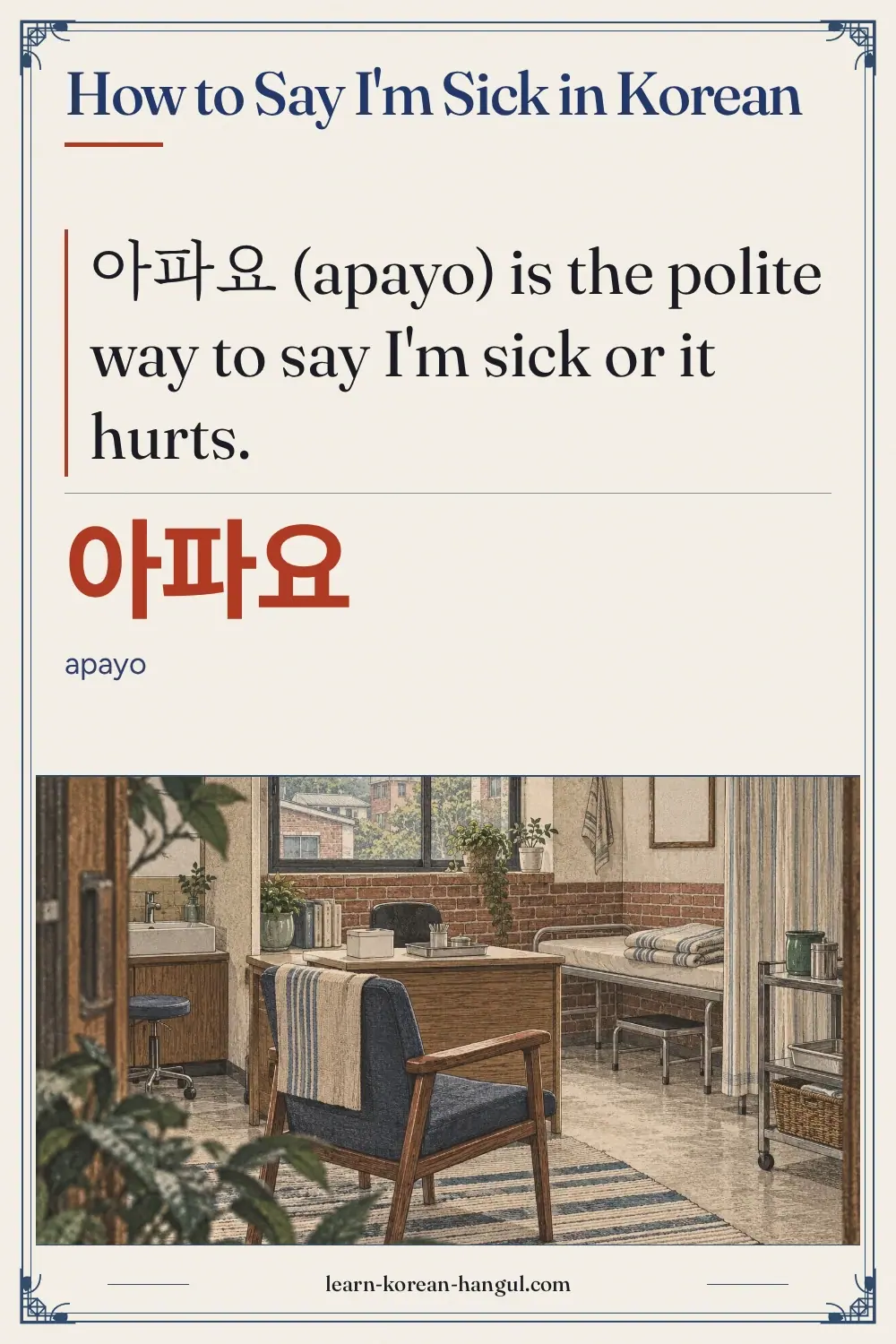
아파요
아파요
What you'll learn
- Say I'm sick with 아파요, 아파 or 아픕니다, depending on the listener.
- Name the part of the body that hurts, and use 몸이 안 좋아요 for a general bad feeling.
- Understand why 아프- becomes 아파-.
- Pronounce 아픕니다 as [아픔니다] and 몸이 안 좋아요 as [모미 안 조아요].
Before you start: you only need to read Hangul. If you have one specific pain, learn I have a headache in Korean. Time: about 10 minutes. Audio plays only when you press a button.
How Do You Say I'm Sick in Korean?
The standard way to say I'm sick in Korean is 아파요. The base word is the adjective 아프다 (apeuda), "to hurt" or "to be ill". English uses two different words, "sick" and "it hurts", but Korean uses one. Korean usually drops "I", so 아파요 alone is a full sentence.
| Situation | Best form | Romanization | Why |
|---|---|---|---|
| Telling a colleague you are ill | 아파요 | apayo | Polite, natural |
| Telling a close friend | 아파 | apa | Casual |
| A formal statement | 아픕니다 | apeumnida | Formal |
| Not feeling well, no clear pain | 몸이 안 좋아요 | momi an joayo | Vague, gentle |
| A specific pain | 머리가 아파요 | meoriga apayo | Name the body part |
| Feeling sick to the stomach | 속이 안 좋아요 | sogi an joayo | Upset stomach |
The next section sorts these forms by listener.
What Are the Polite, Formal and Casual Ways to Say I'm Sick?
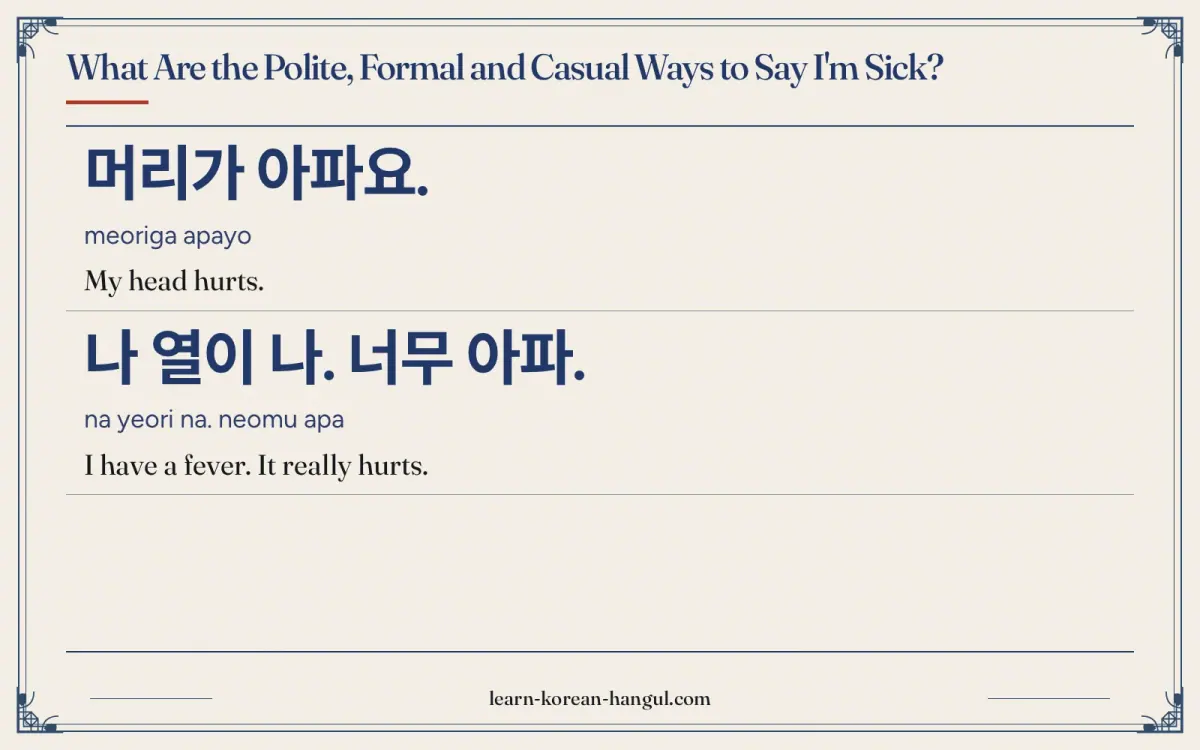
The stem 아프- stays the same and the ending changes with the speech level. The whole system is in the guide to Korean speech levels.
Polite: 아파요 (apayo)
Polite · 해요체아파요 is the form to learn first. It suits family, colleagues and strangers. The past tense is 아팠어요 (apasseoyo), "I was sick". To name where it hurts, put the body part first with the particle 가 or 이:
머리가 아파요.
meoriga apayo
My head hurts.
The same pattern works for 배가 아파요 (my stomach hurts), 목이 아파요 (my throat hurts) and 다리가 아파요 (my leg hurts).
배가 너무 아파서 병원에 갔어요.
baega neomu apaseo byeongwone gasseoyo
My stomach hurt so much that I went to the hospital.
Polite and General: 몸이 안 좋아요 (momi an joayo)
Polite · 해요체몸이 안 좋아요 means "my body is not good". It is vaguer than 아파요 and does not claim a strong pain. Employees use it to ask for time off, and it sounds responsible and calm. It is pronounced [모미 안 조아요].
몸이 안 좋아서 오늘 쉬어도 될까요?
momi an joaseo oneul swieodo doelkkayo?
I'm not feeling well, so may I take today off?
Casual: 아파 (apa)
Casual · 반말아파 drops the polite ending. Use it with close friends, siblings and children. It is also the instant reaction to pain, like "ouch, it hurts".
나 열이 나. 너무 아파.
na yeori na. neomu apa
I have a fever. It really hurts.
Formal: 아픕니다 (apeumnida)
Formal · 합쇼체아픕니다 is the formal form. It appears in announcements, formal letters and news. It is pronounced [아픔니다].
Behind these forms sits one small grammar rule.
Why Does 아프다 Become 아파요?
The stem 아프- ends in the vowel ㅡ (eu). Before the endings -아요 or -어요, Korean drops that ㅡ. The ending is 아 if the vowel in the syllable before is ㅏ or ㅗ, and 어 otherwise. In 아프다 the syllable before is 아, with ㅏ, so the ending is 아: 아프 + 아요 becomes 아파요.
- 아프다 → 아파요 (sick, hurting)
- 바쁘다 → 바빠요 (busy)
- 슬프다 → 슬퍼요 (sad)
- 예쁘다 → 예뻐요 (pretty)
This is called ㅡ-dropping (으 탈락). School grammar counts it as regular, though many learner books teach it with the irregular verbs. Before consonant endings the ㅡ stays, which gives the formal 아픕니다. The modifier before a noun is 아픈, as in 아픈 사람 (a sick person).
How Do You Pronounce 아파요?
아파요 is pronounced [아파요], a-pa-yo, in three syllables. It sounds as it is written.
- 아 (a): an open "ah". There is no consonant sound before it, because the ㅇ at the start is silent.
- 파 (pa): ㅍ is aspirated, a clear puff of air.
- 요 (yo): a short "yo".
Sound Changes to Listen For
These changes follow the National Institute of Korean Language standard pronunciation rules (표준 발음법):
- ㅂ before ㄴ becomes ㅁ. 아픕니다 is [아픔니다] (Article 18). See Korean nasalization.
- Linking. 몸이 is [모미], because the final ㅁ moves onto the vowel that follows (Article 13).
- Silent ㅎ. 좋아요 is [조아요], because ㅎ is silent before a vowel (Article 12). See aspiration in Korean for the cases where ㅎ is not silent.
- Aspirated ㅍ. The ㅍ in 아파요 is already an aspirated sound, so nothing changes.
With the sound clear, here is when each form fits.
When Should You Use 아파요, and When Should You Not?
Use 아파요 for real pain or illness. Use a softer word when you only want to explain a day off.
Situations Where It Fits
- At a pharmacy or clinic. 목이 아파요 (my throat hurts) tells the pharmacist what you need.
- To a boss. 몸이 안 좋아요 explains an absence politely.
- To a friend. 나 오늘 좀 아파.
Situations to Avoid
- For a stomachache from bad food. Say 속이 안 좋아요 (sogi an joayo, [소기 안 조아요]) for an upset stomach, or 메스꺼워요 (meseukkeowoyo) for nausea.
- For being fed up. English "sick of it" is 지겨워요 (jigyeowoyo), not 아파요.
- In a real emergency. Call 119 and say clearly what is wrong. The page on I need a doctor in Korean has the words for it.
Two short conversations show how it sounds.
What Does I'm Sick Sound Like in a Real Conversation?
In real life the line is followed by advice. Notice the answers.
A Friend Looks Unwell
Jimin
얼굴이 안 좋아 보여. 어디 아파?
eolguri an joa boyeo. eodi apa?
You don't look well. Where does it hurt?
Seojun
머리가 너무 아파.
meoriga neomu apa
My head really hurts.
Jimin
열은 있어? 빨리 병원에 가 봐.
yeoreun isseo? ppalli byeongwone ga bwa
Do you have a fever? Go to the hospital soon.
Seojun
응, 약 먹고 갈게.
eung, yak meokgo galge
Yes, I'll take some medicine and go.
What to notice: 어디 아파? is a wh-question, so it does not end with a sharp rise; 열은 있어? is a yes/no question and rises. The friend answers with advice, not only sympathy.
Asking for a Sick Day
Employee
팀장님, 몸이 안 좋아서 오늘 쉬어도 될까요?
timjangnim, momi an joaseo oneul swieodo doelkkayo?
Team leader, I'm not feeling well. May I take today off?
Team Leader
어디가 아파요?
eodiga apayo?
Where does it hurt?
Employee
열이 나고 목이 아파요.
yeori nago mogi apayo
I have a fever and my throat hurts.
Team Leader
그럼 병원에 가 보세요.
geureom byeongwone ga boseyo
Then please go and see a doctor.
What to notice: the employee starts with the vague, polite 몸이 안 좋아서 and gives the detail only when asked. The team leader uses 가 보세요, a polite suggestion that sounds like care, not an order.
What Should You Know about the Culture behind I'm Sick?
For small illnesses, many Koreans first visit a pharmacy, called 약국 (yakguk, [약꾹]), and describe the symptom. Pharmacists can often suggest medicine for a cold, a headache or an upset stomach. For anything more serious, people go to a clinic or hospital, 병원 (byeongwon).
When someone is ill, a classic comfort food is 죽 (juk), a soft rice porridge. A friend might say 따뜻한 죽 먹어 (ttatteutan juk meogeo, eat some warm porridge). Colleagues say 푹 쉬세요 (puk swiseyo, get plenty of rest) and 얼른 나으세요 (eolleun naeuseyo, get well soon).
Workers often ask for time off with 몸이 안 좋아서, which is polite and does not demand detail. It is better to give a short reason than none, and more detail is not required.
An expert tip: if a Korean friend says 어디 아파? when you look tired, they are showing care. Answer with the place that hurts, or say 괜찮아요 (gwaenchanayo, I'm fine) if you do not want to discuss it.
What Mistakes Do Learners Make with I'm Sick in Korean?
Most mistakes come from the ㅡ-dropping stem and from the honorific.
| Wrong | Why it is a problem | Correct |
|---|---|---|
| 아프어요 | The ㅡ must drop | 아파요 |
| 아프아요 | The ㅡ is not dropped | 아파요 |
| 아프세요 about yourself | -시- is honorific and only for others | 아파요 |
| 저는 병이에요 | Sounds like "I am a disease" | 아파요 |
| 머리를 아파요 | The body part is the subject | 머리가 아파요 |
| [아프니다] for the formal form | The ㅂ is not dropped: it is said as ㅁ before ㄴ | [아픔니다] |
| 아파 to a manager | Too casual | 아파요 or 몸이 안 좋아요 |
Notice that 아프세요? asked to someone older is correct, because it is the honorific question. It is only wrong when you say it about yourself.
How Do You Ask Someone If They Are Sick?
Turn the words into a question. To a friend, say 아파? (apa?). To a colleague, say 아파요? (apayo?) with a gentle rise, because this is a yes/no question. To an elder, use the honorific 아프세요? (apeuseyo?), or 많이 아프세요? (mani apeuseyo?), "does it hurt a lot?".
To ask where it hurts, use a question word: 어디가 아파요? (eodiga apayo?). The stress goes on 어디, and the pitch falls or rises and falls, not a sharp rise. A sharp rise would turn 어디 into "somewhere", and the question would sound like "does it hurt somewhere?".
Is It the Same as I Am Sick, Sick, I Feel Sick, It Hurts or Hurts?
Mostly yes. The short answers below cover the other searches folded into this page.
- I am sick in Korean: 아파요, or 몸이 안 좋아요 for a vaguer feeling.
- Sick in Korean: the adjective is 아프다, and before a noun it is 아픈, as in 아픈 아이 (a sick child).
- I feel sick in Korean: 속이 안 좋아요 for a bad stomach, or 몸이 안 좋아요 for the whole body.
- It hurts in Korean: 아파요, with the place named first if you can.
- Hurts in Korean: the same word, 아파요, because Korean has no separate word for "hurts".
Related Phrases to Learn Next
- For a specific pain, learn I have a headache in Korean.
- If you need medical help, see I need a doctor in Korean.
- To comfort someone else, say get well soon in Korean.
- For a typical illness, learn I caught a cold in Korean.
Every phrase in this group lives in the Korean feelings phrases collection.
Practice: Say It Aloud
Play the slow clip of 아파요 three times and keep the ㅍ crisp. Then choose a phrase. Answers follow.
- You tell a close friend your head hurts.
- You tell a coworker politely that you feel ill.
- You ask your manager for a day off.
- You ask an older relative whether they are sick.
Answers
- 나 머리 아파.
- 아파요.
- 몸이 안 좋아서 오늘 쉬어도 될까요?
- 아프세요?
Drill these with the phrase flashcards. Saying i'm sick in Korean is easier when you know that 아파요 covers both pain and illness and that the body part goes first.
Frequently Asked Questions
How do you say I'm sick in Korean?
Say 아파요 (apayo) in polite speech, 아파 (apa) to a close friend and 아픕니다 (apeumnida) in formal speech. 아파요 covers both being ill and feeling pain. For a vaguer feeling, say 몸이 안 좋아요 (momi an joayo), which means I'm not feeling well.
How do you pronounce 아파요?
아파요 has three syllables, a-pa-yo, and is pronounced as it is written. The ㅍ is aspirated, a clear puff of air, and the first vowel is open. In 몸이 안 좋아요, the final ㅁ of 몸 links to the next vowel, giving [모미 안 조아요], and the ㅎ of 좋 is silent before a vowel.
What is the difference between 아파요 and 몸이 안 좋아요?
아파요 usually points to pain or clear illness, as in 머리가 아파요 (my head hurts). 몸이 안 좋아요 means your body is not in good shape and fits a general bad feeling, such as before taking a day off. Both are polite.
Is 아파요 formal or casual?
아파요 is polite, the everyday middle level. The formal level is 아픕니다 and the casual level is 아파. The polite form is safe with almost any adult.
Can I use 아파요 with friends, elders and strangers?
Yes. With friends use 아파, and with elders or strangers use 아파요. To ask an older person whether they are sick, use the honorific question 아프세요? (apeuseyo?). The honorific -시- is only for other people, so never use 아프세요 to talk about yourself.
What is the most common mistake with I'm sick in Korean?
Learners say 아프세요 about themselves, write 아프아요 or 아프어요, or say 저는 병이에요, which is not natural. The correct polite form is 아파요, and for a body part use the pattern 머리가 아파요 with the particle 가.