감기에 걸렸어요
감기에 걸렸어요
What you'll learn
- Say 감기에 걸렸어요, 감기 기운이 있어요, 열이 나요 and 기침이 나요 at a pharmacy or clinic.
- Explain why Korean uses 걸리다 (to be hooked) and the past tense for a cold you still have.
- Pronounce 걸렸어요 [걸려써요] and the links in 기침이 and 열이.
- Avoid the literal translation 감기를 잡았어요.
Before you start: the lesson on Korean speech levels explains the endings used below. Time: about 12 minutes. Audio plays only when you press a button.
How Do You Say I Caught a Cold in Korean?
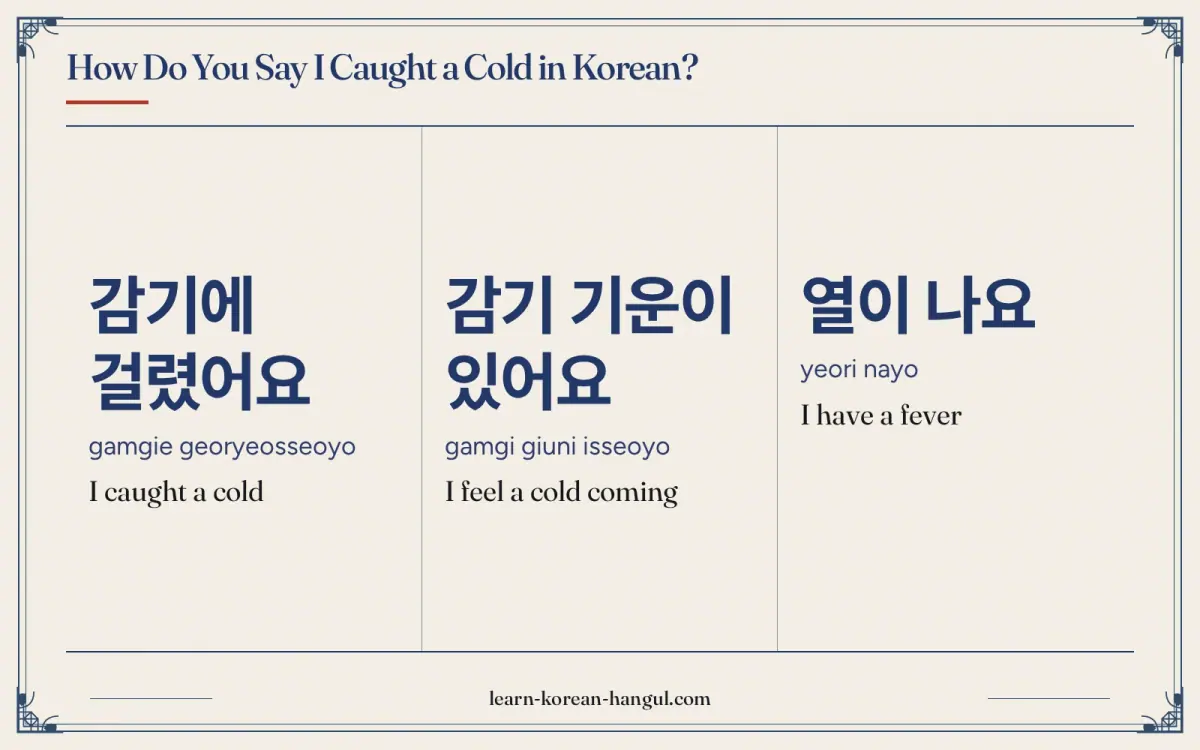
The standard way to say I caught a cold in Korean is 감기에 걸렸어요. The sentence has three parts: 감기 (a cold), 에 (a particle that marks the thing that has caught you) and 걸렸어요 (the past tense of 걸리다, to get hooked or caught). Korean pictures a cold as something that hooks onto you.
| Situation | Korean | Romanization | Meaning |
|---|---|---|---|
| You are ill now | 감기에 걸렸어요 | gamgie georyeosseoyo | I caught a cold |
| It is starting | 감기 기운이 있어요 | gamgi giuni isseoyo | I feel a cold coming |
| Fever | 열이 나요 | yeori nayo | I have a fever |
| Cough | 기침이 나요 | gichimi nayo | I am coughing |
| Friend, casual | 감기 걸렸어 | gamgi georyeosseo | I caught a cold |
Revised Romanization (the South Korean government standard of 2000) is only a reading aid here. Learn the Hangul first. The next section explains each form.
What Are the Polite Ways to Say I Caught a Cold?
A Korean speaker rarely says only one sentence about a cold. They give the main fact, then add a symptom, so these four forms often appear together. All four use the polite -요 ending, which is correct for strangers, pharmacists and doctors.
Polite: 감기에 걸렸어요 (gamgie georyeosseoyo)
Polite · 해요체감기에 걸렸어요 is the standard sentence. The past tense -었- shows that the cold has already caught you, and it still holds now. So the same sentence answers "What happened?" and "What is wrong?". The present form 감기에 걸려요 would mean that you tend to catch colds, or that you are about to.
감기에 걸렸어요. 목도 아파요.
gamgie georyeosseoyo. mokdo apayo
I caught a cold. My throat hurts too.
Polite: 감기 기운이 있어요 (gamgi giuni isseoyo)
Polite · 해요체기운 means energy or a sign of something, so 감기 기운 is "a touch of a cold". Say it when you feel tired, chilly or scratchy but are not fully ill. The structure uses 있어요 (there is), so the cold is in you, not caught by you. It works well to explain why you will leave early.
어제부터 감기 기운이 있어요.
eojebuteo gamgi giuni isseoyo
I have felt a cold coming since yesterday.
Polite: 열이 나요 (yeori nayo)
Polite · 해요체열 means fever or heat, and the verb 나다 means to come out. So 열이 나요 is "a fever is coming out", the natural way to say you have a temperature. A doctor may reply 열이 몇 도예요? (how high is the fever?). The page on fever in Korean covers the noun.
열이 나요. 병원에 가고 싶어요.
yeori nayo. byeongwone gago sipeoyo
I have a fever. I want to go to the hospital.
Polite: 기침이 나요 (gichimi nayo)
Polite · 해요체The same verb 나다 works with 기침 (cough): 기침이 나요 means "I am coughing". It also pairs with 콧물이 나요 (konmuri nayo), "I have a runny nose", and 재채기가 나요 (jaechaegiga nayo), "I am sneezing". See cough in Korean for the noun on its own.
기침이 나요. 감기약 주세요.
gichimi nayo. gamgiyak juseyo
I am coughing. Please give me cold medicine.
Casual: 감기 걸렸어 (gamgi georyeosseo)
Casual · 반말Drop 에 and -요 for friends and family: 감기 걸렸어. In formal writing or an announcement, use 감기에 걸렸습니다 (gamgie georyeotseumnida). Next, the sound of the main phrase.
How Do You Pronounce 감기에 걸렸어요?
감기에 걸렸어요 is pronounced [감기에 걸려써요], with seven syllables: gam-gi-e geol-lyeo-sseo-yo. The first half is simple, and the second half has one link to learn.
- 감 (gam): a short syllable ending in the lip sound ㅁ.
- 기 (gi): a clear ㄱ. There is no tensing after ㅁ in this noun, so it stays [감기].
- 에 (e): a short, open vowel.
- 걸 (geol): the unrounded ㅓ, so keep your lips flat.
- 렸어요 (lyeosseoyo): the final ㅆ of 렸 moves to the next syllable and is pronounced like a tense ㅆ, so you hear 려-써-요.
Sound Changes to Listen For
- Liaison in 걸렸어요. The final ㅆ moves to the vowel that follows, so the ending sounds like [려써요].
- Liaison in 기침이. The final ㅁ of 침 moves to the next syllable, so 기침이 sounds like [기치미] and RR writes gichimi.
- Liaison in 열이 and 기운이. 열이 is [여리], and 기운이 is [기우니]. Written Hangul keeps the batchim, but the sound slides forward.
- Nasalization in 걸렸네. The casual 걸렸네 sounds like [걸련네], because the final ㅆ (said as ㄷ) turns into ㄴ before ㄴ.
The Korean nasalization lesson covers the last pattern. Say 걸려요, then 걸렸어요, and listen for the tense ㅆ. Sound is only part of the story, so now look at when to use each sentence.
When Should You Use 감기에 걸렸어요, and When Should You Not?
Use 감기에 걸렸어요 when you want to name your illness clearly. Use a symptom phrase when you want to describe what you feel.
Situations Where It Fits
- At a pharmacy. 감기에 걸렸어요 starts the conversation, and the pharmacist asks about symptoms.
- At a clinic. Add 열이 나요 or 기침이 나요 to explain details.
- At work or school. 감기 기운이 있어요 explains why you are tired or leaving early.
- With friends. 감기 걸렸어 explains why you cannot meet.
Situations to Avoid
- Serious or unclear symptoms. If you have trouble breathing or very high fever, use I need a doctor in Korean instead.
- Dizziness or nausea alone. A cold sentence will not describe them.
- Literal English. Do not translate "catch" as 잡다 (감기를 잡았어요).
Three short dialogues show where these sentences are used.
What Does I Caught a Cold Sound Like in a Real Conversation?
Cold talk is short and sympathetic. Listen for the gentle question from the helper and the clear list of symptoms from the patient.
At a Pharmacy
Pharmacist
어디가 아프세요?
eodiga apeuseyo
Where does it hurt?
Customer
감기에 걸렸어요. 열도 나고 기침도 나요.
gamgie georyeosseoyo. yeoldo nago gichimdo nayo
I caught a cold. I have a fever and a cough too.
What to notice: 아프세요 is the honorific form of 아프다, and the question 어디가 아프세요? is a wh-question, so its pitch does not rise sharply. The patient uses -고 to join two symptoms.
Two Coworkers
Colleague
목소리가 안 좋아요. 감기예요?
moksoriga an joayo. gamgiyeyo
Your voice sounds bad. Is it a cold?
Coworker
네, 감기 기운이 있어요.
ne, gamgi giuni isseoyo
Yes, I feel a cold coming.
What to notice: 목소리가 sounds like [목쏘리가], with a tense ㅆ, and 좋아요 sounds like [조아요], because the ㅎ is silent between vowels. 감기예요? is a yes-or-no question, so it rises.
A Child and a Parent
Child
엄마, 열이 나요.
eomma, yeori nayo
Mom, I have a fever.
Parent
어디 보자. 감기에 걸렸네. 병원에 가자.
eodi boja. gamgie georyeonne. byeongwone gaja
Let me see. You've caught a cold. Let's go to the doctor.
What to notice: 걸렸네 is [걸련네], and the ending -네 shows that the parent has just noticed. 병원에 sounds like [병워네]. The way people handle a cold also reflects daily habits in Korea.
What Should You Know about the Culture behind I Caught a Cold?
Colds are a common topic, and a few habits are worth knowing before you visit a pharmacy or a clinic.
- Pharmacies are the first stop. For a mild cold, many people go to a 약국 (pharmacy), describe symptoms and receive cold medicine after a short talk with the pharmacist.
- Clinics by specialty. For a cold, people often visit an internal-medicine clinic (내과) or an ear, nose and throat clinic (이비인후과).
- Masks. Wearing a mask (마스크) when you have a cold is common courtesy, so you may see it as a sign of consideration.
- Words of care. After you say 감기에 걸렸어요, friends often reply with a short wish. See get well soon in Korean for the options.
An expert insight: because 걸리다 treats the illness as something that hooks onto you, Korean uses the same verb for 병에 걸리다 (to get a disease) and 감기에 걸리다 (to catch a cold). The mistakes below usually come from translating the English verb.
What Mistakes Do Learners Make with I Caught a Cold in Korean?
Most mistakes come from the verb and the tense.
| Mistake | Why it is a problem | Fix |
|---|---|---|
| 감기를 잡았어요 | Literal "caught"; 잡다 means to grab | Say 감기에 걸렸어요 |
| 감기에 걸려요 for a cold you have now | Present tense sounds like a habit | Use the past 걸렸어요 |
| 감기가 있어요 | Sounds unnatural | Say 감기에 걸렸어요 or 감기 기운이 있어요 |
| 열이 있어요 for a rising fever | Describes having heat, not its start | Say 열이 나요 |
| Writing 걸려써요 | Spelling follows the verb stem | Write 걸렸어요, say [걸려써요] |
Learners often think the past tense means the cold is over. Actually, in Korean a past form with 걸리다 describes a state that began earlier and still holds.
Is It the Same as Fever, Cough, I Have a Cold and I Have a Fever?
Four nearby searches share this page, and each has a short answer.
- Fever in Korean: the noun is 열 (yeol). Say 열이 나요 for "I have a fever".
- Cough in Korean: the noun is 기침. Say 기침이 나요 for "I am coughing".
- I have a cold in Korean: say 감기에 걸렸어요 or 감기 걸렸어요.
- I have a fever in Korean: say 열이 나요, or 열이 있어요 if you want to say there is a fever now.
Practice: Say It Aloud
Play the slow clip and repeat 감기에 걸렸어요 three times, linking 걸려써요. Then choose the best sentence. Answers follow.
- You feel a little chilly and tired.
- You tell a doctor about a high temperature.
- You tell a friend you cannot come, casually.
- You ask the pharmacist for cold medicine.
Answers
- 감기 기운이 있어요.
- 열이 나요.
- 감기 걸렸어.
- 감기약 주세요.
The phrase flashcards drill these forms with audio.
Related Phrases to Learn Next
Cold phrases connect to a small health cluster.
- Get well soon in Korean: what to say to someone who is ill.
- I need a doctor in Korean: when a cold is not enough.
- Where is the pharmacy in Korean: finding medicine.
This guide belongs to the Korean medical phrases collection. What this page does not cover: medical diagnosis, medicine names and emergency care. State the problem plainly, add one symptom, and you can say I caught a cold in Korean naturally.
Frequently Asked Questions
How do you say I caught a cold in Korean?
Say 감기에 걸렸어요 (gamgie georyeosseoyo) in polite speech. The past tense also means that you still have the cold. In casual speech, drop the particle and say 감기 걸렸어요, or 감기 걸렸어 with friends. For a cold that is only starting, say 감기 기운이 있어요.
How do you pronounce 감기에 걸렸어요?
Say gam-gi-e geol-lyeo-sseo-yo in seven syllables. The final ㅆ of 렸 moves to the next syllable, so the ending sounds like [려써요]. The vowel ㅓ in 걸 is unrounded. 감기 has no tensing, so the ㄱ stays plain. Keep a falling pitch at the end, because it is a statement.
What is the difference between 감기에 걸렸어요 and 감기 기운이 있어요?
감기에 걸렸어요 says that you have a cold. 감기 기운이 있어요 says that you feel one coming, with mild signs such as chills or a scratchy throat. Use the first for a clear illness at a clinic, and the second to explain tiredness at work without sounding seriously sick.
Can I use 감기에 걸렸어요 with friends, elders and strangers?
Yes. The polite -요 form is safe with pharmacists, doctors, elders and strangers. With friends and family, say 감기 걸렸어. In a formal setting such as an email to a manager, use 감기에 걸렸습니다. Add 죄송합니다 if the cold makes you miss work or a meeting.
What is the most common mistake with I caught a cold in Korean?
Translating "catch" literally as 잡다 to get 감기를 잡았어요. Korean uses 걸리다, so the natural sentence is 감기에 걸렸어요. Another mistake is using the present 걸려요 for a cold you have now. Use the past 걸렸어요, which describes a state that started earlier.