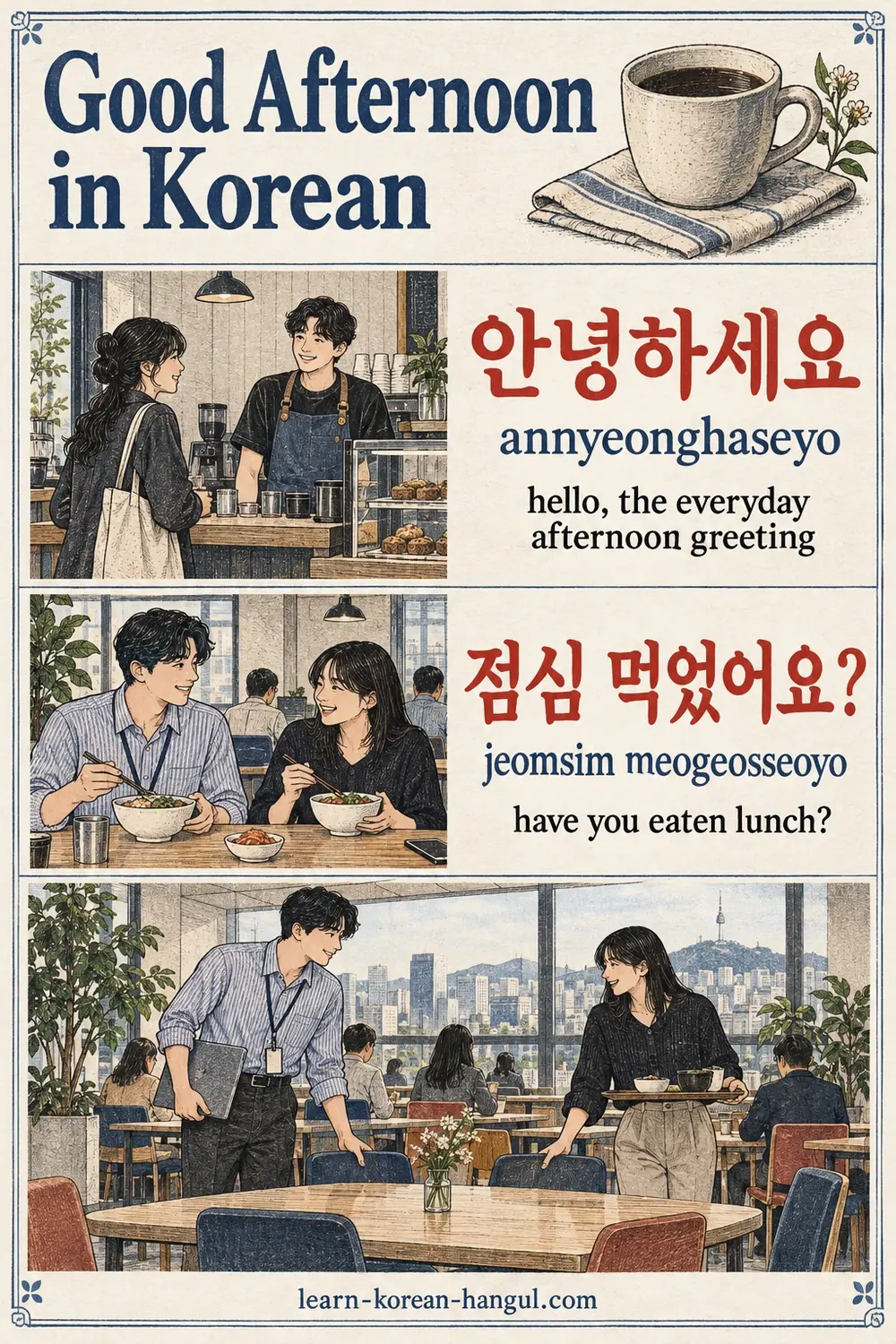
How Do You Say Good Afternoon in Korean?
The everyday way to say good afternoon in Korean is 안녕하세요 (annyeonghaseyo). The word is made of 안녕 (annyeong, "peace, well-being") and 하세요 (haseyo, the polite form of "to do"), so it literally asks about someone's peace. It fits every hour of the day, so no separate afternoon word is needed.
Three forms cover the afternoon.
| Korean | Revised Romanization | Meaning | Register |
|---|---|---|---|
| 안녕하세요 | annyeonghaseyo | hello, the everyday afternoon greeting | polite (해요체) |
| 점심 먹었어요? | jeomsim meogeosseoyo | have you eaten lunch? | polite, friendly opener |
| 좋은 오후예요 | joeun ohuyeyo | good afternoon | formal in tone, mostly written |
Revised Romanization (the South Korean government standard of 2000) is a reading aid only; the Hangul is the real spelling. The next section explains how the three forms differ by listener.
What Are the Formal and Polite Ways to Say Good Afternoon?
Afternoon greetings come in two levels that matter to learners: polite (해요체) and formal (합쇼체). The Korean speech levels decide which one fits: polite for daily life with strangers, coworkers and elders, formal for announcements, speeches and written notices.
Polite: 안녕하세요 (annyeonghaseyo)
안녕하세요 means "hello" and is the real afternoon greeting. It suits shops, offices, schools and phone calls, and it works with someone of any age. The guide to hello in Korean covers the phrase in full.
Example: 안녕하세요, 민수 씨. (annyeonghaseyo, minsu ssi.) "Hello, Minsu."
Polite: 점심 먹었어요? (jeomsim meogeosseoyo)
점심 먹었어요? means "have you eaten lunch?" Coworkers and friends use it around midday as a friendly way to start a talk. It is a question about lunch, so it needs a reply such as 네 (ne, "yes") or 아직요 (ajigyo, "not yet").
Example: 점심 먹었어요? 같이 가요. (jeomsim meogeosseoyo? gachi gayo.) "Have you had lunch? Let's go together."
Formal in Tone: 좋은 오후예요 (joeun ohuyeyo)
좋은 오후예요 means "it is a good afternoon." The pattern copies 좋은 아침이에요 from the good morning in Korean page. It sounds written or ceremonial: the ending -예요 is the polite style, and the stiffness comes from the translated wording. After a vowel-ending noun such as 오후, the polite "is" takes the form 예요, not 이에요. In a formal announcement the ending changes to 입니다: 좋은 오후입니다 (joeun ohuimnida).
Example: 좋은 오후예요, 여러분. (joeun ohuyeyo, yeoreobun.) "Good afternoon, everyone."
Which Time Words Does Korean Use for the Afternoon?
Korean splits the day into words that do not match English exactly. The table lists the common ones.
| Korean | Revised Romanization | Meaning |
|---|---|---|
| 아침 | achim | morning, also breakfast |
| 점심 | jeomsim | midday, also lunch |
| 오후 | ohu | afternoon (PM) |
| 저녁 | jeonyeok | evening, also dinner |
| 밤 | bam | night |
Notice that 아침, 점심 and 저녁 each name a meal as well as a time. That overlap explains why Korean greetings about meals are common. With the options in view, pronunciation is the next step.
How Do You Pronounce 안녕하세요?
안녕하세요 is pronounced [안녕하세요], close to "an-nyeong-ha-se-yo," with five syllables and the stress spread evenly. Play the slow clip, then the normal clip, and repeat each one aloud.
The syllable 녕 ends in the sound "ng," and 하 starts after it with a soft "h." In fast speech the ㅎ between 녕 and 하 weakens and can almost disappear, which is normal and still counts as correct.
How Should the Intonation Sound?
A greeting ends with a gentle fall in pitch: 안녕하세요 sounds settled and friendly, with no rise at the end. A question rises: in 점심 먹었어요?, the pitch climbs on the last syllable 요. 안녕하세요 is often written with a question mark, because it literally asks whether the listener is at peace, but as a greeting it does not need the clear rise of a real question. Practise the settled greeting and the rising lunch question as two separate habits.
Sound Changes to Listen for in the Afternoon Phrases
The two other forms have sound changes that follow the Standard Pronunciation Rules (표준 발음법) of the National Institute of Korean Language (국립국어원).
- 점심 is read jeom-sim, with the final ㅁ of 점 staying as an "m" sound before ㅅ.
- 먹었어요 becomes [머거써요], romanized meogeosseoyo. The final ㄱ of 먹 moves to the next syllable (liaison, 연음), and the double ㅆ in 었 is a tense sound.
- 오후예요 is read [오후예요], with the polite "is" attached directly to the vowel.
The double ㅆ is a letter that is already tense, which differs from rules that make plain consonants tense. The tensification guide shows both cases. After the sounds, the remaining question is where each phrase fits.
When Should You Use 안녕하세요, and When Should You Not?
Use 안녕하세요 whenever you meet someone in the afternoon, because no dedicated afternoon greeting exists in speech. Save the lunch question 점심 먹었어요? for coworkers or friends you already know, since it asks about a person's meal and sounds personal to a stranger.
Situations Where 안녕하세요 Fits
- Walking into a shop or cafe. Say 안녕하세요 to the staff and start your order.
- Meeting a teacher or boss in the afternoon. Add a small nod and the person's title, such as 안녕하세요, 선생님.
- Answering a business call. 안녕하세요 opens the call politely at any hour.
Situations to Avoid with 좋은 오후예요
- Spoken to a colleague. A colleague will find a dictionary phrase like 좋은 오후예요 stiff. Say 안녕하세요.
- Used with a stranger on the street. The formal-sounding form draws attention. Say 안녕하세요 or nothing.
- Asking 점심 먹었어요? to a stranger. The question suits colleagues and friends only.
The safe default is 안녕하세요. Real exchanges show how the forms work together.
What Does Good Afternoon Sound Like in a Real Conversation?

Both dialogues use the forms above. Read the lines, play the clip, and then say one role aloud.
Dialogue 1: At a cafe counter
- A: 안녕하세요. 어서 오세요. (annyeonghaseyo. eoseo oseyo.) "Hello. Welcome."
- B: 안녕하세요. 커피 한 잔 주세요. (annyeonghaseyo. keopi han jan juseyo.) "Hello. One coffee, please."
- A: 네, 알겠습니다. (ne, algetseumnida.) "Yes, understood."
안녕하세요. 어서 오세요. 안녕하세요. 커피 한 잔 주세요. 네, 알겠습니다.
Dialogue 2: Two coworkers at midday
- A: 점심 먹었어요? (jeomsim meogeosseoyo?) "Have you eaten lunch?"
- B: 아직요. 같이 먹을까요? (ajigyo. gachi meogeulkkayo?) "Not yet. Shall we eat together?"
- A: 좋아요. (joayo.) "Sounds good."
점심 먹었어요? 아직요. 같이 먹을까요? 좋아요.
In Dialogue 1, both speakers open with 안녕하세요, and no afternoon-specific word appears. In Dialogue 2, the lunch question replaces the greeting because the two coworkers know each other. Behind this habit lies a cultural idea worth knowing.
What Should You Know about the Culture behind Good Afternoon?
Asking whether someone has eaten works as a caring greeting in Korea, much as "how are you" does in English. The question 점심 먹었어요? often means "I hope you are well and fed" more than "tell me your menu." A short answer, such as 네, 먹었어요 (ne, meogeosseoyo, "yes, I have eaten") or 아직요, is enough, and the asker will usually offer to eat together only if the two of you are close.
Age and rank shape the choice as well. Younger speakers use 안녕하세요 with older ones, often with a light nod. Close friends of the same age can skip the greeting and say 점심 먹었어? (jeomsim meogeosseo?), the casual form. The distance between speakers is what sets the words.
What Mistakes Do Learners Make with Good Afternoon in Korean?
The most common mistake is reading 좋은 오후 from a dictionary and saying it to a colleague, who will find it stiff. Four more appear often:
- Expecting a separate afternoon word. Fix: use 안녕하세요, and add the time only when the sentence needs it.
- Dropping the 요. 점심 먹었어 is casual and rude to a boss. Fix: end with 요.
- Mixing up 이에요 and 예요. After a vowel, such as in 오후, the polite "is" is 예요. Fix: say 오후예요, not 오후이에요.
- Saying 먹었어요 as "meok-eo-seo-yo". Fix: link the sounds as [머거써요].
These mistakes come from carrying English habits into Korean, and a few folded questions repeat related searches.
Short Answers on Good Afternoon Formal and Afternoon Greeting
Two searches point to this page, so each gets a short answer.
- Good afternoon formal in Korean: The formal form is 좋은 오후입니다 (joeun ohuimnida), used in announcements. For polite daily use, say 안녕하세요.
- Afternoon greeting in Korean: The usual afternoon greeting is 안녕하세요, and between close coworkers 점심 먹었어요? takes its place.
For the other times of day see good morning in Korean and good evening in Korean. A quick table then sorts all the forms by listener.
Choosing a Form by Listener
The table matches each listener with one form, so you can decide quickly. When two listeners overlap, pick the one with higher rank.
| Listener | Best choice | Why |
|---|---|---|
| Stranger, shop staff | 안녕하세요 | polite at any hour |
| Teacher or boss | 안녕하세요 plus the title | respectful and safe |
| Coworker you know well | 점심 먹었어요? | friendly midday opener |
| Close friend, same age | 안녕 or 점심 먹었어? | casual |
| Speech, notice or announcement | 좋은 오후입니다 | formal style |
A small nod or bow usually goes with the greeting, and the depth of the nod grows with the age or rank of the person. Once the choice is clear, the related pages build the rest of the cluster.
Related Phrases to Learn Next
Use the following pages to build the rest of the greeting cluster:
- Hello in Korean: the full guide to 안녕하세요 and its casual 안녕.
- Good morning in Korean: morning forms and the 잘 잤어요? check-in.
- Good evening in Korean: the evening version of the same idea.
The complete list sits in the Korean greetings cluster. Practice makes the phrase automatic.
Practice: Say It Aloud
Take five minutes and follow these steps.
- Play the slow clip of 안녕하세요 and repeat it three times.
- Say 안녕하세요, 민수 씨 aloud with a small nod.
- Say 점심 먹었어요? with rising intonation, then answer yourself with 아직요.
- Hide the Romanization with the toggle and read the three forms from Hangul only.
- Drill the cluster with the phrase flashcards.
After this routine you can say good afternoon in Korean the way people actually do.
Frequently Asked Questions
The answers below add details about how to say good afternoon in Korean beyond the sections above.
Is there a Korean word that means only good afternoon?
Yes, but it is rare in speech. 좋은 오후예요 (joeun ohuyeyo) means "it is a good afternoon" and appears in announcements and writing. In daily life, people say 안녕하세요 because it works at any hour and sounds natural to every listener, from a classmate to a manager.
What is the difference between 안녕하세요 and 점심 먹었어요?
안녕하세요 is a greeting that says hello. 점심 먹었어요? is a question about lunch that also works as a warm opener between people who know each other. The first fits strangers, teachers and bosses at any hour. The second fits colleagues and friends around midday and expects a short answer.
Is 안녕하세요 formal or casual?
안녕하세요 is polite, in the 해요체 style, which suits most daily situations. The formal version is 안녕하십니까 (annyeonghasimnikka), used in speeches and news. The casual version is 안녕 (annyeong), used only with close friends and younger people, and never with a teacher or a boss.
Can I use 안녕하세요 with friends, elders and strangers?
Yes. 안녕하세요 works with strangers, elders, teachers, coworkers and most friends. Only very close friends of the same age usually switch to the casual 안녕. When you are unsure how close you are, the polite form is the safer choice, and Koreans rarely mind if you are too polite.
How do I say have a good afternoon when leaving?
Say 좋은 오후 보내세요 (joeun ohu bonaeseyo), which means "please spend a good afternoon." The phrase works when parting with a coworker or a shop clerk. The verb 보내다 means "to spend time," and the ending 세요 makes the sentence polite. Between friends, shorten it to 좋은 오후 보내.
What is the most common mistake with good afternoon in Korean?
Learners read 좋은 오후 from a dictionary and say it to a colleague, who finds it stiff. The natural choice is 안녕하세요. A second frequent mistake is dropping the 요 from 점심 먹었어요?, which turns a polite question into a casual one and can sound rude to a boss.