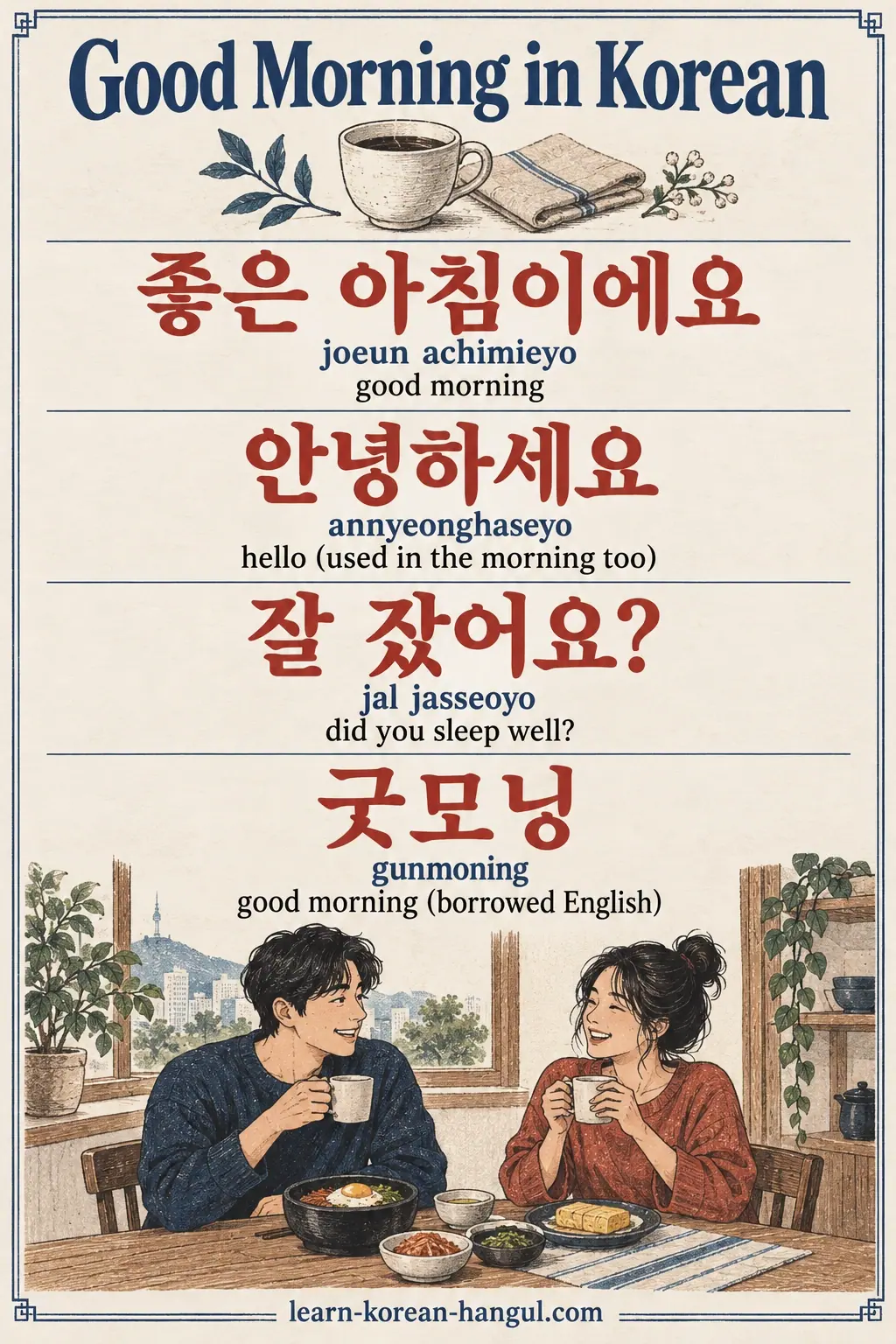
How Do You Say Good Morning in Korean?

The standard polite way to say good morning in Korean is 좋은 아침이에요 (joeun achimieyo). The phrase is made of three parts: 좋은 (joeun, "good"), 아침 (achim, "morning") and 이에요 (ieyo, "is"). Together they say "it is a good morning," and the 요 at the end makes the sentence polite.
Here are the four forms you will meet most often. Each one gets its own section below.
| Korean | Revised Romanization | Meaning | Register |
|---|---|---|---|
| 좋은 아침이에요 | joeun achimieyo | good morning | polite (해요체) |
| 안녕하세요 | annyeonghaseyo | hello (used in the morning too) | polite (해요체) |
| 잘 잤어요? | jal jasseoyo | did you sleep well? | polite (해요체) |
| 굿모닝 | gunmoning | good morning (borrowed English) | casual, playful |
In speech the phrase runs together as one breath group, and the final 요 is light and quick. Say it at the speed of a friendly hello, not as a slow reading.
Revised Romanization (로마자 표기법, the South Korean government standard of 2000) is shown only as a reading aid. Learn the Hangul version first, because the spelling in Latin letters hides some sounds. The next section explains how to choose between the four forms.
What Are the Polite and Casual Ways to Say Good Morning?

Korean has no single word for good morning that fits everyone. The right choice depends on who is listening: use 좋은 아침이에요 for a polite, slightly warm greeting, 안녕하세요 when you want to be safe with anyone, 잘 잤어요? with people you know, and 굿모닝 with friends. Korean grammar calls these levels of politeness speech levels (존댓말 and 반말).
Three styles matter for this phrase:
- Formal (합쇼체): the ending -ㅂ니다 or -습니다, used in news, speeches and announcements. Example: 좋은 아침입니다 (joeun achimimnida).
- Polite (해요체): the ending -아요 or -어요, used with strangers, coworkers and older people in daily life. Example: 좋은 아침이에요.
- Casual (해체): the same sentence without 요, used with close friends and younger people. Example: 좋은 아침 (joeun achim) or 잘 잤어? (jal jasseo?).
The formal version, 좋은 아침입니다, is the one you will hear from a broadcaster opening a morning programme.
Polite: 좋은 아침이에요 (joeun achimieyo)
좋은 아침이에요 means "good morning" and sounds warm and a little formal. It suits text messages, emails, radio greetings and the first message in a group chat. When spoken face to face, it can sound like a translation from English, which the usage section below explains.
Example: 좋은 아침이에요, 여러분. (joeun achimieyo, yeoreobun.) "Good morning, everyone."
Polite: 안녕하세요 (annyeonghaseyo)
안녕하세요 means "hello," and it is what people most often say in the morning, because Korean has one hello for the whole day. It works with strangers, teachers, coworkers and grandparents. The full guide to hello in Korean covers it in depth.
Example: 안녕하세요, 선생님. (annyeonghaseyo, seonsaengnim.) "Hello, teacher."
Polite: 잘 잤어요? (jal jasseoyo)
잘 잤어요? means "did you sleep well?" It works as a morning check-in with family, roommates, hosts and coworkers you know. The casual version for friends is 잘 잤어? (jal jasseo?).
Example: 잘 잤어요? 오늘은 날씨가 좋아요. (jal jasseoyo? oneureun nalssiga joayo.) "Did you sleep well? The weather is nice today."
Casual: 굿모닝 (gunmoning)
굿모닝 is the English "good morning" written in Hangul. It is pronounced [군모닝], because the final ㅅ is said as [ㄷ] and then becomes [ㄴ] before ㅁ (nasalization), which is why the romanization is gunmoning. Friends use it in a playful way, mostly in messages, and it is not used with elders or in formal settings.
Example: 굿모닝! 오늘도 힘내요. (gunmoning! oneuldo himnaeyo.) "Good morning! Do your best today."
Choosing a Form by Listener
The table below puts the forms side by side so you can pick one in two seconds. Elders at home get one more form, 안녕히 주무셨어요? (annyeonghi jumusyeosseoyo?), which means "did you sleep peacefully?" and uses the respectful verb 주무시다 (jumusida, "to sleep" for someone you honour).
| Listener | Best choice | Why |
|---|---|---|
| Stranger, shop staff, teacher | 안녕하세요 | polite and safe at any hour |
| Coworker or classmate | 안녕하세요 | the everyday greeting in offices and schools |
| Grandparent or older relative at home | 안녕히 주무셨어요? | respectful morning check-in |
| Friend your age | 굿모닝 or 잘 잤어? | casual and warm |
| Group chat or written note | 좋은 아침이에요 | clear and friendly in writing |
| Broadcast or speech | 좋은 아침입니다 | formal style |
Always pick the ending by the oldest or most senior person in the room. The four forms differ in sound as well as in politeness, so the next section turns to pronunciation.
How Do You Pronounce 좋은 아침이에요?
좋은 아침이에요 is pronounced [조은 아치미에요], roughly "jo-eun a-chi-mi-e-yo," with five syllables in the second word and no pause inside it. Listen to the slow clip first, then to the normal-speed clip above, and repeat after each one.
| Syllable | Spelled | Spoken | Revised Romanization |
|---|---|---|---|
| 좋은 | 좋-은 | [조은] | joeun |
| 아침이에요 | 아-침-이-에-요 | [아치미에요] | achimieyo |
What Sound Changes Happen in 좋은 아침이에요?
Two sound changes make the spelling differ from the sound.
- Silent ㅎ. In 좋은, the letter ㅎ is written but not pronounced, because a vowel follows it. The Standard Pronunciation Rules (표준 발음법, 국립국어원) cover this in Article 12. So 좋은 sounds like [조은].
- Liaison (연음). In 아침이에요, the final ㅁ of 침 moves onto the empty ㅇ of 이에요, so the word sounds like [아치미에요]. Article 13 of the same rules describes this. The page on liaison lists more examples.
Say "a-chim i-e-yo" as separate pieces and you will sound careful but foreign; say "a-chi-mi-e-yo" in one flow and the phrase sounds natural. After the sound changes, the remaining question is when the phrase actually fits.
When Should You Use 좋은 아침이에요, and When Should You Not?

Use 좋은 아침이에요 in writing, in announcements and in warm, slightly playful greetings. For spoken greetings in daily life, 안녕하세요 is the usual choice. Real morning greetings in Korea are usually 안녕하세요 or a question such as 잘 잤어요?, so 좋은 아침 is understood but sounds translated when spoken to a coworker at the office door.
Situations Where 좋은 아침이에요 Fits
- A text to a friend or partner. A morning message such as 좋은 아침이에요! sounds kind and clear.
- A radio or video opening. A presenter opens a morning show with 좋은 아침입니다, the formal form.
- A message to a group chat. Starting a day's thread with 좋은 아침이에요 is polite and brief.
Situations to Avoid with 좋은 아침이에요
- A coworker at the door. Use 안녕하세요 instead. The literal translation sounds stiff.
- A close friend, face to face. Use 굿모닝 or just 잘 잤어? instead.
- Midday or later. Use 안녕하세요, because 아침 means morning only. For later hours see good afternoon in Korean and good evening in Korean.
The safe rule is simple: when unsure, say 안녕하세요. The next section shows the phrases working in real exchanges.
What Does Good Morning Sound Like in a Real Conversation?

Real conversations mix the forms above. Read each dialogue first, then play the clip and say your lines aloud.
Dialogue 1: Breakfast with a host family
- A: 잘 잤어요? (jal jasseoyo?) "Did you sleep well?"
- B: 네, 잘 잤어요. 좋은 아침이에요. (ne, jal jasseoyo. joeun achimieyo.) "Yes, I slept well. Good morning."
- A: 아침 드세요. (achim deuseyo.) "Please have breakfast."
- B: 감사합니다. (gamsahamnida.) "Thank you."
잘 잤어요? 네, 잘 잤어요. 좋은 아침이에요. 아침 드세요. 감사합니다.
Dialogue 2: Two friends texting
- A: 굿모닝! (gunmoning!) "Good morning!"
- B: 굿모닝! 잘 잤어? (gunmoning! jal jasseo?) "Good morning! Did you sleep well?"
In Dialogue 1, B answers a question with 좋은 아침이에요, which makes the reply warm and complete. In Dialogue 2, both friends use the casual forms, with no 요 at the end of 잘 잤어?. Beyond the words, there is the habit behind them.
What Should You Know about the Culture behind Good Morning?

Korean greetings often check on the person instead of describing the time of day. A set phrase such as "good morning" is less central than a short question about sleep or food. Many families greet each other at breakfast with a short 잘 잤어? rather than a fixed phrase, and a question like 아침 먹었어요? (achim meogeosseoyo?, "have you eaten breakfast?") can work as a caring hello between people who know each other.
Politeness depends on age and rank as well as on the words. A younger person greets an older person with the polite 안녕하세요, often with a small nod or bow. A friend your own age can get 굿모닝 or 잘 잤어?. Because the greeting follows the relationship, the same morning can call for different words in different rooms. That difference is where learners most often go wrong.
What Mistakes Do Learners Make with Good Morning in Korean?
Learners most often translate "good morning" word for word and use 좋은 아침이에요 with coworkers as if it were the standard greeting. Five mistakes appear again and again:
- Using 좋은 아침이에요 as the default spoken greeting. Fix: say 안녕하세요, and keep 좋은 아침이에요 for messages and announcements.
- Saying 좋은 아침 with no ending to a boss. The casual 좋은 아침 is for friends. Fix: add 이에요, or switch to 안녕하세요.
- Dropping the liaison. Saying "a-chim i-e-yo" in two pieces sounds like a reading from a textbook. Fix: join the sounds as [아치미에요].
- Pronouncing the ㅎ in 좋은. Reading it as "joh-eun" sounds wrong. Fix: say [조은].
- Using 굿모닝 with elders. The borrowed English word is playful. Fix: use 안녕하세요 with anyone older.
Learners also ask whether Korean has a regional or dialect word for good morning. It does vary by region, but this page covers the standard Seoul-area forms taught in classrooms and used in the National Institute of Korean Language (국립국어원) materials. Dialect greetings are outside its scope.
Each mistake has the same cause: a rule from English meeting a habit of Korean. The folded questions below answer related searches in a sentence or two.
Short Answers on Good Morning Korean, Formal and Casual Forms
Several searches point to the same page, so each gets a short answer here.
- Good morning Korean: The shortest answer is 좋은 아침이에요 in writing and 안녕하세요 in speech.
- Morning greeting in Korean: Koreans greet in the morning with 안녕하세요 or with a question such as 잘 잤어요?, because Korean greetings often check on the person.
- Good morning formal in Korean: The formal form is 좋은 아침입니다 (joeun achimimnida), used in broadcasts and speeches. For a polite, everyday level use 좋은 아침이에요.
- Good morning casual in Korean: Friends say 굿모닝, 좋은 아침 or 잘 잤어?.
Knowing the options is useful only when they are practised, which is the next step.
Related Phrases to Learn Next
After good morning, the natural next steps are the other main greetings of the day. These three pages follow the same layout as this one:
- Hello in Korean: the greeting that works from morning to night.
- Good night in Korean: the matching phrase for the end of the day, which you will often hear in the same conversation.
- How are you in Korean: the follow-up question that comes after the greeting.
The full cluster is listed under Korean greetings, where every greeting has a short summary and a lead audio clip. After you can greet, practise until the sounds feel automatic.
Practice: Say It Aloud
Spend five minutes on this routine, and repeat it on three mornings in a row.
- Play the slow clip of 좋은 아침이에요 and repeat it three times.
- Play the normal-speed clip and repeat it three times, keeping the five syllables of 아침이에요 joined.
- Say 안녕하세요, then 잘 잤어요?, then 굿모닝 aloud, and name the listener each one fits.
- Cover the Romanization with the toggle and read the four forms from the Hangul alone.
- Drill the whole cluster with the phrase flashcards.
When 좋은 아침이에요 comes out without thinking, you can say good morning in Korean in the right form for each listener.
Frequently Asked Questions
The answers below cover details about how to say good morning in Korean that the sections above do not.
What does 좋은 아침이에요 literally mean?
좋은 아침이에요 means "it is a good morning." The parts are 좋은 (good), 아침 (morning) and 이에요 (the polite form of "to be"). Korean speakers read it as a warm, slightly written-style greeting, so it feels natural in messages, captions and announcements, and less natural at the office door.
Is 좋은 아침이에요 formal or casual?
좋은 아침이에요 is polite, in the 해요체 style, which sits between formal and casual. The formal form is 좋은 아침입니다, used in broadcasts, and the casual form is 좋은 아침, used with close friends. Choose the ending by the person you are speaking to, not by the time of day.
Can I say 좋은 아침이에요 to friends, elders and strangers?
With elders and strangers, 안녕하세요 is the safer spoken greeting, and 좋은 아침이에요 works in messages. With friends, 굿모닝 or 잘 잤어? sounds more natural. A coworker is treated like a stranger until you know each other well, so 안녕하세요 is the safe default for the first weeks.
Do Koreans really say good morning at all?
Koreans do say good morning, but mostly in writing, on air, or in a playful way. In daily speech, 안녕하세요 or a question about sleep or breakfast is more common. The phrase is understood everywhere, but spoken at an office door it sounds translated from English, so learners use 안녕하세요 there.
How do I say good morning to my teacher?
Say 안녕하세요, 선생님 (annyeonghaseyo, seonsaengnim) with a small nod. Add 좋은 아침이에요 only in a written note. 선생님 means teacher and is the respectful title used for teachers in Korean schools and classes, so the greeting stays polite without extra words.
How do I reply when someone says good morning to me?
Repeat the same phrase back. If someone says 안녕하세요, answer 안녕하세요. If someone says 좋은 아침이에요, answer 좋은 아침이에요 or 안녕하세요. If someone asks 잘 잤어요?, answer 네, 잘 잤어요 (ne, jal jasseoyo), which means "yes, I slept well." Add 감사합니다 if the person is a host who gave you a bed.