
잘했어요
잘했어요
What you'll learn
- Say good job with 잘했어요 and its casual form 잘했어.
- Tell the difference between praising a result (잘했어요), thanking effort (수고했어요) and admiring skill (대단해요).
- Choose a safe line for a boss or an elder.
- Pronounce 잘했어요 as [잘해써요] and 수고했어요 as [수고해써요].
Before you start: you need to read Hangul and know the polite ending 요. Knowing congratulations in Korean helps, because praise and congratulations often come together. Time: about 15 minutes. Audio plays only when you press a button.
How Do You Say Good Job in Korean?
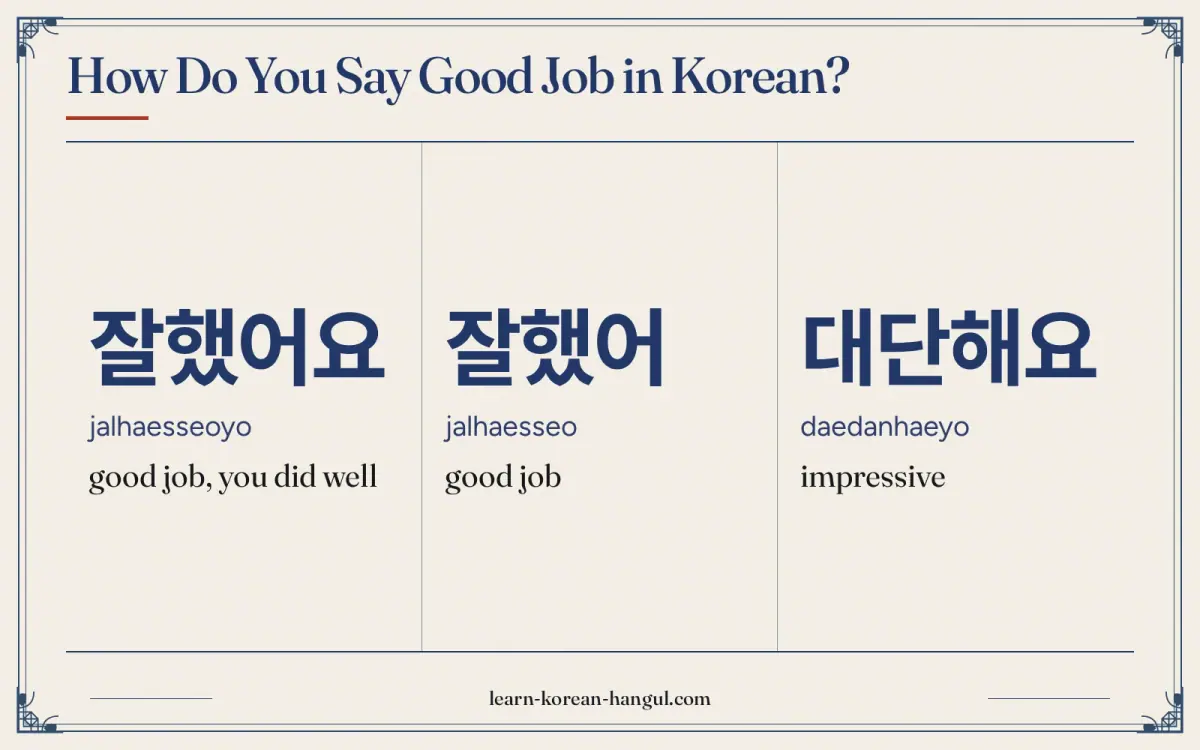
The everyday way to say good job in Korean is 잘했어요. It comes from 잘하다 (jalhada, "to do well"), made of 잘 ("well") and 하다 ("to do"). The past tense 잘했어요 says "you did it well", so it praises a finished action and not a person's character.
| Form | Korean | Romanization | Meaning | Style |
|---|---|---|---|---|
| Polite | 잘했어요 | jalhaesseoyo | good job, you did well | everyday, from equal or higher to lower |
| Casual | 잘했어 | jalhaesseo | good job | friends, children, juniors |
| Polite | 대단해요 | daedanhaeyo | impressive | safe admiration |
| Polite | 수고했어요 | sugohaesseoyo | good work, thanks for your effort | after work or a task |
| Formal | 수고하셨습니다 | sugohasyeotseumnida | thank you for your hard work | colleagues and seniors |
| Elder-safe | 대단하세요 | daedanhaseyo | you are impressive | elders and bosses |
Building the polite form takes three steps:
- Take the verb 잘하다 and remove 다: 잘하-.
- Change 하 to 해 and add the past marker ㅆ: 잘했-.
- Add 어요: 잘했어요.
The present form 잘해요 means "you are good at it" and describes a skill, while 잘했어요 praises what just happened. The next section sets the forms out by listener.
What Are the Polite and Casual Ways to Say Good Job?
The right form depends on who is listening. The guide to Korean speech levels explains the system. In short: the word 잘했어요 flows downward or sideways, so use it with equals and juniors, and choose a different line for elders.
Polite: 잘했어요 (jalhaesseoyo)
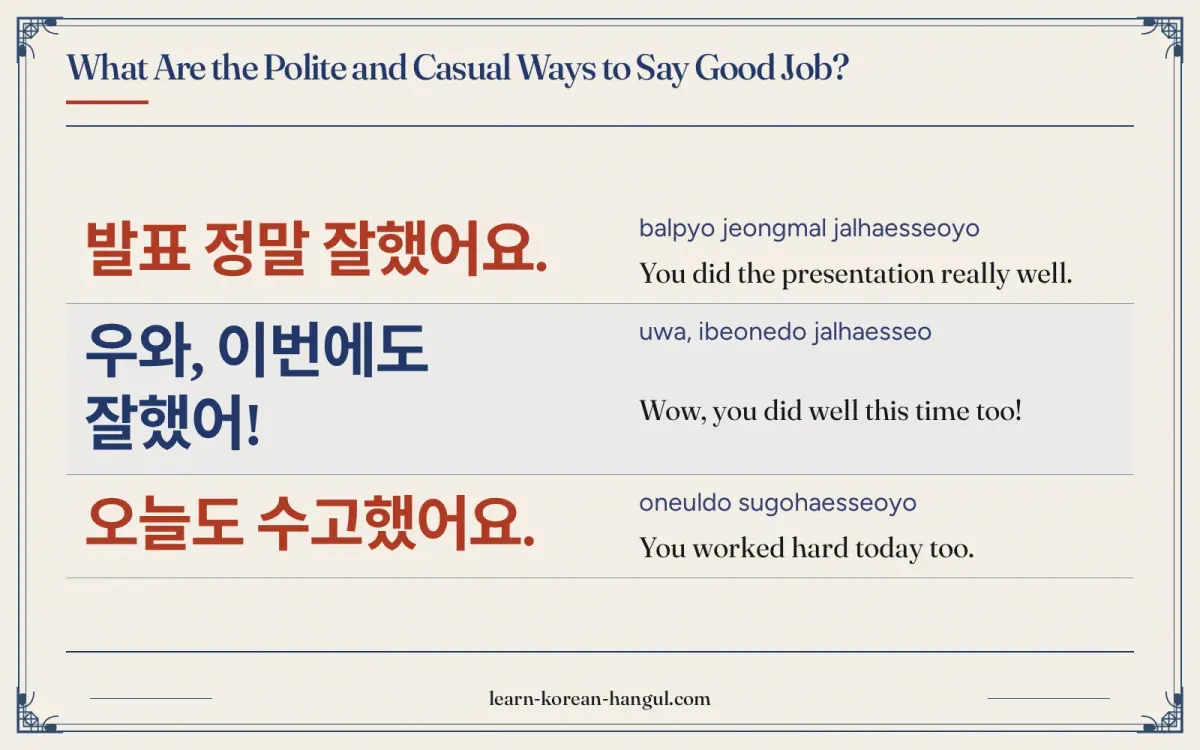
Polite · 해요체잘했어요 is the standard praise. A teacher says it to a student, a parent to a child, and a coworker to an equal. Add 정말 (jeongmal, "really") or 아주 ("very") to raise the strength.
발표 정말 잘했어요.
balpyo jeongmal jalhaesseoyo
You did the presentation really well.
Casual: 잘했어 (jalhaesseo)
Casual · 반말잘했어 drops the 요 and is for friends, siblings and children. A cheerful tone and the word 우와 make it warm.
우와, 이번에도 잘했어!
uwa, ibeonedo jalhaesseo
Wow, you did well this time too!
Polite: 대단해요 (daedanhaeyo)
Polite · 해요체대단해요 means "impressive" and admires skill or effort, not just one result. It is safer than 잘했어요 across ages, because it does not grade the listener. For an elder, add the honorific -시- and say 대단하세요.
와, 대단해요! 이걸 혼자 만들었어요?
wa, daedanhaeyo! igeol honja mandeureosseoyo
Wow, impressive! You made this by yourself?
Polite: 수고했어요 (sugohaesseoyo)
Polite · 해요체수고했어요 thanks someone for effort and is common at the end of a task or a work day. It sounds like praise from a person of higher or equal rank. To a senior, use the formal 수고하셨습니다, which is a staple in Korean offices.
오늘도 수고했어요.
oneuldo sugohaesseoyo
You worked hard today too.
Pronunciation comes next, because the spelling hides a sound change.
How Do You Pronounce 잘했어요?
잘했어요 is pronounced [잘해써요], jalhaesseoyo in Revised Romanization, in four even syllables: jal-hae-sseo-yo. The first syllable ends in a clear ㄹ, and the tense ㅆ moves to the start of the third syllable.
- 잘 (jal): a soft "ja" ending in an "l" sound.
- 해 (hae): "heh".
- 써 (sseo): a tense s, said with a firm tongue and no puff of air.
- 요 (yo): short and level.
Sound Changes to Listen For
The spelling and the sound differ in two places, following the National Institute of Korean Language Standard Pronunciation rules (표준 발음법):
- 했어요 is [해써요]. The ㅆ at the end of 했 moves into the empty first slot of 어, and it keeps its tense sound. This is liaison, and the page on Korean tensification explains how tense sounds behave.
- 수고했어요 is [수고해써요]. The same move happens in the middle of the word.
- 수고하셨습니다 is [수고하셛씀니다]. The ㅆ of 셨 is read as [ㄷ] before a consonant, the ㅅ of 습 turns tense, and the ㅂ becomes [ㅁ] before ㄴ.
Revised Romanization writes 잘했어요 as jalhaesseoyo, matching the sound. With the sounds in place, the next question is when each form fits.
When Should You Use 잘했어요, and When Should You Not?
Use 잘했어요 to praise a result when you are equal to or senior to the listener, and avoid it when you are praising a boss or an elder. The lists below show where it fits and where it does not.
Situations Where It Fits
- A teacher praising a student. 잘했어요 is the classic school phrase.
- A parent or older sibling praising a child. 잘했어 and 참 잘했어요 are both natural.
- A friend after good news. 잘했어! shows that you are pleased.
- A coworker after a task. 수고했어요 thanks for the effort, and 잘했어요 praises the result.
Situations to Avoid
- A boss or an elder. 잘했어요 sounds like grading them. Use 대단하세요 (you are impressive) or 훌륭하세요 (you are excellent).
- A stranger. Praise from someone with no relationship can sound patronising. Use 대단하네요 or stay with a thank-you.
- A mistake. Said flatly after an error, 잘했어요 can sound sarcastic, as in "nice going". Tone decides the meaning.
- A skill compliment to an elder. Say 잘하시네요 (jalhasineyo, "you are good at it"), which adds -시- for respect.
Which Line Fits Which Listener
One table sorts the three kinds of praise by listener. Use it when you cannot decide in the moment.
| Listener | Praise a result | Thank for effort | Admire skill |
|---|---|---|---|
| Child | 잘했어, 참 잘했어요 | 고생했어 | 잘하네 |
| Friend | 잘했어 | 수고했어 | 대단해 |
| Coworker of equal rank | 잘했어요 | 수고했어요 | 대단해요 |
| Boss or elder | 훌륭하십니다 | 수고하셨습니다 | 대단하세요 |
Notice that the last row never uses 잘했어요. The grid is a guide, not a law: tone, closeness and workplace habits move the line, so watch what the people around you say. The dialogues below show these rules in everyday settings.
What Does Good Job Sound Like in a Real Conversation?
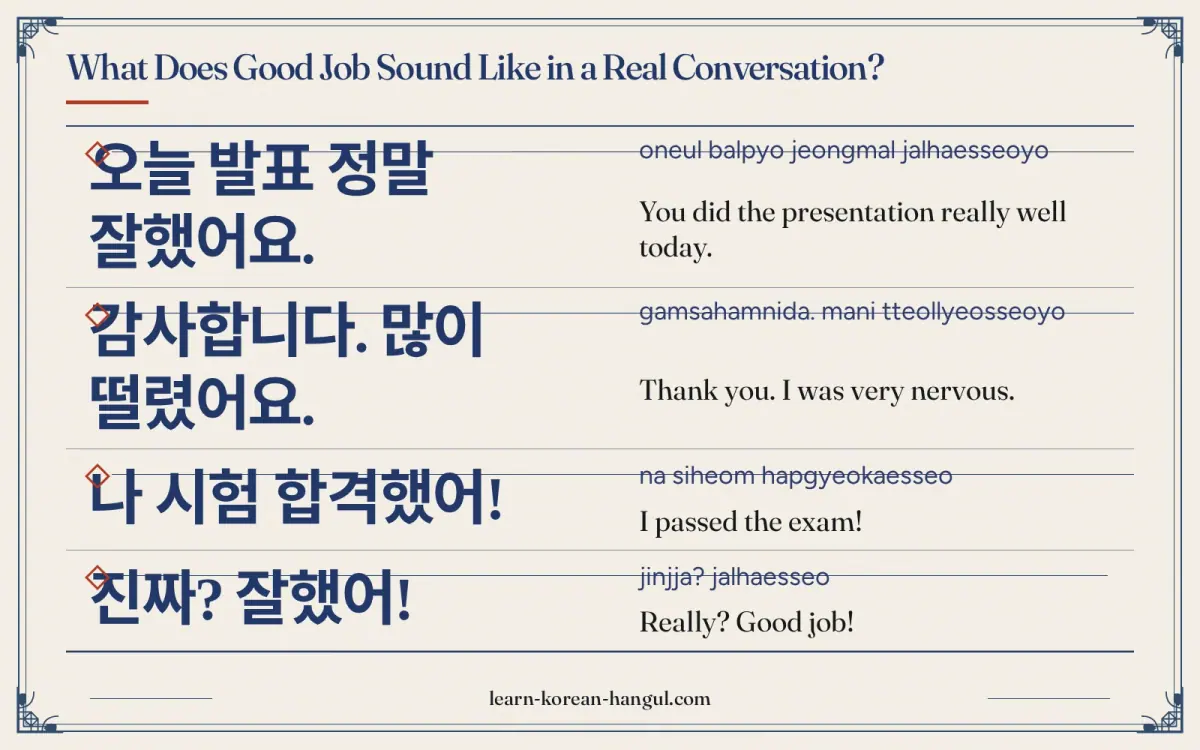
A Korean praise line is short and often followed by thanks. Listen for the polite ending in the first and third dialogues and the casual ending in the second.
After a Speaking Test
Teacher
오늘 발표 정말 잘했어요.
oneul balpyo jeongmal jalhaesseoyo
You did the presentation really well today.
Student
감사합니다. 많이 떨렸어요.
gamsahamnida. mani tteollyeosseoyo
Thank you. I was very nervous.
Teacher
괜찮아요. 다음에도 잘할 수 있어요.
gwaenchanayo. daeumedo jalhal su isseoyo
It is fine. You can do well next time too.
What to notice: the teacher says 잘했어요, and the student answers with 감사합니다. 떨렸어요 means "I was nervous", from 떨리다.
Exam Results Among Friends
Eunji
나 시험 합격했어!
na siheom hapgyeokaesseo
I passed the exam!
Taeho
진짜? 잘했어!
jinjja? jalhaesseo
Really? Good job!
Eunji
고마워. 네 덕분이야.
gomawo. ne deokbuniya
Thanks. It is thanks to you.
What to notice: friends use 잘했어 and drop the 요. 덕분이야 (deokbuniya) means "it is thanks to you".
At the End of the Work Day
Manager
오늘 보고서 잘했어요. 수고했어요.
oneul bogoseo jalhaesseoyo. sugohaesseoyo
Today's report was good. Good work.
Junior
감사합니다. 부장님도 수고하셨습니다.
gamsahamnida. bujangnimdo sugohasyeotseumnida
Thank you. You worked hard too, (Manager).
Manager
내일 봐요.
naeil bwayo
See you tomorrow.
What to notice: the manager uses both 잘했어요 for the result and 수고했어요 for the effort. The junior answers with 수고하셨습니다 and the title 부장님 (bujangnim), because 수고했어요 would sound too casual upward. The same rank rules shape good work today in Korean.
What Should You Know about the Culture behind Good Job?
In Korean workplaces and schools, praise follows rank. A senior praises the result, and a junior thanks the senior for effort or compliments skill in respectful words.
- 수고하셨습니다 is a daily ritual. Colleagues say it at the end of the day or after a task, and it works like "thank you for your work".
- The school stamp. Teachers give young children a stamp that reads 참 잘했어요 ("very well done"), so the phrase carries a gentle, childlike tone for many adults.
- Praise often comes with a small push. After 잘했어요, people may add 다음에도 잘할 수 있어요 ("you can do well next time too") or 파이팅. See you can do it in Korean.
- 수고 to a superior is debated. The National Institute of Korean Language's etiquette guide (표준 언어 예절) advises against 수고 phrases toward a superior, because they sound like a judgement from above. In many offices 수고하셨습니다 is still said upward every day; if you want the safest line for a boss, say 감사합니다 or 고생 많으셨습니다.
- Humility is the standard reply. People answer with 감사합니다 or 아니에요, 아직 부족해요 ("no, I still lack skill").
An expert insight: learners often use 잘했어요 as a polite thanks to everyone, because it ends in 요. Korean sorts praise by relationship, so the 요 does not make it safe for a boss. The mistakes below follow from that.
What Mistakes Do Learners Make with Good Job in Korean?
Most mistakes come from praising upward or from confusing praise for a result with praise for a skill. The table collects the five most common ones.
| Mistake | Why it is a problem | Fix |
|---|---|---|
| Saying 잘했어요 to a boss or an elder | It sounds like grading them | Say 대단하세요 or 수고하셨습니다 |
| Saying 잘해요 for a finished task | The present form describes a skill | Say 잘했어요 for "you did well" |
| Saying 잘했어 to a teacher | Casual form is too close | Add the 요, or use 감사합니다 |
| Using 수고했어요 for a result only | It thanks effort | Say 잘했어요 for the result |
| Saying it flat after an error | It can sound sarcastic | Match the tone, or say 괜찮아요 |
Learners often assume that 수고했어요 is the best translation of "good job". Actually 수고했어요 means "you worked hard", which fits the end of effort, while 잘했어요 judges the quality of the result. In daily life, Koreans use them together, one for the effort and one for the result.
How Do You Reply When Someone Praises You in Korean?
Reply with a short thanks and a modest remark, because Korean etiquette values humility. The table gives replies by relationship.
| Reply | Romanization | Meaning | Use |
|---|---|---|---|
| 감사합니다 | gamsahamnida | thank you | any listener, safe |
| 아니에요, 아직 부족해요 | anieyo, ajik bujokaeyo | no, I still have more to learn | modest, polite |
| 덕분이에요 | deokbunieyo | it is thanks to you | teacher, boss, helper |
| 더 열심히 할게요 | deo yeolsimhi halgeyo | I will work harder | teacher, manager |
| 고마워 | gomawo | thanks | friends |
Learners often hear 한국어 잘하시네요 ("you speak Korean well") from Koreans who are surprised and pleased. The verb 잘하다 appears again, with -시- for respect. A good reply is 아니에요, 아직 멀었어요 ("no, I still have a long way to go") or simply 감사합니다. The modest answer is polite, and accepting the compliment with thanks is also fine.
Next, the English phrases folded into this page.
Is It the Same as Great Job or Nice Work?
Close, but not identical. Korean splits praise by what you are praising, so the English phrases map to different Korean lines. The list answers the related searches folded into this page.
- Great job in Korean: 정말 잘했어요 for a strong result, or 훌륭해요 (hullyunghaeyo, "excellent") for a high standard.
- Nice work in Korean: 수고했어요 for effort, and 멋져요 (meotjyeoyo, "that is great") for the result.
- Good job casual in Korean: 잘했어 or 최고야 (choegoya, "you are the best") with friends.
- Good job to an elder: 대단하세요, 훌륭하세요 or 잘하시네요.
Now practise the phrases aloud.
Practice: Say It Aloud
Play the slow clip of 잘했어요 and repeat it three times, then add 정말. Then choose a line for each situation. Answers follow.
- Praise a student after an excellent speech.
- Tell a friend that they did well on a test.
- Thank a senior colleague at the end of the day.
- Compliment your friend's father on his cooking skill.
Answers
- 정말 잘했어요.
- 잘했어!
- 수고하셨습니다.
- 요리를 정말 잘하시네요.
The phrase flashcards drill praise phrases with audio.
Related Phrases to Learn Next
Praise is part of a set of encouraging lines; the other phrases complete it.
- Good work today in Korean: 오늘도 수고하셨습니다, for the end of a work day.
- Congratulations in Korean: 축하해요, for success and good news.
- You can do it in Korean: 할 수 있어요, for encouragement before a task.
This guide belongs to the Korean feelings phrases collection. What this page does not cover: the full grammar of past tense endings and the rules for workplace titles, which belong to the grammar lessons. Praise the result with 잘했어요, thank the effort with 수고했어요, and you can say good job in Korean to the right person at the right time.
Frequently Asked Questions
What is the difference between 잘했어요 and 잘했어?
Both mean "good job". 잘했어요 is the polite form, with the ending 요, and fits a student, a coworker of equal rank or a junior. 잘했어 drops the 요 and is for close friends, siblings and children. Using 잘했어 with someone you have just met sounds too casual, so keep the 요 until the other person relaxes.
Is 잘했어요 formal or casual?
It is polite, which sits between formal and casual. The ending 요 is respectful without being stiff. The formal praise forms are 수고하셨습니다 and 잘하셨습니다, used in speeches and at work. But politeness is not the main issue: 잘했어요 also depends on rank, because it sounds like praise from above.
Can I use 잘했어요 with friends, elders and strangers?
With friends, use 잘했어 or 잘했어요. With elders and bosses, avoid it and say 대단하세요 or 수고하셨습니다. With a stranger, a thank-you is better than praise, because praise from someone with no relationship can sound patronising. If you must praise a stranger, 대단하네요 is a safe polite option.
What does 참 잘했어요 mean?
참 잘했어요 means "very well done". Korean teachers write it on stickers and stamps for young children, so the phrase has a warm, childlike tone. Adults still say it to praise a child or a friend in a playful way. Said to a colleague with a flat voice, it can sound like a joke.
How do I praise a child in Korean?
Say 잘했어 (jalhaesseo) or 참 잘했어요 with a smile, and add 최고야 (choegoya, "you are the best") for strong praise. Name the thing you liked, such as 그림 잘 그렸네 ("you drew that well"). Short, specific praise teaches more than a general line, and the casual form is natural with children.