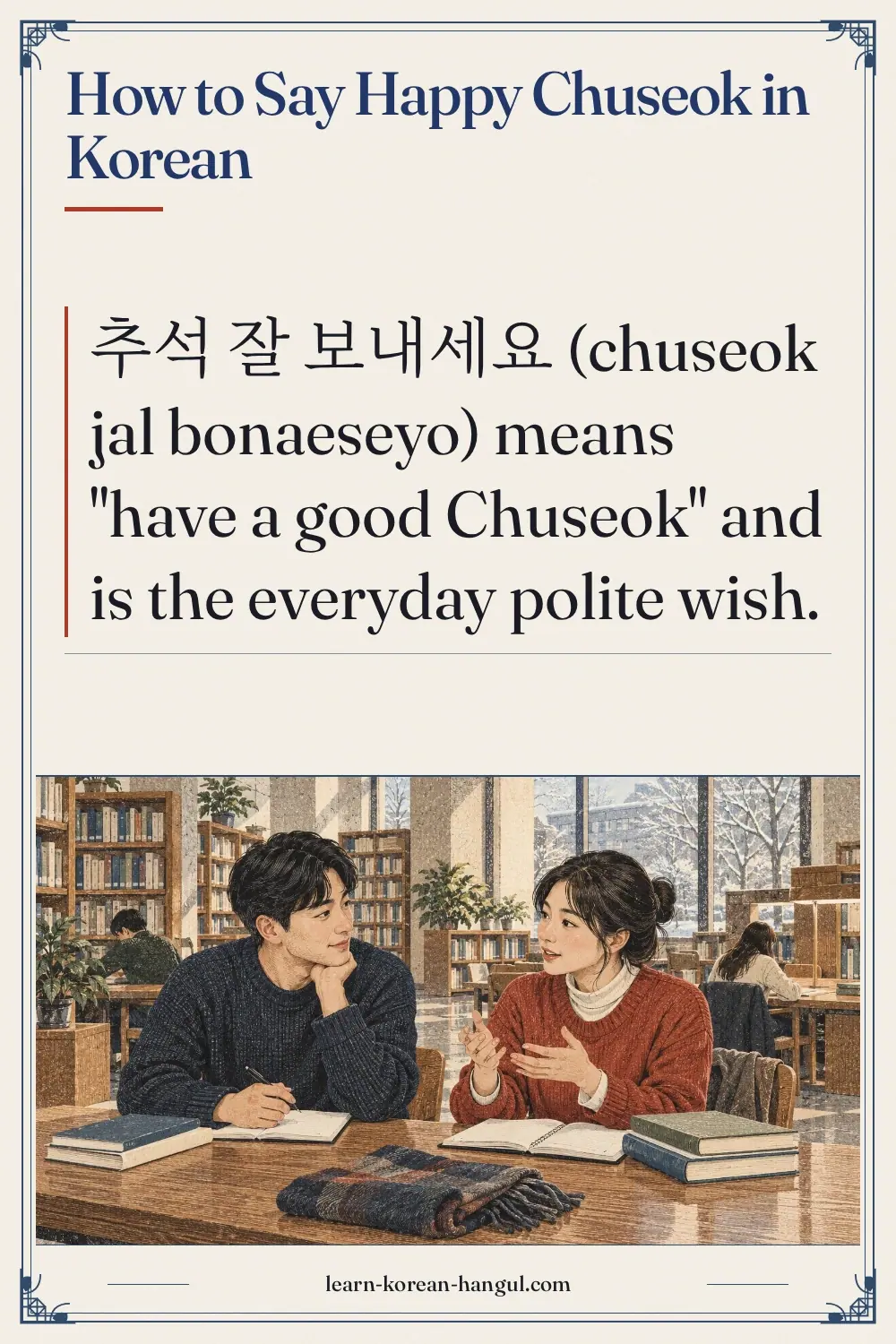
추석 잘 보내세요
추석 잘 보내세요
What you'll learn
- Say 추석 잘 보내세요, 풍성한 한가위 되세요 and 즐거운 추석 보내세요 and match each one to a listener.
- Pronounce 한가위, 풍성한 and 보내세요 with the right syllables.
- Wish a colleague, a neighbour and a grandparent a good holiday in three short scenes.
- Avoid the most common mistake, which is saying 해피 추석 or 추석 축하해요.
Before you start: you only need basic Hangul. For the holiday itself, see chuseok in Korean, which lists the holiday words. Time: about 12 minutes. Audio plays only when you press a button.
How Do You Say Happy Chuseok in Korean?
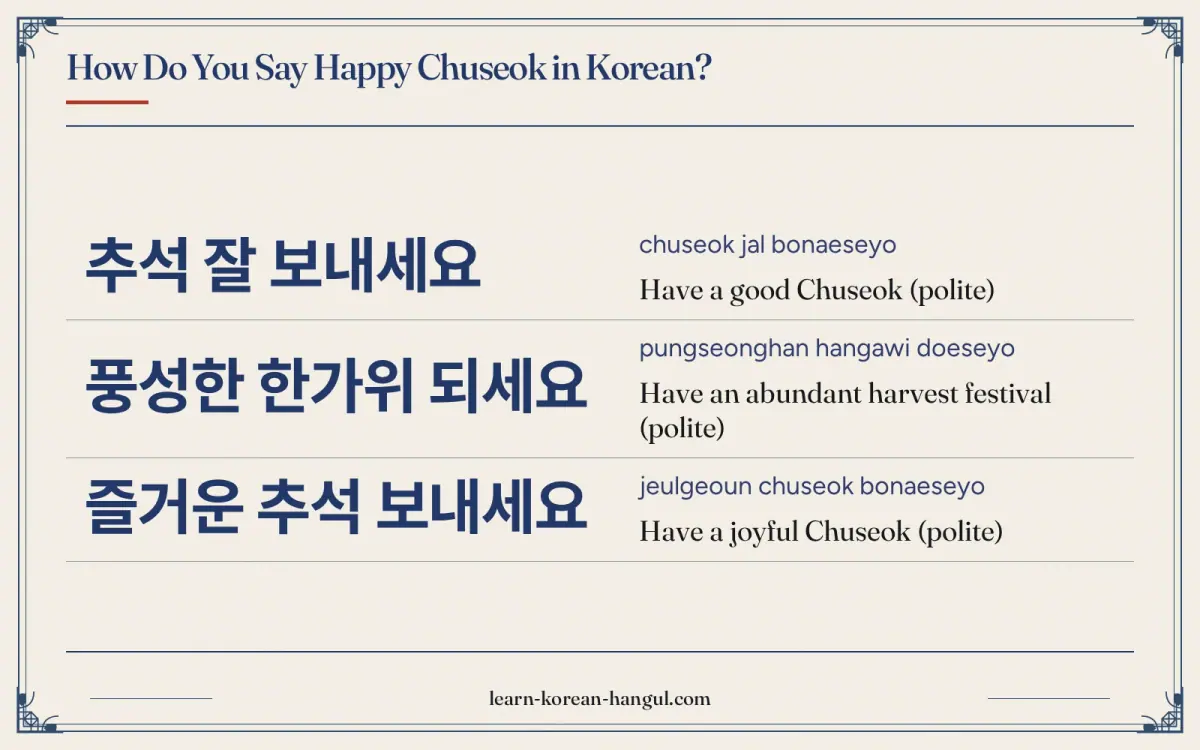
The most useful way to say happy chuseok in Korean is 추석 잘 보내세요. Word by word, 추석 (chuseok) is the holiday, 잘 (jal) means "well", and 보내세요 (bonaeseyo) is the polite, honorific request to "spend" a time. So the whole wish is "Please spend Chuseok well".
| Korean | Romanization | Meaning | Where you hear it |
|---|---|---|---|
| 추석 잘 보내세요 | chuseok jal bonaeseyo | Have a good Chuseok (polite) | Everyone, the day before the holiday |
| 풍성한 한가위 되세요 | pungseonghan hangawi doeseyo | Have an abundant harvest festival (polite) | Cards, banners, warm greetings |
| 즐거운 추석 보내세요 | jeulgeoun chuseok bonaeseyo | Have a joyful Chuseok (polite) | Friends, coworkers |
Revised Romanization (the South Korean government standard of 2000) is only a reading aid here. Learn the Hangul first. The next section shows how to choose between the forms.
What Are the Polite Ways to Say Happy Chuseok?
Happy chuseok in Korean has several polite forms and one casual form, and the listener and the mood decide. All of the polite forms end in -세요, which raises the listener.
Polite: 추석 잘 보내세요 (chuseok jal bonaeseyo)
Polite · 해요체추석 잘 보내세요 is the safe default. Use it with a coworker, a teacher or a neighbour on the last working day before the holiday. It wishes the person a good time without assuming what they will do.
민수 씨, 추석 잘 보내세요.
minsu ssi, chuseok jal bonaeseyo
Min-su, have a good Chuseok.
Polite: 풍성한 한가위 되세요 (pungseonghan hangawi doeseyo)
Polite · 해요체한가위 (hangawi) is the older, native Korean name for Chuseok. It is often explained as 한 ("big") plus 가위 ("middle"), the middle of autumn. 풍성한 (pungseonghan) means "abundant". Together with 되세요 ("please be"), the wish says "I hope your festival is rich and full". It is warm and a little traditional, so it fits cards and older listeners.
선생님, 풍성한 한가위 되세요!
seonsaengnim, pungseonghan hangawi doeseyo
Teacher, I wish you a bountiful harvest festival!
Polite: 즐거운 추석 보내세요 (jeulgeoun chuseok bonaeseyo)
Polite · 해요체즐거운 (jeulgeoun) means "joyful" or "pleasant". This wish is friendlier and a bit lighter than 잘 보내세요. It often comes with a mention of family.
가족들과 즐거운 추석 보내세요.
gajokdeulgwa jeulgeoun chuseok bonaeseyo
Have a joyful Chuseok with your family.
Casual: 추석 잘 보내 (chuseok jal bonae)
Casual · 반말With a close friend, drop the honorific ending. 추석 잘 보내 is short and relaxed, and friends often add "see you after the holiday".
추석 잘 보내! 다음에 보자.
chuseok jal bonae! daeume boja
Have a good Chuseok! See you next time.
Choosing a form is half the job. The other half is saying the words with the right sounds, which the next section breaks down.
How Do You Pronounce 추석 잘 보내세요?
추석 잘 보내세요 is pronounced [추석 잘 보내세요]. The wish has three words and seven syllables, and most of it is said just as it is written. Play the slow clip and follow along.
- 추 (chu): an aspirated ㅊ, with a puff of air, then ㅜ.
- 석 (seok): ㅓ with relaxed, unrounded lips and a closed ㄱ at the end, with no vowel after it.
- 잘 (jal): a plain ㅈ and a light final ㄹ.
- 보 (bo): ㅂ and a rounded ㅗ.
- 내 (nae): ㄴ and ㅐ, like the "e" in "bed".
- 세 (se): ㅅ and ㅔ.
- 요 (yo): a short, light ending.
Sound Changes to Listen For
- Tense ㅈ in fast speech. A final ㄱ makes the next ㅈ tense inside a word (Standard Pronunciation Rules, Article 23). Across a space, many speakers still run the two words together and say [추석짤]. Revised Romanization does not show tensing caused by a neighbouring sound.
- Three syllables in 한가위. 한가위 is han-ga-wi. The last syllable 위 is a diphthong, said as a quick [wi].
- Closed ㄱ in 추석. The final ㄱ is not released, so 추석 ends sharply and does not become "chu-seo-ku".
- Nothing hidden in 풍성한. 풍성한 is said as written: pung-seong-han. The ㅇ endings are the nasal "ng".
- The vowel ㅐ. The standard pronunciation rules still list ㅐ and ㅔ as two vowels, but most Seoul speakers today pronounce them the same. So 보내세요 has two almost identical vowels in a row.
The most common slip is adding a vowel after the final ㄱ of 석. Stop the sound sharply. Once the sound is right, the next question is when to say it.
When Should You Use 추석 잘 보내세요, and When Should You Not?
Say 추석 잘 보내세요 in the last days before Chuseok, when you part from someone who will leave for the holiday. Use the casual form with close friends, and 풍성한 한가위 되세요 in a card or for an older person. The key difference is timing: the wish belongs before the holiday, not on or after it.
Situations Where It Fits
- The last day before the holiday. You leave work and say it to your team.
- A message to relatives. You send 풍성한 한가위 되세요 in a text or a card.
- A neighbour or a shop owner. You exchange the wish in passing.
- A phone call to a grandparent. You say it before you visit.
Situations to Avoid
- Saying 추석 축하해요. It congratulates the holiday, which sounds odd.
- Saying it after Chuseok. Ask 추석 잘 보냈어요? instead.
- Casual 추석 잘 보내 with a boss or an elder. It drops the honorific ending.
Short scenes make these choices clearer. The next section shows three real exchanges.
What Does Happy Chuseok Sound Like in a Real Conversation?
Holiday talk is warm and short. Listen for the wish and the way people return it.
Leaving the Office before the Holiday
Ji-Hyeon
팀장님, 추석 잘 보내세요.
timjangnim, chuseok jal bonaeseyo
Team leader, have a good Chuseok.
Team Leader
고마워요. 지현 씨도 추석 잘 보내요.
gomawoyo. jihyeon ssido chuseok jal bonaeyo
Thanks. You have a good Chuseok too.
Ji-Hyeon
네, 고향에 다녀올게요.
ne, gohyange danyeoolgeyo
Yes, I'll go back to my hometown.
What to notice: the junior uses the honorific 보내세요, and the senior answers with 보내요, the plain polite form. The particle 도 means "too".
Asking about Holiday Plans
Su-Bin
이번 추석에 뭐 해요?
ibeon chuseoge mwo haeyo
What are you doing this Chuseok?
Ha-Na
가족들하고 송편을 만들 거예요.
gajokdeulhago songpyeoneul mandeul geoyeyo
I'll make songpyeon with my family.
Su-Bin
와, 맛있겠어요. 추석 잘 보내요!
wa, masitgesseoyo. chuseok jal bonaeyo
Wow, that sounds delicious. Have a good Chuseok!
What to notice: 만들 거예요 sounds like [만들꺼예요], because the ㄱ becomes tense after the ending -ㄹ. 뭐 해요? is a wh-question, so it does not end in a sharp rise. Songpyeon (송편) are half-moon rice cakes.
A Call to a Grandmother
Grandchild
할머니, 즐거운 추석 보내세요.
halmeoni, jeulgeoun chuseok bonaeseyo
Grandma, have a joyful Chuseok.
Grandmother
고마워. 이번 추석에 꼭 와.
gomawo. ibeon chuseoge kkok wa
Thank you. Be sure to come this Chuseok.
Grandchild
네, 꼭 갈게요.
ne, kkok galgeyo
Yes, I'll definitely come.
What to notice: the grandchild uses the honorific ending, while the grandmother uses the casual 고마워 and 와. 갈게요 sounds like [갈께요], with a tense ㄱ after -ㄹ.
What Should You Know about the Culture behind Happy Chuseok?
Chuseok is one of the two biggest Korean holidays, along with the Lunar New Year. These notes are general, and each family has its own way.
- The date. Chuseok falls on the 15th day of the 8th month of the lunar calendar, so the date in the usual calendar changes every year, usually between early September and early October. Check the yearly lunar calendar from the Korea Astronomy and Space Science Institute or the government holiday notice.
- The holiday. It usually lasts about three days, and many people travel to their family's hometown.
- Ancestors and food. Families hold ancestral rites (차례, charye), visit graves, and make songpyeon (송편), the half-moon rice cakes.
- Thanksgiving, not congratulations. Chuseok is a time of thanks for the harvest and for family, so people wish each other a good time rather than congratulating each other.
An expert tip: say the wish in the days before the holiday, and return it with the same words. Because Korean puts respect in the ending, -세요 matters more than the exact wording. For the structure behind the endings, see Korean speech levels, which explains why -세요 raises the listener. For the other big holiday, happy new year in Korean teaches the New Year wish, and merry christmas in Korean covers the Christmas wish.
What Mistakes Do Learners Make with Happy Chuseok in Korean?
Most mistakes come from translating "happy" and "congratulations" word for word.
| Mistake | Why it is a problem | Fix |
|---|---|---|
| Saying 해피 추석 | It is a word-for-word translation | Say 추석 잘 보내세요 |
| Saying 추석 축하해요 | It congratulates a holiday | Say 즐거운 추석 보내세요 |
| Saying it after the holiday | The wish is for the time ahead | Ask 추석 잘 보냈어요? |
| Using 추석 잘 보내 with a boss | It drops the honorific ending | Add -세요 |
| Adding a vowel after 석 | The final ㄱ is closed | Stop the sound sharply |
| Using 추수감사절 for Chuseok | That is the North American holiday | Say 추석 or 한가위 |
Learners often think there must be a word for "happy". In Korean, 잘 보내세요 wishes a good time, and the holiday name completes the idea.
Is It the Same as Chuseok in Korean, Korean Thanksgiving or Harvest Festival?
Mostly yes. These searches all point to the same holiday and the same small set of wishes.
- Chuseok in Korean: 추석 is the name of the holiday. The wish adds 잘 보내세요.
- Korean Thanksgiving: Chuseok is the Korean harvest and family holiday that people compare with Thanksgiving. The name 추수감사절 (chusugamsajeol) is the North American holiday, not Chuseok.
- Harvest festival in Korean: 한가위 (hangawi) is the native name, and 풍성한 한가위 되세요 is the matching wish.
Practice: Say It Aloud
Play the slow clip and repeat 추석 잘 보내세요 three times, then choose the best wish for each person. Answers follow.
- Your coworker leaves for the holiday.
- A teacher, in a card.
- Your close friend.
- How many syllables does 한가위 have?
Answers
- 추석 잘 보내세요.
- 풍성한 한가위 되세요.
- 추석 잘 보내.
- Three: han-ga-wi.
The phrase flashcards drill these wishes with audio.
Related Phrases to Learn Next
Holiday wishes connect to several celebration phrases.
- happy new year in Korean: the wish for the other big holiday.
- merry christmas in Korean: the wish for Christmas.
- happy birthday in Korean: the wish that does use a congratulation word.
This guide belongs to the korean celebration phrases collection. What this page does not cover: ancestral rite wording, gift-giving customs and the full list of Chuseok foods. Learn 추석 잘 보내세요 for most people and 풍성한 한가위 되세요 for cards, and you can say happy chuseok in Korean to anyone.
Frequently Asked Questions
How do you say happy chuseok in Korean?
Say 추석 잘 보내세요 (chuseok jal bonaeseyo), which means "have a good Chuseok". Korean wishes people a good holiday and does not congratulate them. You can also say 풍성한 한가위 되세요 for a warm, traditional wish, or 즐거운 추석 보내세요 for a joyful holiday. Say it before the holiday starts.
How do you pronounce 추석 잘 보내세요?
It is pronounced [추석 잘 보내세요]. The final ㄱ of 석 is a closed sound with no vowel after it, and many speakers tense the ㅈ of 잘 so that it sounds like [추석짤]. The rest is said as written. Revised Romanization writes chuseok jal bonaeseyo and does not show the tense sound.
What is the difference between 추석 잘 보내세요 and 풍성한 한가위 되세요?
추석 잘 보내세요 is the everyday wish, and it fits colleagues, neighbours and elders. 풍성한 한가위 되세요 is more traditional and poetic. It uses 한가위, the older native name for Chuseok, and 풍성한 (abundant), so it wishes a rich harvest. Both are polite, and the second is common in cards and shop banners.
Can I use 추석 잘 보내세요 with friends, elders and strangers?
Yes. The ending -세요 is honorific and polite, so it fits elders, bosses, coworkers and shop staff. With a close friend you can say the casual 추석 잘 보내. Strangers rarely exchange holiday wishes, but a shop clerk or a neighbour may say it first, and you can answer with the same words.
What is the most common mistake with happy chuseok in Korean?
Saying 해피 추석 or 추석 축하해요. Koreans normally wish people a good holiday with 잘 보내세요 rather than congratulating them. A second slip is saying it after the holiday. Afterwards, ask 추석 잘 보냈어요?, which means "Did you have a good Chuseok?"
Is Chuseok the same as Korean Thanksgiving or the harvest festival?
Yes, Chuseok is often called Korean Thanksgiving, and 한가위 is the older name for the harvest festival. Families give thanks for the harvest and honour their ancestors. The North American holiday is a different one, called 추수감사절 (chusugamsajeol), so do not use that word for Chuseok.