
메리 크리스마스
메리 크리스마스
What you'll learn
- Say 메리 크리스마스 with five clear Korean syllables in 크리스마스.
- Choose between 메리 크리스마스, 크리스마스 잘 보내세요, 즐거운 성탄절 보내세요 and 성탄 축하드립니다 for a stranger, a senior and a friend.
- Pronounce 행복한 as [행보칸].
- Avoid the casual use of 성탄절 and the half-English 해피 크리스마스.
Before you start: you need to read Hangul; romanization is shown as an aid and can be hidden. Time: about 10 minutes.
Key facts
- 메리 크리스마스 (meri keuriseumaseu) is the everyday greeting, borrowed from English, and it fits coworkers, friends and couples.
- 즐거운 성탄절 보내세요 and 행복한 크리스마스 되세요 are polite wishes meaning "have a happy Christmas".
- 크리스마스 has five syllables: keu-ri-seu-ma-seu.
How Do You Say Merry Christmas in Korean?
The standard way to say merry christmas in Korean is 메리 크리스마스. It is a loanword, a word taken from another language and written in Hangul, so it sounds close to English and every Korean speaker knows it. Korean also has polite wishes built on native and Sino-Korean words, and the table lists them side by side.
| Form | Romanization | Meaning | Register |
|---|---|---|---|
| 메리 크리스마스 | meri keuriseumaseu | Merry Christmas | Everyday, friendly |
| 크리스마스 잘 보내세요 | keuriseumaseu jal bonaeseyo | Have a good Christmas | Polite |
| 즐거운 성탄절 보내세요 | jeulgeoun seongtanjeol bonaeseyo | Have a happy Christmas | Polite, a little formal |
| 행복한 크리스마스 되세요 | haengbokan keuriseumaseu doeseyo | Have a happy Christmas | Polite |
| 성탄 축하드립니다 | seongtan chukadeurimnida | Congratulations on Christmas | Formal, often church or cards |
| 크리스마스 잘 보내 | keuriseumaseu jal bonae | Have a good Christmas | Casual |
The first form is the one to learn first. The others add a wish and a level of respect, and the next section shows each one with an example.
What Are the Polite Ways to Say Merry Christmas?
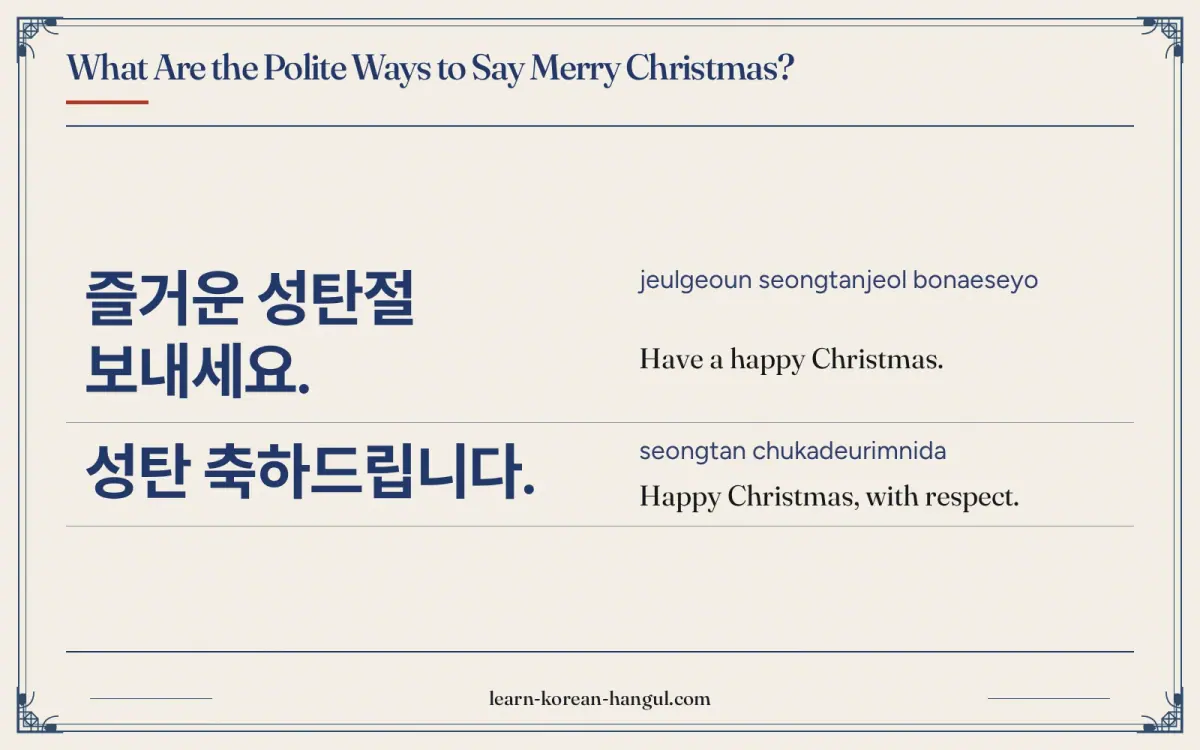
Merry christmas in Korean follows the Korean speech levels, the endings that change with the listener's age, status and closeness, explained in the guide to Korean speech levels. The loanword stays the same for everyone, while the wishes change their endings.
Everyday: 메리 크리스마스 (meri keuriseumaseu)
Polite · 해요체메리 크리스마스 has no ending, so it sits outside the speech levels and sounds friendly to almost everyone. Say it to coworkers, neighbours and friends, with a smile and a short nod. It is also the line printed on most cards and shop signs.
메리 크리스마스, 김 대리님.
meri keuriseumaseu, gim daerinim
Merry Christmas, Mr. Kim.
Polite: 크리스마스 잘 보내세요 (keuriseumaseu jal bonaeseyo)
Polite · 해요체잘 보내세요 means "spend it well". The ending -(으)세요 is the honorific polite ending, which shows respect to the listener. The same pattern appears in wishes for weekends and holidays, such as 주말 잘 보내세요.
선생님, 크리스마스 잘 보내세요.
seonsaengnim, keuriseumaseu jal bonaeseyo
Teacher, have a good Christmas.
Polite: 즐거운 성탄절 보내세요 (jeulgeoun seongtanjeol bonaeseyo)
Polite · 해요체즐거운 means "enjoyable", and 성탄절 means "the Day of the Nativity", the formal name used by churches and the news. This wish sounds a little more careful and fits messages to elders, to teachers and to members of a congregation.
즐거운 성탄절 보내세요.
jeulgeoun seongtanjeol bonaeseyo
Have a happy Christmas.
Polite: 행복한 크리스마스 되세요 (haengbokan keuriseumaseu doeseyo)
Polite · 해요체행복한 means "happy", and 되세요 comes from 되다, "to become", so the phrase wishes that Christmas "becomes" a happy one for the listener. It is a common line in messages and cards. Language guides, including the National Institute of Korean Language, point out that 되세요 is grammatically odd here, since the listener does not "become" Christmas, and recommend 행복한 크리스마스 보내세요; both are widely used. The first word is pronounced [행보칸], and the sound change is explained in the pronunciation section below.
가족과 함께 행복한 크리스마스 되세요.
gajokgwa hamkke haengbokan keuriseumaseu doeseyo
Have a happy Christmas with your family.
Formal: 성탄 축하드립니다 (seongtan chukadeurimnida)
Formal · 합쇼체성탄 축하드립니다 means "I congratulate you on the Nativity" and uses the formal humble ending -드립니다. It is the style of a church greeting, a pastor's message or a formal card, and it is rare in daily conversation. Recognise it when you hear it, and use it with congregations and senior contacts.
성탄 축하드립니다.
seongtan chukadeurimnida
Happy Christmas, with respect.
Casual: 크리스마스 잘 보내 (keuriseumaseu jal bonae)
Casual · 반말With close friends, drop the honorific ending and say 크리스마스 잘 보내. Friends mostly say 메리 크리스마스 and add a plan, such as 오늘 뭐 해? (What are you doing today?).
메리 크리스마스. 오늘 뭐 해?
meri keuriseumaseu. oneul mwo hae
Merry Christmas. What are you doing today?
Each version answers the same wish at a different distance from the listener. The sounds come next, because the long loanword trips up many learners.
How Do You Pronounce 메리 크리스마스?
메리 크리스마스 is pronounced [메리 크리스마스]. The first word has two syllables and the second has five, so the whole greeting has seven beats. Follow these steps for 크리스마스:
- 크 (keu): a quick "k" and the vowel ㅡ, said with flat, unrounded lips, a little like the "u" in "put" with the lips spread.
- 리 (ri): a light tap of the tongue, between an English "r" and "l", plus "ee".
- 스 (seu): "s" plus ㅡ. Keep the vowel, so you do not say a bare "s".
- 마 (ma): an open "mah".
- 스 (seu): the same as step 3, short and light.
English speakers often squeeze the word into "Christ-mas" with two syllables, but Korean needs all five. The vowel ㅡ after each consonant is what makes it a Korean word.
Sound Changes to Listen For
- Aspiration across a syllable edge in 행복한. When ㄱ at the end of 복 meets ㅎ at the start of 한, the two sounds merge into the aspirated [ㅋ]. So 행복한 is [행보칸]. This follows the standard pronunciation rules (표준 발음법), Article 12, and the full rule is explained in Korean aspiration before ㅎ.
- A clear 성탄절. In 성탄절 the sounds stay as written: [성탄절]. Say each syllable evenly.
- No change in 보내세요 and 되세요. Both are pronounced as written, so say each syllable clearly.
Revised Romanization, the official system for writing Korean in Latin letters, writes meri keuriseumaseu and haengbokan. Because 행복한 is an adjective form, RR writes the merged [ㅋ] as k; in nouns it keeps the h instead, as in 축하 (chukha). Romanization is only a guide; the Hangul is the real spelling. Pronunciation is half the picture, and the other half is knowing when to use each greeting.
When Should You Use 메리 크리스마스, and When Should You Not?
Use 메리 크리스마스 when you want a friendly, simple greeting on or before 25 December. Use 크리스마스 잘 보내세요 when you part from someone before the holiday. Add the formal 성탄 축하드립니다 for a church or a very senior contact.
Situations Where It Fits
- On the day itself. Greet neighbours, friends and coworkers with 메리 크리스마스.
- When leaving work before the holiday. 크리스마스 잘 보내세요 works like "have a good holiday".
- In a message or card. 즐거운 성탄절 보내세요 or 행복한 크리스마스 되세요 sounds warm and polite.
- At church. 성탄 축하드립니다 is the usual greeting.
Situations to Avoid
- 성탄절 in casual speech. Friends will find it too formal.
- A church greeting to people outside church. 성탄 축하드립니다 is religious in tone, so with people who do not go to church the secular 메리 크리스마스 is the safer choice.
- Wrong register to elders. A bare 크리스마스 잘 보내 to a boss is too casual.
Three short exchanges show these choices in practice.
What Does Merry Christmas Sound Like in a Real Conversation?
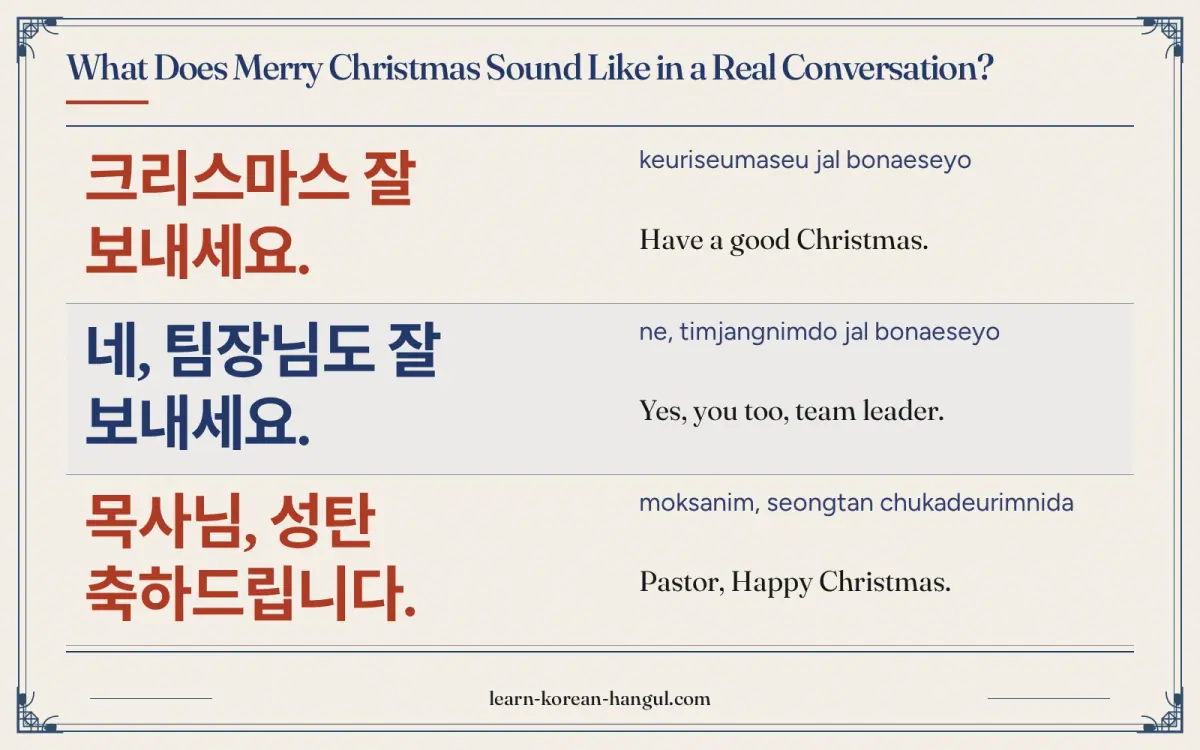
In real exchanges, the greeting is usually followed by a question about plans or a wish for the new year. Listen for what comes next.
Coworkers on 24 December
Team Leader
크리스마스 잘 보내세요.
keuriseumaseu jal bonaeseyo
Have a good Christmas.
You
네, 팀장님도 잘 보내세요.
ne, timjangnimdo jal bonaeseyo
Yes, you too, team leader.
What to notice: the reply repeats the wish and adds 도 (also), so you return the greeting politely.
Friends Meet on Christmas Day
Minsu
메리 크리스마스. 오늘 계획 있어?
meri keuriseumaseu. oneul gyehoek isseo?
Merry Christmas. Do you have plans today?
Sua
응, 친구들이랑 케이크 먹으러 가.
eung, chingudeurirang keikeu meogeureo ga
Yes, I'm going to eat cake with friends.
What to notice: friends use the short greeting and the casual ending -어, with no -요.
Greeting after a Church Service
Member
목사님, 성탄 축하드립니다.
moksanim, seongtan chukadeurimnida
Pastor, Happy Christmas.
Pastor
감사합니다. 즐거운 성탄절 보내세요.
gamsahamnida. jeulgeoun seongtanjeol bonaeseyo
Thank you. Have a happy Christmas.
What to notice: a church setting uses the formal 성탄 and 성탄절, which would sound stiff among friends. These choices also reflect how Christmas feels in Korea.
What Should You Know about the Culture behind Merry Christmas?
Christmas Day is a public holiday in South Korea, and many people treat it as a festive day for couples and friends. Streets, shops and cafes put up lights and trees, people buy Christmas cakes, and many go out on Christmas Eve (크리스마스 이브, keuriseumaseu ibeu) as well. Families tend to gather for the big traditional holidays, Seollal (Lunar New Year) and Chuseok, rather than Christmas.
- Couples and friends. Dates, dinners and small gifts (선물, seonmul) are common, and cakes are a familiar treat.
- Churches. Many congregations hold services and celebrate with special programmes, and the formal wishes are heard there.
- Greeting style. A short 메리 크리스마스 and a smile are normal, and long speeches are not expected.
- Year-end greetings. Many people add 새해 복 많이 받으세요 (a blessed new year) for the new-year side of the season. See happy new year in Korean.
An expert insight: learners expect Christmas to be a family holiday, as in many English-speaking countries, and plan greetings like "see you with your family". In Korea, the cultural weight is usually lighter and more social, so a casual 크리스마스 계획 있어요? (do you have plans?) fits better than a family question. The mistakes below come from this difference and from register.
What Mistakes Do Learners Make with Merry Christmas in Korean?
Most mistakes come from register, borrowed English habits and pronunciation.
| Mistake | Why it is a problem | Fix |
|---|---|---|
| Saying 성탄절 to a friend | Formal, church style | Say 메리 크리스마스 |
| Saying 해피 크리스마스 | Half-English and less usual | Say 메리 크리스마스 |
| Saying "Christ-mas" in two syllables | Drops three Korean vowels | Say keu-ri-seu-ma-seu |
| Pronouncing 행복한 as [행복한] | The ㄱ and ㅎ merge into ㅋ | Say [행보칸] |
| Using a bare 크리스마스 잘 보내 with a boss | Casual ending | Add -세요: 크리스마스 잘 보내세요 |
Learners often assume that the longest, most formal phrase is the most polite choice. In fact, an overly formal 성탄 축하드립니다 between colleagues who say 메리 크리스마스 can sound distant, so match the mood of the room.
Other Ways People Search for Merry Christmas in Korean
People search for merry christmas in Korean in several forms. The short answers below cover each one.
- Christmas in Korean: the word is 크리스마스 (keuriseumaseu); the holiday's formal name is 성탄절 (seongtanjeol). The page for christmas in Korean gives the full word entry.
- Xmas in Korean: Korean has no common Hangul short form like Xmas, so 크리스마스 is written in full.
- Christmas greeting in Korean: 메리 크리스마스 is the everyday greeting, and 크리스마스 잘 보내세요 is the polite wish.
A greeting is easy to read and harder to say on cue, so practise now.
Practice: Say It Aloud
Play the slow clip of 메리 크리스마스, repeat it three times, then try 행복한 as [행보칸]. Then choose a greeting for each situation. Answers follow.
- You meet a neighbour in the lift on Christmas Day.
- You leave the office on 24 December and speak to your boss.
- A close friend texts you at midnight on Christmas Eve.
- You greet your pastor after the service.
Answers
- 메리 크리스마스.
- 크리스마스 잘 보내세요.
- 메리 크리스마스 (and a friendly 오늘 뭐 해? if you want to chat).
- 성탄 축하드립니다.
Drill 메리 크리스마스 and the related phrases with the phrase flashcards, which include audio for each form.
Related Phrases to Learn Next
Merry Christmas belongs to the year-end group of wishes that learners meet each December.
- Happy new year in Korean: 새해 복 많이 받으세요 and its variants.
- Happy birthday in Korean: 생일 축하해요 and the polite forms.
- Cheers in Korean: 건배 for a toast at the party.
- Christmas in Korean: the word 크리스마스 on its own.
This guide belongs to the korean celebration phrases collection. What this page does not cover: Korean Christmas songs, church liturgy and gift-giving etiquette. Use 메리 크리스마스 for most people, 크리스마스 잘 보내세요 for seniors and 성탄 축하드립니다 in church, and you can say merry christmas in Korean with the right level of respect.
Frequently Asked Questions
How do you say merry christmas in Korean?
Say 메리 크리스마스 (meri keuriseumaseu). It is the English greeting written in Hangul and is understood by everyone, from coworkers to children. For a more polite wish, say 크리스마스 잘 보내세요 (keuriseumaseu jal bonaeseyo, have a good Christmas) or 즐거운 성탄절 보내세요 (jeulgeoun seongtanjeol bonaeseyo, have a happy Christmas).
How do you pronounce 메리 크리스마스?
Say meh-ri, then keu-ri-seu-ma-seu, five syllables with even weight. 메리 is [메리]. In 크리스마스 the vowel ㅡ is said with flat, unrounded lips, and the 스 syllables keep it, so do not add an English "Christ" sound or drop the vowels. The whole greeting is pronounced [메리 크리스마스], and the Hangul spelling is the real guide.
What is the difference between 메리 크리스마스 and 즐거운 성탄절 보내세요?
메리 크리스마스 is a borrowed English greeting that sounds friendly and works everywhere. 즐거운 성탄절 보내세요 is a full polite sentence meaning "have a happy Christmas", and it uses 성탄절, the formal name of the holiday. It sounds more careful and fits cards, church and elders, while 메리 크리스마스 fits chat and daily talk.
Can I use 메리 크리스마스 with friends, elders and strangers?
Yes. 메리 크리스마스 is friendly and fits friends, coworkers and shop staff, and most elders accept it. For a teacher, a boss or a church member, add a polite wish such as 크리스마스 잘 보내세요 or 성탄 축하드립니다 so the greeting sounds respectful. Among close friends, a short 메리 크리스마스 is enough.
What is the most common mistake with merry christmas in Korean?
The most common mistake is using 성탄절 in casual speech, where it sounds like a church or a news report. The second mistake is saying 해피 크리스마스, a half-English mix that is less usual than 메리 크리스마스. The third is mispronouncing 크리스마스 with English sounds instead of five Korean syllables.