밸런타인데이 잘 보내요
밸런타인데이 잘 보내요
What you'll learn
- Say 밸런타인데이 잘 보내요, 초콜릿 받아 주세요, 화이트데이 and 좋아해요 and match each one to a moment.
- Pronounce 밸런타인데이, 초콜릿 and 받아 correctly.
- Give chocolate, answer a gift and make a simple confession in three short scenes.
- Avoid the most common mistake, which is assuming the gift-giving direction is the same as in the West.
Before you start: you only need basic Hangul and the polite ending 요. If you want the stronger confession, see i love you in Korean. Time: about 12 minutes. Audio plays only when you press a button.
How Do You Say Happy Valentine's Day in Korean?
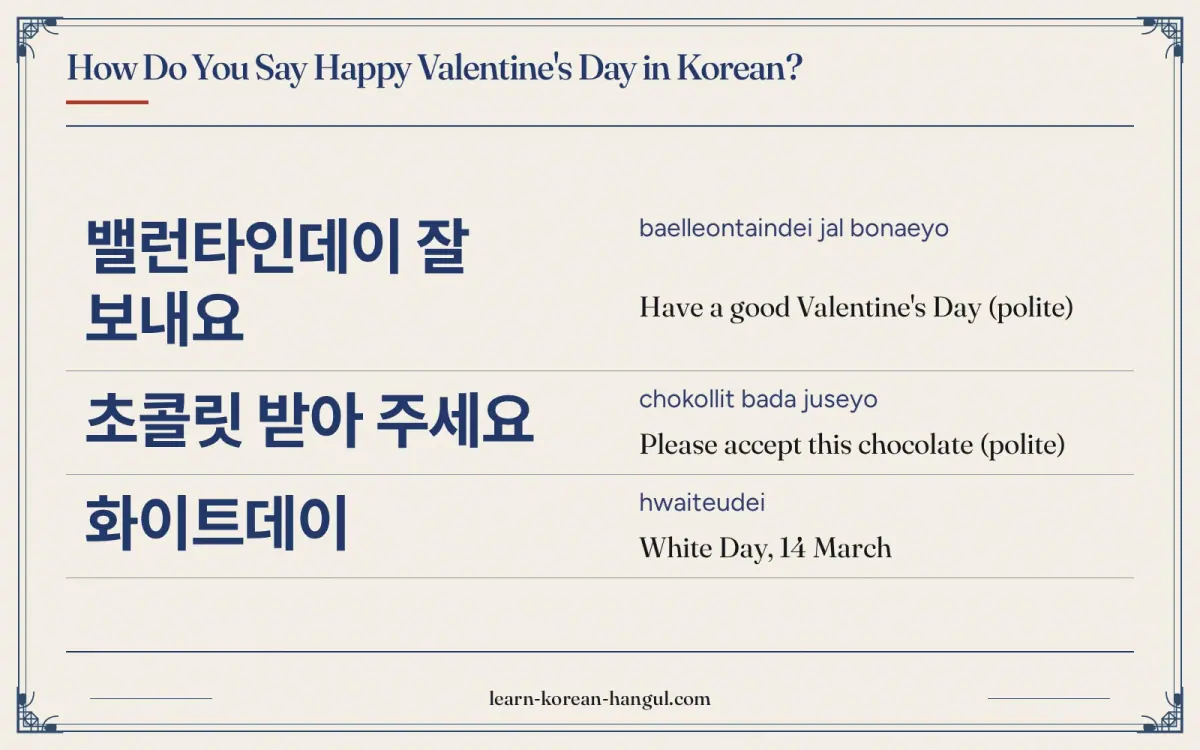
The most useful way to say happy valentine's day in Korean is 밸런타인데이 잘 보내요. Word by word, 밸런타인데이 (baelleontaindei) is the holiday name, 잘 (jal) means "well", and 보내요 (bonaeyo) means "spend" in the polite style. So the whole wish is "Spend Valentine's Day well". 밸런타인데이 is the standard spelling under the Korean Loanword Orthography (외래어 표기법). You will also see 발렌타인데이 (ballentaindei) very often on shop signs and packaging, and both are read the same way in everyday speech.
| Korean | Romanization | Meaning | Where you hear it |
|---|---|---|---|
| 밸런타인데이 잘 보내요 | baelleontaindei jal bonaeyo | Have a good Valentine's Day (polite) | Friends, coworkers, partners |
| 초콜릿 받아 주세요 | chokollit bada juseyo | Please accept this chocolate (polite) | When you hand over a gift |
| 화이트데이 | hwaiteudei | White Day, 14 March | A month later |
| 좋아해요 | joahaeyo | I like you (a confession line) | A shy confession |
Revised Romanization (the South Korean government standard of 2000) is only a reading aid here. Learn the Hangul first. The next section shows how to choose between the forms.
What Are the Polite Ways to Say Happy Valentine's Day?
Happy valentine's day in Korean has a wish, a gift line and a confession line, and the moment decides which one fits. All of them are polite, so they suit people you know a little.
Polite: 밸런타인데이 잘 보내요 (baelleontaindei jal bonaeyo)
Polite · 해요체밸런타인데이 잘 보내요 is the safe default wish. Use it with a friend, a classmate or a coworker on the day itself or the day before. For an elder or a boss, raise it with 보내세요: 밸런타인데이 잘 보내세요.
민수 씨, 밸런타인데이 잘 보내요!
minsu ssi, baelleontaindei jal bonaeyo
Min-su, have a good Valentine's Day!
Polite: 초콜릿 받아 주세요 (chokollit bada juseyo)
Polite · 해요체초콜릿 받아 주세요 means "please accept this chocolate". 받아 주세요 is a gentle request to take something from you. It is what you say as you hand over a gift, and it sounds modest and kind.
이거 직접 만들었어요. 초콜릿 받아 주세요.
igeo jikjeop mandeureosseoyo. chokollit bada juseyo
I made this myself. Please accept this chocolate.
White Day: 화이트데이 (hwaiteudei)
Polite · 해요체화이트데이 is White Day, on 14 March, a month after Valentine's Day. The person who received chocolate gives candy back. In the sentence below, the speaker promises to do so.
한 달 뒤에는 화이트데이예요. 사탕 줄게요.
han dal dwieneun hwaiteudeiyeyo. satang julgeyo
A month later it is White Day. I'll give you candy.
Confession: 좋아해요 (joahaeyo)
Polite · 해요체좋아해요 means "I like you" or "I like it". On Valentine's Day it is a gentle confession, much lighter than 사랑해요 ("I love you"). Add the person's name and the object particle 를 to make it clear.
저는 지수 씨를 좋아해요.
jeoneun jisu ssireul joahaeyo
I like you, Ji-su.
Casual: 밸런타인데이 잘 보내 (baelleontaindei jal bonae)
Casual · 반말Close friends drop the ending: 밸런타인데이 잘 보내. A casual confession is 좋아해 (joahae). Use them only with people your own age whom you know well.
Choosing a form is half the job. The other half is saying the words with the right sounds, which the next section breaks down.
How Do You Pronounce 밸런타인데이 잘 보내요?
밸런타인데이 잘 보내요 is pronounced [밸런타인데이 잘 보내요]. The wish has three words and ten syllables, and the first word is long, so take it slowly. Play the slow clip and follow along.
- 밸 (bael): ㅂ, ㅐ and a light final ㄹ.
- 런 (leon): the ㄹ is long, because it meets the ㄹ of 밸, so you hear "bael-leon". The ㅓ is unrounded.
- 타 (ta): an aspirated ㅌ, with a puff of air.
- 인 (in): a short ㅣ and ㄴ.
- 데 (de): a plain ㄷ and ㅔ.
- 이 (i): a short ㅣ, so 데이 sounds like English "day".
- 잘 (jal): a plain ㅈ and a light ㄹ.
- 보 (bo): ㅂ and a rounded ㅗ.
- 내 (nae): ㄴ and ㅐ.
- 요 (yo): a short, light ending.
Sound Changes to Listen For
- Doubled ㄹ in 밸런. The two ㄹ sounds meet and make one long l. Revised Romanization writes ll: baelleon.
- Final ㅅ in 초콜릿. A final ㅅ is said as ㄷ when nothing follows, so 초콜릿 is [초콜릳]. Revised Romanization writes chokollit. With a vowel after it, the ㅅ comes back: 초콜릿이 is [초콜리시].
- Linking in 받아. The final ㄷ of 받 slides onto the vowel of 아, so 받아 is [바다]. Revised Romanization writes bada.
- Silent ㅎ in 좋아해요. The ㅎ in 좋 is silent before a vowel, so you hear [조아해요]. Revised Romanization writes joahaeyo.
- The vowel ㅐ. The standard pronunciation rules still list ㅐ and ㅔ as two vowels, but most Seoul speakers today pronounce them the same. So 보내요 and 데이 have the same "e" vowel.
The most common slip is to say 밸런타인 with a single ㄹ. Hold the ㄹ a little longer. Once the sound is right, the next question is when to say it.
When Should You Use 밸런타인데이 잘 보내요, and When Should You Not?
Use 밸런타인데이 잘 보내요 on or just before 14 February, with people you know. Use 초콜릿 받아 주세요 when you hand over a gift. Use 좋아해요 only when you mean it as a confession. The key difference is the purpose: the wish is friendly, the gift line is kind, and the confession is personal.
Situations Where It Fits
- A school or office exchange. You give chocolate to a friend or a coworker.
- A couple's day. You wish your partner a good day with a small gift.
- A shy confession. You hand over chocolate and say 좋아해요.
- A message. You send the wish in a chat on the morning of the day.
Situations to Avoid
- Casual 좋아해 with someone you barely know. It can feel too forward.
- Using 사랑해요 for a light confession. It is much stronger.
- Expecting the Western gift order. In Korea, the traditional order is the opposite, as the culture section explains.
Short scenes make these choices clearer. The next section shows three real exchanges.
What Does Happy Valentine's Day Sound Like in a Real Conversation?
Valentine's talk is short and a little shy. Listen for the gift line and the wish.
Giving Chocolate to a Coworker
Ha-Na
민수 씨, 이거 받아 주세요. 밸런타인데이 초콜릿이에요.
minsu ssi, igeo bada juseyo. baelleontaindei chokollisieyo
Min-su, please take this. It's Valentine's chocolate.
Min-Su
와, 감사합니다! 밸런타인데이 잘 보내요.
wa, gamsahamnida! baelleontaindei jal bonaeyo
Wow, thank you! Have a good Valentine's Day.
Min-Su
한 달 뒤에 사탕 줄게요.
han dal dwie satang julgeyo
I'll give you candy in a month.
What to notice: 초콜릿이에요 sounds like [초콜리시에요], because the ㅅ moves to the next syllable. Min-su's second line points ahead to White Day. 줄게요 sounds like [줄께요], with a tense ㄱ after -ㄹ.
A Shy Confession
Ji-Hyeon
민수 씨, 이거 직접 만들었어요. 초콜릿 받아 주세요.
minsu ssi, igeo jikjeop mandeureosseoyo. chokollit bada juseyo
Min-su, I made this myself. Please accept this chocolate.
Min-Su
정말요? 고마워요.
jeongmaryo? gomawoyo
Really? Thank you.
Ji-Hyeon
그리고… 저는 민수 씨를 좋아해요.
geurigo... jeoneun minsu ssireul joahaeyo
And... I like you, Min-su.
Min-Su
저도요.
jeodoyo
Me too.
What to notice: in common speech, 정말요? is often pronounced [정말료]. A ㄴ sound slips in before 요, and it turns into ㄹ after the ㄹ of 말. Revised Romanization does not show this, so it writes jeongmaryo. The line 저도요 means "me too", and the particle 도 means "also".
Two Friends Make Plans
Su-Bin
밸런타인데이 잘 보내!
baelleontaindei jal bonae
Have a good Valentine's Day!
Ji-Ho
너도. 오늘 약속 있어?
neodo. oneul yaksok isseo
You too. Do you have plans today?
Su-Bin
아니, 친구랑 영화 볼 거야.
ani, chingurang yeonghwa bol geoya
No, I'm going to watch a movie with a friend.
What to notice: friends drop the ending 요 in every line. 약속 있어? is a yes or no question, so it ends with a rise. 볼 거야 sounds like [볼꺼야], with a tense ㄱ after -ㄹ.
What Should You Know about the Culture behind Happy Valentine's Day?
Valentine's Day in Korea follows its own pattern. These are general habits, and people differ by age and group.
- The direction of gifts. On 14 February, women traditionally give chocolate to men. On 14 March, White Day, men return candy.
- Customs are loosening. Many people now give gifts both ways, and friends and coworkers may swap sweets, so you do not need to follow the old pattern strictly.
- A calendar of 14ths. Couples also mark the 14th of other months, and popular lists give each one a theme, though how seriously people take them varies.
- Black Day. On 14 April, some people who received nothing eat black noodles, 짜장면 (jjajangmyeon). It is a playful custom.
An expert tip: pair the gift line with a clear, light wish. Because Korean puts respect in the ending, 받아 주세요 followed by 잘 보내요 sounds kind and not pushy. For the structure behind the endings, see Korean speech levels, which explains why 요 makes a sentence polite. If the day is also a relationship milestone, happy anniversary in Korean teaches the next wish.
What Mistakes Do Learners Make with Happy Valentine's Day in Korean?
Most mistakes come from the culture and from word-for-word translation.
| Mistake | Why it is a problem | Fix |
|---|---|---|
| Expecting men to give first | The traditional order is the opposite | Remember White Day, 14 March |
| Saying 해피 밸런타인데이 only | It is borrowed English and sounds less natural than a wish | Say 밸런타인데이 잘 보내요 |
| Saying 사랑해요 for a light confession | It is much stronger | Say 좋아해요 |
| Saying 잘 보내 to an elder | It drops the polite ending | Say 잘 보내세요 |
| Saying 밸런타인 with one ㄹ | The two ㄹ sounds form a long l | Say bael-leon |
| Writing only the English "Valentine" | The loanword has a standard Hangul spelling | Write 밸런타인데이 (the common spelling is 발렌타인데이) |
Learners often think there must be a Korean word for "happy". In Korean, 잘 보내요 wishes a good day, and the holiday name completes the idea.
Is It the Same as Valentine, Valentines Day, White Day or Valentine's Day in Korean?
Mostly yes. These searches all point to the same holiday and the same small set of phrases.
- Valentine in Korean: 밸런타인 (baelleontain) is the standard Korean spelling of "Valentine", and 발렌타인 (ballentain) is the common one. People say 밸런타인데이 for the holiday itself.
- Valentines day in Korean / valentine's day in Korean: 밸런타인데이 (often written 발렌타인데이) is the holiday, and the wish is 잘 보내요.
- White day in Korean: 화이트데이 (hwaiteudei), on 14 March. The wish is 화이트데이 잘 보내요, and the gift is candy.
Practice: Say It Aloud
Play the slow clip and repeat 밸런타인데이 잘 보내요 three times, then choose the best phrase for each moment. Answers follow.
- You hand over chocolate.
- You wish your boss a good day.
- You make a light confession.
- How is 초콜릿 pronounced?
Answers
- 초콜릿 받아 주세요.
- 밸런타인데이 잘 보내세요.
- 좋아해요.
- [초콜릳]: the final ㅅ is said as ㄷ when nothing follows.
The phrase flashcards drill these lines with audio.
Related Phrases to Learn Next
Valentine's wishes connect to several love and celebration phrases.
- i love you in Korean: the stronger line, for a serious relationship.
- i like you in Korean: the lighter line, with more forms and examples.
- happy anniversary in Korean: the wish for a couple's milestone.
- happy birthday in Korean: the other personal wish you may need.
This guide belongs to the korean celebration phrases collection. What this page does not cover: gift ideas, how to write a card and the history of White Day. Learn 밸런타인데이 잘 보내요 for the wish and 초콜릿 받아 주세요 for the gift, and you can say happy valentine's day in Korean to anyone.
Frequently Asked Questions
How do you say happy valentine's day in Korean?
Say 밸런타인데이 잘 보내요 (baelleontaindei jal bonaeyo), which means "have a good Valentine's Day". To an elder or a boss, use 잘 보내세요. When you give chocolate, say 초콜릿 받아 주세요, "please accept this chocolate". Korean wishes a good day and does not use the English word "happy".
How do you pronounce 밸런타인데이 잘 보내요?
It is pronounced [밸런타인데이 잘 보내요], in ten syllables. The ㄹ at the end of 밸 meets the ㄹ of 런, so you hear a long l: bael-leon. The word 데이 sounds like English "day". Revised Romanization writes baelleontaindei jal bonaeyo. This is the standard spelling under the Loanword Orthography. The spelling 발렌타인데이 (ballentaindei) is also very common, especially on shop signs.
What is the difference between 밸런타인데이 잘 보내요 and 초콜릿 받아 주세요?
밸런타인데이 잘 보내요 is a wish, said to anyone you want to greet on the day. 초콜릿 받아 주세요 is a request that goes with a gift: "please accept this chocolate". You can say both together when you hand over chocolate: first the gift line, then the wish.
Can I use 밸런타인데이 잘 보내요 with friends, elders and strangers?
Yes with friends, partners and coworkers. For an elder or a boss, change it to 밸런타인데이 잘 보내세요. With a close friend, drop the 요 and say 밸런타인데이 잘 보내. Strangers do not usually exchange this wish, so use it with people you know.
What is the most common mistake with happy valentine's day in Korean?
Assuming the gift-giving direction matches the West. On 14 February, women traditionally give chocolate to men. On 14 March (White Day), men return candy. Customs are loosening, but a learner who expects the reverse may feel confused. A second slip is using 사랑해요 (I love you) where 좋아해요 (I like you) is meant.
What is White Day in Korea?
White Day (화이트데이, hwaiteudei) falls on 14 March, a month after Valentine's Day. Men traditionally give candy to the women who gave them chocolate. It is also a day when people may confess feelings.