
자기야
자기야
What you'll learn
- Say 자기야 aloud with soft, plain consonants.
- Choose between 자기야, 여보, 애기야, 내 사랑 and 당신 for a partner.
- Explain who can use these names and who cannot.
- Spot the risky cases, such as 당신 with a stranger.
Before you start: pet names use the casual speech level, so a look at Korean speech levels helps. Time: about 12 minutes.
How Do You Say Honey in Korean?
The most common way to say honey in Korean is 자기야 (jagiya). 자기 (jagi) is also the ordinary word for "oneself", and -야 (ya) is the calling ending; 자기야 is often explained as calling someone as close as yourself. Korean has no single word for honey that everyone uses, so the name depends on the couple.
| Form | Romanization | Meaning | Register | Used by |
|---|---|---|---|---|
| 자기야 | jagiya | honey, babe | Casual | Dating and married couples |
| 여보 | yeobo | honey, dear | Casual to polite | Married couples, often older |
| 애기야 | aegiya | baby | Affectionate | Partners, and parents to a child |
| 내 사랑 | nae sarang | my love | Affectionate | Partners |
| 당신 | dangsin | you, dear | Intimate | Married couples only |
Every name in the table is private, because each belongs to the closest level of Korean speech. The next section sorts them by tone.
What Are the Polite and Casual Ways to Say Honey?
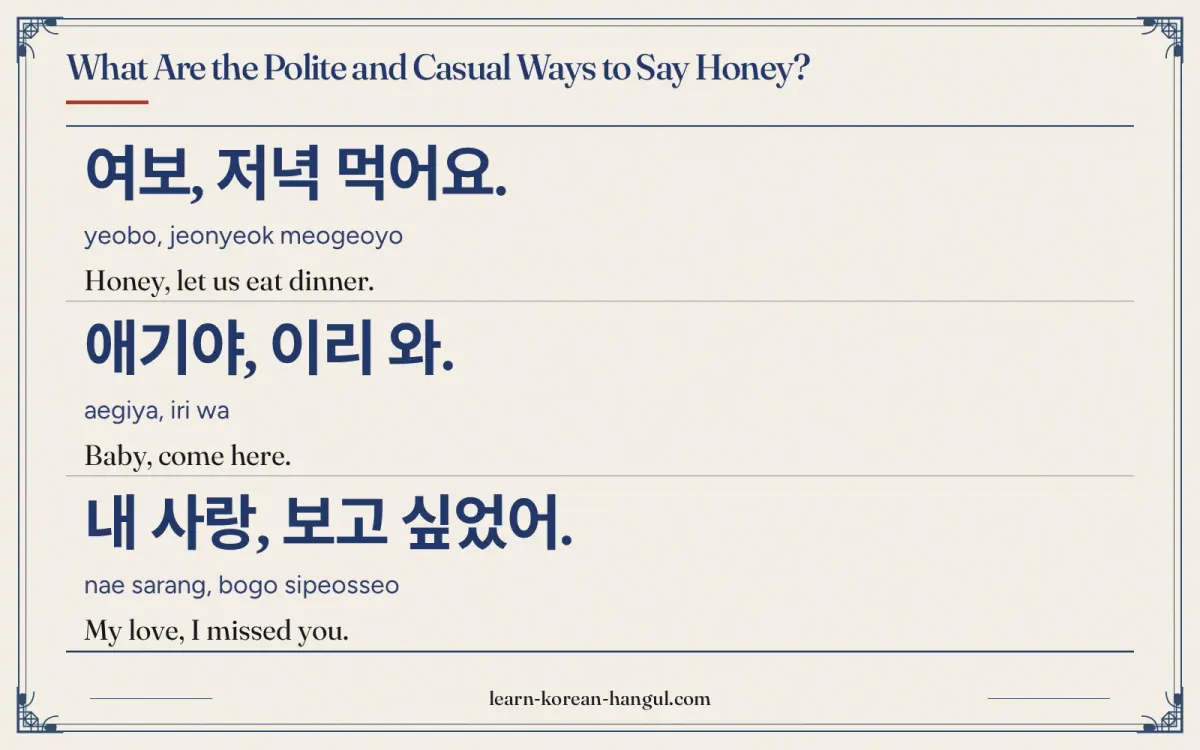
Pet names live at the intimate end of the speech levels, explained in the guide to Korean speech levels. Most are casual, but a polite ending can follow a name, especially between spouses.
Casual: 자기야 (jagiya)
Casual · 반말자기야 is the all-round couple name. Say it to get your partner's attention or to start a sentence. Without -야, 자기 can also sit inside a sentence: 자기, 어디야? (honey, where are you?). Add -요 for a gentler tone: 자기, 식사했어요? (honey, have you eaten?).
자기야, 오늘 몇 시에 끝나?
jagiya, oneul myeot sie kkeunna
Honey, what time do you finish today?
Casual: 여보 (yeobo)
Casual · 반말여보 is the traditional name between spouses. It carries a settled, family tone, like English "dear". Unlike 자기야, 여보 often goes with polite endings: 여보, 저녁 먹어요 (dear, let's eat dinner). Many couples start with 자기 and move to 여보 after marriage or children.
여보, 저녁 먹어요.
yeobo, jeonyeok meogeoyo
Honey, let us eat dinner.
Casual: 애기야 (aegiya)
Casual · 반말애기야 means "baby". Parents and grandparents call small children this, and partners sometimes use it playfully. The standard spelling of the word is 아기 (agi), but 애기 is very common in speech. Use it only if your partner enjoys it.
애기야, 이리 와.
aegiya, iri wa
Baby, come here.
Affectionate: 내 사랑 (nae sarang)
Casual · 반말내 사랑 means "my love", from 내 (nae, my) and 사랑 (sarang, love). It is warmer and more romantic than 자기야, and it fits messages, songs and special moments. In daily life, couples use it less often than 자기야.
내 사랑, 보고 싶었어.
nae sarang, bogo sipeosseo
My love, I missed you.
Intimate: 당신 (dangsin)
Polite · 해요체당신 is a pronoun meaning "you". Between spouses it means "dear", and it is common in love songs. With anyone else, it can sound cold or aggressive, as the mistakes section explains.
당신 덕분에 행복해요.
dangsin deokbune haengbokaeyo
I'm happy thanks to you.
Five names, five moods: the pet name to choose depends on how long you have been together. The sound of the main name comes next.
How Do You Pronounce 자기야?
자기야 is pronounced ja-gi-ya, in three light syllables with the stress spread evenly.
- 자 (ja): a soft j, close to the "ja" in "jar" but gentler.
- 기 (gi): a soft g, like "gee".
- 야 (ya): "yah".
Sound Changes to Listen For
Pronunciation here is simple, which helps beginners. No rule from the National Institute of Korean Language (국립국어원) Standard Pronunciation rules (표준 발음법) changes these names, but two details are worth hearing:
- Plain consonants stay plain. The ㅈ in 자 and the ㄱ in 기 are plain, not tense, and they sound slightly voiced between vowels. They do not become ㅉ or ㄲ. For the tense versions, see Korean tensification.
- Voiced ㅂ in 여보. The ㅂ in 보 sits between vowels and sounds like a soft b, not a hard p.
Saying the names well matters less than choosing the right person to say them to, which is the next topic.
How Do You Use a Pet Name inside a Sentence?
Put the pet name at the start of the sentence, or drop it in as the word for "you". Korean often avoids the word "you" and uses a name or a pet name instead, so 자기 does the work of a pronoun in couple talk.
- As an opener. 자기야, 이것 좀 봐. (Honey, look at this.)
- As "you". 자기는 뭐 먹을래? (What do you want to eat, honey?) Here 자기는 replaces the plain "you".
- With a polite ending. 자기, 괜찮아요? (Honey, are you okay?) The ending -요 softens the tone.
- With a real name. 민수야, 이것 좀 봐. The calling ending -야 follows a name that ends in a vowel (민수야, 민아야), and -아 follows a name that ends in a consonant (준아, 은정아).
A warning for later study: 자기 also means "oneself" in ordinary grammar, as in 자기 일은 자기가 해요 (people do their own work). The pet name and the reflexive pronoun are the same word, and context tells them apart. With the grammar clear, the next topic is who should hear these names.
When Should You Use 자기야, and When Should You Not?
Use 자기야 and 여보 only with a partner you are in a relationship with, and in private or relaxed settings. Younger couples favour 자기야, while married couples, especially older ones, use 여보.
Situations Where It Fits
- Calling your partner. 자기야, 어디야? on the phone.
- Texting. A short 자기야 to start a message.
- At home. 여보, 밥 먹어요 between spouses.
- Affectionate moments. 내 사랑 in a card or on an anniversary.
Situations to Avoid
- A friend or coworker. 자기야 sounds romantic and may be insulting.
- A stranger with 당신. The pronoun sounds like a quarrel.
- A parent-in-law. Use titles, not pet names.
- In public with older relatives. Many couples avoid pet names around family elders.
Two short scenes show the names in real conversation.
What Does Honey Sound Like in a Real Conversation?
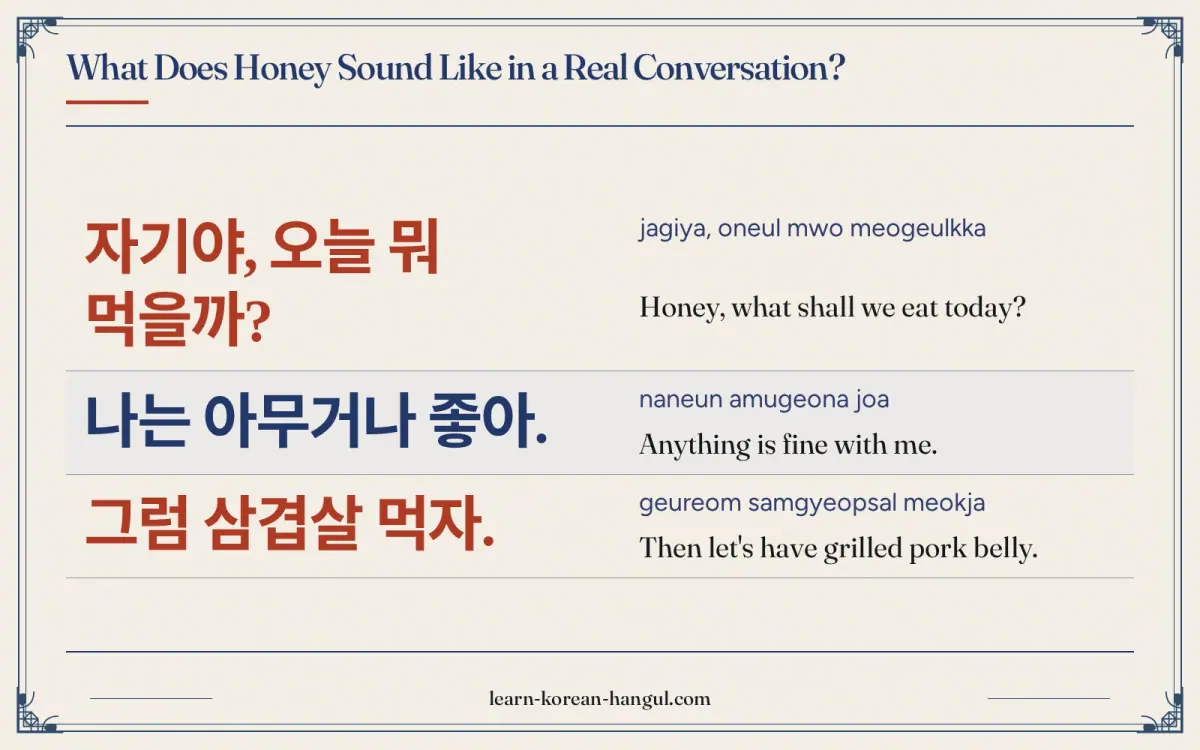
Couples use these names to open a sentence and soften a request. Notice that the names carry the tone, so the rest of the sentence can be very short.
A Dating Couple Choosing Dinner
Ara
자기야, 오늘 뭐 먹을까?
jagiya, oneul mwo meogeulkka
Honey, what shall we eat today?
Jun
나는 아무거나 좋아.
naneun amugeona joa
Anything is fine with me.
Ara
그럼 삼겹살 먹자.
geureom samgyeopsal meokja
Then let's have grilled pork belly.
What to notice: both speakers use casual speech, and the name opens the question.
A Married Couple
Wife
여보, 퇴근길에 우유 좀 사 와요.
yeobo, toegeungire uyu jom sa wayo
Dear, please buy some milk on your way home.
Husband
알았어요.
arasseoyo
Okay.
What to notice: 여보 pairs with polite endings, which is typical for spouses. These customs reflect how Korean couples talk.
What Should You Know about Couple Names in Korea?
Korean couples choose their names as they move through life stages, and the choice says as much about the relationship as the word.
- Dating years. 자기야 and 오빠 (a woman's name for an older boyfriend, covered in oppa in Korean) are the most common.
- After marriage. Many couples shift towards 여보 after marriage or children. The change can feel like a milestone.
- Old-fashioned feel. Some young couples find 여보 and 당신 old-fashioned, so they keep 자기 or use first names.
- Private names. Many couples invent their own nicknames, so a rule does not apply to every pair.
- Related page. The names 자기야 and 여보 have their own pages, jagiya in Korean and yobo in Korean.
An expert insight: learners often use the dictionary word and miss the relationship. A pet name signals closeness, and using it too early can feel like an advance. Wait for your partner to start, then follow. The mistakes below come from the same idea.
What Mistakes Do Learners Make with Honey in Korean?
Most mistakes come from translating "honey" as a general friendly word, or from using 당신 as a neutral "you".
| Mistake | Why it is a problem | Fix |
|---|---|---|
| Calling a coworker 자기야 | Sounds flirty or insulting | Use their name and title |
| Saying 당신 to a stranger | Sounds confrontational | Use 저기요 or 선생님 |
| Saying 여보 to a new boyfriend | Sounds like a married couple | Say 자기야 |
| Using 꿀 as a pet name | 꿀 is honey the food | Say 자기야 |
| Saying "jagi-ya" with a hard j | The consonants are soft | Say a gentle ja-gi-ya |
| Saying 자기야 to an elder | Too intimate | Use the right title |
Learners often assume 당신 is the polite word for "you". Actually, 당신 is intimate between spouses and sharp between strangers, so Korean avoids the word "you" and uses names or titles instead. The next section collects the other searches.
Is 자기야 the Same as "Babe"?
Mostly. The English words babe, baby, darling and sweetheart all map to 자기야 or a close alternative. The short answers below cover the other searches.
- Babe in Korean: 자기야. The single-word page is babe in Korean.
- Baby in Korean: 애기야 for a partner or child; the word itself is covered in baby in Korean.
- Darling in Korean: 여보 or 자기야.
- Sweetheart in Korean: 내 사랑 or 자기야.
- Honey bunch in Korean: no real equivalent; use 자기야.
- My love in Korean: 내 사랑.
- Honey the food: 꿀 (kkul).
Now practise.
Practice: Say It Aloud
Play the slow clip of 자기야 and repeat it three times, then try 여보. Next choose the name for each case. Answers follow.
- You are dating and want to call your partner.
- You are a married couple in your sixties.
- You write "my love" on an anniversary card.
- You meet a coworker and want to call them by a pet name. What should you do?
Answers
- 자기야.
- 여보.
- 내 사랑.
- Do not use a pet name; use their name and title, such as 민수 씨.
The phrase flashcards drill these couple names with audio.
Related Phrases to Learn Next
Couple names open the door to other romantic phrases.
- I love you in Korean: 사랑해 and 사랑해요.
- Jagiya in Korean: the name in more detail.
- Yobo in Korean: the married-couple name.
- I miss you in Korean: 보고 싶어.
This guide belongs to the Korean love phrases collection. What this page does not cover: texting slang, family names and proposal phrases. Choose 자기야 for dating, 여보 for marriage and 내 사랑 for special moments, and you can say honey in Korean the way real couples do.
Frequently Asked Questions
How do you say honey, babe or baby to a boyfriend or girlfriend in Korean?
Say 자기야 (jagiya) to a boyfriend or girlfriend. It covers "honey", "babe" and "baby" in one word. Many women also call an older boyfriend 오빠 (oppa), and many couples mix both names. Use the name your partner likes, because Korean pet names vary by couple and by age.
Is 자기야 formal or casual?
자기야 is casual, the intimate 반말 register for a partner. Add -요 for a softer tone: 자기, 식사했어요? (honey, have you eaten?). Between spouses who speak politely to each other, 여보 with a polite ending is more natural. Never use 자기야 with a boss, teacher or stranger.
What is the difference between 자기야 and 여보?
자기야 is used by dating and young married couples, and sounds playful. 여보 is more traditional and is used mainly by married couples, often middle-aged or older. Many couples move from 자기 to 여보 after marriage or children, but plenty of young spouses still say 자기. Both are for a partner only.
Can I call a friend 자기야?
Usually no. 자기야 sounds romantic, so a friend may think you are flirting. Close women friends sometimes use 자기야 jokingly, but a coworker or acquaintance may find it rude or confusing. For a friend, use their name with 야 or 아, such as 민아야, or use 친구야 (friend).
How do you say honey the food in Korean?
The food is 꿀 (kkul), as in 꿀 한 스푼 (one spoon of honey). Do not use 자기야 or 꿀 for the pet name. Korean speakers do sometimes say 허니 (heoni), the English word in Hangul, as a joke or a brand name, but a real pet name between Koreans is 자기야 or 여보.