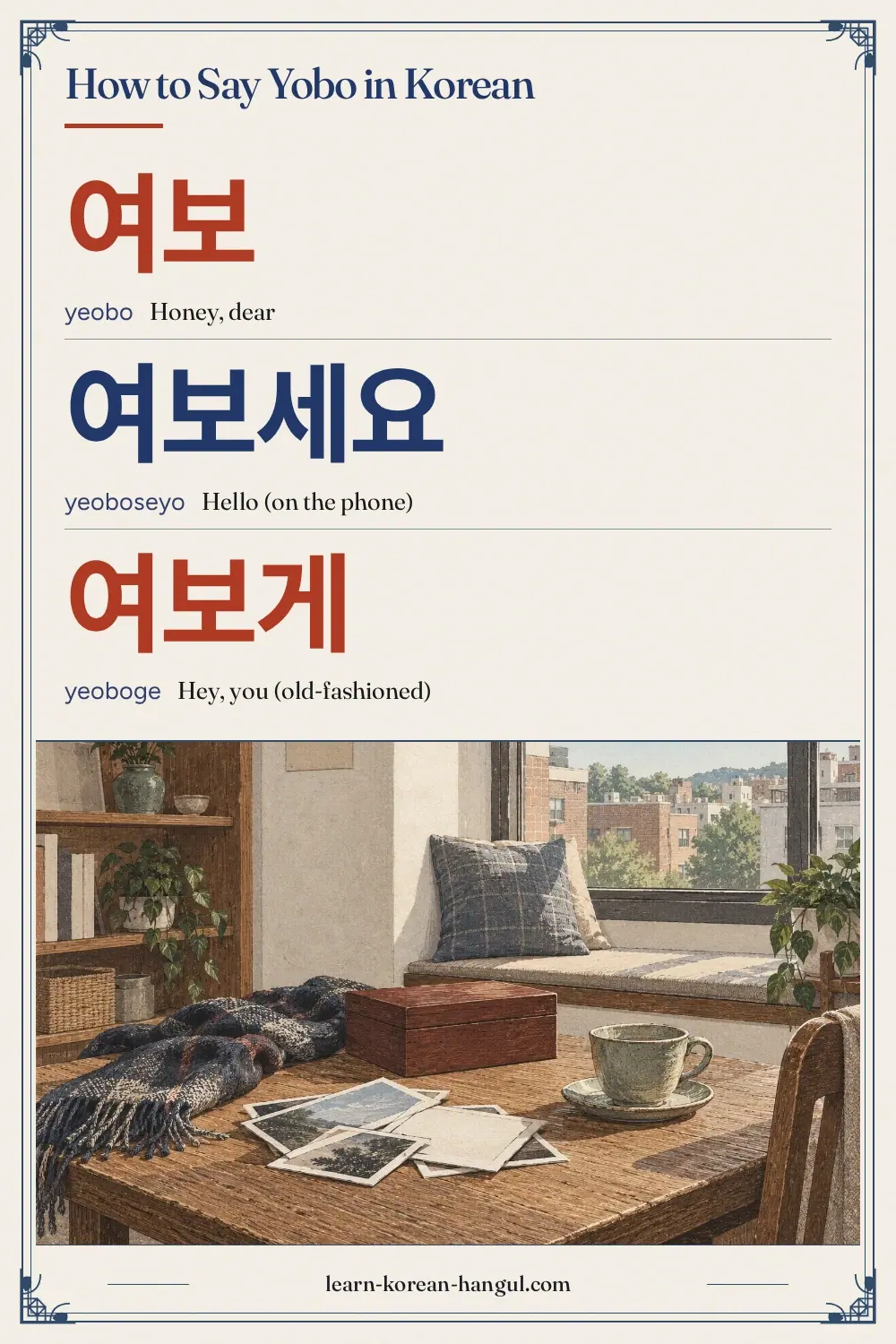
여보
여보
What you'll learn
- Say 여보 for a spouse, 여보세요 on the phone and 여보게 for the old-fashioned "hey, friend".
- Choose the right word for a spouse, a partner who is not your spouse and a phone caller.
- Say 여 as "yeo", not "yo", and 여보세요 in four syllables.
- Avoid answering the phone with 여보.
Before you start: knowing hello in Korean helps, because 여보세요 is a kind of hello. Time: about 15 minutes. Audio plays only when you press a button.
How Do You Say Yobo in Korean?
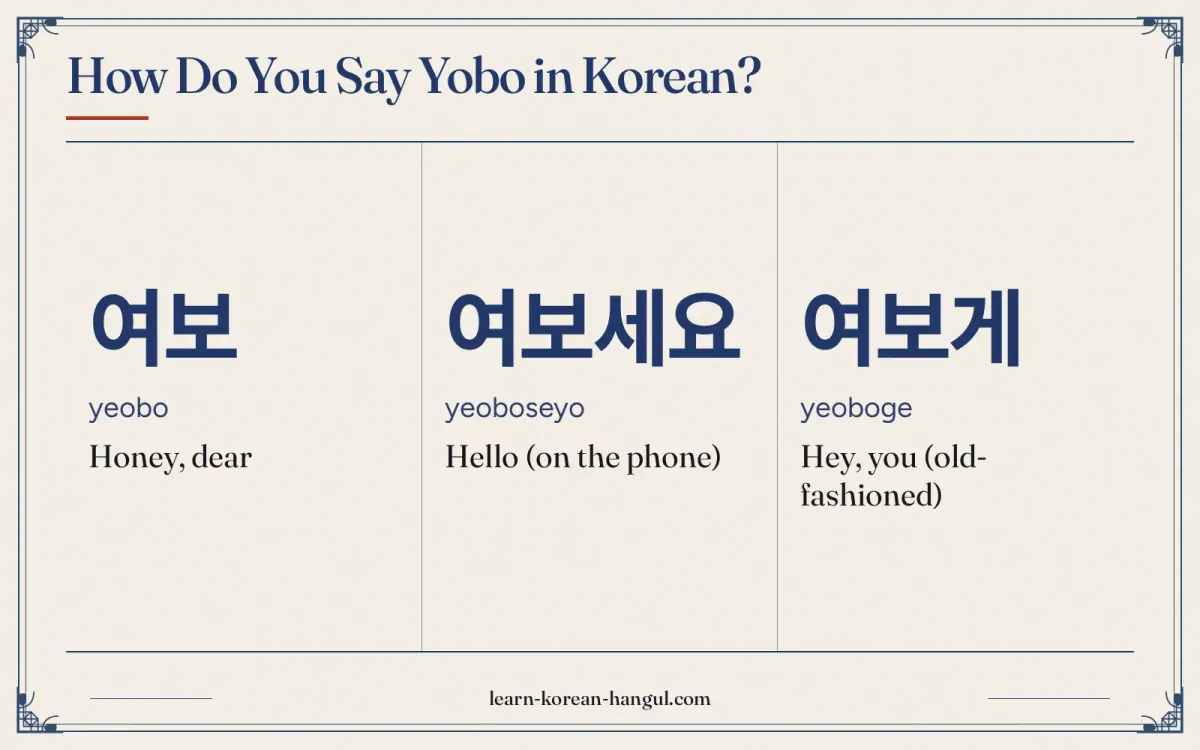
The word is 여보, said as [여보], and it names one thing: the person you are married to. Three related words share the same start, so the table compares them.
| Korean | Revised Romanization | Meaning | Who says it |
|---|---|---|---|
| 여보 | yeobo | Honey, dear | Husband and wife |
| 여보세요 | yeoboseyo | Hello (on the phone) | Anyone on a call |
| 여보게 | yeoboge | Hey, you (old-fashioned) | An older man to a peer |
Learners search for several spellings of the same word. All of the forms below point to the same Korean words:
| Spelling you may see | Korean word |
|---|---|
| yobo, yeobo | 여보 |
| yoboseyo, yeoboseyo | 여보세요 |
The standard spelling is the one with "yeo", following the Revised Romanization of Korean (Ministry of Culture notice 2000-8). The next section shows each word in a sentence.
What Are the Polite and Casual Ways to Say Yobo?
Korean speech levels, the endings that mark the listener, are explained in the guide to Korean speech levels. 여보 is a term of address (호칭) used by a husband and wife, so the word itself has no formal version, and the surrounding sentence carries the level.
Casual: 여보 (yeobo)
Casual · 반말여보 is intimate and used at home. Both husband and wife can say it, and it works as the first word of a sentence, like "honey, ...". Because spouses speak informally, the sentence after it is usually casual.
여보, 오늘 저녁 뭐 먹을까?
yeobo, oneul jeonyeok mwo meogeulkka?
Honey, what should we eat tonight?
Polite: 여보세요 (yeoboseyo)
Polite · 해요체여보세요 is 여보 with the polite ending -세요, and it means "hello" on a phone call. It is the same for friends, strangers and customers, so it is safe for every listener. When you answer, lift the pitch on the last syllable.
여보세요? 김민수 씨 계세요?
yeoboseyo? gim minsu ssi gyeseyo?
Hello? Is Mr Kim Minsu there?
Casual: 여보게 (yeoboge)
Casual · 반말여보게 is a dated way for an older man to call a friend or a younger man: "hey, you". It belongs to the 하게체 style, an old speech level that is now rare outside dramas and some older speakers. A learner has no need to say it, but you may hear it.
여보게, 자네 어디 가나?
yeoboge, jane eodi gana?
Hey, where are you going?
With the meanings clear, the next step is the sound, because 여 is easy to mishear.
How Do You Pronounce 여보?
여보 is pronounced [여보], yeobo, in two syllables, with a "yuh" start and a short, round "bo".
- 여 (yeo): glide from "y" into the open vowel ㅓ, which sounds like "uh" in "cut".
- 보 (bo): a soft b and the rounded vowel ㅗ, like "bo" in "boat" with a shorter sound.
For 여보세요, continue with 세 (se) and 요 (yo): yeo-bo-se-yo, four syllables.
Sound Changes to Listen For
Neither word has a spelling-to-sound change, so each is read as written. The hard part is the vowel:
- 여 versus 요. 여 is ㅕ (yeo) and 요 is ㅛ (yo). Compare 여름 (yeoreum, summer) with 요리 (yori, cooking). The eo vs o difference page trains the two vowels, and the ㅕ lesson shows how the letter is built.
- The last 요 lifts. When you answer a call, 여보세요 often ends on a rising pitch, a bit like a question.
- ㅂ between vowels. The ㅂ in 보 sounds like an English b in this position, so 여보 does not sound like "yeopo".
The rest of the skill is deciding who can hear each word, which depends on the relationship.
When Should You Use 여보, and When Should You Not?
Use 여보 only with your husband or wife, usually at home. Use 여보세요 on any phone call, and do not use either for a boyfriend, girlfriend, friend or stranger.
Situations Where It Fits
- At home with your spouse. Calling across a room or starting a request.
- On a call or in a text to your spouse. 여보 works in speech and writing.
- Answering any call. 여보세요 suits every caller, formal or friendly.
- Calling out to a stranger. 여보세요 is possible, but 저기요 is gentler. See excuse me in Korean.
Situations to Avoid
- Answering the phone with 여보. You would be calling the caller "honey".
- A boyfriend or girlfriend. 여보 is for married couples; most unmarried partners use 자기야 or a name. See jagiya in Korean.
- Friends and coworkers. It sounds like a joke or a mistake.
- Using 여보게 as a learner. It sounds like a drama line.
A few short conversations show the difference between the home use and the phone use.
What Does Yobo Sound Like in a Real Conversation?
Three exchanges cover a couple at home, a phone call and a message after work. Listen to the first word of each.
Deciding on Dinner
Husband
여보, 오늘 저녁 뭐 먹을까?
yeobo, oneul jeonyeok mwo meogeulkka?
Honey, what should we eat tonight?
Wife
김치찌개 어때?
gimchijjigae eottae?
How about kimchi stew?
Husband
좋지.
jochi
Sounds good.
What to notice: spouses often use casual endings with each other, so there is no -요 here.
Answering a Phone Call
Caller
여보세요? 김민수 씨 계세요?
yeoboseyo? gim minsu ssi gyeseyo?
Hello? Is Mr Kim Minsu there?
Minsu
네, 전데요.
ne, jeondeyo
Yes, speaking.
What to notice: the caller opens with 여보세요 and the other person answers 네, 전데요, "yes, that's me". More on this pattern is in hello on the phone in Korean.
A Call after Work
Husband
여보, 나 지금 퇴근해.
yeobo, na jigeum toegeunhae
Honey, I'm leaving work now.
Wife
응, 조심해서 와.
eung, josimhaeseo wa
Okay, come safely.
What to notice: 여보 opens the message, then the news. The reply 조심해서 와 is a caring everyday phrase. Words like these also reflect habits in how Korean couples talk.
What Should You Know about the Culture behind Yobo?
Couples in Korea change how they address each other over time, and 여보 often marks a stage of marriage.
- Older couples keep 여보 for life. For many couples who have been married for years, 여보 is the default name for each other.
- Younger couples often choose other words. 자기야 and first names are common, and some wives call their husbands 오빠.
- Children change the names. After a child arrives, many couples add forms such as the child's name plus 아빠 or 엄마, for example 민수 아빠 (Minsu's dad).
- 당신 is another spouse word. 당신 can mean "dear" between spouses, but it sounds sharp in an argument.
- The origin is debated. 여보 is commonly explained as 여기 보오, "look here", but the history is not settled, and another popular folk explanation links it to 如寶, "precious as a treasure".
An expert insight: 여보 is a gender-neutral address term. Husbands and wives both say it, and it needs no ending. Specific mistakes are collected in the table below.
What Mistakes Do Learners Make with Yobo in Korean?
Most mistakes come from mixing up 여보 with 여보세요, or from using a spouse word for someone who is not a spouse.
| Mistake | Why it is a problem | Fix |
|---|---|---|
| Answering a call with 여보 | It calls the caller "honey" | Say 여보세요 |
| Calling a boyfriend or girlfriend 여보 | It is for married couples | Say 자기야 or use a name |
| Saying "yo-bo" with 요 | 요 is a different vowel | Say 여 (yeo) with open lips |
| Using 여보게 with friends | It is old-fashioned | Use their name or 야 |
| Writing yobo as the standard spelling | It is not the Revised Romanization | Write yeobo |
Learners often assume 여보 and 여보세요 are the same word. Actually, 여보세요 is a polite phrase for any listener, while 여보 is a private name for a spouse, so only one of them is safe to say to a stranger.
What Does Yobo Mean?
Yobo, written 여보, means "honey" or "dear" between married partners. The searches below all lead to that answer.
- What does yobo mean in Korean? It means "honey" or "dear" between married partners.
- Yobo meaning: the spelling is 여보, and the standard romanization is yeobo.
- Yeobo in Korean: 여보, a married couple's pet name.
- Yeoboseyo in Korean: 여보세요, "hello" on the phone.
Now practise hearing the difference.
Practice: Say It Aloud
Play the slow clip of 여보 three times and repeat it. Then pick the word for each situation. Answers follow.
- You answer a call from an unknown number.
- You want your husband's attention in the kitchen.
- You call a company and the line connects.
- You greet your boyfriend by phone.
Answers: 1. 여보세요. 2. 여보. 3. 여보세요. 4. 여보세요 to start the call, then 자기야 if you both use it.
Drill these words with the phrase flashcards.
Related Phrases to Learn Next
- Honey in Korean: other pet names for a partner.
- Jagiya in Korean: the common choice for a boyfriend, girlfriend or younger couple.
- Hello on the phone in Korean: more phone phrases after 여보세요.
- I love you in Korean: saying it to the person you call 여보.
This guide belongs to the Korean love phrases collection. What this page does not cover: all the pet names couples use and the full 하게체 style. Keep 여보 for a spouse, use 여보세요 for any call, and you can say yobo in Korean without calling the wrong person "honey".
Frequently Asked Questions
What is the difference between 여보 and 여보세요?
여보 is a pet name that married partners use for each other. 여보세요 is a polite phrase meaning "hello" on a phone call, and anyone can say it. They share the same two opening syllables, but 여보세요 adds the polite ending -세요, so it works with strangers and customers while 여보 does not.
Is 여보 formal or casual?
It is casual and intimate. 여보 is a term of address with no formal version, and it belongs to married couples at home. In formal settings, use the person's name and title instead. The related 여보세요 is polite and works for any listener.
Can I use 여보 with friends, elders and strangers?
No. 여보 is only for your husband or wife. With friends use their name, with elders use a title such as 선생님, and with strangers use 저기요. The phone greeting 여보세요 is the one word from this family that suits any listener.
Why do some people write yobo and others yeobo?
English speakers hear 여 as "yo", so many write yobo. The Revised Romanization of Korean writes 여 as yeo, giving yeobo and yeoboseyo. The difference matters on signs, forms and searches, where yeobo is the official form. Learn the Hangul 여보, and the spelling question disappears.
What is the most common mistake with yobo in Korean?
Answering the phone with 여보. A learner who says 여보 into the phone is calling the caller "honey". Say 여보세요 instead. The second most common error is using 여보 for a boyfriend or girlfriend, where 자기야 or a name is the usual choice.