
자기야
자기야
What you'll learn
- Say 자기야 and see how the calling ending 야 works.
- Use 자기야 and 자기 only with a partner, and know why there is no polite version.
- Tell the pet name 자기 apart from the plain word 자기, meaning "oneself".
- Choose a safer address word when you are not in a relationship.
Before you start: you need to read Hangul; romanization is shown as an aid and can be hidden. Time: about 8 minutes.
Key facts
- 자기 (jagi) alone is "dear" as a pet name, but elsewhere it means "oneself".
- 야 is the casual calling ending that marks the person you speak to.
- Married couples often move on to 여보 (yeobo) or 당신 (dangsin).
How Do You Say Jagiya in Korean?
The standard way to say jagiya in Korean is 자기야, written with three Hangul blocks: 자 (ja), 기 (gi) and 야 (ya). It has no single English twin, because "honey", "babe" and "dear" each cover only part of its warmth.
| Form | Romanization | Meaning | Register |
|---|---|---|---|
| 자기야 | jagiya | Honey, babe (calling) | Casual, intimate |
| 자기 | jagi | Dear, honey (inside a sentence) | Casual, intimate |
| 자기야 보고 싶어 | jagiya bogo sipeo | Honey, I miss you | Casual, intimate |
| 자기야, 뭐 해? | jagiya, mwo hae | Honey, what are you doing? | Casual, intimate |
The word 자기 itself means "self" or "oneself". As a pet name it borrows the idea of "the person closest to me", and the ending 야 turns it into a call. The next section shows each form in a sentence.
What Are the Casual Ways to Say Jagiya?
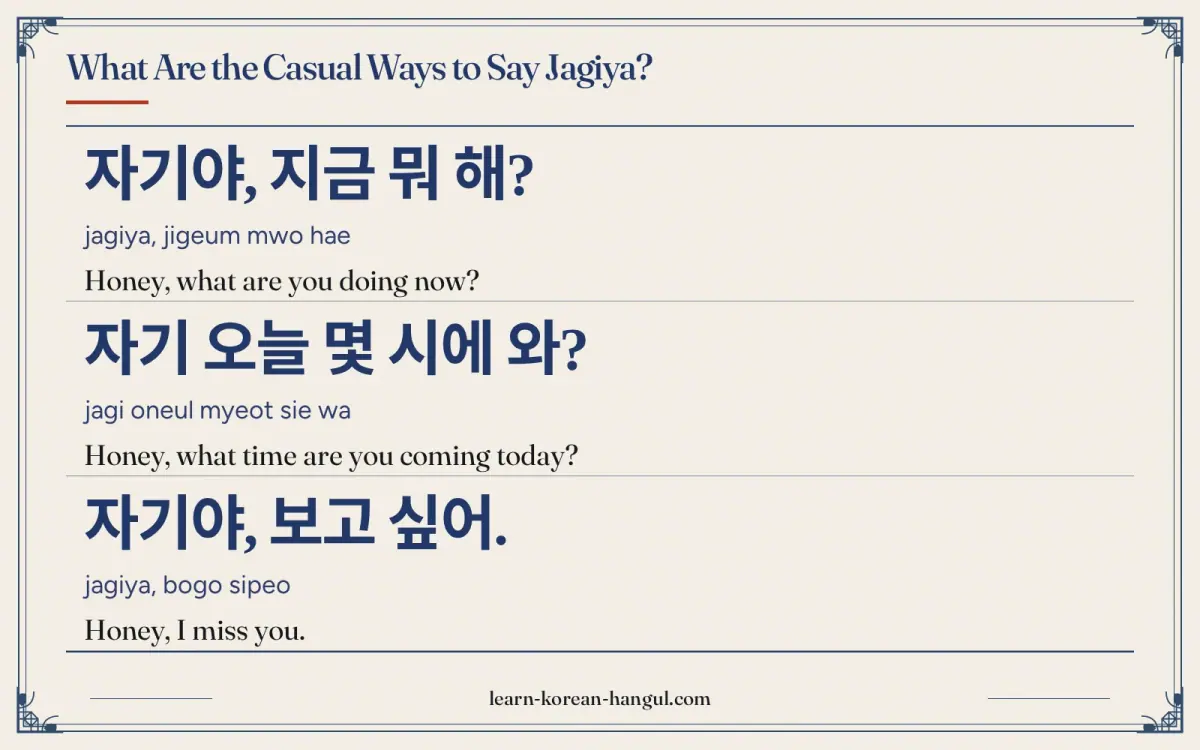
Jagiya belongs to the casual end of the Korean speech levels, the endings that change with the listener's age, status and closeness, explained in the guide to Korean speech levels. There are no formal or polite forms of this pet name, so every example below is casual.
Casual: 자기야 (jagiya)
Casual · 반말자기야 is the calling form. The ending 야 is the casual vocative, a small sound that tells the listener "I am speaking to you". It comes after a vowel, as in 기, and the pet name starts a sentence or fills a pause.
자기야, 지금 뭐 해?
jagiya, jigeum mwo hae
Honey, what are you doing now?
Casual: 자기 (jagi)
Casual · 반말자기 without 야 is the pet name inside a sentence, not a call. Partners say it where English speakers say "honey" in the middle of a thought. It is the same word that means "oneself", so the situation matters.
자기 오늘 몇 시에 와?
jagi oneul myeot sie wa
Honey, what time are you coming today?
Casual: 자기야 보고 싶어 (jagiya bogo sipeo)
Casual · 반말보고 싶어 literally means "I want to see you" and is the usual way to say "I miss you" in Korean. With 자기야 in front, it becomes a loving message. The full phrase is covered in the guide to i miss you in Korean.
자기야, 보고 싶어.
jagiya, bogo sipeo
Honey, I miss you.
Casual: 자기야 밥 먹었어? (jagiya bap meogeosseo)
Casual · 반말Koreans show care by asking about meals. 밥 먹었어? means "Did you eat?" and carries the meaning "I am thinking of you". Together with 자기야 it is a very ordinary couple's check-in.
자기야, 밥 먹었어?
jagiya, bap meogeosseo
Honey, did you eat?
These four lines are all casual by design. The sounds come next, and they are simple.
How Do You Pronounce 자기야?
자기야 is pronounced [자기야], jah-gee-ya, in three light, even syllables. Follow these steps:
- 자 (ja): a plain "jah". The ㅈ here is the plain consonant, with a soft puff.
- 기 (gi): a light "gee". The ㄱ sits between two vowels, so it is softer and close to an English g.
- 야 (ya): "yah", spoken lightly. Because it is the calling ending, it gets the least stress.
Sound Changes to Listen For
자기야 has no special sound change, so each block is pronounced as written. The softer ㄱ in 기 is the normal voicing of plain consonants between vowels, explained in the guide to the difference between voiced and voiceless sounds. One neighbouring phrase does change: 보고 싶어 is pronounced [보고 시퍼], because the final ㅍ-sound of 싶 links to the vowel of 어.
Revised Romanization, the official system for writing Korean in Latin letters, writes jagiya and bogo sipeo. It records the spelling, not the sound change, so it does not show [시퍼]. Romanization is only a guide; the Hangul is the real spelling. Saying the word is easy, and the harder part is knowing who may hear it.
When Should You Use 자기야, and When Should You Not?
Use 자기야 only with someone you are in a romantic relationship with, in private or in friendly company. If the relationship is not romantic, skip it.
Situations Where It Fits
- Calling your partner. 자기야, 어디야? (Honey, where are you?) works on the phone or in a message.
- Starting a sweet request. 자기야, 나 좀 도와줘 (Honey, help me a little).
- Texting a partner. 자기야 and 자기 appear often in couples' chats.
- Playful teasing between a couple. The tone can be warm or joking.
Situations to Avoid
- Colleagues, teachers, elders and strangers. The word is far too intimate.
- Friends who are not a couple. Some women use 자기 with close female friends or younger colleagues, and some friends joke with it, but a learner may be misunderstood.
- A first date. Wait until the relationship is clear.
If you need an everyday warm word without romance, use the person's name plus 씨 (ssi), or a title such as 선생님. Real conversations show how the pet name sounds.
What Does Jagiya Sound Like in a Real Conversation?
In real talk, 자기야 starts a sentence and the rest carries the message. Listen for the pet name at the start.
A Couple on the Phone
Jimin
자기야, 지금 어디야?
jagiya, jigeum eodiya?
Honey, where are you now?
Hyun
회사 앞이야. 곧 도착해.
hoesa apiya. got dochakae
I'm in front of the office. I'll arrive soon.
What to notice: 자기야 is followed by the casual question ending 야, so the whole exchange has no polite -요.
Planning Dinner Together
Jimin
자기야, 오늘 뭐 먹고 싶어?
jagiya, oneul mwo meokgo sipeo?
Honey, what do you want to eat today?
Hyun
자기가 좋아하는 거 먹자.
jagiga joahaneun geo meokja
Let's eat what you like.
What to notice: 자기가 here means "you" in a pet-name way, so 자기 can replace the word for "you" between a couple. In the next dialogue, the same word means something else.
Self, Not Honey
Teacher
자기가 한 일은 자기가 책임져야 해요.
jagiga han ireun jagiga chaegimjyeoya haeyo
One must take responsibility for what one has done oneself.
Student
네, 알겠어요.
ne, algesseoyo
Yes, I understand.
What to notice: here 자기 means "oneself" and has nothing to do with romance. The surrounding words and the lack of 야 decide the meaning. This leads to how couples use the word in life.
What Should You Know about the Culture behind Jagiya?
Pet names mark a stage in a relationship. Korean couples often call each other by a pet name as they become closer, and 자기야 is one of the most common.
- Dating and newlyweds. 자기야 is common among dating couples and newlyweds, both ways.
- Married couples. Many married couples drift to 여보 (yeobo) or 당신 (dangsin), which sound more settled, and some use parent labels such as "Minsu's dad". See yobo in Korean.
- Other pet names. Couples also say a name plus 아 or 야, such as 민수야, or short sweet words such as 애기야 (aegiya, baby; a colloquial form of 아기). The page on honey in Korean compares them.
- Older-partner names. Women often call an older boyfriend 오빠, which is covered in oppa in Korean.
An expert insight: learners often copy 자기야 from a drama and use it for any friendly person. Actually, in Korean it announces a relationship, so it carries more meaning than the English "honey" does with a waiter. The mistakes below come from copying the word without that weight.
What Mistakes Do Learners Make with Jagiya in Korean?
Most mistakes come from the second meaning of 자기 and from using it outside a relationship.
| Mistake | Why it is a problem | Fix |
|---|---|---|
| Translating every 자기 as honey | 자기 also means oneself | Check the ending 야 and the context |
| Calling a friend or colleague 자기야 | Sounds romantic or odd | Use a friend's name (민수야) or a colleague's name plus 씨 |
| Adding -요 to 자기야 | Pet names are casual | Keep the pet name without -요 |
| Saying it flat and loud | Pet names are soft | Keep the pitch light and gentle |
| Using it on a first date | Skips a relationship stage | Wait until you are a couple |
Learners often assume that a pet name is a safe, friendly word. In fact, 자기야 is closer to a relationship label, and used wrongly it can embarrass the listener.
Other Ways People Search for Jagiya in Korean
People search for jagiya in Korean in several forms. The short answers below cover each one.
- Jagi in Korean: 자기 is the short pet name, and also the plain word for "oneself".
- Jagi meaning: "dear" or "honey" when it is a pet name between partners, and "oneself" in ordinary sentences.
- What does jagi mean in Korean: it depends on context. Look for the partner relationship and the calling ending 야.
- Jagiya meaning: "honey" or "babe", used to call a partner.
Knowing the meaning is only the start; saying it with the right warmth is the next step, so practise now.
Practice: Say It Aloud
Play the slow clip of 자기야, repeat it three times, then say 자기야, 보고 싶어 in a soft voice. Then decide whether 자기야 fits each situation. Answers follow.
- You call your girlfriend on the phone.
- A coworker asks you for a favour.
- Your husband asks, 자기 어디야? (Where are you, honey?)
- A teacher says, 자기가 한 일은 자기가 책임져야 해요 (one must take responsibility for one's own actions).
Answers
- Yes: 자기야, 뭐 해?
- No: use their name plus 씨.
- Yes: 자기 here is the pet name; answer 집이야 (I'm at home).
- No: 자기 here means oneself.
Drill 자기야 and the related phrases with the phrase flashcards, which include audio for each form.
Related Phrases to Learn Next
Jagiya sits in the group of couple's words that every learner of romantic Korean meets.
- Honey in Korean: the wider set of ways to say honey.
- Yobo in Korean: 여보, the word for a spouse.
- I love you in Korean: 사랑해요 and its forms.
- I miss you in Korean: 보고 싶어요 and its forms.
This guide belongs to the korean love phrases collection. What this page does not cover: regional pet names, texting abbreviations and pet names for children. Use 자기야 only with a partner, and you can say jagiya in Korean with the right closeness.
Frequently Asked Questions
How do you say jagiya in Korean?
Write it 자기야. It is three Hangul blocks, 자, 기 and 야, and it means honey or babe. Couples say it when they call each other or start a sentence, as in 자기야, 뭐 해? (honey, what are you doing?). It is casual and intimate, so use it only with a partner, never with a stranger or a colleague.
How do you pronounce 자기야?
Say jah-gee-ya in three light, even syllables: [자기야]. The ㄱ in 기 sits between two vowels, so it sounds softer, close to an English g. The ending 야 is the calling sound and gets the lightest stress. There is no special sound change, so each block is pronounced as it is written.
What is the difference between 자기야 and 자기?
자기야 is the calling form: 야 marks the person you are talking to, so 자기야 means "honey" addressed to someone. 자기 alone can be a pet name inside a sentence, as in 자기 어디야? (where are you, honey?), and it is also the plain word for oneself. Context and the ending decide the meaning.
Can I use 자기야 with friends, elders and strangers?
Not as a learner. 자기야 is mainly a couple's word. Some women use 자기 with close female friends, but between other friends it sounds teasing or flirtatious, and with colleagues, elders and strangers it is out of place. Use a friend's name, a name plus 씨 (ssi) or a title instead.
What is the most common mistake with jagiya in Korean?
The most common mistake is hearing 자기 in a sentence and translating it as honey. In 자기가 한 일 (what one did oneself), 자기 is a reflexive word meaning self. The second mistake is using 자기야 outside a relationship, where it sounds far too intimate. Check the ending 야 and the situation before you decide which meaning applies.