어떻게 가요?
어떻게 가요?
What you'll learn
- Say 어떻게 가요?, ...에 어떻게 가요?, 길을 알려 주세요 and 여기에 어떻게 가요? and match each one to a situation.
- Pronounce 어떻게 as [어떠케] and 알려 as [알려].
- Ask for directions in three situations: a street, a phone map and a friend's home.
- Avoid the most common mistake, which is using 어디 가요? to ask the way.
Before you start: you only need basic Hangul and the polite ending 요. After you ask the way, you will want to understand the answer, so see go straight in Korean too. Time: about 12 minutes. Audio plays only when you press a button.
How Do You Say How Do I Get to in Korean?
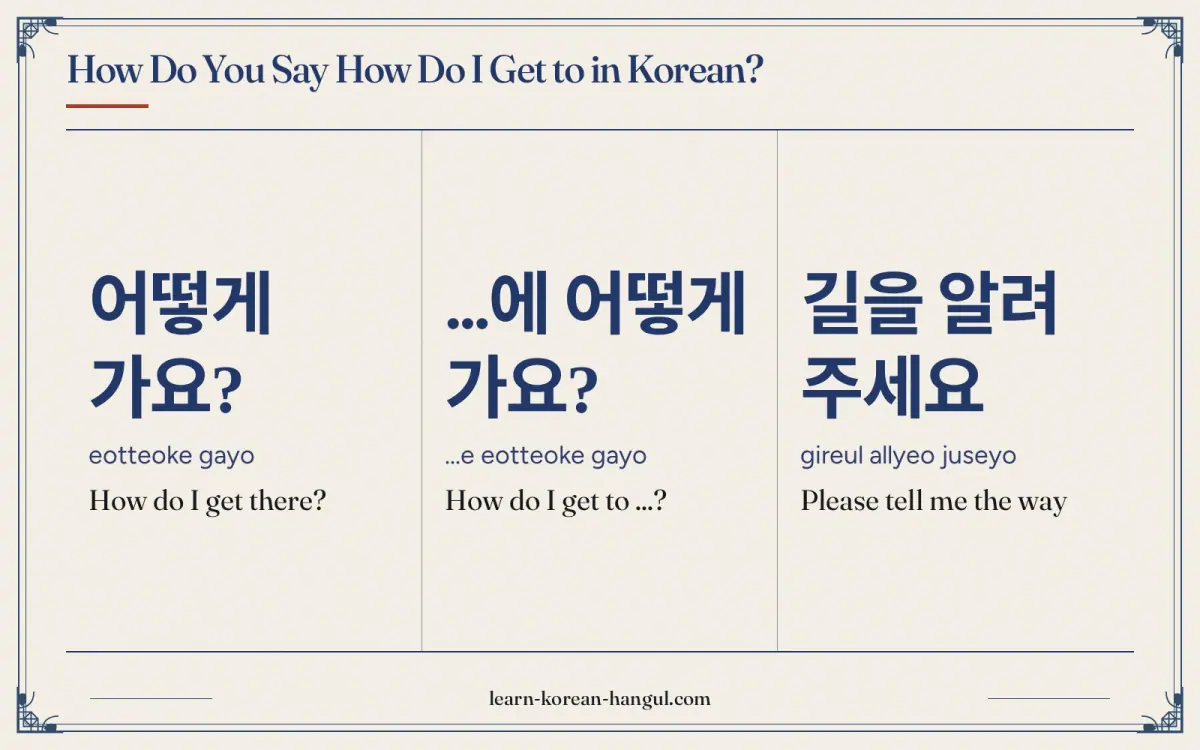
The most useful way to say how do i get to in Korean is 어떻게 가요? The word 어떻게 (eotteoke) means "how", and 가요 (gayo) is the polite form of 가다 (gada, "to go"). So the question is literally "How do I go?" You put the place first, with the particle 에 (e, "to"): 서울역에 어떻게 가요?
| Korean | Romanization | Meaning | Where you hear it |
|---|---|---|---|
| 어떻게 가요? | eotteoke gayo | How do I get there? | When the place is already clear |
| ...에 어떻게 가요? | ...e eotteoke gayo | How do I get to ...? | Asking a stranger |
| 길을 알려 주세요 | gireul allyeo juseyo | Please tell me the way | Politely asking for help |
| 여기에 어떻게 가요? | yeogie eotteoke gayo | How do I get here? | Showing an address on a phone |
Revised Romanization (the South Korean government standard of 2000) is only a reading aid here. Learn the Hangul first. The next section shows how to choose between the forms.
What Are the Polite Ways to Say How Do I Get To?
How do i get to in Korean has one main polite form with a few useful variants, and the situation decides. Most of the time you are talking to a stranger, so the polite style is the right default.
Polite: 어떻게 가요? (eotteoke gayo)
Polite · 해요체어떻게 가요? works when you and the listener both know which place you mean, for example when you stand at a map or point at a sign. It sounds natural but a little short, so many people add the place name.
저기요, 서울역에 어떻게 가요?
jeogiyo, Seoullyeoge eotteoke gayo
Excuse me, how do I get to Seoul Station?
Polite: ...에 어떻게 가요? (e eotteoke gayo)
Polite · 해요체Say the place, add 에, then ask. This pattern is the one to memorize, because you can swap in any place name. Many speakers also say 어떻게 가면 돼요? (eotteoke gamyeon dwaeyo), which means "How should I go?" and sounds a little softer.
명동에 어떻게 가면 돼요?
myeongdonge eotteoke gamyeon dwaeyo
How should I go to Myeongdong?
Polite: 길을 알려 주세요 (gireul allyeo juseyo)
Polite · 해요체길을 알려 주세요 means "please tell me the way". It is a request, not a question, so it is very polite. 길 (gil) means "road" or "way", and 알려 주세요 is "please let me know".
죄송한데 길을 알려 주세요.
joesonghande gireul allyeo juseyo
Sorry to bother you, but please tell me the way.
Polite: 여기에 어떻게 가요? (yeogie eotteoke gayo)
Polite · 해요체여기 (yeogi) means "here" in many sentences, but here it points to the spot on your phone. Show the screen and say this, and the listener can see the exact place. It is the safest option when you cannot say the name.
여기에 어떻게 가요? 멀어요?
yeogie eotteoke gayo? meoreoyo
How do I get here? Is it far?
Other Levels: Formal and Casual
With a very formal listener, such as a hotel manager, the question becomes 어떻게 갑니까? (eotteoke gamnikka), pronounced [어떠케 감니까]. With a close friend, drop the ending: 어떻게 가? (eotteoke ga). For strangers, stay with 요.
Choosing a form is half the job. The other half is saying 어떻게 with the right sounds, which the next section breaks down.
How Do You Pronounce 어떻게 가요?
어떻게 가요 is pronounced [어떠케 가요]. The question has two words and five syllables, and the first word hides a sound change. Play the slow clip and follow along.
- 어 (eo): ㅓ with relaxed, unrounded lips and a half-open jaw.
- 떻 (tteo): a tense ㄸ, tighter than ㄷ and with no puff of air, then ㅓ. The final ㅎ is not said by itself.
- 게 (ke): spelled with ㄱ, but it is said as an aspirated ㅋ, with a puff of air.
- 가 (ga): a plain ㄱ and ㅏ.
- 요 (yo): a short, light ending.
Sound Changes to Listen For
- ㅎ + ㄱ becomes ㅋ. When a final ㅎ meets ㄱ, the two sounds blend into an aspirated ㅋ (Standard Pronunciation Rules, Article 12). So 어떻게 sounds like "eo-tteo-ke". Revised Romanization writes eotteoke, which shows the change.
- Doubled ㄹ in 알려. In 알려 주세요, the ㄹ of 알 and the ㄹ of 려 meet, so the sound is a long ㄹ: [알려]. Revised Romanization writes allyeo with a double l.
- Linking in 길을. The final ㄹ of 길 moves to the next syllable, so 길을 is [기를].
- Linking in 서울역에. The place 서울역에 sounds like [서울려게]. A ㄴ sound is added in front of 역, and it turns into ㄹ after the ㄹ of 서울. Revised Romanization writes Seoullyeoge.
- Question word and tone. 어떻게 is a question word, so the question usually falls or rises and falls at the end. It does not end with a sharp rise.
The most common slip is to say the ㅎ in 어떻게 as a separate "h". Merge it into the ㅋ. Once the sound is right, the next question is when to ask.
When Should You Use 어떻게 가요?, and When Should You Not?
Ask 어떻게 가요? when you need a route and the listener is likely to know it, such as a passer-by, a hotel clerk or a shop owner. Name the place every time with a stranger. The key difference is how much the listener already knows: with a friend who knows where you are going, 어떻게 가요? alone is enough.
Situations Where It Fits
- On the street. You stop a passer-by and ask 저기요, 명동에 어떻게 가요?
- At a hotel desk. You show the address on your phone and ask 여기에 어떻게 가요?
- On the phone. A friend invites you over, and you ask how to reach their home.
- In a station. You ask a staff member 서울역에 어떻게 가요? when the signs are confusing.
Situations to Avoid
- A bare 어디 가요? It means "Where are you going?", not "How do I go?" Use 어떻게 가요? or 어디예요?
- No place name. A stranger cannot answer 어떻게 가요? if they do not know where you mean.
- Casual 어떻게 가? with a stranger. It drops the polite ending and sounds abrupt.
Short scenes make these choices clearer. The next section shows three real exchanges.
What Does How Do I Get to Sound Like in a Real Conversation?
A request for directions usually takes two or three lines. Listen for the place name and the question word.
Asking a Passer-by on the Street
Tourist
저기요, 서울역에 어떻게 가요?
jeogiyo, Seoullyeoge eotteoke gayo
Excuse me, how do I get to Seoul Station?
Local
이 길로 쭉 가세요. 그리고 지하철을 타세요.
i gillo jjuk gaseyo. geurigo jihacheoreul taseyo
Go straight along this road. Then take the subway.
Tourist
감사합니다.
gamsahamnida
Thank you.
What to notice: the tourist starts with 저기요 (jeogiyo) to get attention, then names the place. The local uses the polite command ending -세요 for directions.
Showing a Place on a Phone
Tourist
실례합니다. 여기에 어떻게 가요?
sillyehamnida. yeogie eotteoke gayo
Excuse me. How do I get here?
Local
걸어서 십 분쯤 걸려요.
georeoseo sip bunjjeum geollyeoyo
It takes about ten minutes on foot.
Tourist
지하철로 갈 수 있어요?
jihacheollo gal su isseoyo
Can I go by subway?
What to notice: the tourist points at the phone and says 여기. The question 갈 수 있어요? is a yes or no question, so it ends with a rise. In 갈 수, the ㅅ turns tense after the ending -ㄹ, so you hear [갈쑤].
A Friend Explains the Way Home
Su-Bin
너희 집에 어떻게 가?
neohui jibe eotteoke ga
How do I get to your place?
Ji-Ho
2번 출구로 나와서 쭉 걸어와.
i beon chulguro nawaseo jjuk georeowa
Come out of exit 2 and walk straight.
Su-Bin
알겠어. 도착하면 전화할게.
algesseo. dochakamyeon jeonhwahalge
Got it. I'll call when I arrive.
What to notice: friends drop the ending 요, so 가? and 알겠어 are casual. 도착하면 is pronounced [도차카면], because ㄱ and ㅎ blend into ㅋ, as in 어떻게.
What Should You Know about the Culture behind How Do I Get To?
Asking the way in Korea follows a few habits. These are general, and people differ by age and place.
- Landmarks and exits. Directions often use landmarks such as 편의점 (pyeonuijeom, "convenience store") and 사거리 (sageori, "crossroads"), and subway exit numbers such as 2번 출구 (i beon chulgu).
- Show the Korean name. Typing or showing the place in Hangul on your phone avoids many misunderstandings, because place names can sound alike.
- Which map app. Many people use Naver Map or Kakao Map for directions, since they work better in Korea than some foreign apps. This can change, so check what locals recommend.
- Walking time. People often answer with minutes on foot, such as 걸어서 십 분쯤 걸려요.
An expert tip: after you hear the route, repeat one key word back, such as 지하철 or 쭉. It checks that you understood and shows respect. For the structure behind the endings, see Korean speech levels, which explains why 요 makes the question polite. For the nearest stop, where is the subway station in Korean teaches the next question.
What Mistakes Do Learners Make with How Do I Get to in Korean?
Most mistakes come from the question word and the missing place name.
| Mistake | Why it is a problem | Fix |
|---|---|---|
| Saying 어디 가요? | It means "Where are you going?" | Say 어떻게 가요? or 어디예요? |
| Saying 어떻게 와요? | 와요 means "come", not "go" | Use 가요 for going to a place |
| Leaving out the place | The listener cannot guess | Add the name: 명동에 어떻게 가요? |
| Saying the ㅎ in 어떻게 | The sound is [어떠케] | Blend ㅎ and ㄱ into ㅋ |
| Ending with a sharp rise | Question word questions usually fall | Let the voice fall or rise-fall |
| Using 어떻게 가? with a stranger | It drops the polite ending | Add 요 |
Learners often think they need one word for "directions". In Korean, the verb carries the meaning: 어떻게 가요? asks how to go.
Is It the Same as How to Get to, Directions or How Do I Get There?
Mostly yes. These searches all point to the same small set of phrases.
- How to get to in Korean: 어떻게 가요? with the place before it, such as 공항에 어떻게 가요? (gonghange eotteoke gayo, "How do I get to the airport?").
- How do I get there in Korean: 거기에 어떻게 가요? (geogie eotteoke gayo). 거기 means "there" and is used when the place was just mentioned.
- Directions in Korean: the noun is 길 (gil, "way") or 방향 (banghyang, "direction"). To say "I'm lost", use 길을 잃었어요 (gireul ireosseoyo). To say "I'm looking for the way", use 길을 찾아요 (gireul chajayo).
Practice: Say It Aloud
Play the slow clip and repeat 어떻게 가요? three times, then choose the best question for each situation. Answers follow.
- You stop a stranger and want to reach Seoul Station.
- You show an address on your phone.
- Your friend invites you home.
- How is 어떻게 pronounced?
Answers
- 서울역에 어떻게 가요?
- 여기에 어떻게 가요?
- 너희 집에 어떻게 가?
- [어떠케]: the ㅎ and ㄱ blend into ㅋ, and the ㄸ is tense.
The phrase flashcards drill these questions with audio.
Related Phrases to Learn Next
Asking the way connects to several travel phrases.
- where is the subway station in Korean: the question to ask when you need a station.
- go straight in Korean: the answer you will hear most often.
This guide belongs to the korean directions phrases collection. What this page does not cover: reading maps, bus and subway apps, and the full set of direction words such as left and right. Learn the pattern "place + 에 어떻게 가요?", and you can say how do i get to in Korean for any place.
Frequently Asked Questions
How do you say how do i get to in Korean?
Name the place and then say 어떻게 가요? (eotteoke gayo). For example, 서울역에 어떻게 가요? means "How do I get to Seoul Station?" If the place is already clear, 어떻게 가요? alone means "How do I get there?" The ending 요 makes it polite for strangers.
How do you pronounce 어떻게 가요?
It is pronounced [어떠케 가요]. The ㅎ at the end of 떻 joins the ㄱ of 게 and makes an aspirated ㅋ sound, so 어떻게 sounds like "eo-tteo-ke". The ㄸ is tense, said with a tight throat and no puff of air. Revised Romanization writes eotteoke gayo.
What is the difference between 어떻게 가요? and ...에 어떻게 가요?
어떻게 가요? asks how to go to a place that you and the listener already know about, such as "how do I get there?" ...에 어떻게 가요? names the place first, so it is clearer for a stranger. When you ask a passer-by, always name the place: 명동에 어떻게 가요?
Can I use 어떻게 가요? with friends, elders and strangers?
Yes. The ending 요 is polite, so it fits strangers, shop staff and elders. With a close friend, drop the 요 and say 어떻게 가? To be extra respectful to an elder, start with 실례합니다 (sillyehamnida, "excuse me"), or ask 어떻게 가면 돼요?, which sounds a little softer.
What is the most common mistake with how do i get to in Korean?
Using 어디 가요?, which means "Where are you going?" To ask for directions, use 어떻게 가요? (how to go) or 어디예요? (where is it). A second slip is leaving out the place name, so the listener has no idea where you want to go.