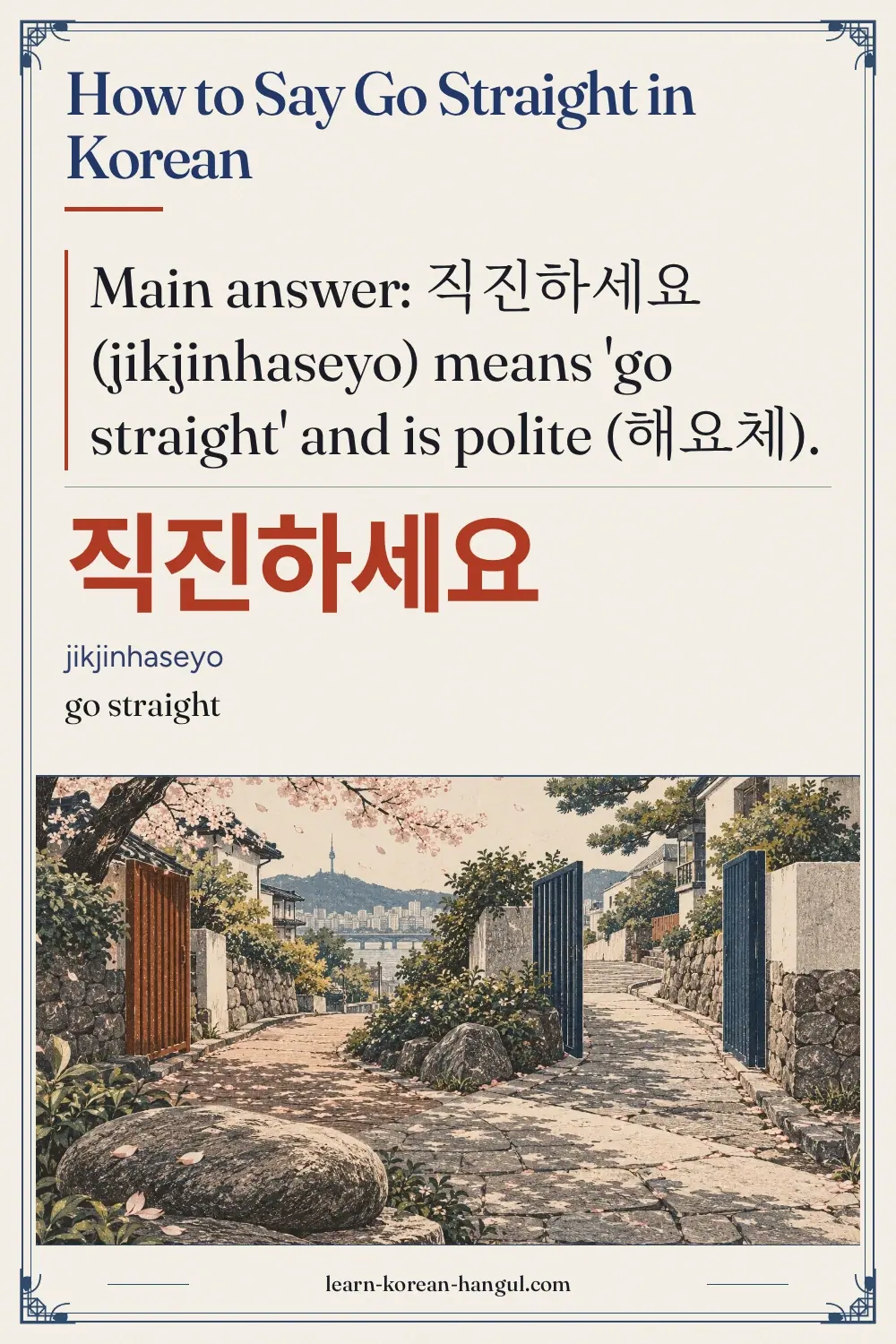
How Do You Say Go Straight in Korean?
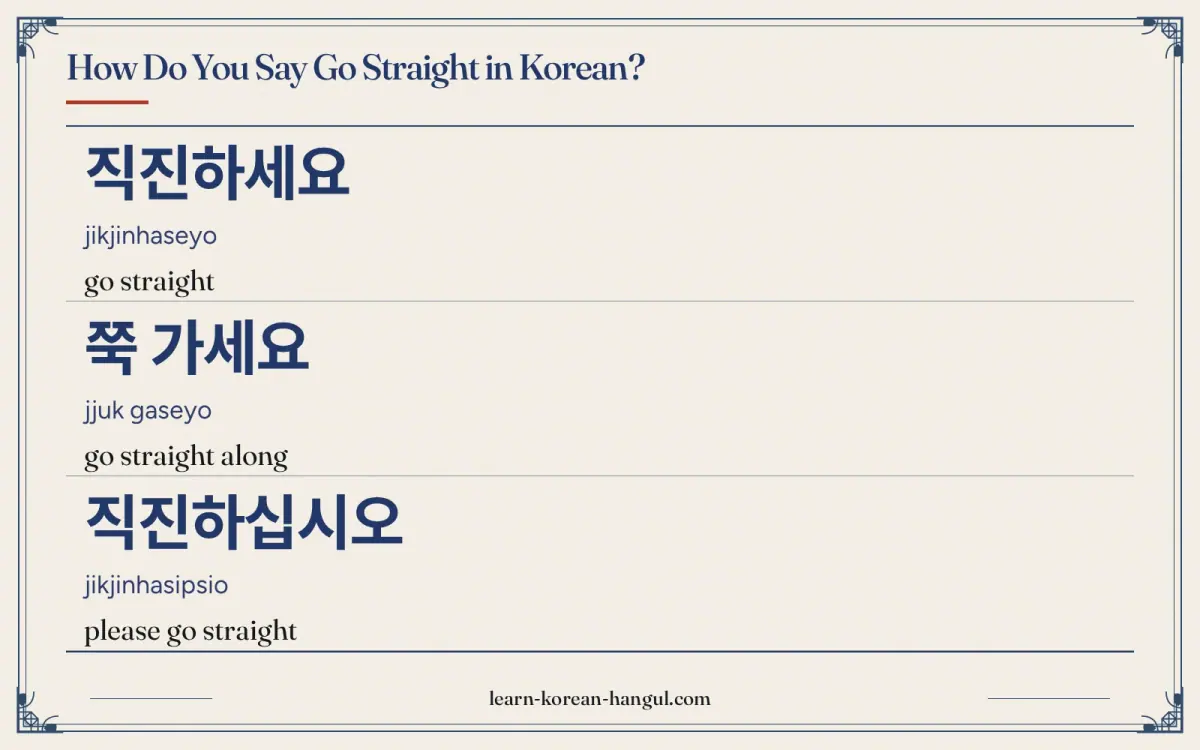
The standard polite way to say go straight in Korean is 직진하세요 (jikjinhaseyo). The phrase has two parts. 직진 (jikjin) is a Sino-Korean noun made of 직 ("straight") and 진 ("advance"). 하세요 (haseyo) is the polite request form of 하다 ("to do"), so the phrase literally says "please do straight-going."
In real directions, many speakers prefer a plain verb. 쭉 가세요 (jjuk gaseyo) combines 쭉 ("in a long, unbroken line") with 가세요 ("please go"). 똑바로 가세요 (ttokbaro gaseyo) adds the idea of not bending or turning.
Four forms cover most situations.
| Korean | Revised Romanization | Meaning | Register |
|---|---|---|---|
| 직진하세요 | jikjinhaseyo | go straight | polite (해요체) |
| 쭉 가세요 | jjuk gaseyo | go straight along | polite, everyday speech |
| 직진하십시오 | jikjinhasipsio | please go straight | formal (합쇼체) |
| 직진해 | jikjinhae | go straight | casual (해체) |
Revised Romanization (the South Korean government standard of 2000) is a reading aid only. The Hangul is the real spelling. The next section shows who each form fits.
What Are the Formal, Polite and Casual Ways to Say Go Straight?
Korean changes the sentence ending to match the listener, and the Korean speech levels explain how. Directions are usually given to strangers, so the polite style is the standard, and the casual style is rare outside friends and family.
Polite: 직진하세요 (jikjinhaseyo)
직진하세요 is the form to learn first. Use it when a stranger asks you the way, or when you give directions to a coworker or a guest. A landmark almost always follows it.
Example: 직진하세요. 두 번째 신호등에서 왼쪽으로 도세요. (jikjinhaseyo. du beonjjae sinhodeungeseo oenjjogeuro doseyo.) "Go straight. At the second traffic light, turn left."
Formal: 직진하십시오 (jikjinhasipsio)
직진하십시오 uses the formal ending -십시오 (합쇼체). It appears in recorded announcements and formal service speech. A person speaking to a stranger would rarely use it in conversation, but staff in a hotel or a department store may.
Example: 직진하십시오. 목적지는 오른쪽에 있습니다. (jikjinhasipsio. mokjeokjineun oreunjjoge itseumnida.) "Please go straight. The destination is on the right."
Casual: 직진해 (jikjinhae)
직진해 drops the 요 and is casual (해체). It fits a friend who is walking beside you, a sibling in a car or a classmate. The verb stays the same, only the ending changes.
Example: 직진해. 거기서 왼쪽으로 돌아. (jikjinhae. geogiseo oenjjogeuro dora.) "Go straight. Turn left there."
Choosing a Form by Listener
The table gives one clear choice per situation.
| Situation | Best choice | Why |
|---|---|---|
| Stranger asks the way | 직진하세요 or 쭉 가세요 | polite and clear |
| Recorded announcement | 직진하십시오 | formal style |
| Taxi driver | 직진해 주세요 | polite request for a favour |
| Friend walking with you | 직진해 | casual |
Once the choice is clear, the next step is to hear the words.
How Do You Pronounce 직진하세요?
직진하세요 is pronounced [직찐하세요], roughly "jik-jjin-ha-se-yo," with five syllables in one word group. Play the slow clip, then the normal clip, and repeat each one aloud.
| Word | Spelled | Spoken | Revised Romanization |
|---|---|---|---|
| 직진하세요 | 직-진-하-세-요 | [직찐하세요] | jikjinhaseyo |
| 똑바로 | 똑-바-로 | [똑빠로] | ttokbaro |
| 왼쪽 | 왼-쪽 | [웬쪽] | oenjjok |
| 오른쪽 | 오-른-쪽 | [오른쪽] | oreunjjok |
What Sound Changes Happen in the Go-Straight Phrases?
The key change is in 직진. The final ㄱ of 직 is a stop sound, and the Standard Pronunciation Rules (표준 발음법) of the National Institute of Korean Language (국립국어원) make the following consonant tense (Article 23). So the ㅈ of 진 becomes tense, and 직진 is spoken [직찐]. Revised Romanization writes jikjin, because it does not show tensing that comes from a neighbouring sound. The ㅎ of 하 comes after ㄴ and is soft, so the word flows without a break. The page on tensification lists the other cases.
똑바로 follows the same rule. The final ㄱ of 똑 tenses the ㅂ of 바, and the word is [똑빠로]. The ㄱ does not turn into ㅇ, because nasalization only happens before a nasal sound such as ㄴ or ㅁ.
The word 왼쪽 contains the vowel ㅚ. The standard lists it as a simple vowel and allows a diphthong [we], and most speakers say [웬쪽]. The tense ㅉ in 쪽 gives a crisp, short sound. Before a particle, the ㄱ moves across: 오른쪽에 is spoken [오른쪼게], and 왼쪽으로 is spoken [웬쪼그로]. For intonation, the phrase falls gently, since it is an instruction. With the sounds clear, the next question is when to say it.
When Should You Use 직진하세요, and When Should You Not?
Use 직진하세요 when the route has a clear straight section and you can name where it ends. The phrase works best with a limit: a traffic light, a corner, a station exit. Without a limit, the listener may not know when to stop.
Situations Where 직진하세요 Fits
- A traveller asks the way to a station. Say 직진하세요, then name the first landmark.
- A taxi driver needs an instruction. Say 직진해 주세요 and add the place. To stop, say 여기서 세워 주세요 (yeogiseo sewo juseyo, "please stop here").
- You walk a friend through a route by phone. Say 직진해, then say what you see.
Situations to Avoid
- A long or winding route. Break it into steps: 직진하세요, then 오른쪽으로 도세요, then 직진하세요 again.
- A listener who does not read Hangul. Point as well as speak, or show a map.
- A very close place. Say 바로 앞이에요 (baro apieyo, "it's right ahead") instead of giving a command.
If unsure, add one landmark. The dialogues below show how that sounds.
What Does Go Straight Sound Like in a Real Conversation?
Read each dialogue, play the clip, and say one role aloud.
Dialogue 1: Asking a passer-by
- A: 실례합니다. 지하철역이 어디예요? (sillyehamnida. jihacheollyeogi eodiyeyo?) "Excuse me. Where is the subway station?"
- B: 직진하세요. 신호등에서 오른쪽으로 도세요. (jikjinhaseyo. sinhodeungeseo oreunjjogeuro doseyo.) "Go straight. At the traffic light, turn right."
- A: 감사합니다. (gamsahamnida.) "Thank you."
실례합니다. 지하철역이 어디예요? 직진하세요. 신호등에서 오른쪽으로 도세요. 감사합니다.
Dialogue 2: In a taxi
- A: 여기서 직진해 주세요. (yeogiseo jikjinhae juseyo.) "Please go straight from here."
- B: 네, 알겠습니다. (ne, algetseumnida.) "Yes, understood."
여기서 직진해 주세요. 네, 알겠습니다.
In Dialogue 1, the question 지하철역이 어디예요? is a wh-question, so the voice does not rise sharply at the end. The guide to where is the subway station in Korean covers the question. The answer gives two steps joined by a landmark. In Dialogue 2, the passenger uses 해 주세요, a polite request, and the driver replies with 알겠습니다. The phrase also reflects how Koreans describe routes.
What Should You Know about the Culture behind Giving Directions?
Koreans usually give directions with landmarks, not street names. A common route sounds like "go straight to the traffic light, turn right at the convenience store, and the station is on the left." Subway stations add another tool: exit numbers, as in 3번 출구 (sam beon chulgu, "exit 3"), which are often the best meeting point.
Listeners rely on short, clear steps. A helpful speaker may also walk a few steps with the traveller, or point and say 저기예요 (jeogiyeyo, "it's over there"). Note that 저기요 on its own means "excuse me", not "over there". If you want to ask the distance, the guide to is it far in Korean gives the question, and how do I get to in Korean gives the opening line. Missing these habits leads to some typical mistakes.
What Mistakes Do Learners Make with Go Straight in Korean?
The most common mistake is using the phrase without a landmark. Five mistakes appear again and again:
- Saying 직진하세요 alone. Fix: add a limit, such as 신호등까지 직진하세요.
- Reading 직진 as [직진]. Fix: tense the ㅈ, [직찐].
- Mixing up 왼쪽 and 오른쪽. Fix: link 왼쪽 to 왼손 (left hand) and 오른쪽 to 오른손 (right hand).
- Using 가세요 when you mean "turn." 가다 means "go", and 돌다 means "turn." Fix: 오른쪽으로 도세요.
- Using the casual 직진해 with a stranger. Fix: add 세요.
All five come from translating "go straight" without the habits of Korean directions. A few related searches ask the same thing in other words, so they are answered next.
Short Answers on Turn Left, Turn Right and Straight Ahead
Four searches lead to this page, so each gets a short answer.
- Turn left in Korean: Say 왼쪽으로 도세요 (oenjjogeuro doseyo). Navigation and taxis use 좌회전 (jwahoejeon).
- Turn right in Korean: Say 오른쪽으로 도세요 (oreunjjogeuro doseyo). The traffic term is 우회전 (uhoejeon).
- Left and right in Korean: 왼쪽 (oenjjok) is left and 오른쪽 (oreunjjok) is right.
- Straight ahead in Korean: Say 앞으로 쭉 가세요 (apeuro jjuk gaseyo) or 똑바로 가세요. 앞으로 alone, with no verb, is only half an instruction, so always finish it with 가세요.
The particle 으로 in these phrases marks direction, as in "toward the left." The page on asking for directions in Korean puts the whole exchange together.
Related Phrases to Learn Next
Three pages follow the same layout and pair well with this one:
- How do I get to in Korean: the question that starts the exchange.
- Is it far in Korean: how to ask about distance.
- Where is the subway station in Korean: the most common destination.
The complete list sits in the Korean directions phrases cluster.
Practice: Say It Aloud
Spend five minutes on this routine.
- Play the slow clip of 직진하세요 and repeat it three times, tensing the ㅈ in [직찐].
- Say 직진하세요, then 쭉 가세요, and name the listener for each.
- Build a route: 직진하세요. 오른쪽으로 도세요. 직진하세요.
- Hide the Romanization with the toggle and read the four forms from Hangul only.
- Drill the cluster with the phrase flashcards.
When you can say the route in three short steps, you can say go straight in Korean and be understood.
Frequently Asked Questions
The answers below add details about how to say go straight in Korean beyond the sections above.
What is the difference between 직진하세요 and 쭉 가세요?
Both tell someone to keep going straight. 직진하세요 uses the noun 직진 ("going straight") and sounds clear and slightly formal, like a road sign. 쭉 가세요 uses the adverb 쭉 ("in a long line") and the verb 가다 ("to go"), and it is how most people give directions in speech.
How do I say turn left and turn right in Korean?
Say 왼쪽으로 도세요 (oenjjogeuro doseyo) for "turn left" and 오른쪽으로 도세요 (oreunjjogeuro doseyo) for "turn right." The verb is 돌다 ("to turn"), whose ㄹ drops before 세요. Taxi drivers and navigation voices often use 좌회전 (jwahoejeon) and 우회전 (uhoejeon) for left and right turns.
Why is 직진 pronounced [직찐]?
The final ㄱ of 직 is a stop sound, and the Standard Pronunciation Rules make a plain ㅈ tense after a stop (Article 23). So 직진 is spoken [직찐]. Revised Romanization still writes jikjin, because it does not show tensing that comes from a neighbouring sound.
Is 직진하세요 formal or casual?
직진하세요 is polite (해요체), between formal and casual. The formal version is 직진하십시오, and the casual version is 직진해. Use the polite form with strangers and passers-by, and the casual one only with friends. Recorded announcements favour the formal style.
How do I ask someone to go straight when I am in a taxi?
Say 직진해 주세요 (jikjinhae juseyo, "please go straight") or 이 길로 쭉 가 주세요 (i gillo jjuk ga juseyo, "please go straight along this road"). The pattern -아/어 주세요 is a polite request for a favour, and it is the standard way to give instructions to a driver.
What is the most common mistake with go straight in Korean?
Learners often say the phrase with no landmark, such as 직진하세요 alone. Korean directions usually name a place, an exit number or a traffic light, for example 신호등까지 직진하세요 (sinhodeungkkaji jikjinhaseyo). Another common slip is a plain ㅈ, [직진], instead of the tense [직찐].