지하철역이 어디예요?
지하철역이 어디예요?
What you'll learn
- Ask for a subway station, ask where one is located, and ask for the nearest one.
- Tell 지하철 (the subway system) from 지하철역 (the station) and 역 (any station).
- Say 지하철역이 as [지하철려기], with the extra sound that appears before 역.
- Understand the short directions and exit numbers people give you.
Before you start: a short opener helps, so see excuse me in Korean. Time: about 15 minutes. Audio plays only when you press a button.
How Do You Say Where Is the Subway Station in Korean?
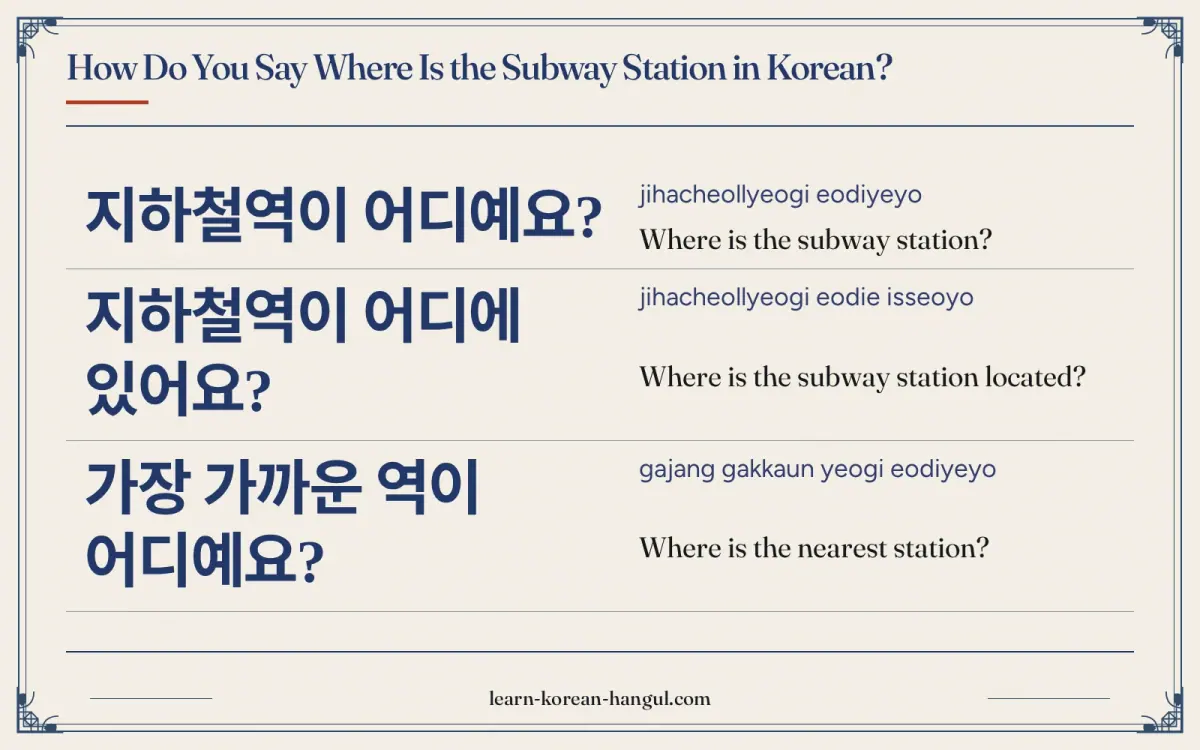
The standard question is 지하철역이 어디예요?, and two partners cover other needs. Pick the form by what you want: the station, its exact location or the closest one.
| Situation | Korean | Revised Romanization | Meaning |
|---|---|---|---|
| Ask where the station is | 지하철역이 어디예요? | jihacheollyeogi eodiyeyo | Where is the subway station? |
| Ask where it is located | 지하철역이 어디에 있어요? | jihacheollyeogi eodie isseoyo | Where is the subway station located? |
| Ask for the nearest one | 가장 가까운 역이 어디예요? | gajang gakkaun yeogi eodiyeyo | Where is the nearest station? |
The word 지하 means "underground" and 철 (鐵) means "iron", the metal of the railway, so 지하철 is the underground railway. The particle 이 marks 지하철역 as the subject, 어디 means "where", and 예요 is the polite "is". The next section shows each form in a sentence.
What Are the Polite Ways to Say Where Is the Subway Station?
Every form below is polite or formal, because you almost always ask strangers. Korean marks the listener with speech levels, the sentence endings explained in the guide to Korean speech levels. The ending -요 makes a sentence polite, and -ㅂ니까 makes a question formal.
Polite: 지하철역이 어디예요? (jihacheollyeogi eodiyeyo)
Polite · 해요체This is the default. Use it with cafe staff, taxi drivers and passers-by. It asks only for the place, so the answer is a direction. For a named station, say the name first: 강남역이 어디예요?
저기요, 지하철역이 어디예요?
jeogiyo, jihacheollyeogi eodiyeyo?
Excuse me, where is the subway station?
Polite: 지하철역이 어디에 있어요? (jihacheollyeogi eodie isseoyo)
Polite · 해요체있어요 means "exists, is located", and 에 marks the place, so this version asks "where is it located?". It sounds a little fuller than the plain form and means the same thing. It is a gentle choice when you are not in a hurry.
실례합니다, 지하철역이 어디에 있어요?
sillyehamnida, jihacheollyeogi eodie isseoyo?
Excuse me, where is the subway station located?
Polite: 가장 가까운 역이 어디예요? (gajang gakkaun yeogi eodiyeyo)
Polite · 해요체가장 means "most", and 가까운 is the modifier form of 가깝다, "to be near". Together they say "the nearest". Use it when you do not know which station is close, and 역 alone is enough because the context is clear.
가장 가까운 역이 어디예요?
gajang gakkaun yeogi eodiyeyo?
Where is the nearest station?
Polite: 몇 번 출구예요? (myeot beon chulguyeyo)
Polite · 해요체When you reach the station, the next question is which exit. 출구 means "exit", and 몇 번 asks for a number. This question is very useful for meeting people.
약속 장소가 몇 번 출구예요?
yaksok jangsoga myeot beon chulguyeyo?
Which exit is our meeting place?
Formal: 지하철역이 어디입니까? (jihacheollyeogi eodiimnikka)
Formal · 합쇼체The formal question ending -ㅂ니까 suits a hotel front desk or a business visit. It is correct but stiff for a quick street question.
실례합니다. 지하철역이 어디입니까?
sillyehamnida. jihacheollyeogi eodiimnikka?
Excuse me. Where is the subway station? (formal)
Casual: 지하철역 어디야? (jihacheollyeok eodiya)
Casual · 반말With close friends and family, drop -요 and say 어디야. Never use it with strangers, staff or elders.
야, 지하철역 어디야?
ya, jihacheollyeok eodiya?
Hey, where's the subway station?
Asking is only half the exchange, so the next section covers what you will hear back.
What Will People Answer When You Ask?
Most answers are short and give a direction or a distance, so learn six replies. People often point as they speak.
| Korean | Revised Romanization | Meaning |
|---|---|---|
| 쭉 가세요 | jjuk gaseyo | Go straight ahead |
| 오른쪽으로 가세요 | oreunjjogeuro gaseyo | Go to the right |
| 왼쪽으로 가세요 | oenjjogeuro gaseyo | Go to the left |
| 길을 건너세요 | gireul geonneoseyo | Cross the road |
| 걸어서 5분 정도예요 | georeoseo o bun jeongdoyeyo | It's about five minutes on foot |
| 저 앞에 있어요 | jeo ape isseoyo | It's just ahead |
The endings -세요 are polite requests, so you will hear them in almost every answer. Knowing the replies prepares you for the sounds in the question itself.
How Do You Pronounce 지하철역이 어디예요?
지하철역이 어디예요? is pronounced [지하철려기 어디예요], ji-ha-cheol-lyeo-gi eo-di-ye-yo, in nine syllables. The first word has a hidden extra sound and a link.
- 지 (ji): a soft j, like "jee".
- 하 (ha): a light h and "ah".
- 철 (cheol): a puff of air, then the unrounded ㅓ, then ㄹ.
- 려 (lyeo): the ㄹ of 철 doubles with a new ㄹ, so you say "l-lyeo".
- 기 (gi): the final ㄱ of 역 moves here and joins 이.
- 어디예요 (eodiyeyo): "uh-dee-yeh-yo", said smoothly.
Sound Changes to Listen For
Four points make the question and its partners sound natural:
- ㄴ-insertion (ㄴ 첨가). In a compound, when the first part ends in a consonant and the second starts with 이, 여, 야, 유 or 요, a ㄴ sound is inserted. 지하철 plus 역 gives [지하철녁]. The National Institute of Korean Language (국립국어원) Standard Pronunciation rules (표준 발음법) describe this in Article 29.
- ㄹ assimilation. The inserted ㄴ becomes ㄹ after the ㄹ of 철, giving [지하철력]. Revised Romanization shows this change, so the word is written jihacheollyeok.
- Liaison (연음). The final ㄱ of 역 moves onto 이, so 지하철역이 sounds like [지하철려기]. See the liaison rules.
- 있어요 is [이써요] and 어디입니까 is [어디임니까]. The first is a liaison; in the second, ㅂ before ㄴ becomes ㅁ. See ㅂ-to-ㅁ nasalization.
The same change appears in station names, such as 서울역에서, which sounds like [서울려게서] and is written Seoullyeogeseo.
Once the sounds are clear, the next step is knowing when each form fits.
When Should You Use 지하철역이 어디예요?, and When Should You Not?
Use 지하철역이 어디예요? when you need to find a subway station in a city that has one. Add a station name, such as 강남역, when you want a specific one.
Situations Where It Fits
- On the street. Ask a passer-by, a shop worker or a police officer.
- From a hotel. The front desk can tell you the closest station and the right exit.
- In a taxi. Ask the driver to stop near a station, with 지하철역 앞에서 세워 주세요.
Situations to Avoid
- Asking for the whole subway. 지하철이 어디예요? asks about the system, so staff may look puzzled; add 역.
- Using the casual form with staff. 지하철역 어디야? is for friends only.
- Asking in a city without a subway. Many towns have only buses or a train station; ask for the 기차역 (train station) there.
Real exchanges show how the questions chain together.
What Does Asking for the Subway Station Sound Like in a Real Conversation?
Three short exchanges cover the usual cases: a street question, a request for the nearest station and a small misunderstanding. Listen for the opening phrase and the answer.
Asking a Passer-By
Traveller
저기요, 지하철역이 어디예요?
jeogiyo, jihacheollyeogi eodiyeyo?
Excuse me, where is the subway station?
Passer-By
길을 건너세요. 바로 앞에 있어요.
gireul geonneoseyo. baro ape isseoyo
Cross the road. It's right ahead.
Traveller
감사합니다.
gamsahamnida
Thank you.
What to notice: the answer starts with an instruction, 건너세요, and ends with a place. Thank people with 감사합니다.
Asking for the Nearest Station
Traveller
가장 가까운 역이 어디예요?
gajang gakkaun yeogi eodiyeyo?
Where is the nearest station?
Shop Clerk
걸어서 5분 정도예요. 쭉 가세요.
georeoseo o bun jeongdoyeyo. jjuk gaseyo
It's about five minutes on foot. Go straight.
Traveller
몇 번 출구예요?
myeot beon chulguyeyo?
Which exit is it?
Shop Clerk
2번 출구예요.
i beon chulguyeyo
It's exit 2.
What to notice: the traveller asks a wh-question, so it ends with a falling or rise-fall tone and not a sharp rise. 걸어서 is the form of 걷다, "to walk", used to say "on foot".
A Small Misunderstanding
Traveller
지하철이 어디예요?
jihacheori eodiyeyo?
Where is the subway?
Passer-By
지하철이요? 역을 찾으세요?
jihacheoriyo? yeogeul chajeuseyo?
The subway? Are you looking for a station?
Traveller
네, 지하철역이요.
ne, jihacheollyeogiyo
Yes, the subway station.
Passer-By
아, 저쪽이에요.
a, jeojjogieyo
Ah, it's over there.
What to notice: the passer-by repeats the word with 이요 and then clarifies with 역. This shows why adding 역 matters. A few local habits also make stations easier to find.
What Should You Know about the Culture behind Finding a Station?
Several Korean cities, including Seoul and Busan, have subway systems, and a few habits make navigation easier.
- Station names end in 역. People say the name with 역, as in 서울역 or 강남역, and 역 is usually kept when you ask for a station.
- Numbered exits. Each station has numbered exits, so directions and meeting points are often "station name plus exit number", such as 3번 출구. See when shall we meet in Korean for the follow-up question.
- Line numbers. Lines are called by number, such as 2호선, and by colour on signs and maps.
- Signs show English. Station signs usually show the name in Korean and English, and map apps work well for finding the nearest station.
An expert insight: learners often say only 지하철 and point. Adding 역 takes one syllable and changes the question from "where is the subway?" to "where is the station?". The next section lists the mistakes that cause the most confusion.
What Mistakes Do Learners Make with Where Is the Subway Station in Korean?
Most mistakes come from dropping a word or from missing the sound change.
| Mistake | Why it is a problem | Fix |
|---|---|---|
| 지하철이 어디예요? | It asks about the system, not the station | Say 지하철역이 어디예요? |
| 지하철역 only, with no 어디 | The question is incomplete | Add 어디예요 or 어디에 있어요 |
| Reading 지하철역 as [지하철역] | The inserted ㄴ and ㄹ sound are missing | Say [지하철력] |
| Using 정류장 for a station | 정류장 is a bus stop | Say 역 |
| Using 어디야 with staff | It is casual and abrupt | Say 어디예요 |
Learners often think 전철 is a different thing from 지하철. In fact the two words overlap in everyday use around Seoul, and many people say either, but 지하철역 is the most common form on signs and maps. Several other English queries fold into this page.
Is It the Same as Subway Station, Station, Subway or Nearest Station?
Mostly yes. Each English word maps onto a Korean word you can use in a question.
- Subway station in Korean: 지하철역. Ask 지하철역이 어디예요?
- Where is the station in Korean: 역이 어디예요? works when the context is clear. Use 기차역 for a train station and 버스 정류장 for a bus stop.
- Where is the subway in Korean: 지하철 is the system, so ask for the 역. Use 지하철 타는 곳 for "where to take the subway".
- Nearest station in Korean: 가장 가까운 역이 어디예요?
Now practise the question until it feels automatic.
Practice: Say It Aloud
Play the slow clip of 지하철역이 어디예요? three times and repeat it. Then choose a form for each situation. Answers follow.
- You ask a passer-by on the street.
- You want to know the closest station.
- You are at a hotel front desk and want the formal form.
- You ask a friend, casually.
Answers: 1. 지하철역이 어디예요? 2. 가장 가까운 역이 어디예요? 3. 지하철역이 어디입니까? 4. 지하철역 어디야?
Use the phrase flashcards to drill the question with audio.
Related Phrases to Learn Next
- How do I get to in Korean: 어떻게 가요? to ask for the route.
- Where is the bathroom in Korean: the same pattern with a new place.
- I'm lost in Korean: the phrase for when the map is not enough.
This guide belongs to the Korean directions phrases collection. What this page does not cover: reading a route map and the vocabulary for turns and landmarks, which deserve their own lessons. Master the three questions above, and you can say where is the subway station in Korean in any city.
Frequently Asked Questions
How do you say where is the subway station in Korean?
Say 지하철역이 어디예요? (jihacheollyeogi eodiyeyo). The word 지하철역 means subway station, 어디 means "where", and 예요 is the polite "is". The ending -요 makes the sentence suitable for strangers and staff. For a named station, put the name first, as in 강남역이 어디예요?
How do you pronounce 지하철역이 어디예요?
It sounds like ji-ha-cheol-lyeo-gi eo-di-ye-yo, with nine syllables. A ㄴ sound is inserted before 역 and becomes ㄹ, so 철역 sounds like 철력, and the final ㄱ links to 이. Revised Romanization shows this as jihacheollyeogi. Keep the ㅓ vowels unrounded and say 예요 lightly.
What is the difference between 지하철역이 어디예요? and 지하철역이 어디에 있어요?
Both ask where the station is, and both are polite. 지하철역이 어디예요? is shorter and the most common in conversation. 지하철역이 어디에 있어요? literally asks "where is it located", sounds slightly fuller, and suits a careful tone. Staff and strangers understand both without any difference in meaning.
Can I use 지하철역이 어디예요? with friends, elders and strangers?
Yes for strangers and elders, because the ending -요 is polite. With a close friend you can drop it and say 지하철역 어디야?. At a hotel desk, the formal 지하철역이 어디입니까? is also fine. Avoid the casual form with staff and with anyone you do not know well.
What is the most common mistake with where is the subway station in Korean?
Saying 지하철이 어디예요? without 역. 지하철 means the subway system, so staff may not know what you are looking for. Add 역 to ask for the station. The second most common mistake is missing the extra ㄹ sound, saying [지하철역] instead of [지하철력].