동의해요
동의해요
What you'll learn
- Say 동의해요, 저도 같은 생각이에요, 맞아요 and 나도 그렇게 생각해 and know which suits a meeting and which suits a chat.
- Use the particle 에 correctly: 그 말에 동의해요.
- Pronounce 동의 and the sound changes in 그렇게 생각해.
- Avoid using 동의해요 as a casual "me too".
Before you start: the lesson on Korean speech levels explains the endings used below. Time: about 12 minutes. Audio plays only when you press a button.
How Do You Say I Agree in Korean?
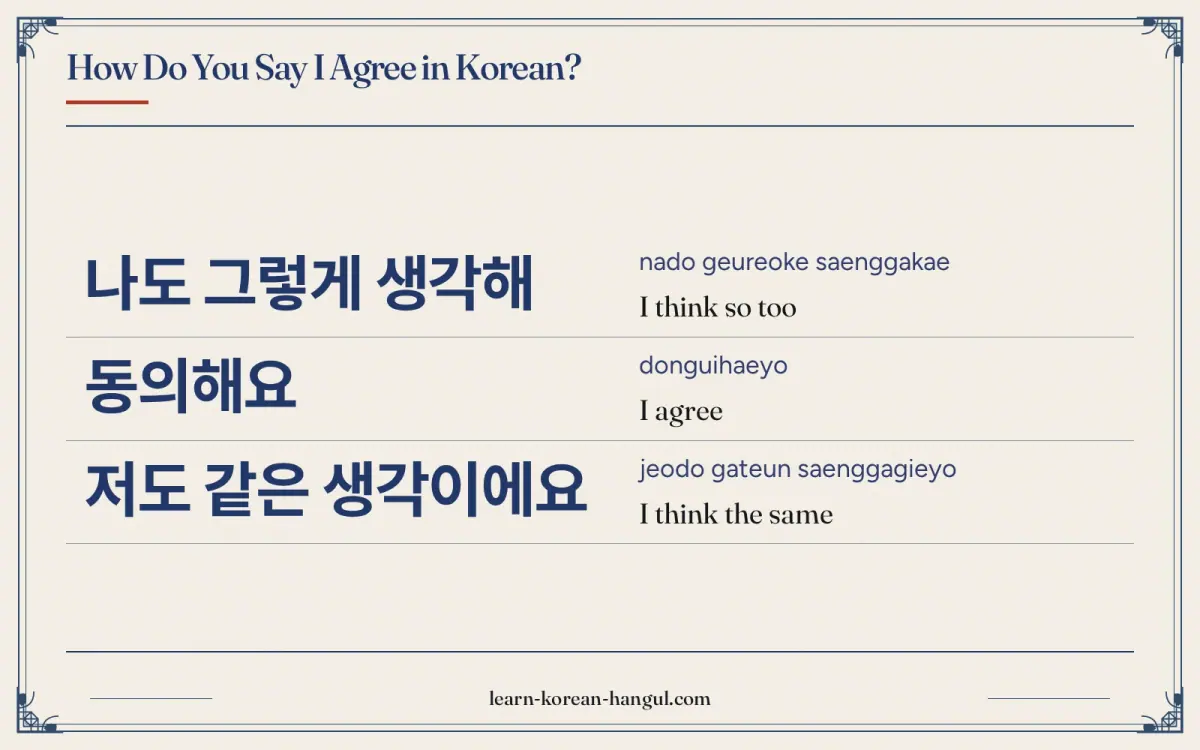
The standard way to say I agree in Korean is 동의해요. It comes from the noun 동의 (agreement) and the verb 하다 (to do), so it means "I give my agreement". Use it when someone states an opinion or a proposal and you accept it.
| Listener | Korean | Romanization | Meaning |
|---|---|---|---|
| Friend, sibling | 나도 그렇게 생각해 | nado geureoke saenggakae | I think so too |
| Coworker, acquaintance | 동의해요 | donguihaeyo | I agree |
| Coworker, friendly chat | 저도 같은 생각이에요 | jeodo gateun saenggagieyo | I think the same |
| Anyone, about a fact | 맞아요 | majayo | That's right |
| Forms, meetings, websites | 동의합니다 | donguihamnida | I agree (formal) |
Revised Romanization (the South Korean government standard of 2000) is only a reading aid here. Learn the Hangul first. The next section explains each form.
What Are the Polite and Casual Ways to Say I Agree?
Korean has two kinds of agreeing. One accepts a plan or an opinion, which uses 동의하다. The other says that a statement is right, which uses 맞다 or a phrase with 생각 (thought). The listener and the topic decide which one sounds natural.
Polite: 동의해요 (donguihaeyo)
Polite · 해요체동의해요 is the clear, reasoned "I agree". It suits meetings, debates and serious talk, where you want the other person to hear that you accept their view. To say what you agree with, add the particle 에: 그 말에 동의해요 (I agree with that), 그 의견에 동의해요 (I agree with that opinion). Without 에, the sentence simply says "I agree".
그 말에 동의해요.
geu mare donguihaeyo
I agree with that.
Polite: 저도 같은 생각이에요 (jeodo gateun saenggagieyo)
Polite · 해요체저도 같은 생각이에요 is warmer than 동의해요. 저도 means "I also", 같은 means "same", and 생각 means "thought", so the sentence says "I have the same thought". It sounds like a friend nodding along, and it works well after a coworker shares an idea.
저도 같은 생각이에요.
jeodo gateun saenggagieyo
I think the same.
Polite: 맞아요 (majayo)
Polite · 해요체맞아요 comes from 맞다 (to be correct). It agrees with a statement about a fact or a feeling, and it is the most common reaction in daily chat. Add 저도 그렇게 생각해요 (jeodo geureoke saenggakaeyo) to say "I think so too" after it. See also that's right in Korean.
맞아요. 저도 그렇게 생각해요.
majayo. jeodo geureoke saenggakaeyo
Right. I think so too.
Casual: 나도 그렇게 생각해 (nado geureoke saenggakae)
Casual · 반말나도 그렇게 생각해 drops the polite ending and uses 나 (I, casual). Friends, classmates and family use it. For the shortest version of agreement, see me too in Korean.
나도 그렇게 생각해.
nado geureoke saenggakae
I think so too.
The formal form 동의합니다 (donguihamnida) appears on forms and in meetings, and its sound changes come next.
How Do You Pronounce 동의해요?
동의해요 is pronounced [동의해요], with four syllables: dong-ui-hae-yo. The unusual part is the vowel ㅢ in the second syllable.
- 동 (dong): a clear "doh" with the tongue back, ending in the "ng" sound.
- 의 (ui): the vowel ㅢ glides from ㅡ to ㅣ. The ㅡ is unrounded, so do not round your lips.
- 해 (hae): the ㅎ is soft and light.
- 요 (yo): a short "yo", level or slightly rising.
Sound Changes to Listen For
- ㅢ in a later syllable. In 동의, the standard sound is [동의]. The National Institute of Korean Language (국립국어원) also allows [동이] when ㅢ is not in the first syllable, and you will often hear that casual version.
- Nasalization in 동의합니다. The ㅂ in 합 becomes ㅁ before ㄴ, so the formal form sounds like [동의함니다], and RR writes donguihamnida.
- Aspiration in 그렇게 생각해. The ㅎ of 그렇 joins the ㄱ of 게 and gives a ㅋ sound: [그러케]. The ㄱ of 각 also joins ㅎ in 해: [생가캐]. RR shows this with predicates: geureoke saenggakae.
- Liaison in 맞아요 and 생각이에요. The final consonant moves to the next syllable: 맞아요 is [마자요], and 생각이에요 is [생가기에요].
- Tensing in 약관에. In 약관에 동의합니다, the ㄱ of 관 becomes tense, so 약관에 sounds like [약꽈네].
The Korean nasalization lesson covers the ㅂ to ㅁ change with audio. Practise by saying 동의, then 동의해요, and keep the ㅡ unrounded. Pronunciation is one half, and the other half is the situation.
When Should You Use 동의해요, and When Should You Not?
Use 동의해요 when you accept a proposal or an opinion in a clear, polite way. Do not use it for every small "me too".
Situations Where It Fits
- A work meeting. 이 의견에 동의합니다 shows a clear vote.
- Online forms. 약관에 동의합니다 is the standard "I agree" for terms and conditions.
- A debate or class. 그 말에 동의해요 accepts a point politely.
- Planning with friends. 동의해요 sounds a little serious but is fine as a joke.
약관에 동의합니다.
yakgwane donguihamnida
I agree to the terms.
Situations to Avoid
- Casual chat about food or a drama. Use 맞아요 or 저도요.
- Agreeing to a request. To say "okay, I'll do it", use 알겠어요 or 좋아요, not 동의해요.
- Text with a very close friend. 동의해요 sounds like a formal announcement.
Three short dialogues show the right level in each setting.
What Does I Agree Sound Like in a Real Conversation?
Agreement phrases are quick. Listen for the calm tone in the meeting and the lively, warm tone between friends.
A Team Meeting
Manager
이 의견에 동의하세요?
i uigyeone donguihaseyo
Do you agree with this opinion?
Colleague
네, 저도 동의합니다.
ne, jeodo donguihamnida
Yes, I agree too.
What to notice: the manager uses the honorific 동의하세요 for the colleague, and the colleague answers with the formal 동의합니다 [동의함니다].
Two Friends at a Cafe
Su-Jin
이 카페 분위기 좋죠?
i kape bunwigi jochyo
The mood in this cafe is nice, isn't it?
Min-Ho
맞아요, 저도 그렇게 생각해요.
majayo, jeodo geureoke saenggakaeyo
Right, I think so too.
What to notice: 좋죠 is [조쵸], and the ending -죠 asks for agreement. 분위기 sounds like [부뉘기], with the ㄴ moving to the next syllable.
Close Friends
Ha-Eun
이 노래 좋다.
i norae jota
This song is good.
Ji-Ho
응, 나도 그렇게 생각해.
eung, nado geureoke saenggakae
Yes, I think so too.
What to notice: 좋다 is [조타], and the casual 응 means "yes". Behind these short answers is a cultural habit.
What Should You Know about the Culture behind I Agree?
Agreement in Korean meetings is often a social act, not only a fact. People care about harmony, so they show that they accept someone's view before they add their own.
- Agree first, add later. A speaker may say 동의해요 and then add 다만 (however) before giving a concern. The soft opening keeps the mood calm.
- Forms and websites. 동의합니다 is the standard wording next to a checkbox for terms, so you meet it in real life early.
- Nodding and short sounds. Listeners often nod and say 네 or 그렇죠 (geureochyo) while someone talks. This does not always mean full agreement, only that the listener follows.
An expert insight: because 동의 is a formal Sino-Korean noun, 동의해요 feels like a decision, while 맞아요 feels like a reaction. Match the word to the weight of the moment. The common errors come from mixing the two.
What Mistakes Do Learners Make with I Agree in Korean?
Most mistakes mix up the weight of the words.
| Mistake | Why it is a problem | Fix |
|---|---|---|
| 동의해요 for a casual "me too" | Sounds like a vote | Say 저도요 or 맞아요 |
| 찬성해요 for agreeing with a person | 찬성 supports a proposal | Use 동의해요 or 맞아요 |
| 맞아요 for "I agree to do it" | 맞다 means correct | Say 알겠어요 or 좋아요 |
| Leaving out 에 after the thing | The sentence is unclear | Say 그 의견에 동의해요 |
| Rounding the lips for ㅡ in 의 | Sounds like a different vowel | Spread the lips |
Learners often think that every English "I agree" becomes 동의해요. Actually, in daily talk Koreans agree with 맞아요 and 저도요 far more often.
Is It the Same as Agree, I Agree with You and Agreeing?
Three nearby searches share this page, and each has a short answer.
- Agree in Korean: the verb is 동의하다 (to agree), with the polite form 동의해요 and the past 동의했어요.
- I agree with you in Korean: say 저도 같은 생각이에요 or 그 말에 동의해요. Korean rarely says "I agree with you" about the person directly.
- Agreeing in Korean: react with 맞아요, 그렇죠 or 저도요 while the other person talks.
Practice: Say It Aloud
Play the slow clip and repeat 동의해요 three times, keeping ㅡ flat. Then choose the best phrase. Answers follow.
- Terms and conditions on a website.
- Your friend says the cafe is lovely.
- A manager asks for your view on a plan.
- Your best friend says the song is great.
Answers
- 동의합니다.
- 맞아요.
- 동의해요 or 저도 같은 생각이에요.
- 나도 그렇게 생각해.
The phrase flashcards drill these forms with audio.
Related Phrases to Learn Next
Agreement belongs to a small group of response phrases.
- I disagree in Korean: the polite way to see things differently.
- That's right in Korean: confirming a statement.
- Me too in Korean: the short, friendly echo.
This guide belongs to the Korean filler words collection. What this page does not cover: the full conjugation of 동의하다 and legal wording of contracts. Match the word to the weight of the moment, and you can say I agree in Korean clearly and kindly.
Frequently Asked Questions
How do you say I agree in Korean?
Say 동의해요 (donguihaeyo) in polite speech. It comes from the noun 동의 (agreement) and the verb 하다. In friendly chat, 맞아요 (majayo) or 저도 같은 생각이에요 (jeodo gateun saenggagieyo) sounds more natural. With friends, say 나도 그렇게 생각해. On forms and websites, the formal 동의합니다 is standard.
How do you pronounce 동의해요?
Say dong-ui-hae-yo in four syllables. The vowel ㅢ glides from an unrounded ㅡ to ㅣ, and in this second syllable many speakers shorten it to [동이]. The ㅎ in 해 is soft. Keep the pitch level, and raise it slightly for a friendly tone.
What is the difference between 동의해요 and 저도 같은 생각이에요?
동의해요 accepts a proposal or opinion and sounds like a clear decision, so it suits meetings and debates. 저도 같은 생각이에요 means "I have the same thought" and sounds warmer and more personal. Use the first for formal agreement and the second for friendly agreement with a coworker or acquaintance.
Is 동의해요 formal or casual?
동의해요 is polite but fairly serious. The casual form is 동의해, though friends rarely say it. The formal form is 동의합니다, used in meetings, contracts and websites. For everyday agreement with friends, use 맞아요 or the casual 나도 그렇게 생각해 instead.
Can I use 동의해요 with friends, elders and strangers?
With elders and strangers, yes, because the polite -요 ending is safe, and 동의합니다 is even more respectful. With friends it can sound too stiff, so prefer 맞아요 or 나도 그렇게 생각해. If you want to be respectful to an elder in a chat, 저도 같은 생각이에요 is a good middle level.
What is the most common mistake with I agree in Korean?
Using 동의해요 for a casual "me too". It sounds like casting a vote. Say 저도요 or 맞아요 instead. Another mistake is using 찬성해요, which means you support a proposal, to agree with a person's statement. A third is using 맞아요 to mean you agree to do something, which needs 알겠어요 or 좋아요.