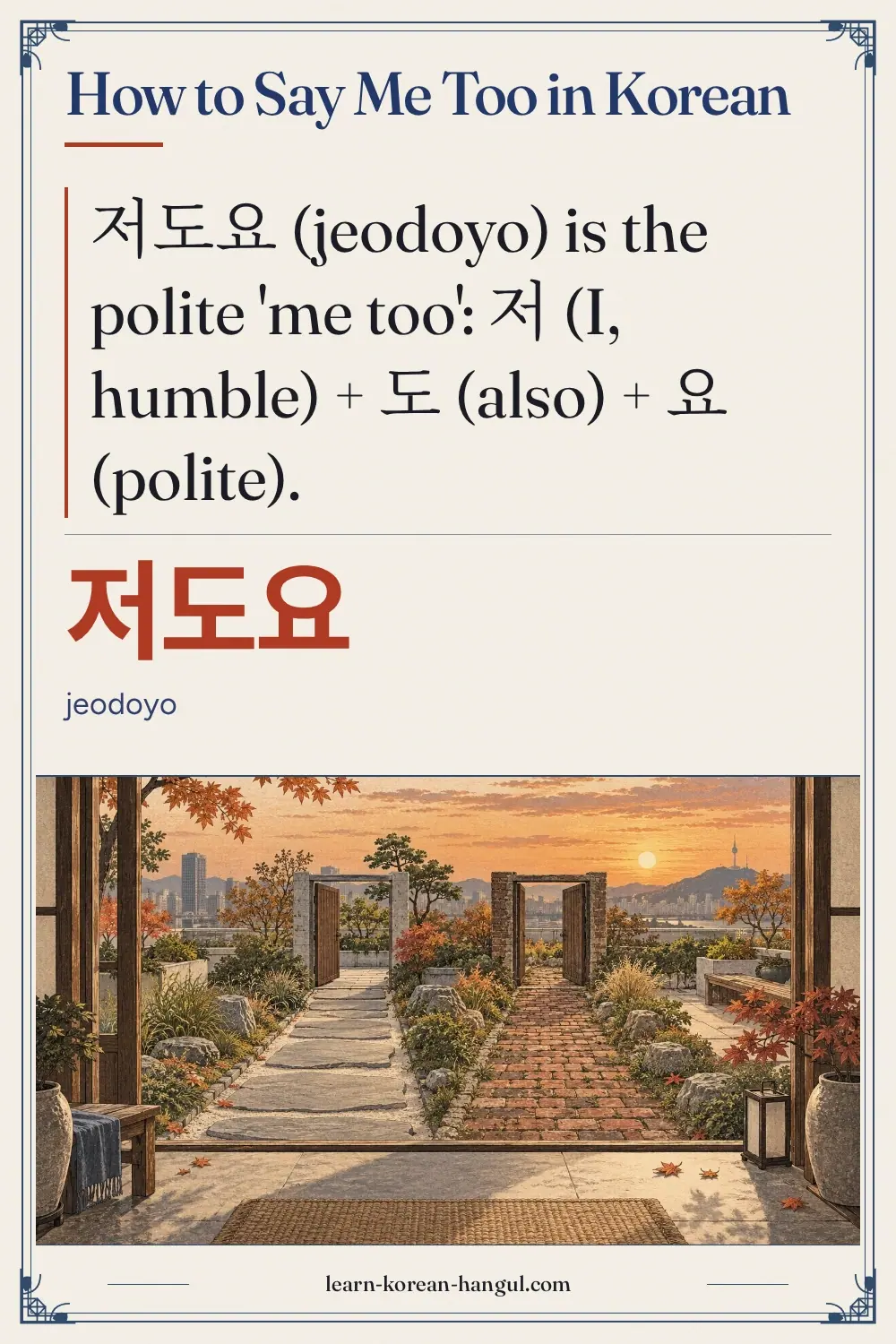
저도요
저도요
What you'll learn
- Say 저도요 and see how it is built from 저, 도 and 요.
- Choose between 저도요, 저도 그래요, 나도 and 저도 마찬가지입니다 for a stranger, a senior and a friend.
- Say "me neither" without confusing the listener.
- Avoid the rude 나도 with elders.
Before you start: you need to read Hangul; romanization is shown as an aid and can be hidden. Time: about 8 minutes.
Key facts
- 저도 그래요 (jeodo geuraeyo) means "same here" and fits feelings, habits and states.
- After a negative statement, 저도요 means "me neither".
How Do You Say Me Too in Korean?
The standard way to say me too in Korean is 저도요, because it is short, polite and safe with almost everyone. It also shows how Korean builds the idea of "too": a small particle, 도, is attached to the person.
| Form | Romanization | Meaning | Register |
|---|---|---|---|
| 저도요 | jeodoyo | Me too | Polite |
| 저도 그래요 | jeodo geuraeyo | Me too, same here | Polite |
| 저도 마찬가지예요 | jeodo machangajiyeyo | It's the same for me | Polite, a little formal |
| 저도 마찬가지입니다 | jeodo machangajiimnida | The same goes for me | Formal |
| 나도 | nado | Me too | Casual |
| 나도 그래 | nado geurae | Same here | Casual |
Look at the pieces of 저도요. 저 (jeo) is "I" in the humble style, 도 (do) is a particle that means "also", and 요 (yo) is the polite ending. Remove 요 and the register drops, and replace 저 with 나 for a casual friend. The next section sorts each form by listener.
What Are the Formal, Polite and Casual Ways to Say Me Too?
Me too in Korean follows the Korean speech levels, the endings that change with the listener's age, status and closeness, explained in the guide to Korean speech levels. The meaning stays "me too" while the pronoun and the ending move up or down. The particle 도 is explained in the guide to the 도 particle.
Polite: 저도요 (jeodoyo)
Polite · 해요체저도요 is the quick polite agreement. It repeats nothing and adds nothing, so it fits when a coworker, teacher or shop owner says something you also feel or do. The -요 ending can attach directly to 저도 because it is a polite particle, not a full verb ending.
오늘 너무 피곤해요. - 저도요.
oneul neomu pigonhaeyo. - jeodoyo
I'm so tired today. - Me too.
Polite: 저도 그래요 (jeodo geuraeyo)
Polite · 해요체저도 그래요 means "I am also like that". 그래요 comes from 그렇다, "to be so", so the phrase points back at whatever the other person said. It sounds fuller than 저도요 and works when you share a feeling, a habit or a situation.
저는 매운 음식이 좋아요. - 저도 그래요.
jeoneun maeun eumsigi joayo. - jeodo geuraeyo
I like spicy food. - Me too, same here.
Casual: 나도 (nado)
Casual · 반말나도 is the casual me too, with 나, the plain word for "I". Friends, siblings and younger people say it. The extension 나도 그래 means "same here". Use neither with a person you should speak politely to, because 나 has no politeness in it.
나 배고파. - 나도.
na baegopa. - nado
I'm hungry. - Me too.
Polite and Formal: 저도 마찬가지예요 (jeodo machangajiyeyo)
Formal · 합쇼체마찬가지 means "the same" or "just as". 저도 마찬가지예요 says "it is the same for me", with -예요 as the polite ending of "to be". The formal ending is -입니다, giving 저도 마찬가지입니다, the choice for a speech, an interview or a business email. It is also a polite way to return a greeting.
만나서 반갑습니다. - 저도 마찬가지입니다.
mannaseo bangapseumnida. - jeodo machangajiimnida
Nice to meet you. - The same goes for me.
There are four forms for four distances. Next, the sounds, which are mostly as written.
How Do You Pronounce 저도요?
저도요 is pronounced [저도요], jeo-do-yo, in three short, even syllables. Follow these steps:
- 저 (jeo): the vowel ㅓ is an open "uh", close to the "u" in "cup". Keep the lips unrounded, or it drifts towards 조.
- 도 (do): the ㄷ sits between two vowels, so it is soft, close to an English d.
- 요 (yo): "yo", with rounded lips, and a slight rise if you are asking back.
Sound Changes to Listen For
저도요 has no sound change, so each block is pronounced as written. The longer forms are worth checking:
- 마찬가지예요 is pronounced [마찬가지예요], and in everyday speech you often hear [마찬가지에요]. Say the five syllables evenly.
- 저도 마찬가지입니다 is pronounced [저도 마찬가지임니다], because the ㅂ of 입 becomes ㅁ before ㄴ. The rule is explained in Korean nasalization.
Revised Romanization, the official system for writing Korean in Latin letters, writes jeodoyo, nado and machangajiimnida. Romanization is only a guide; the Hangul is the real spelling. A clean accent matters less than choosing the right form for the listener, so here are the situations.
When Should You Use 저도요, and When Should You Not?
Use 저도요 when you agree with a statement about a feeling, a habit or a plan and the listener deserves politeness. Use 나도 with friends, and keep 저도 마찬가지입니다 for formal moments.
Situations Where It Fits
- Sharing a feeling. A coworker says she is hungry, and you say 저도요.
- Sharing a habit. A neighbour says he walks every morning, and you reply 저도 그래요.
- Returning a greeting. After 만나서 반갑습니다, say 저도 반갑습니다 (I am glad too).
- Agreeing in a meeting. 저도 같은 의견입니다 (I have the same opinion) is a formal choice.
Situations to Avoid
- 나도 to a teacher, boss or older stranger. It sounds blunt, because 나 and the missing -요 both drop the respect.
- A bare 저도요 after a negative. The meaning of "me too" or "me neither" can be unclear, so add 안 or 못.
- 저도요 as a reply to a question. If someone asks, "Do you like coffee?", answer 네, 좋아해요 first and use 저도요 only when they state their own view.
These choices become clearer in real exchanges, so here are three.
What Does Me Too Sound Like in a Real Conversation?
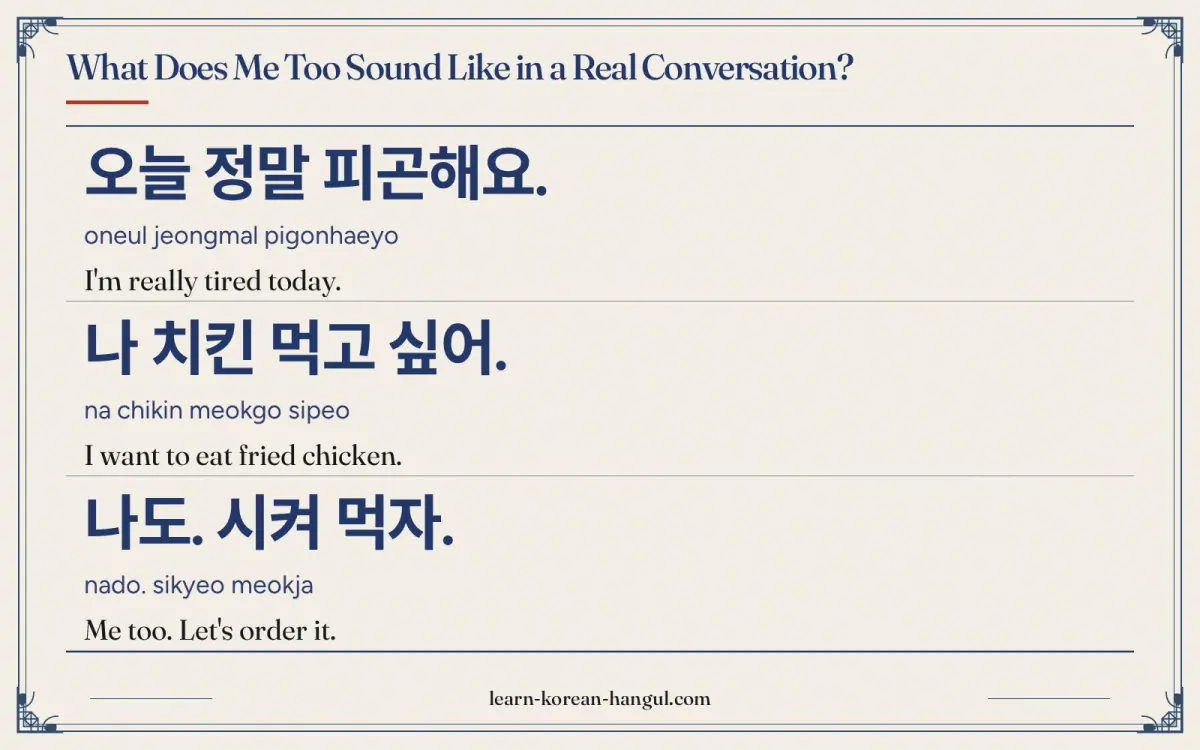
In real talk, "me too" echoes the other person and usually adds a short comment. Listen for the echo.
Tired Coworkers on Friday
Coworker
오늘 정말 피곤해요.
oneul jeongmal pigonhaeyo
I'm really tired today.
You
저도요. 빨리 퇴근하고 싶어요.
jeodoyo. ppalli toegeunhago sipeoyo
Me too. I want to leave work soon.
What to notice: 저도요 comes first, and a short wish follows, which keeps the exchange warm.
Friends Choose a Snack
Minsu
나 치킨 먹고 싶어.
na chikin meokgo sipeo
I want to eat fried chicken.
Sua
나도. 시켜 먹자.
nado. sikyeo meokja
Me too. Let's order it.
What to notice: friends use 나도 and the casual suggestion ending -자, with no polite -요.
Agreeing with a Negative Statement
Neighbour
저는 매운 음식을 안 좋아해요.
jeoneun maeun eumsigeul an joahaeyo
I don't like spicy food.
You
저도 안 좋아해요.
jeodo an joahaeyo
I don't like it either.
What to notice: repeating 안 좋아해요 removes any doubt, which is more natural than a bare 저도요 here. Why Koreans echo like this is a matter of culture.
What Should You Know about the Culture behind Me Too?
Koreans often show closeness by agreeing and echoing, so "me too" is a social glue as much as a fact. Saying 저도요 tells the speaker that you feel the same, which makes a small moment feel shared.
- Echo, then add. A short 저도요 is usually followed by a related comment, as in the first dialogue.
- Pronoun choice carries respect. 저 humbles the speaker and 나 is plain. Using the right one signals that you understand the relationship.
- Negatives are literal. Korean answers to the statement, so 저도요 after 안 좋아해요 means "I also do not like it".
- Returning greetings. Many greetings, such as 반갑습니다, are answered with 저도 plus the same word.
An expert insight: learners often use 저도요 as a general "yes" and answer questions with it. Actually, 저도요 only echoes someone's own statement, so it needs something to mirror. Without that, 네 is the right word. The common mistakes below come from this and from the choice of pronoun.
What Mistakes Do Learners Make with Me Too in Korean?
Most mistakes come from the pronoun, the missing negative and the confusion with "yes".
| Mistake | Why it is a problem | Fix |
|---|---|---|
| Saying 나도 to an elder | Plain pronoun with no politeness | Say 저도요 |
| Bare 저도요 after a negative | Ambiguous between me too and me neither | Say 저도 안 좋아해요 |
| Answering a question with 저도요 | There is no statement to echo | Say 네 first |
| Saying 저도 alone to a boss | Missing polite ending | Add -요: 저도요 |
| Using 저도 마찬가지입니다 with friends | Too formal | Say 나도 or 나도 그래 |
Learners often assume that 저 and 나 are only different words for "I". In fact, they change the whole register of the sentence, so the pronoun is the first thing a Korean listener checks.
Other Ways People Search for Me Too in Korean
People search for me too in Korean in several forms. The short answers below cover each one.
- Me too casual in Korean: 나도 or 나도 그래. Use them with friends and younger people only.
- Same in Korean: for "it is the same", Korean uses 같아요 (gatayo) or 똑같아요 (ttokgatayo, exactly the same). For "me too", use 저도요.
- Same here in Korean: 저도 그래요 for polite speech and 나도 그래 for friends.
Knowing the forms is only the start; saying them on cue is the next step, so practise now.
Practice: Say It Aloud
Play the slow clip of 저도요, repeat it three times, then try 나도 and 저도 마찬가지입니다. Then choose a form for each situation. Answers follow.
- Your manager says she is looking forward to the weekend.
- Your best friend says he is hungry.
- A neighbour says, 저는 커피를 안 마셔요 (I don't drink coffee), and you don't either.
- Someone says 만나서 반갑습니다 at a business meeting.
Answers
- 저도요 or 저도 그래요.
- 나도.
- 저도 안 마셔요, or 저도요 if the tone is clear.
- 저도 반갑습니다 or 저도 마찬가지입니다.
Drill 저도요 and the related phrases with the phrase flashcards, which include audio for each form.
Related Phrases to Learn Next
Me too sits in a group of short agreements that beginners need in every conversation.
- I like you in Korean: 좋아해요, the statement that 저도요 often echoes.
- I love you too in Korean: the romantic answer to 사랑해요.
- I think so in Korean: 그렇게 생각해요 and other ways to agree with an opinion.
- Okay in Korean: 좋아요, 알겠어요 and 괜찮아요 for accepting plans.
This guide belongs to the korean filler words collection. What this page does not cover: the full grammar of the particle 도, writing styles for email and regional forms. Use 저도요 with seniors, 나도 with friends and 저도 마찬가지입니다 in formal moments, and you can say me too in Korean for any listener.
Frequently Asked Questions
How do you say me too in Korean?
The usual polite way is 저도요 (jeodoyo). It means "I also" with a polite ending. To say "same here" about a feeling or situation, use 저도 그래요 (jeodo geuraeyo). With close friends, shorten it to 나도 (nado). In formal settings, say 저도 마찬가지입니다 (jeodo machangajiimnida), meaning the same is true for me.
How do you pronounce 저도요?
Say jeo-do-yo in three even syllables: [저도요]. The first vowel is a relaxed "uh" sound, as in "cup", with unrounded lips. The ㄷ in 도 sits between two vowels, so it sounds softer and close to an English d. The last syllable 요 is "yo". No sound change occurs, so each block is pronounced as written.
What is the difference between 저도요 and 저도 그래요?
저도요 echoes a statement in two beats and fits quick agreement: 피곤해요, then 저도요. 저도 그래요 literally says "I am also like that", which sounds fuller and works when you share a feeling, a habit or a situation. Both are polite. Use 저도요 for speed and 저도 그래요 when you want to sound engaged.
Is 저도요 formal or casual?
저도요 is polite, not formal. The -요 ending makes it suitable for coworkers, teachers, shop staff and strangers. The casual form is 나도, kept for friends and younger people. The formal form is 저도 마찬가지입니다, used in meetings, speeches and business emails. Only the pronoun and the ending change, while 도 stays.
Can I use 저도요 with friends, elders and strangers?
Yes with elders and strangers, where 저도요 is the right choice. With close friends, 저도요 can sound stiff, so they say 나도 or 나도 그래. Never use 나도 with an elder, because 나 is the plain pronoun and the sentence has no polite ending. When you are unsure, 저도요 is the safe middle ground.
What is the most common mistake with me too in Korean?
The most common mistake is saying 나도 to an elder, which sounds rude. The second is saying a bare 저도요 after a negative statement and leaving the meaning unclear. After 안 좋아해요 (I don't like it), 저도요 means me neither, so add 저도 안 좋아해요 if there is any doubt.