저는 생각이 달라요
저는 생각이 달라요
What you'll learn
- Say 저는 생각이 달라요, 그렇지 않아요, 동의하지 않아요 and 제 생각에는 좀 다른 것 같아요 and match them to the listener.
- Tell 다르다 (different) from 틀리다 (wrong).
- Say the sound changes in 그렇지 않아요 [그러치 아나요] and 달라요.
- Soften a disagreement with 맞는 말씀이지만 (that is true, but).
Before you start: the lesson on Korean speech levels explains the endings used below. Time: about 12 minutes. Audio plays only when you press a button.
How Do You Say I Disagree in Korean?
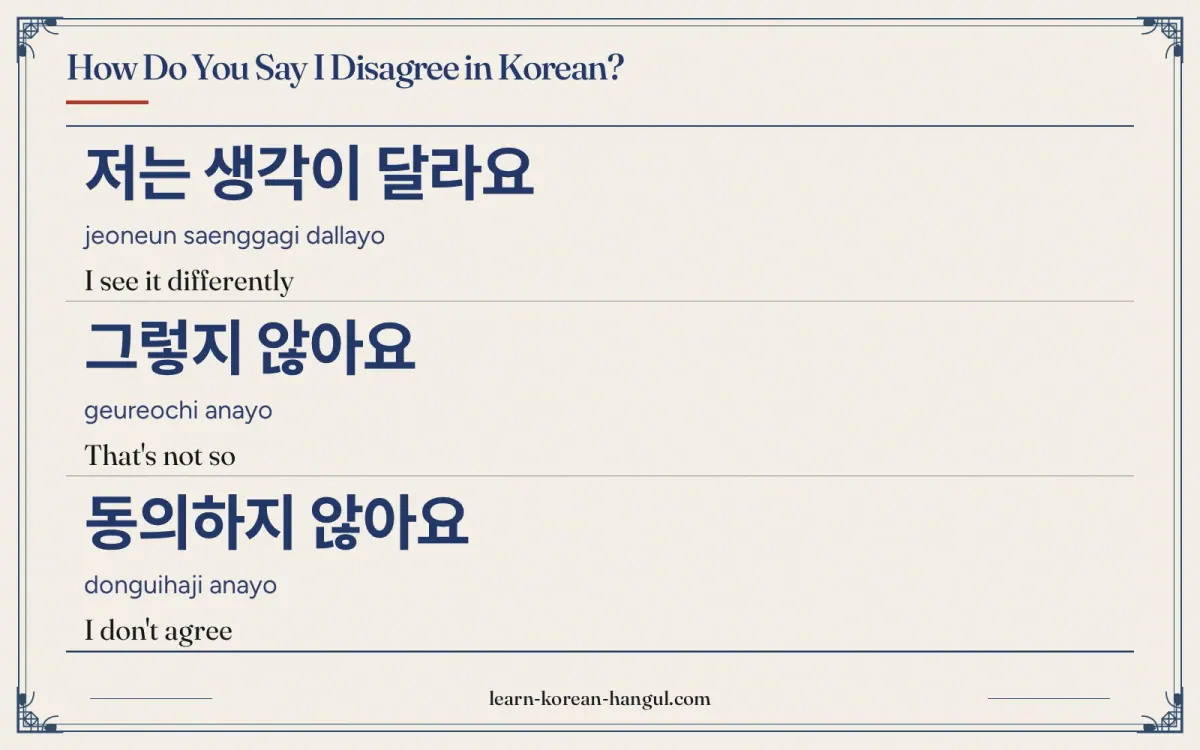
The standard way to say I disagree in Korean is 저는 생각이 달라요. The sentence has three parts: 저는 (as for me), 생각이 (my thought) and 달라요 (is different). So it does not say "you are wrong". It says that your thinking differs, which keeps the tone gentle.
| Strength | Korean | Romanization | Meaning |
|---|---|---|---|
| Soft | 저는 생각이 달라요 | jeoneun saenggagi dallayo | I see it differently |
| Soft, polite | 제 생각에는 좀 다른 것 같아요 | je saenggageneun jom dareun geot gatayo | In my opinion, it seems a little different |
| Direct | 그렇지 않아요 | geureochi anayo | That's not so |
| Firm | 동의하지 않아요 | donguihaji anayo | I don't agree |
| Friend, casual | 아닌데? | aninde | Really? I don't think so |
Revised Romanization (the South Korean government standard of 2000) is only a reading aid here. Learn the Hangul first. The next section explains each form.
What Are the Polite Ways to Say I Disagree?
Disagreement in Korean comes in steps from soft to firm. All the forms below are polite, and you choose the step by the situation and the person's rank.
Polite: 저는 생각이 달라요 (jeoneun saenggagi dallayo)
Polite · 해요체This is the safest sentence. 달라요 comes from the adjective 다르다 (to be different), which belongs to the 르 irregular group: 다르 + 아요 becomes 달라요, with an extra ㄹ. Adding 좀 (a little) softens it further: 저는 생각이 좀 달라요.
저는 생각이 달라요. 다른 방법이 좋아요.
jeoneun saenggagi dallayo. dareun bangbeobi joayo
I see it differently. Another method is better.
Polite: 그렇지 않아요 (geureochi anayo)
Polite · 해요체그렇지 않아요 means "it is not like that". It corrects a statement instead of describing your view, so it is more direct. Use it with colleagues and friends, and add a reason. For a plain "no", see no in Korean.
그렇지 않아요. 가격이 더 비싸요.
geureochi anayo. gagyeogi deo bissayo
That is not so. The price is higher.
Polite: 동의하지 않아요 (donguihaji anayo)
Polite · 해요체동의하지 않아요 is the opposite of 동의해요 on the page for I agree in Korean. It is clear and firm, which fits a meeting or a debate. Start with 죄송하지만 (sorry, but) to keep it courteous.
죄송하지만 동의하지 않아요.
joesonghajiman donguihaji anayo
Sorry, but I do not agree.
Polite: 제 생각에는 좀 다른 것 같아요 (je saenggageneun jom dareun geot gatayo)
Polite · 해요체This longer sentence is the most careful. 제 생각에는 means "in my opinion", and 것 같아요 means "it seems". Together they present your view as a personal impression, not a fact. It is the best choice with a boss, a teacher or an older person.
제 생각에는 좀 다른 것 같아요.
je saenggageneun jom dareun geot gatayo
In my opinion, it seems a little different.
Casual: 난 생각이 달라 (nan saenggagi dalla)
Casual · 반말Friends say 난 생각이 달라 or just 아닌데? (aninde), where the ending -ㄴ데 leaves a soft "but..." hanging, like "I don't think so". In formal situations, say 저는 생각이 다릅니다 (jeoneun saenggagi dareumnida), which sounds like [다름니다].
Each of these has a sound pattern, so the next section goes through them.
How Do You Pronounce 저는 생각이 달라요?
저는 생각이 달라요 is pronounced [저는 생가기 달라요], with eight syllables: jeo-neun saeng-ga-gi dal-la-yo. Three features need attention.
- 저 (jeo): the vowel ㅓ is unrounded, so keep your lips flat and relaxed.
- 생각이 (saeng-ga-gi): the final ㄱ of 각 moves to the next syllable, so you hear 가-기.
- 달라요 (dal-la-yo): the ㄹ at the end of 달 and the ㄹ at the start of 라 join into one long ㄹ, [달라요].
Sound Changes to Listen For
- Aspiration in 그렇지. The ㅎ of 그렇 meets the ㅈ of 지 and makes a ㅊ sound, so 그렇지 is [그러치]. RR writes geureochi.
- Silent ㅎ in 않아요. The ㅎ of 않 is silent before a vowel, so 않아요 is [아나요]. The whole phrase 그렇지 않아요 sounds like [그러치 아나요].
- Tensing in 것 같아요. The final ㅅ of 것 sounds like ㄷ, and the ㄱ of 같 becomes tense, so 것 같아요 sounds like [걷까타요]. RR does not show tensing caused by a neighbouring sound, so it writes dareun geot gatayo.
- Nasalization in 맞는 말씀이지만. The ㅈ-sound in 맞 becomes ㄴ before ㄴ, so 맞는 is [만는]. The ㅆ in 말씀 stays tense.
- Nasalization in 다릅니다. The ㅂ in 릅 becomes ㅁ before ㄴ, so the formal form sounds like [다름니다].
The Korean nasalization lesson covers the ㅂ to ㅁ change. Practise by saying 다르다, then 달라요, and notice how the second ㄹ appears. Sound is one half, and tact is the other.
When Should You Use 저는 생각이 달라요, and When Should You Not?
Use 저는 생각이 달라요 when you respect the other person but see things another way. Pick a firmer phrase only when the person needs a clear answer.
Situations Where It Fits
- A team meeting. 저는 생각이 좀 달라요 opens a different view politely.
- A group of friends choosing a place. 저는 생각이 좀 달라요 keeps the mood friendly.
- A class discussion. 제 생각에는 좀 다른 것 같아요 sounds thoughtful.
- A decision in a shop or office. 동의하지 않아요 states a clear position.
Situations to Avoid
- A flat 아니에요 to a senior. In a meeting, it can sound confrontational.
- Calling a view 틀려요. It says the other person is wrong.
- Disagreement with no reason. Add a short reason after 그렇지 않아요, or the reply feels cold.
Three short dialogues show different levels of care.
What Does I Disagree Sound Like in a Real Conversation?
Listen for the gentle pause before the disagreement and the warm tone that follows.
A Team Meeting
Manager
이 방법이 가장 좋아요.
i bangbeobi gajang joayo
This method is the best.
Team Member
맞는 말씀이지만, 저는 생각이 좀 달라요.
manneun malsseumijiman, jeoneun saenggagi jom dallayo
That is true, but I see it a little differently.
What to notice: the team member first accepts the manager's point with 맞는 말씀이지만 [만는 말쓰미지만], then gives a different view. 말씀 is the honorific word for "words", which suits a senior.
Coworkers Choosing Lunch
Mi-Na
이 식당이 제일 좋죠?
i sikdangi jeil jochyo
This restaurant is the best, isn't it?
Jun-Seo
글쎄요, 저는 생각이 좀 달라요.
geulsseyo, jeoneun saenggagi jom dallayo
Well, I see it a little differently.
What to notice: 글쎄요 (well, I'm not sure) is a soft opener, and 좋죠 is [조쵸]. The ending -죠 invites agreement, so the reply is a gentle no.
Close Friends
Seo-Yeon
그 노래 진짜 좋지?
geu norae jinjja jochi
That song is really good, right?
Tae-Min
아닌데? 난 별로야.
aninde? nan byeolloya
Hmm, I don't think so. It's not for me.
What to notice: 좋지 is [조치], and 아닌데? rises a little because it is a short, questioning reaction. This kind of directness is for close friends only.
What Should You Know about the Culture behind I Disagree?
Many Koreans put weight on harmony and on respect for age and position. That shapes how disagreement is expressed.
- Contradicting a senior directly can feel disrespectful. People usually preface with 맞는 말씀이지만 (that is true, but) or 좋은 의견이지만 (good opinion, but) before giving a different view.
- Opinions as impressions. Endings such as 것 같아요 (it seems) present a view as a personal impression, which feels gentler than a statement.
- Reasons matter. A short reason, such as 비용이 걱정돼요 [비용이 걱쩡돼요] (I'm worried about the cost), makes the disagreement feel useful.
An expert insight: Korean often avoids the word "no" in a discussion and instead says the situation is different or difficult. 다르다 gives you a neutral, respectful way to do the same. The mistakes below come from translating English directness.
What Mistakes Do Learners Make with I Disagree in Korean?
Most mistakes are about word choice and tone.
| Mistake | Why it is a problem | Fix |
|---|---|---|
| 틀려요 for a different opinion | 틀리다 means incorrect | Say 달라요 |
| 아니에요 to a senior in a meeting | Sounds confrontational | Say 제 생각에는 좀 다른 것 같아요 |
| 다르어요 | Skips the 르 irregular change | Say 달라요 |
| 반대해요 for a small difference | 반대하다 means to oppose | Say 생각이 달라요 |
| Writing 그러치 | The spelling keeps the letters ㅎ and ㅈ | Write 그렇지, say [그러치] |
Learners often think 달라요 and 틀려요 are interchangeable. Actually, the standard language keeps them apart, even though you may hear 틀려요 for different in casual speech.
Is It the Same as Disagree, I Don't Agree and I Do Not Agree?
Three nearby searches share this page, and each has a short answer.
- Disagree in Korean: the closest idea is 생각이 다르다 (to think differently). To oppose a plan, the verb is 반대하다, polite 반대해요.
- I don't agree in Korean: say 동의하지 않아요, or the casual 동의 안 해.
- I do not agree in Korean: the formal version is 동의하지 않습니다 (donguihaji anseumnida), which sounds like [동의하지 안씀니다].
Practice: Say It Aloud
Play the slow clip and repeat 저는 생각이 달라요 three times, keeping the double ㄹ. Then choose the best phrase. Answers follow.
- A manager shares a plan you doubt.
- A close friend says a film is great, and you disagree.
- You need a firm, clear position in a debate.
- Write the polite form of 다르다.
Answers
- 제 생각에는 좀 다른 것 같아요.
- 아닌데? or 난 생각이 달라.
- 동의하지 않아요.
- 달라요.
The phrase flashcards drill these forms with audio.
Related Phrases to Learn Next
Disagreement belongs to a small group of response phrases.
- I agree in Korean: the other side of the conversation.
- No in Korean: the plain refusal.
- I think so in Korean: giving a soft opinion.
This guide belongs to the Korean filler words collection. What this page does not cover: formal debate vocabulary and the full conjugation of 다르다. Acknowledge the point, say your view gently, and you can say I disagree in Korean respectfully and clearly.
Frequently Asked Questions
How do you say I disagree in Korean?
Say 저는 생각이 달라요 (jeoneun saenggagi dallayo), which means "I see it differently". For a plainer "I don't agree", say 동의하지 않아요 (donguihaji anayo). To correct a statement, say 그렇지 않아요. With friends, 아닌데? is natural. Starting with 맞는 말씀이지만 (that is true, but) makes any version softer.
How do you pronounce 저는 생각이 달라요?
Say jeo-neun saeng-ga-gi dal-la-yo in eight syllables. The ㄱ of 각 moves to the next syllable, so 생각이 sounds like [생가기]. The two ㄹ sounds in 달라요 join into one long ㄹ. The ㅓ in 저 is unrounded. Keep the pitch level and calm, because a harsh tone makes disagreement sound angry.
What is the difference between 저는 생각이 달라요 and 그렇지 않아요?
저는 생각이 달라요 talks about your own thought, so it sounds soft and personal. 그렇지 않아요 talks about the statement itself and says it is not so, so it feels more direct. Use the first with seniors and in meetings, and the second with colleagues and friends, ideally with a reason.
Can I use 저는 생각이 달라요 with friends, elders and strangers?
Yes. The polite form is safe with elders, strangers and coworkers, and 제 생각에는 좀 다른 것 같아요 is even more careful. With close friends, you can say 난 생각이 달라 or 아닌데?. In formal speech, use 저는 생각이 다릅니다.
What is the most common mistake with I disagree in Korean?
Saying 틀려요, which means "that is wrong". Use 달라요 for a different opinion, because 다르다 means different and 틀리다 means incorrect. A second mistake is saying 다르어요, which ignores the 르 irregular change. The correct polite form is 달라요.