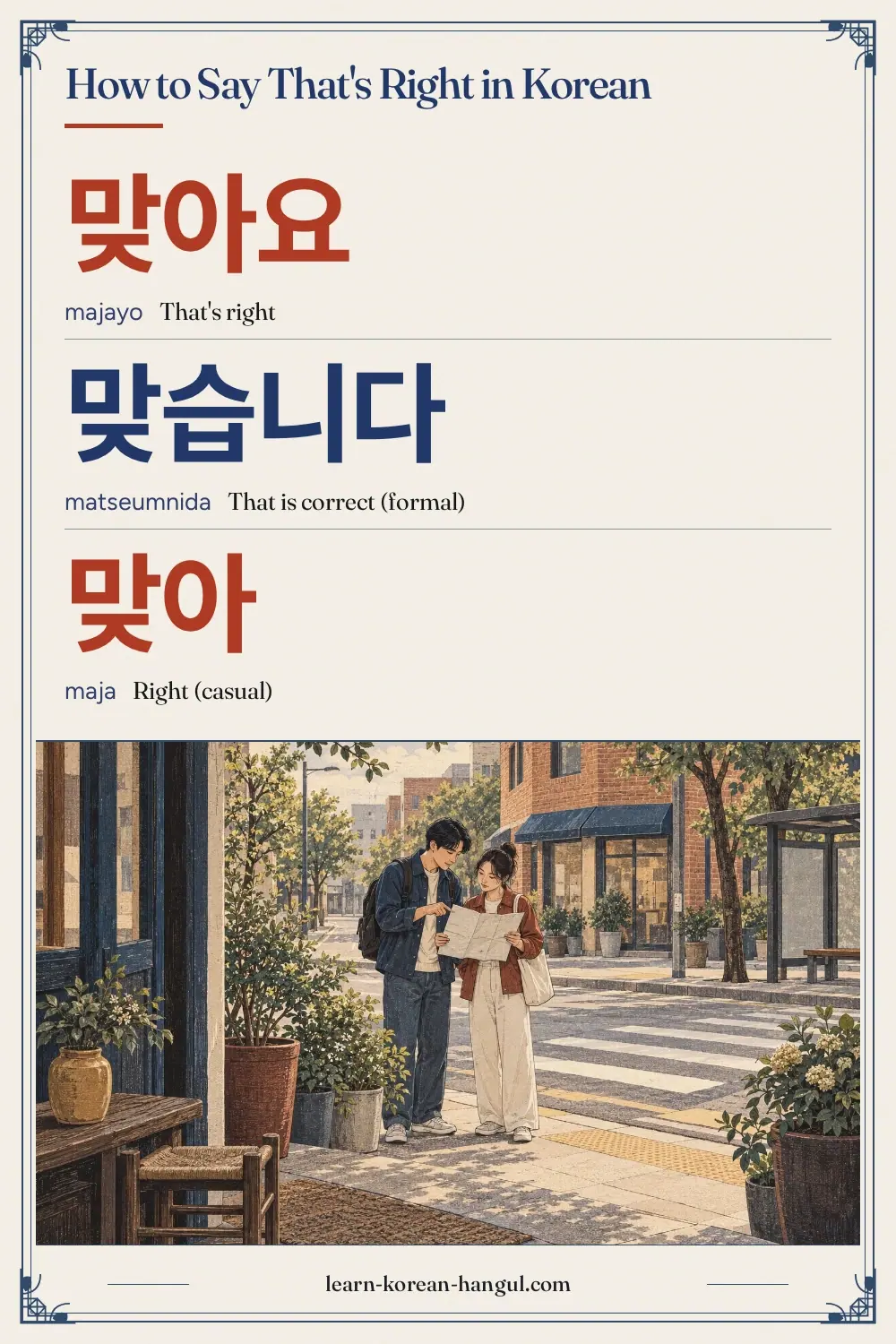
맞아요
맞아요
What you'll learn
- Say 맞아요, 맞습니다 and 맞아 and choose the one that fits the listener.
- Pronounce 맞아요 as [마자요] and 맞습니다 as [맏씀니다].
- Use 맞죠? to check a fact and 맞는 말씀이세요 to agree respectfully.
- Avoid confusing 틀려요 (wrong) with 달라요 (different).
Before you start: if you only need a plain "yes", see yes in Korean first. Time: about 12 minutes. Audio plays only when you press a button.
How Do You Say That's Right in Korean?
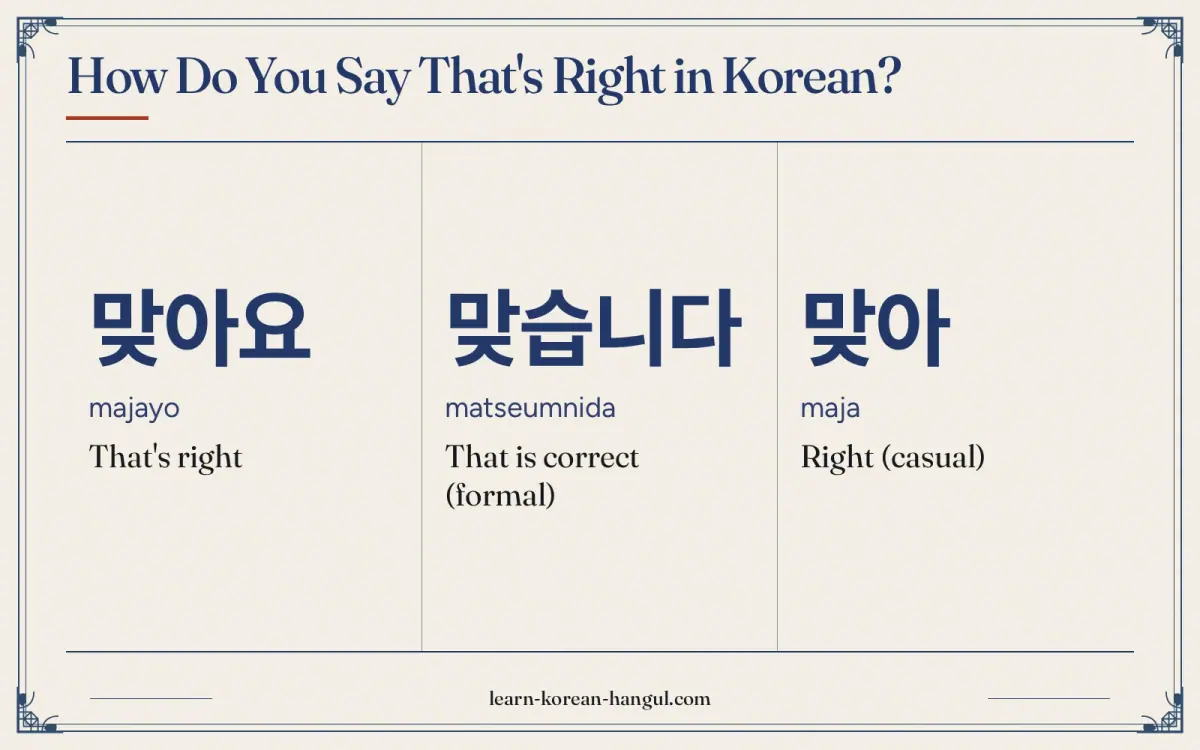
The standard way to say that's right in Korean is 맞아요. The verb 맞다 means "to be correct", "to match" or "to fit". The polite ending -아요 turns it into a short sentence. Because Korean drops obvious subjects, 맞아요 alone means "that's right" or "you're right".
| Korean | Romanization | Meaning | Where you hear it |
|---|---|---|---|
| 맞아요 | majayo | That's right | Most people, daily life |
| 맞습니다 | matseumnida | That is correct (formal) | Meetings, customers, elders |
| 맞아 | maja | Right (casual) | Friends, family |
| 그렇죠 | geureochyo | That's so, isn't it | Polite agreement, softer |
| 정확해요 | jeonghwakaeyo | That's exact | Checking numbers and facts |
| 맞는 말씀이세요 | manneun malsseumiseyo | What you say is right (respectful) | Elders, seniors |
Revised Romanization (the South Korean government standard of 2000) is only a reading aid here. Learn the Hangul first. The next section shows how the forms differ.
What Are the Polite and Casual Ways to Say That's Right?
That's right in Korean has formal, polite and casual forms. The meaning is the same, and the ending changes with the listener.
Polite: 맞아요 (majayo)
Polite · 해요체맞아요 is the safe default. Use it to confirm a fact, to agree with an opinion and to say "yes, you got it". If you add 네, the answer sounds warmer: 네, 맞아요.
네, 맞아요.
ne, majayo
Yes, that's right.
Formal: 맞습니다 (matseumnida)
Formal · 합쇼체맞습니다 is the formal form. It suits a presentation, a phone call with a customer, or an answer to a senior at work. It sounds firm, like "that is correct". To agree with an opinion respectfully, add the honorific idiom 맞는 말씀이세요.
Casual: 맞아 (maja)
Casual · 반말맞아 is what friends say. It is often doubled for emphasis: 맞아, 맞아. A friend might also say 그치 (geuchi), a casual "right?". Never use these with a boss or an elder.
맞아, 어제 봤어.
maja, eoje bwasseo
Right, I saw it yesterday.
Respectful Agreement: 맞는 말씀이세요 (manneun malsseumiseyo)
Formal · 합쇼체When an elder or a customer gives an opinion, you can say 맞는 말씀이세요, "what you say is right". 말씀 is the honorific noun for "words". Say it as [만는 말쓰미세요].
Checking: 맞죠? (matjyo)
Polite · 해요체Add -죠 to ask for confirmation: 맞죠? means "that's right, isn't it?". It is a polite tag question, and it ends with a gentle rise.
The forms share one core. The next section shows how to say it out loud.
How Do You Pronounce 맞아요?
맞아요 is pronounced [마자요], in three syllables: ma-ja-yo. Even though the spelling shows ㅈ at the end of 맞, you do not say a separate ㅈ sound at the end of the first syllable. The sound moves to the next syllable.
- 마 (ma): a plain m and the vowel ㅏ.
- 자 (ja): a plain j, which comes from the final ㅈ of 맞, and ㅏ.
- 요 (yo): a short, light ending.
Sound Changes to Listen For
- Liaison before a vowel. When a final consonant meets a vowel-starting syllable, it moves over: 맞아요 sounds like [마자요]. Standard Pronunciation Rules (표준 발음법) call this 연음.
- Final ㅈ becomes [ㄷ] before a consonant. At the end of a word or before a consonant, a ㅈ batchim is pronounced [ㄷ]. So 맞 alone is [맏], and 맞습니다 is [맏씀니다].
- Tense [씀] in 맞습니다. After the [ㄷ] sound, the ㅅ becomes tense. The ㅂ of -습니다 also turns into [ㅁ] before ㄴ: [맏씀니다]. The Revised Romanization writes matseumnida, so it shows the ㅅ but not the tensing. See Korean tensification.
- Tense [쪼] in 맞죠. The ㅈ of 죠 becomes tense after the [ㄷ] sound: [맏쪼].
- Nasal [ㄴ] in 맞네요 and 맞는. Before ㄴ, the final sound becomes [ㄴ]: 맞네요 is [만네요], and 맞는 is [만는].
- No rising pitch in a statement. 맞아요. ends calmly. A rise, 맞아요?, turns it into "Is that right?".
Listen for the clear [자] in the middle and you will sound natural. Next, when does each form fit?
When Should You Use 맞아요, and When Should You Not?
Use 맞아요 to confirm or to agree. Use 맞습니다 when the listener is a senior or a customer, and 맞아 with friends. The choice depends on age and closeness, not on how sure you are.
Situations Where It Fits
- Checking a fact. Someone asks 오늘 월요일이죠? and you answer 네, 맞아요.
- Agreeing in conversation. Listeners often say 맞아요, 맞아요 while you speak, to show they follow you.
- Language class. A teacher says 맞아요! when your answer is correct.
Situations to Avoid
- 맞아 with an elder. Without the polite ending, the reply sounds casual and can seem dismissive.
- 맞아요 to mean "I understand". It confirms a fact. To say you understand, use i see in Korean or 알겠어요.
- 맞아요 to answer a request. A request such as "please send it" needs 네 or 알겠습니다, not 맞아요.
Three short scenes show the forms in use.
What Does That's Right Sound Like in a Real Conversation?
Confirmations are short. Listen for the ending of each sentence.
A Learner Checks a Word
Student
이게 한글이에요?
ige hangeurieyo
Is this Hangul?
Teacher
네, 맞아요. 한글이에요.
ne, majayo. hangeurieyo
Yes, that's right. It's Hangul.
What to notice: 한글이에요 sounds like [한그리에요], because the final ㄹ moves to the next syllable. The question 이게 한글이에요? ends with a gentle rise, and the answer starts with 네.
Confirming a Meeting Time
Manager
회의는 오후 세 시죠?
hoeuineun ohu se sijyo
The meeting is at three in the afternoon, isn't it?
Staff
네, 맞습니다.
ne, matseumnida
Yes, that's correct.
What to notice: The staff member uses the formal 맞습니다 [맏씀니다] with a manager. The question ends with -죠, which asks for confirmation.
Friends Check a Fact
Ji-Ho
너 어제 영화 봤지?
neo eoje yeonghwa bwatji
You saw the film yesterday, right?
Su-Bin
맞아, 어제 봤어.
maja, eoje bwasseo
Right, I saw it yesterday.
What to notice: Both lines drop 요, because the friends are close. 봤지 sounds like [봗찌], with a tense ㅈ after the final [ㄷ] sound.
What Should You Know about the Culture behind That's Right?
These are general patterns, not rules.
- Agreement as listening. Korean listeners often say 맞아요, 그렇죠 or 네 while you speak. It means "I'm following", not always "I agree".
- Softer than a flat yes. 그렇죠 ("it is so, isn't it?") sounds gentler than 맞아요 when you want to agree without sounding like a judge.
- Be careful with disagreement. There is no single opposite of 맞아요. People usually say 글쎄요 ("well...") or 그건 좀 다른 것 같아요 ("I think that is a little different") instead of 아니에요. See no in Korean.
An expert tip: 맞다 does more than "be right". It also means "to fit", as in 이 옷이 잘 맞아요 ("this outfit fits well"). A different 맞다 means "to get hit" or "to get rained on", as in 비를 맞았어요. The forms are the same, so the context decides. For the way endings carry politeness, see Korean speech levels.
What Mistakes Do Learners Make with That's Right in Korean?
Most errors come from the wrong word for wrong, or the wrong ending.
| Mistake | Why it is a problem | Fix |
|---|---|---|
| Saying 틀려요 to mean "different" | 틀려요 means "wrong" | Use 달라요 for "different" |
| Saying 옳아요 in casual agreement | 옳다 is a bookish, judging word for right (often moral right), so it sounds stiff in conversation | Use 맞아요 |
| Saying 맞아 to an elder | The casual form can sound dismissive | Use 맞아요 or 맞습니다 |
| Reading 맞아요 as [마다요] | The ㅈ moves to the next syllable | Say [마자요] |
| Answering "Is it hot?" with 맞아요 only | 맞아요 confirms a statement or fact, so it sounds odd as a reply about how something feels | Add the adjective: 네, 더워요 |
Learners often translate "right" word for word and reach for 오른쪽 (the right side) or 권리 (a right). In Korean, agreement uses the verb 맞다.
Is It the Same as Correct, Exactly or That's Correct?
Yes, mostly. Each English phrase is covered by the forms above, with a small difference in tone.
- Correct in Korean: 맞아요 for a quick answer, or 정답이에요 (jeongdabieyo) for "that's the correct answer".
- Exactly in Korean: 바로 그거예요 (baro geugeoyeyo), "that's exactly it", or 정확해요 (jeonghwakaeyo) [정화캐요] for exact details.
- That's correct in Korean: 맞습니다, the formal form.
- Right in the sense of a direction or a right: these are different words, covered in right in korean.
Practice: Say It Aloud
Play the slow clip and repeat 맞아요 three times. Then choose the best reply for each scene. Answers follow.
- A teacher asks whether your answer is right, and it is.
- A manager checks the time of a meeting, and it is correct.
- A friend says you saw the film, and you did.
- An elder shares an opinion you agree with.
Answers
- 네, 맞아요.
- 네, 맞습니다.
- 맞아.
- 맞는 말씀이세요.
The phrase flashcards drill these replies with audio.
Related Phrases to Learn Next
Confirming leads to other short replies.
- yes in Korean: the simple answer before 맞아요.
- i see in Korean: show that you follow.
- of course in Korean: a stronger, warmer agreement.
This guide belongs to the korean filler words collection. What this page does not cover: debate wording, polite disagreement and written exam answers. Learn 맞아요 and 맞습니다, and you can say that's right in Korean to anyone.
Frequently Asked Questions
How do you say that's right in Korean?
Say 맞아요 (majayo) for "that's right". To a boss or an elder, 맞습니다 is more formal. With friends, say 맞아. The verb 맞다 means to be correct, so it also answers a question like "Is this right?" in one word.
How do you pronounce 맞아요?
It has three syllables: ma-ja-yo, written [마자요]. The ㅈ at the bottom of 맞 moves onto the next syllable and is pronounced as a full ㅈ. By itself, or before a consonant, the same final sound is [ㄷ], as in 맞습니다 [맏씀니다]. Revised Romanization writes majayo.
What is the difference between 맞아요 and 그래요?
맞아요 confirms that a fact or an opinion is correct. 그래요 means "that is so" or "really?", and it can show surprise. If someone says 한국은 추워요, you can agree with 맞아요. If you only react, say 그래요?
Is 맞아요 formal or casual?
It is polite. The ending -아요 suits colleagues, shop staff and people you have just met. The formal form is 맞습니다, and the very respectful form is 맞는 말씀이세요. The casual form is 맞아, which fits friends and family only.
What is the most common mistake with that's right in Korean?
Using 틀리다 for "different". 틀려요 means "that is wrong", so it is the opposite of 맞아요. To say two things differ, use 다르다 (달라요). Another mistake is using 옳아요, which sounds formal and about right and wrong, in casual agreement.