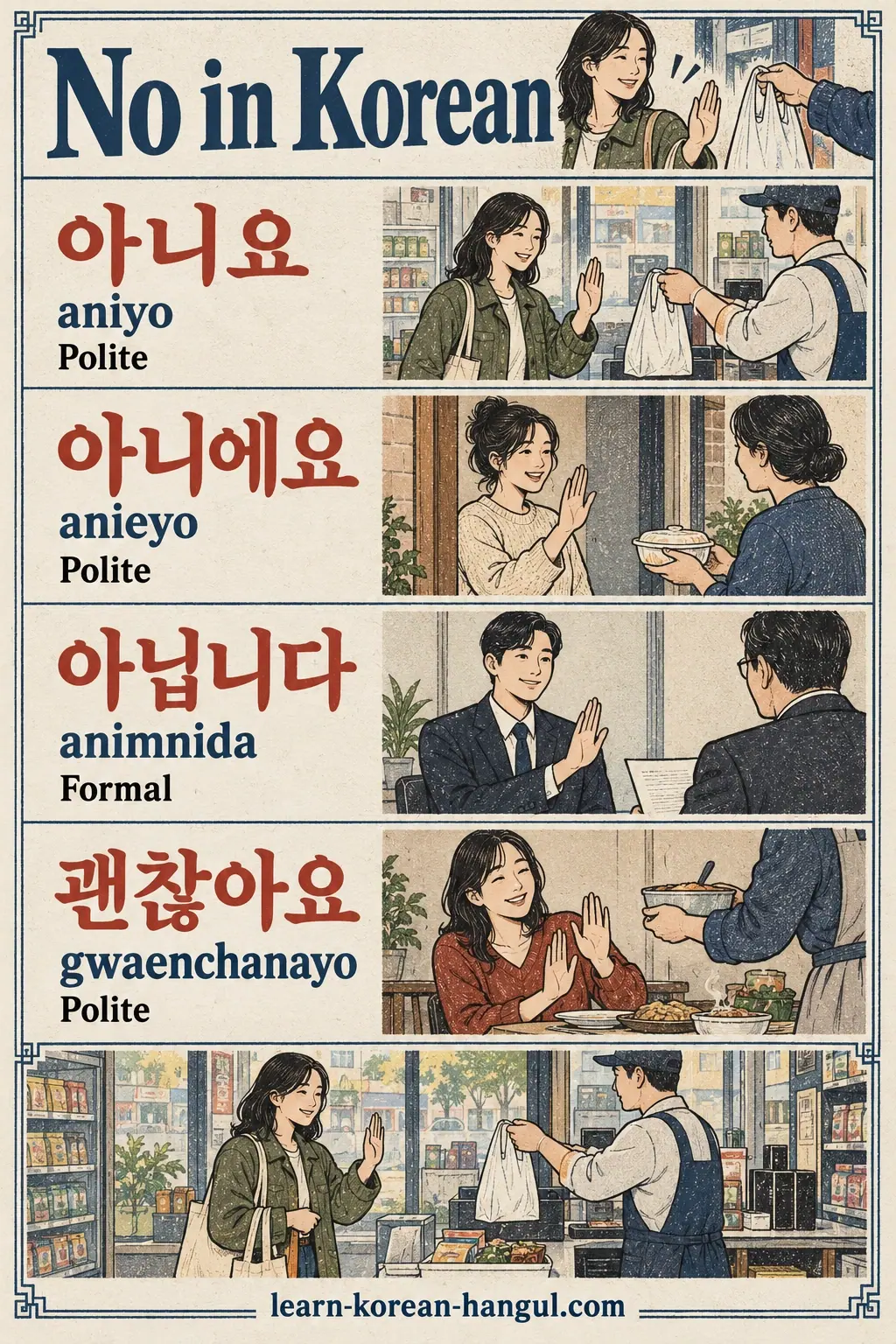
아니요
아니요
What you'll learn
- Say 아니요 and its short form 아뇨 aloud, and pronounce 아닙니다 as [아님니다].
- Choose between 아니요, 아니에요, 아니, 아닙니다 and 괜찮아요 for a stranger, a senior and a friend.
- Answer negative questions such as 안 먹었어요? the Korean way.
- Refuse food, a bag or help without sounding blunt.
Before you start: you need to read Hangul; romanization is shown as an aid and can be hidden. Time: about 10 minutes. Audio plays only when you press a button.
How Do You Say No in Korean?
The standard way to say no in Korean is 아니요, because it is polite enough for anyone and answers any yes-no question. Korean has a few other forms of no, and each one fits a different listener or a different job.
| Form | Romanization | Register | Use it for |
|---|---|---|---|
| 아니요 / 아뇨 | aniyo / anyo | Polite | Answering questions with anyone |
| 아니에요 | anieyo | Polite | "It's not ..." and "it's nothing" after thanks |
| 아니 / 아니야 | ani / aniya | Casual (반말) | Close friends, siblings, children |
| 아닙니다 | animnida | Formal | Speeches, interviews, the army, senior staff |
| 괜찮아요 | gwaenchanayo | Polite | Turning down an offer softly |
아니요 is the answer word, the opposite of 네 (yes). 아니에요 and 아닙니다 come from the verb 아니다, "to not be", so they can form full sentences such as "I'm not a student". The next section shows each form in use.
What Are the Formal, Polite and Casual Ways to Say No?

No in Korean follows the Korean speech levels, the endings that change with the listener's age, status and closeness, explained in the guide to Korean speech levels. The meaning stays "no" while the ending shifts.
Polite: 아니요 (aniyo)
Polite · 해요체아니요 is the everyday polite no. It answers a direct question, and Koreans usually add a short sentence after it to give the real answer, just as English speakers say "No, it's my first time."
아니요, 처음이에요.
aniyo, cheoeumieyo
No, it's my first time.
In relaxed speech, 아니요 contracts to 아뇨 (anyo). Both are polite and both are correct.
Polite: 아니에요 (anieyo)
Polite · 해요체아니에요 means "it is not" or "I am not". It denies that something is something: "I'm not Chinese", "That's not mine". Standing alone, 아니에요 is also the modest "it's nothing" Koreans say when someone thanks or praises them. A short spelling, 아녜요, also exists.
저는 중국 사람이 아니에요.
jeoneun jungguk sarami anieyo
I'm not Chinese.
Casual: 아니 (ani)
Casual · 반말아니 is the casual no, for close friends, younger siblings, partners and children. 아니야 (aniya) is the casual version of 아니에요, "it's not". Use neither with someone you should speak politely to.
아니, 안 바빠.
ani, an bappa
No, I'm not busy.
Formal: 아닙니다 (animnida)
Formal · 합쇼체아닙니다 uses the formal ending -ㅂ니다. It sounds firm and respectful, so it fits interviews, presentations, the army and replies to senior managers. It also waves off thanks in formal settings, where 아닙니다 means "not at all".
아닙니다, 제가 하겠습니다.
animnida, jega hagetseumnida
No, I will do it.
Polite Refusal: 괜찮아요 (gwaenchanayo)
Polite · 해요체괜찮아요 literally means "it's fine" or "I'm okay". When someone offers you more food, a bag or a hand with your luggage, 괜찮아요 is the polite way to decline. It is covered in depth on the page for it's okay in Korean.
아니에요, 괜찮아요. 배불러요.
anieyo, gwaenchanayo. baebulleoyo
Oh no, I'm fine. I'm full.
All five forms say no in a different way. The main word and its formal version have sounds worth practising, so pronunciation comes next.
How Do You Pronounce 아니요?
아니요 is pronounced [아니요], a-ni-yo, in three short, even syllables. The word starts with a vowel because the first ㅇ is silent, and the last syllable 요 is said "yo", not "yoh-oo".
- 아 (a): an open "ah", as in "father".
- 니 (ni): a light "nee".
- 요 (yo): "yo", with rounded lips, and a falling pitch for a plain no.
Sound Changes to Listen For
Three changes shape the forms of no you will hear most:
- Nasalization in 아닙니다. When ㅂ meets ㄴ, it becomes ㅁ, so 아닙니다 is said [아님니다], animnida. This rule from the Standard Pronunciation rules (표준 발음법) is explained in Korean nasalization.
- Contraction to 아뇨. In fast speech, 니 and 요 merge into one syllable, 뇨, giving 아뇨 [아뇨]. Many speakers say 아뇨 more often than the full form.
- Linking in 괜찮아요. The ㅎ in 찮 is silent before a vowel, so 괜찮아요 is said [괜차나요], gwaenchanayo.
Revised Romanization, the official system for writing Korean in Latin letters, writes aniyo, anyo and animnida. It records the nasal change in animnida, but romanization is only a guide; the Hangul is the real spelling. Choosing when to say no at all matters even more, as the next section shows.
When Should You Use 아니요, and When Should You Not?

Use 아니요 when someone asks you a direct yes-no question and the answer is no: "Are you a student?", "Is this your first visit?". For offers and invitations, a softer 괜찮아요 usually works better, and with friends 아니 is enough.
Situations Where It Fits
- Correcting a fact. "Are you Japanese?" gets 아니요, 미국 사람이에요 (No, I'm American).
- Answering a clerk's question. "Do you have a point card?" gets 아니요, 없어요 (No, I don't).
- Replying to thanks. 아니에요 after 감사합니다 means "it's nothing".
- Formal corrections. In a meeting or interview, 아닙니다 sounds clear and respectful.
Situations to Avoid
- A bare 아니요 to refuse food from a host. It can sound cold; say 괜찮아요, 배불러요 (I'm fine, I'm full).
- 아니 or 아니야 to a teacher, boss or older stranger. Casual forms skip the respect they expect.
- 아니요 to an invitation from your manager. Koreans soften it: 죄송한데, 오늘은 좀… (Sorry, but today is a bit…).
These choices are easier to feel in real exchanges, so here are three.
What Does No Sound Like in a Real Conversation?

A Korean no is usually followed by a reason or a softener, so it never stands alone for long. Listen for what comes after the no.
Declining a Bag at a Convenience Store
Clerk
봉투 필요하세요?
bongtu piryohaseyo?
Do you need a bag?
Customer
아니요, 괜찮아요.
aniyo, gwaenchanayo
No, I'm fine.
What to notice: 아니요 answers the question, and 괜찮아요 makes the no friendly.
Waving off Thanks from a Neighbour
Neighbour
도와주셔서 감사합니다.
dowajusyeoseo gamsahamnida
Thank you for helping me.
You
아니에요.
anieyo
It's nothing.
What to notice: 아니에요 here does not mean "no" at all; it politely shrinks the favour.
A Friend Asks If You Are Hungry
Minsu
너 배고파?
neo baegopa?
Are you hungry?
Sua
아니, 아까 먹었어.
ani, akka meogeosseo
No, I ate a while ago.
What to notice: friends use 아니 and the casual ending -어, with no -요. Behind these short replies sits a cultural habit of softening no.
What Should You Know about the Culture behind No?

Korean speakers often avoid a flat no, especially to elders, hosts and bosses, because a direct refusal can feel like rejecting the person. They soften it with reasons, apologies and vague answers instead.
- Softeners before no. 죄송한데요 (I'm sorry, but) or 글쎄요 (well…) often signal a refusal before any no is said.
- The trailing 좀… An unfinished sentence such as 오늘은 좀… (today is a bit…) is understood as no.
- Polite refusals of food. Hosts may offer food two or three times. A smiling 괜찮아요 and a reason, such as 배불러요 (I'm full), is the gentle way out.
- No disagrees with the question. To 안 추워요? (Aren't you cold?), 아니요 means "No, that's wrong, I am cold." The full logic is in the page on answering yes or no questions in Korean.
An expert insight: learners often think 아니에요 is just a longer, more polite 아니요. Actually, they do different jobs. 아니요 answers a question, while 아니에요 says "it is not", which is why it also works as "it's nothing" after thanks. The common mistakes below come from this and from English answer logic.
What Mistakes Do Learners Make with No in Korean?

Most no mistakes come from English answer logic, from bluntness, or from spelling.
| Mistake | Why it is a problem | Fix |
|---|---|---|
| Saying 네 to 안 먹었어요? when you did eat | Korean no rejects the question | Say 아니요, 먹었어요 |
| Refusing a host's food with a bare 아니요 | Sounds cold | Say 괜찮아요, 배불러요 |
| Writing 아니오 for the answer word | Different, old-style ending | Write 아니요 or 아뇨 |
| Saying 아니 to a teacher or boss | Casual 반말 form | Use 아니요 or 아닙니다 |
| Pronouncing a b in 아닙니다 | ㅂ becomes ㅁ before ㄴ | Say [아님니다] |
Learners often assume that saying no clearly is always the polite choice, as in many English-speaking workplaces. Actually, in Korean the softened no, with a reason or 죄송한데요, is what sounds considerate, because it protects the other person's face.
Other Ways People Search for No in Korean
People search for no in Korean in several forms. The short answers below cover each one.
- No formal in Korean: 아닙니다 is the formal form; 아니요 is polite and always safe.
- No casual in Korean: 아니 or 아니야, for close friends and younger people.
- No romanized in Korean: aniyo for 아니요, anyo for 아뇨 and ani for 아니, following the Revised Romanization of Korean; romanization is an aid, not the real spelling.
- Nope in Korean: 아니 among friends, or the borrowed 노노; in chats, ㄴㄴ.
- No thank you in Korean: 괜찮아요 or 아니요, 괜찮아요, covered in no thank you in Korean.
Reading the forms is one thing; producing them on cue is another, so practise now.
Practice: Say It Aloud
Play the slow clip of 아니요, repeat it three times, then try 아뇨, 아니 and [아님니다]. Then choose a form for each situation. Answers follow.
- A taxi driver asks, 처음 오셨어요? (Is this your first time here?), and it is not.
- Your friend asks, 이거 네 거야? (Is this yours?), and it is not.
- A colleague asks, 점심 안 먹었어요? (You didn't eat lunch?), and you did eat.
- Your host offers a third bowl of rice, and you are full.
Answers
- 아니요, or 아뇨, 두 번째예요 (No, it's my second time).
- 아니, 내 거 아니야 (No, it's not mine).
- 아니요, 먹었어요, because 아니요 rejects "you didn't eat".
- 괜찮아요, 배불러요.
Drill 아니요 and the related phrases with the phrase flashcards, which include audio for each form.
Related Phrases to Learn Next
No sits in a small group of short replies that every beginner needs.
- Yes in Korean: 네, 예 and 응, the partners of 아니요.
- It's okay in Korean: 괜찮아요 in all its uses, from refusals to reassurance.
- Maybe in Korean: 아마 and 글쎄요 for answers between yes and no.
- No thank you in Korean: polite ways to turn down offers.
This guide belongs to the Korean filler words and responses collection. What this page does not cover: the full grammar of negation with 안 and 못, regional forms, and refusals in business letters. Use 아니요 for questions, 괜찮아요 for offers and 아니 with close friends, and you can say no in Korean without sounding rude.
Frequently Asked Questions
Is it 아니요 or 아니오?
The answer word is spelled 아니요. Korean spelling rules keep 아니오 for a different use, an old-fashioned sentence ending meaning "it is not", found in written or theatrical style. Learners and even native speakers mix them up in writing. When you answer a question with no, always write 아니요 or the short 아뇨.
Is 아니요 formal or casual?
아니요 is polite. It contains the polite marker -요, so it suits strangers, staff, teachers and colleagues. The formal level is 아닙니다, used in speeches, interviews and the army. The casual level is 아니 or 아니야, kept for close friends, younger siblings and children. Dropping -요 is what makes it casual.
Can I use 아니요 with friends, elders and strangers?
Yes with elders and strangers, where 아니요 is the right choice, often softened with 괜찮아요. With close friends, 아니요 sounds stiff, so they say 아니 or 아니야. In very formal settings with seniors, 아닙니다 adds respect. When you are unsure of the relationship, 아니요 is the safe middle ground.
How do you say nope or no way in Korean?
Nope among friends is a quick 아니 or 아니야, and young people also say 노노, borrowed from English, or type ㄴㄴ in chats. For "no way" in disbelief, friends say 말도 안 돼 (that makes no sense). All of these are casual, so use 아니요 with anyone you speak politely to.
How do you write no in Hangul?
No is written 아니요 in Hangul, three blocks: 아, 니 and 요. The short spoken form 아뇨 has two blocks, 아 and 뇨. The casual 아니 is two blocks, 아 and 니. In each case the first block 아 starts with a silent ㅇ, so the word begins with a vowel sound.
What is the most common mistake with no in Korean?
The most common mistake is answering negative questions with English logic. To 안 먹었어요? (You didn't eat?), say 아니요, 먹었어요 if you did eat, because 아니요 rejects the question as asked. The second mistake is refusing food with a bare 아니요, which sounds blunt; say 괜찮아요 instead.