그런 것 같아요
그런 것 같아요
What you'll learn
- Say 그런 것 같아요 aloud as [그런 걷까타요], with the tense ㄲ and the linked ㅌ.
- Choose between 그런 것 같아요, 그렇게 생각해요 and 그런 것 같아.
- Understand why Koreans hedge, and when hedging sounds unsure.
- Avoid saying 생각해요 alone when you mean "I think so".
Before you start: you need to read Hangul; romanization is shown as an aid and can be hidden. Time: about 9 minutes. Audio plays only when you press a button.
How Do You Say I Think so in Korean?
The direct answer is 그런 것 같아요. Its parts are 그런 (like that), 것 (a thing, here "a matter") and 같아요 (is like, seems). Together they say "it seems to be like that". Korean also has a firmer way to give an opinion, and the table shows how the options differ.
| Form | Romanization | Meaning | Use it for |
|---|---|---|---|
| 그런 것 같아요 | geureon geot gatayo | I think so | Soft agreement with most adults |
| 그렇게 생각해요 | geureoke saenggakaeyo | I think so (my opinion) | Stating a view when asked |
| 그런 것 같아 | geureon geot gata | I guess so | Friends and family |
| 그렇게 생각합니다 | geureoke saenggakamnida | I think so (formal) | Meetings and speeches |
| 제 생각에는 | je saenggageneun | In my opinion | Opening a view |
All of these express "I think so", and they differ in how much you own the opinion. The next section puts each in a sentence.
What Are the Polite, Casual and Formal Ways to Say I Think So?
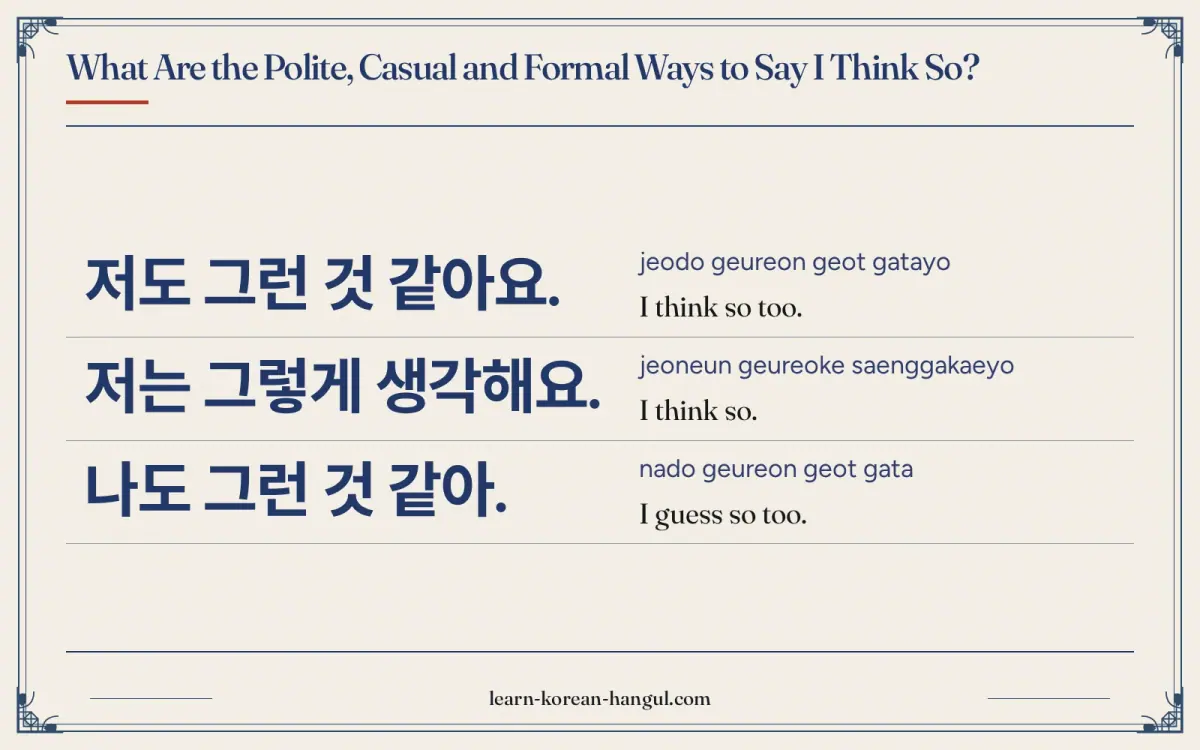
The forms follow the Korean speech levels explained in the guide to Korean speech levels. Endings shift with closeness, and the hedge or the opinion verb shifts with how firm you want to sound.
Polite: 그런 것 같아요 (geureon geot gatayo)
Polite · 해요체This is the everyday choice. It agrees without pushing, so it suits colleagues, elders and strangers. Add 저도 (me too) when you share the view.
저도 그런 것 같아요.
jeodo geureon geot gatayo
I think so too.
Polite: 그렇게 생각해요 (geureoke saenggakaeyo)
Polite · 해요체생각하다 means "to think", and 그렇게 means "that way". This form owns the opinion. Use it when someone asks "what do you think?" and you want to be clear.
저는 그렇게 생각해요.
jeoneun geureoke saenggakaeyo
I think so.
Casual: 그런 것 같아 (geureon geot gata)
Casual · 반말Drop the -요 and the hedge becomes casual. It sounds like "I guess so" and works well with friends, siblings and younger people.
나도 그런 것 같아.
nado geureon geot gata
I guess so too.
Formal: 그렇게 생각합니다 (geureoke saenggakamnida)
Formal · 합쇼체In a meeting, a presentation or a written statement, use the formal ending. 그런 것 같습니다 is also possible when you want to stay hedged.
그렇게 생각합니다.
geureoke saenggakamnida
I think so.
Opening a View: 제 생각에는 (je saenggageneun)
Polite · 해요체제 생각에는 means "in my thinking", so "in my opinion". It opens a sentence, and the rest follows in any style.
제 생각에는 좋아요.
je saenggageneun joayo
In my opinion, it's good.
The forms differ in tone more than meaning, and the hedge has several sounds that learners rarely hear in writing.
How Do You Pronounce 그런 것 같아요?
그런 것 같아요 is pronounced [그런 걷까타요], geureon geot gatayo in Revised Romanization, the official system for writing Korean in Latin letters.
- 그런 (geureon): "geu-ruhn", with an unrounded ㅡ and ㅓ.
- 것 (geot): said [걷], ending with a short stop.
- 같 (gat): the ㄱ is tense after the stop, [까].
- 아요 (ayo): the ㅌ moves forward, so 같아요 is [가타요].
Sound Changes to Listen For
- Tensification after a stop. After the stop sound at the end of 것 [걷], the ㄱ of 같 becomes tense, so 것 같아요 is [걷까타요]. The two words are spaced in writing but said as one unit. Revised Romanization does not show this tensing, which is why it reads geot gatayo. See the lesson on Korean tensification.
- Liaison in 같아요. The final ㅌ of 같 moves onto the silent ㅇ of 아, so 같아요 is [가타요].
- The common shortening. In everyday speech, 것 often becomes 거, and 그런 거 같아요 is [그런 거까타요]. Both are correct, and the 거 form is more casual in writing.
Once the sounds are clear, the question is when to hedge and when to state your view, which comes next.
When Should You Use 그런 것 같아요, and When Should You Not?
Use 그런 것 같아요 when you agree but want to stay gentle, or when you are not fully sure. Use 그렇게 생각해요 when you want to be counted as having a clear opinion.
Situations Where It Fits
- Agreeing with a colleague. It leaves space for them to continue.
- Giving an opinion to an elder. The hedge sounds humble and polite.
- Answering uncertainty. If you are not sure, it is honest.
Situations to Avoid
- Stating facts. Hedging "I am a student" sounds unsure about yourself.
- A direct request for your view. If a teacher asks for your opinion in class, 그렇게 생각해요 sounds clearer.
- A strong disagreement. If you disagree, 그런 것 같아요 can mislead; say 저는 다르게 생각해요 (I think differently).
The difference shows up in context, so here are three exchanges.
What Does I Think so Sound Like in a Real Conversation?
Agreement is rarely dramatic in Korean. Listen for the hedge in each reply.
Talking about the Weather
A
내일 비가 올까요?
naeil biga olkkayo
Will it rain tomorrow?
B
네, 그런 것 같아요.
ne, geureon geot gatayo
Yes, I think so.
A
그럼 우산을 가져갈게요.
geureom usaneul gajyeogalgeyo
Then I'll take an umbrella.
What to notice: 가져갈게요 is said [가저갈께요], because 져 is pronounced [저], and the ending -ㄹ게요 is tense. Also, 올까요 ends with a rise, because it is a yes/no question.
Friends Listening to a Song
Friend
이 노래 좋지?
i norae jochi
This song is good, right?
You
응, 나도 그런 것 같아.
eung, nado geureon geot gata
Yeah, I think so too.
What to notice: 좋지 is said [조치], because ㅎ and ㅈ merge into aspirated ㅊ. Between friends, the casual hedge is natural.
A Meeting with a Manager
Manager
이 방법이 더 좋을까요?
i bangbeobi deo joeulkkayo
Would this method be better?
You
저는 그렇게 생각합니다.
jeoneun geureoke saenggakamnida
I think so.
What to notice: in a meeting where the manager asks your view, 그렇게 생각합니다 owns the opinion in a formal tone. Behind this variety lies a habit of softening that is common in Korean.
What Should You Know about the Culture behind Hedging?
Koreans often soften statements with 것 같아요, even when they are quite sure. The pattern is a politeness tool and not a sign of doubt.
- Hedging feelings. People say 배고픈 것 같아요 ("I seem to be hungry") to avoid sounding pushy. The same pattern is used for tiredness, preferences and opinions.
- Leaving room. A hedge gives the listener space to disagree without losing face.
- Group harmony. In a group, a soft opinion fits better than a firm one.
- Learners may find it vague. If you need a clear answer, ask 정말 그렇게 생각해요? (do you really think so?).
An expert insight: learners often learn 생각해요 as the translation of "think" and use it for every opinion. Actually, 것 같아요 is much more common in daily talk, and 생각해요 is for clear opinions when asked. The mistakes below follow from this.
What Mistakes Do Learners Make with I Think so in Korean?
Most mistakes come from dropping words or hedging the wrong things.
| Mistake | Why it is a problem | Fix |
|---|---|---|
| 생각해요 alone | Means "I think" or "I'm thinking" | Say 그렇게 생각해요 |
| 저는 학생인 것 같아요 | Hedges a fact about yourself | Say 저는 학생이에요 |
| 그런 것 같아요 when you disagree | Sounds like agreement | Say 저는 다르게 생각해요 |
| 믿어요 for "I think" | Means "I believe in, I trust" | Use 생각해요 |
| Saying geot gat-a-yo with plain g | Misses the tense ㄲ | Say [걷까타요] |
Learners often assume 그런 것 같아요 always shows doubt. Actually, it is a normal, polite way to agree, and Koreans use it even when they are certain.
Other Ways People Search for I Think so in Korean
People search for related ideas in a few shapes. The short answers below cover each one.
- I think in Korean: 생각해요 for the verb, or 제 생각에는 to open an opinion.
- I guess in Korean: 것 같아요, which says "it seems"; the casual 그런 것 같아 is "I guess so".
- I believe in Korean: 그렇게 생각해요 for an opinion; 믿어요 (mideoyo, [미더요]) is for trust or faith, and not for opinion.
- Romanized: geureon geot gatayo, following the Revised Romanization of Korean; romanization is an aid, not the real spelling.
Reading the forms is one thing; saying them on cue is another, so practise now.
Practice: Say It Aloud
Play the slow clip of 그런 것 같아요 and repeat it three times, with the tense [까] and the linked [타]. Then say 그렇게 생각해요 with a clear voice. Choose a phrase for each situation, and check the answers below.
- A colleague says it will be busy tomorrow, and you agree gently.
- A teacher asks for your opinion in class.
- A friend says the movie was long, and you agree.
Answers
- 그런 것 같아요.
- 저는 그렇게 생각해요.
- 나도 그런 것 같아.
Drill these lines with the phrase flashcards, which include audio for each form.
Related Phrases to Learn Next
Soft agreement connects to other short answers.
- Maybe in Korean: a softer, less certain answer.
- I agree in Korean: a clearer agreement.
- That's right in Korean: confirming that someone is correct.
This guide belongs to the Korean filler words collection. What this page does not cover: the past forms of the hedge and written essay style. Use 그런 것 같아요 to agree gently, 그렇게 생각해요 to own a view, and you will say I think so in Korean the way Koreans do.
Frequently Asked Questions
How do you say I think so in Korean?
Say 그런 것 같아요 (geureon geot gatayo). It means "it seems like that" and is the polite, soft way to agree. If you want a firmer opinion, say 그렇게 생각해요, "I think so". With friends, drop the ending and say 그런 것 같아. In speeches and formal writing, use 그렇게 생각합니다.
How do you pronounce 그런 것 같아요?
It sounds like [그런 걷까타요]. The 것 is said [걷], and the ㄱ of 같 becomes tense after it. Then the ㅌ of 같 moves onto 아, giving [가타요]. In everyday speech, 것 often shortens to 거, and you hear [그런 거까타요]. Revised Romanization writes geureon geot gatayo.
What is the difference between 그런 것 같아요 and 그렇게 생각해요?
그런 것 같아요 hedges: you agree, but you keep some distance from the claim. 그렇게 생각해요 owns the opinion: you state that this is what you think. Koreans often prefer the hedge, because it sounds less pushy, but in a discussion where people ask your view, 그렇게 생각해요 sounds clearer and more confident.
Is 그런 것 같아요 formal or casual?
It is polite, which sits between formal and casual. The ending -요 makes it suitable for most adults. For a formal setting, say 그런 것 같습니다. For friends, say 그런 것 같아. The hedge itself, 것 같다, works at every level, and it is one of the most common patterns in daily Korean.
Can I use 그런 것 같아요 with friends, elders and strangers?
Yes, with elders and strangers it is a safe, humble choice. With friends it is slightly polite but fine, and 그런 것 같아 is more natural. Because it hedges, it works especially well when you are not sure or when you disagree gently, as it leaves room for the other person.
What is the most common mistake with I think so in Korean?
The most common mistake is saying 생각해요 alone. Without 그렇게, it means "I think" or "I am thinking", with no "so". Keep 그렇게 생각해요, or use 그런 것 같아요. A second mistake is hedging facts, such as 저는 학생인 것 같아요 for "I am a student", which sounds unsure about yourself.