어지러워요
어지러워요
What you'll learn
- Say 어지러워요, 속이 메스꺼워요, 토할 것 같아요 and 머리가 빙빙 돌아요 and know when each fits.
- Explain why 어지럽다 becomes 어지러워요 (a ㅂ irregular adjective).
- Ask to sit down with 앉아도 돼요? and describe heat dizziness.
- Say 토할 것 같아요 with the correct tense sounds.
Before you start: the lesson on Korean speech levels explains the endings used below. Time: about 12 minutes. Audio plays only when you press a button.
How Do You Say I Feel Dizzy in Korean?
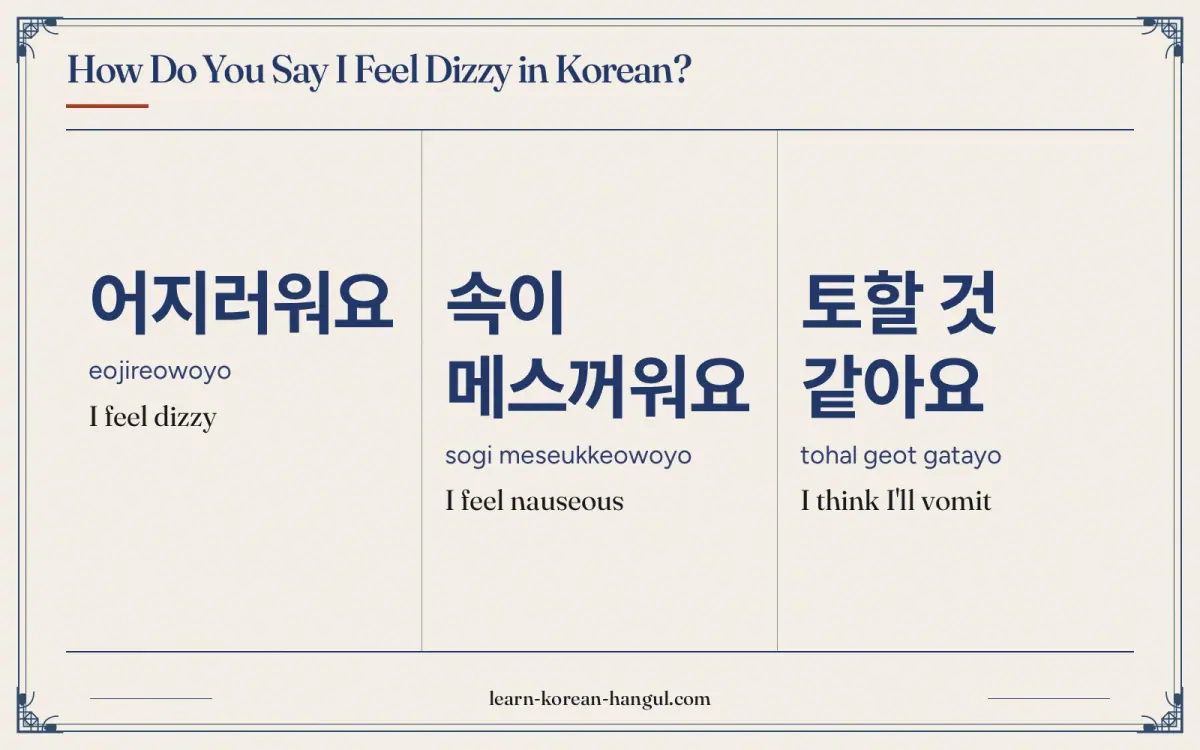
The standard way to say I feel dizzy in Korean is 어지러워요. It comes from the adjective 어지럽다 (to be dizzy), and the polite ending turns it into 어지러워요. You can say it alone, because Korean drops the subject when it is clear.
| Feeling | Korean | Romanization | Meaning |
|---|---|---|---|
| Dizzy, light-headed | 어지러워요 | eojireowoyo | I feel dizzy |
| Queasy stomach | 속이 메스꺼워요 | sogi meseukkeowoyo | I feel nauseous |
| About to be sick | 토할 것 같아요 | tohal geot gatayo | I think I'll vomit |
| Spinning room | 머리가 빙빙 돌아요 | meoriga bingbing dorayo | My head is spinning |
| Friend, casual | 어지러워 | eojireowo | I'm dizzy |
Revised Romanization (the South Korean government standard of 2000) is only a reading aid here. Learn the Hangul first. The next section explains each form.
What Are the Polite Ways to Say I Feel Dizzy?
Four polite sentences cover most cases. Choose by what your body feels: balance, stomach or the sense that the room is moving. All of them end in -요, so they are safe with doctors, pharmacists and strangers.
Polite: 어지러워요 (eojireowoyo)
Polite · 해요체어지러워요 is the first thing to say. The dictionary form 어지럽다 ends in ㅂ, and in the ㅂ irregular group the ㅂ turns into 우 before an ending that starts with a vowel, so 어지럽 + 어요 becomes 어지러워요. Add 갑자기 (suddenly) or 좀 (a little) to describe how it feels. To ask for a seat, use 앉아도 돼요? (may I sit?).
갑자기 어지러워요. 앉아도 돼요?
gapjagi eojireowoyo. anjado dwaeyo
I suddenly feel dizzy. May I sit down?
Polite: 속이 메스꺼워요 (sogi meseukkeowoyo)
Polite · 해요체속 means the inside or the stomach, and 메스껍다 means to feel queasy. The sentence reads "my inside is queasy". It is another ㅂ irregular adjective, so 메스껍 + 어요 becomes 메스꺼워요. Use it when the problem is nausea more than balance. For a general "I'm sick", see I'm sick in Korean.
속이 메스꺼워요. 물 좀 주세요.
sogi meseukkeowoyo. mul jom juseyo
I feel nauseous. Please give me some water.
Polite: 토할 것 같아요 (tohal geot gatayo)
Polite · 해요체토할 것 같아요 uses the pattern -ㄹ 것 같아요, which means "it seems that ...". With 토하다 (to vomit) it warns that you may be sick very soon. It helps a person next to you act quickly, for example by finding a bathroom or a bag.
토할 것 같아요.
tohal geot gatayo
I think I am going to vomit.
Polite: 머리가 빙빙 돌아요 (meoriga bingbing dorayo)
Polite · 해요체머리 is the head, 빙빙 imitates spinning, and 돌아요 comes from 돌다 (to turn). Together they say "my head is spinning in circles". It paints a clear picture of vertigo and helps when 어지러워요 alone is not enough.
머리가 빙빙 돌아요.
meoriga bingbing dorayo
My head is spinning.
Casual: 어지러워 (eojireowo)
Casual · 반말Drop -요 for friends and family: 어지러워. In a formal report or an announcement, use 어지럽습니다 (eojireopseumnida), which sounds like [어지럽씀니다]. Next, the sound.
How Do You Pronounce 어지러워요?
어지러워요 is pronounced [어지러워요], with five syllables: eo-ji-reo-wo-yo. There is no sound change, but three vowels need care.
- 어 (eo): the vowel ㅓ is unrounded, so keep your lips relaxed and flat.
- 지 (ji): a soft ㅈ, not as hard as English "j".
- 러 (reo): the ㄹ between vowels is a quick tap of the tongue.
- 워 (wo): a rounded "w" glides into ㅓ.
- 요 (yo): a short "yo", level or slightly falling.
Sound Changes to Listen For
- Liaison in 속이. The final ㄱ of 속 moves to the next syllable, so 속이 sounds like [소기]. RR writes sogi.
- Tensing in 토할 것 같아요. After the -ㄹ ending, 것 becomes tense, and the ㄱ of 같 follows. Standard Pronunciation Rules, Article 27, describe the -ㄹ tensing. You hear [토할껃까타요], and RR writes tohal geot gatayo because it does not show tensing caused by a neighbouring sound.
- Liaison in 같아요. The ㅌ of 같 moves to the vowel, so 같아요 is [가타요].
- Liaison in 돌아요 and 앉아도. 돌아요 is [도라요], and 앉아도 is [안자도], because the final sounds move forward.
- Tensing in 속도. In 속도 메스꺼워요, the ㄱ before ㄷ makes ㄷ tense, so you hear [속또].
The Korean tensification lesson explains these patterns. Say 어지럽다, then 어지러워요, and notice that the ㅂ turns into a w sound. When you feel unwell, speed matters more than perfect sounds, so the next section shows when to use each phrase.
When Should You Use 어지러워요, and When Should You Not?
Use 어지러워요 to tell someone how you feel, to ask for a seat or to explain your condition to a doctor. Use another phrase when the situation is urgent.
Situations Where It Fits
- On public transport. 어지러워요. 앉아도 돼요? asks for a seat.
- At a pharmacy. 어지러워요 and 속이 메스꺼워요 help the pharmacist choose the right advice.
- At a clinic. Add how long it has lasted, such as 어제부터 (since yesterday).
- In hot weather. Friends may say 더위 먹었나 봐 (maybe I've got heat sickness).
Situations to Avoid
- A serious emergency. If you feel you may faint or the dizziness is sudden and severe, say 쓰러질 것 같아요 (sseureojil geot gatayo, "I feel like I'll collapse") and ask for help. See call an ambulance in Korean. In Korea, the emergency number for fire and ambulance is 119.
- A headache only. Dizzy and 머리가 아파요 (my head hurts) are different.
- The noun 현기증 in casual talk. 현기증 (hyeongijeung, dizziness) is a Sino-Korean noun that sounds formal or medical; in conversation 어지러워요 is more natural.
Three short dialogues show the phrases in action.
What Does I Feel Dizzy Sound Like in a Real Conversation?
Dizziness phrases are short and spoken quietly. Listen for the helper's concern and the patient's clear, simple answer.
At a Clinic
Doctor
어디가 불편하세요?
eodiga bulpyeonhaseyo
What is bothering you?
Patient
어지러워요. 속도 메스꺼워요.
eojireowoyo. sokdo meseukkeowoyo
I feel dizzy. My stomach feels queasy too.
What to notice: the doctor's question is a wh-question, so it does not need a sharp rise. The patient adds 속도 (my stomach too) with the particle 도, which means "also".
On the Subway
Stranger
괜찮으세요?
gwaenchaneuseyo
Are you okay?
Passenger
어지러워요. 앉아도 돼요?
eojireowoyo. anjado dwaeyo
I feel dizzy. May I sit?
What to notice: 괜찮으세요 sounds like [괜차느세요], because the ㅎ is silent. The question rises, and the reply asks permission with -아도 돼요. A stranger would answer 네, 여기 앉으세요 (yes, sit here).
Friends on a Hot Day
Friend
얼굴이 빨개요.
eolguri ppalgaeyo
Your face is red.
Su-Ho
어지러워. 더위 먹었나 봐.
eojireowo. deowi meogeonna bwa
I feel dizzy. I think I got heat sickness.
What to notice: 얼굴이 sounds like [얼구리], and 먹었나 봐 sounds like [머건나 봐]. The ending -나 봐 means "it seems". People use this daily vocabulary around illness in many ways.
What Should You Know about the Culture behind I Feel Dizzy?
Health talk in Korea mixes everyday words with a few habits that help you understand the replies you hear.
- Heat sickness. In summer, people say 더위 먹었어요 (deowi meogeosseoyo), literally "I ate the heat", for dizziness or tiredness from hot weather.
- Anemia. When someone looks dizzy after standing up, a friend may ask 빈혈이에요? (binhyeorieyo), "is it anemia?". It is a common guess in daily life, not a diagnosis.
- Priority seating. Public transport has priority seats for older people, pregnant women, people with disabilities and others who need them, and a polite request such as 앉아도 돼요? is usually met kindly.
- Pharmacy first. For mild symptoms, many people ask a pharmacist (약사) before visiting a clinic.
An expert insight: because 어지럽다 and 메스껍다 are both ㅂ irregular adjectives, learning one conjugation gives you the other. The mistakes below come from conjugation and from using the wrong level of word.
What Mistakes Do Learners Make with I Feel Dizzy in Korean?
Most mistakes are about conjugation and word level.
| Mistake | Why it is a problem | Fix |
|---|---|---|
| 어지럽어요 | Skips the ㅂ irregular change | Say 어지러워요 |
| 메스껍어요 | Same error | Say 메스꺼워요 |
| 현기증이 있어요 in daily talk | 현기증 sounds formal or medical | Say 어지러워요 |
| 어지러워요 for a headache | Dizzy is not the same as head pain | Say 머리가 아파요 |
| Reading 토할 것 같아요 with a plain 것 | Loses the tense sound | Say [토할껃까타요] |
Learners often think 어지럽다 works like 좋다, which adds -아요 directly. Actually, ㅂ irregular adjectives such as 어지럽다, 춥다 and 덥다 follow the same pattern: 어지러워요, 추워요, 더워요.
Is It the Same as Dizzy, Nauseous and Feel Sick?
Three nearby searches share this page, and each has a short answer.
- Dizzy in Korean: the adjective is 어지럽다, and the polite sentence is 어지러워요.
- Nauseous in Korean: the adjective is 메스껍다, and the polite sentence is 속이 메스꺼워요.
- Feel sick in Korean: for a general feeling, say 몸이 안 좋아요 (momi an joayo), "my body isn't good", or 속이 안 좋아요 (sogi an joayo), "my stomach isn't good". The page for I'm sick in Korean covers more.
Practice: Say It Aloud
Play the slow clip and repeat 어지러워요 three times, keeping ㅓ flat. Then choose the best sentence. Answers follow.
- You stand up and the room moves.
- Your stomach feels queasy.
- You think you will be sick very soon.
- Write the polite form of 어지럽다.
Answers
- 어지러워요. or 머리가 빙빙 돌아요.
- 속이 메스꺼워요.
- 토할 것 같아요.
- 어지러워요.
The phrase flashcards drill these forms with audio.
Related Phrases to Learn Next
Dizziness phrases belong to a health group.
- I'm sick in Korean: the general way to say you are unwell.
- I need a doctor in Korean: asking for medical help.
- Call an ambulance in Korean: the urgent request.
This guide belongs to the Korean medical phrases collection. What this page does not cover: medical advice, medicine names and a full list of symptoms. Name the feeling, ask for a seat or help, and you can say I feel dizzy in Korean clearly when it matters.
Frequently Asked Questions
How do you say I feel dizzy in Korean?
Say 어지러워요 (eojireowoyo) in polite speech. It comes from the adjective 어지럽다. Add 갑자기 (suddenly) or 좀 (a little) if you want to describe it. If your head feels like it is spinning, say 머리가 빙빙 돌아요. With friends, say 어지러워.
How do you pronounce 어지러워요?
Say eo-ji-reo-wo-yo in five syllables. The vowel ㅓ is unrounded, so keep your lips flat. The ㄹ between vowels is a quick tap of the tongue, and 워 glides from a rounded "w" into ㅓ. There is no sound change. Keep the pitch level or slightly falling, because it is a statement.
What is the difference between 어지러워요 and 속이 메스꺼워요?
어지러워요 describes dizziness, a loss of balance or a spinning feeling. 속이 메스꺼워요 describes nausea, the queasy feeling in the stomach. They often appear together, so patients may say both. Use the first when the problem is balance and the second when the problem is your stomach.
Can I use 어지러워요 with friends, elders and strangers?
Yes. The polite -요 form is safe with doctors, pharmacists, elders and strangers. With close friends, say 어지러워. In a formal setting, such as a written report, use 어지럽습니다. When you ask a stranger for a seat, add 앉아도 돼요? to be polite.
What is the most common mistake with I feel dizzy in Korean?
Writing or saying 어지럽어요. The adjective 어지럽다 is ㅂ irregular, so the ㅂ turns into 우 before an ending that starts with a vowel, and the polite form is 어지러워요. Another mistake is leaning on the more formal noun 현기증 in daily talk, where 어지러워요 sounds natural.