의사가 필요해요
의사가 필요해요
What you'll learn
- Say 의사가 필요해요 aloud as [의사가 피료해요], with the linked ㄹ.
- Tell the difference between 의사 (a doctor) and 병원 (a hospital).
- Ask where the hospital is and ask someone to call an ambulance.
- Know where minor problems usually go first in Korea.
Before you start: you need to read Hangul; romanization is shown as an aid and can be hidden. Time: about 9 minutes. Audio plays only when you press a button. In a real emergency, call 119 first and read this page later.
Key facts
- 의사 is a doctor and 병원 is a hospital, so do not swap them.
- For an emergency, add 구급차를 불러 주세요 (call an ambulance); 119 is the number for an ambulance.
How Do You Say I Need a Doctor in Korean?
The direct answer is 의사가 필요해요. The word 의사 (uisa) means "doctor", 필요 (piryo) means "need" and 해요 completes the polite sentence. The particle 가 marks 의사 as the thing that is needed. Other phrases cover the place, the directions and the emergency, and the table shows them side by side.
| Form | Romanization | Meaning | Use it for |
|---|---|---|---|
| 의사가 필요해요 | uisaga piryohaeyo | I need a doctor | Telling someone you need medical help |
| 병원에 가고 싶어요 | byeongwone gago sipeoyo | I want to go to the hospital | Asking for a taxi or a ride |
| 병원이 어디예요? | byeongwoni eodiyeyo | Where is the hospital? | Asking for directions |
| 구급차를 불러 주세요 | gugeupchareul bulleo juseyo | Please call an ambulance | A serious emergency |
| 의사가 필요합니다 | uisaga piryohamnida | I need a doctor (formal) | Formal calls and offices |
The first four are polite and work with anyone you meet. The next section shows each in a sentence.
What Are the Polite, Casual and Formal Ways to Say I Need a Doctor?
The phrase changes only in its ending, and the endings follow the Korean speech levels explained in the guide to Korean speech levels. In a medical need, the polite style is the safe choice, because you are asking strangers for help.
Polite: 의사가 필요해요 (uisaga piryohaeyo)
Polite · 해요체Use this for staff, passers-by and pharmacists. Add how you feel first if you can: 몸이 안 좋아요 (I don't feel well).
몸이 안 좋아요. 의사가 필요해요.
momi an joayo. uisaga piryohaeyo
I don't feel well. I need a doctor.
Polite: 병원에 가고 싶어요 (byeongwone gago sipeoyo)
Polite · 해요체This one names the place. The particle 에 marks the destination, and -고 싶어요 means "I want to". It fits a taxi ride or a request for directions. Follow it with the symptom: 배가 아파요 (my stomach hurts).
배가 너무 아파요. 병원에 가고 싶어요.
baega neomu apayo. byeongwone gago sipeoyo
My stomach hurts a lot. I want to go to the hospital.
Polite: 병원이 어디예요? (byeongwoni eodiyeyo)
Polite · 해요체Ask for the place with 어디예요, "where is it?". The 예요 ending follows a word that ends in a vowel, like 어디. Start with 저기요 to get attention.
저기요, 병원이 어디예요?
jeogiyo, byeongwoni eodiyeyo
Excuse me, where is the hospital?
Polite: 구급차를 불러 주세요 (gugeupchareul bulleo juseyo)
Polite · 해요체구급차 (gugeupcha) is an ambulance. 불러 주세요 means "please call", from the verb 부르다 (to call). Add 도와주세요 (please help) to get attention at once, as explained in help in Korean.
도와주세요. 구급차를 불러 주세요.
dowajuseyo. gugeupchareul bulleo juseyo
Help me. Please call an ambulance.
Casual and Formal Versions
With a close friend or family member, drop the -요: 의사가 필요해 (uisaga piryohae). In a formal call, say 의사가 필요합니다.
Formal · 합쇼체All of these forms carry the same need; next, listen to how the main phrase flows.
How Do You Pronounce 의사가 필요해요?
의사가 필요해요 is pronounced [의사가 피료해요], uisaga piryohaeyo in Revised Romanization, the official system for writing Korean in Latin letters.
- 의사가 (uisaga): the first 의 is said as a full [의], like "oo-ee" said fast, because it starts the word.
- 필 (pi): a short "pee", where the final ㄹ moves forward.
- 요 (ryo): "ryo", carrying the ㄹ from the syllable before.
- 해요 (haeyo): "heh-yo", with a light h.
Sound Changes to Listen For
- Liaison in 필요. The final ㄹ of 필 moves onto the silent ㅇ of 요, so 필요 is [피료], not "pil-yo". See the lesson on liaison.
- Liaison in 병원에. The final ㄴ of 원 moves onto the silent ㅇ of 에, so 병원에 is [병워네]. The same shift gives 병원이 as [병워니].
- The ㅍ in 싶어요. The final ㅍ of 싶 moves onto 어, so 싶어요 is [시퍼요].
Clear sounds help, and so does choosing the right place to ask, which the next section covers.
When Should You Use 의사가 필요해요, and When Should You Not?
Use 의사가 필요해요 when you want a person to find or call a doctor for you. For directions, ask about the hospital instead, and for a life-threatening problem, ask for an ambulance.
Situations Where It Fits
- At a hotel. Tell the front desk 의사가 필요해요, and they can phone a clinic.
- At a pharmacy. Describe the problem, and ask if a doctor is needed.
- With a colleague or host. Say it if you feel unwell while visiting.
Situations to Avoid
- A life-threatening emergency. Do not rely on a polite sentence; say 구급차를 불러 주세요, or call 119 yourself.
- Asking where the building is. 의사가 어디예요? means "where is the doctor?", so say 병원이 어디예요?.
- A minor ache at night. A pharmacy may help first; see the culture notes below.
Real exchanges show how short and direct these requests are, so here are three.
What Does I Need a Doctor Sound Like in a Real Conversation?
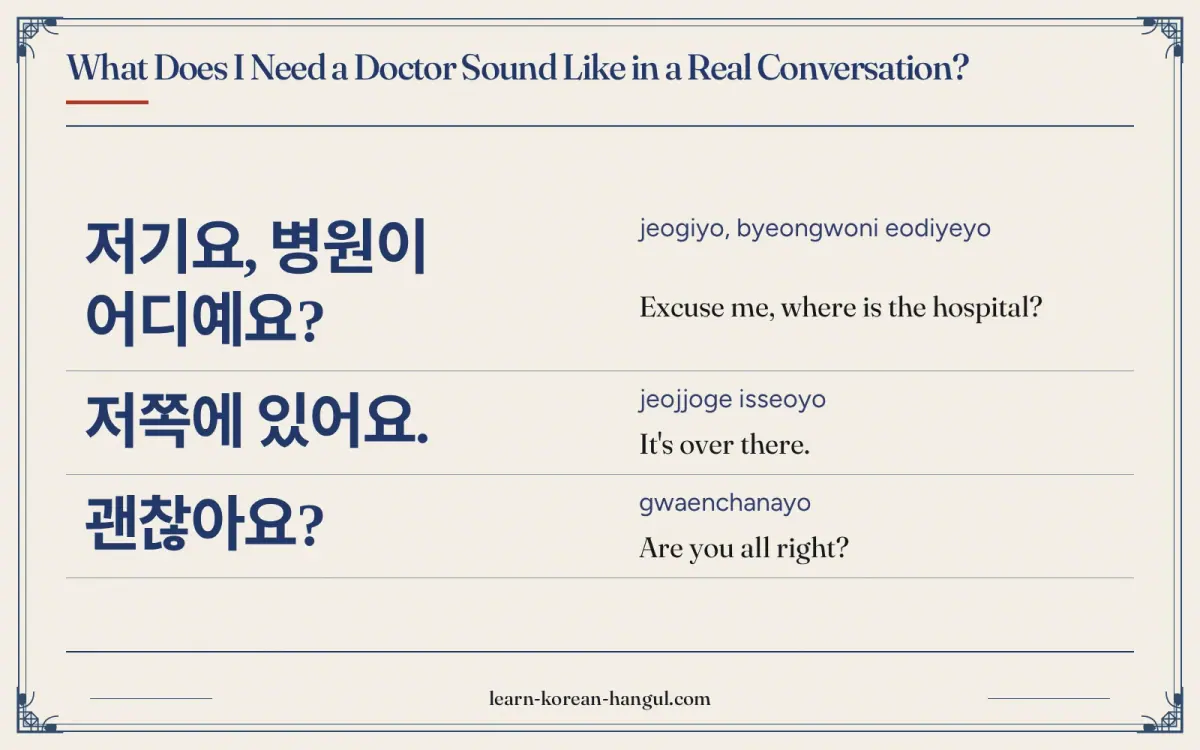
Health requests in Korea are brief and polite. Listen for the symptom first and the request second.
Asking a Hotel Clerk for a Doctor
Guest
몸이 안 좋아요. 의사가 필요해요.
momi an joayo. uisaga piryohaeyo
I don't feel well. I need a doctor.
Clerk
네, 바로 병원에 전화할게요.
ne, baro byeongwone jeonhwahalgeyo
Yes, I'll call a hospital right away.
What to notice: 안 좋아요 is said [안 조아요], because the ㅎ of 좋 is silent before a vowel.
Asking a Passer-by Where the Hospital Is
You
저기요, 병원이 어디예요?
jeogiyo, byeongwoni eodiyeyo
Excuse me, where is the hospital?
Passer-By
저쪽에 있어요.
jeojjoge isseoyo
It's over there.
What to notice: a wh-question ends with a fall or a rise-fall and not a sharp rise, because 어디 already carries the question.
Calling for an Ambulance
Passer-By
괜찮아요?
gwaenchanayo
Are you all right?
You
아니요, 구급차를 불러 주세요.
aniyo, gugeupchareul bulleo juseyo
No, please call an ambulance.
Passer-By
네, 지금 불러요.
ne, jigeum bulleoyo
Yes, I'm calling now.
What to notice: 괜찮아요 is said [괜차나요], and a rising voice marks it as a yes/no question. These exchanges also reflect how the Korean health system is organised.
What Should You Know about the Culture behind Seeing a Doctor in Korea?
Small ailments often go first to a 약국 (pharmacy) or a 의원 (clinic), and bigger problems go to a 병원 (hospital). Knowing which word to use helps you get to the right place.
- 약국. The pharmacy [약꾹] is a common first stop for colds, upset stomachs and minor pain. Ask 약국이 어디예요?.
- 의원. A neighbourhood clinic. Its sign often names the specialty, such as 내과 (internal medicine).
- 병원. A larger hospital, which may also have an emergency room (응급실 [응급씰]).
- 접수. The reception desk is 접수. At a clinic you may first be asked to register there.
- 119. The number for an ambulance and fire. Say the address, and keep the phone line open.
An expert insight: patients call their doctor 의사 선생님 (the doctor, with the respectful title 선생님), while 의사 alone names the profession. To ask a stranger for help, 의사가 필요해요 is enough, and the title is not needed. The title becomes important once you are in the room with the doctor. The mistakes below come from mixing up the words.
What Mistakes Do Learners Make with I Need a Doctor in Korean?
Most mistakes come from mixing the person and the place, or from a missing particle.
| Mistake | Why it is a problem | Fix |
|---|---|---|
| 의사가 어디예요? for the building | Asks where the person is | Say 병원이 어디예요? |
| 병원이 필요해요 for "I need care" | Means "I need a hospital" | Say 의사가 필요해요 |
| Saying pil-yo | Misses the liaison | Say [피료] |
| 의사를 필요해요 | Wrong particle for what is needed | Use 가: 의사가 필요해요 |
| Delaying in an emergency | A polite sentence can wait; the ambulance cannot | Call 119 and ask 구급차를 불러 주세요 |
Learners often assume 병원이 필요해요 is more serious than 의사가 필요해요. Actually, both are understood, but 병원이 필요해요 sounds like needing the building, so 의사가 필요해요 is the more natural way to ask for medical help.
Other Ways People Search for I Need a Doctor in Korean
People search for this topic in a few forms. The short answers below cover each one.
- Doctor in Korean: 의사 (uisa). The word page for doctor in Korean covers the title 선생님.
- Hospital in Korean: 병원 (byeongwon), with a full entry on hospital in Korean.
- Where is the hospital in Korean: 병원이 어디예요?, as above.
- Clinic in Korean: 의원 (uiwon) or a specialty sign such as 내과; 병원 is understood too.
- Romanized: uisaga piryohaeyo, following the Revised Romanization of Korean; romanization is an aid, not the real spelling.
Reading the forms is one thing; saying them on cue is another, so practise now.
Practice: Say It Aloud
Play the slow clip of 의사가 필요해요 and repeat it three times, linking [피료]. Then say 병원이 어디예요? with a fall or a rise-fall at the end, not a sharp rise. Choose a phrase for each situation, and check the answers below.
- You feel dizzy and ask the hotel desk for help.
- You need to find the hospital on the street.
- A traveller has collapsed, and you ask a bystander to help.
Answers
- 의사가 필요해요, or 몸이 안 좋아요.
- 병원이 어디예요?
- 구급차를 불러 주세요.
Drill these lines with the phrase flashcards, which include audio for each form.
Related Phrases to Learn Next
Needing a doctor leads to a short set of health phrases.
- Call an ambulance in Korean: the emergency line in more detail.
- I have a headache in Korean: how to describe pain.
- I'm sick in Korean: how to say you are unwell.
This guide belongs to the Korean medical phrases collection. What this page does not cover: medical vocabulary, insurance and prescriptions. Say 의사가 필요해요, ask where the hospital is, and call 119 when it is serious, and you will be understood.
Frequently Asked Questions
How do you say I need a doctor in Korean?
Say 의사가 필요해요 (uisaga piryohaeyo). It is polite and works with strangers, hotel staff and pharmacists. If you also need help getting there, add 병원에 가고 싶어요, "I want to go to the hospital". In an emergency, say 구급차를 불러 주세요, "please call an ambulance", and use the number 119.
How do you pronounce 의사가 필요해요?
It sounds like [의사가 피료해요]. The ㄹ at the end of 필 moves onto the silent ㅇ of 요, so 필요 becomes pi-ryo. The first 의 is said as a full [의] because it begins the word. Revised Romanization writes it uisaga piryohaeyo. The linked ㄹ is written r, and the ㅎ of 해요 is kept as h.
What is the difference between 의사가 필요해요 and 병원에 가고 싶어요?
의사가 필요해요 says what you need: a doctor, as a person. 병원에 가고 싶어요 says where you want to go: a hospital, as a place. Use the first when you want someone to fetch or call a doctor, and the second when you want directions or a taxi. In a serious emergency, skip both and say 구급차를 불러 주세요.
Can I use 의사가 필요해요 with friends, elders and strangers?
Yes. It ends in the polite -요, so it suits strangers, elders and staff. With a close friend, drop the ending and say 의사가 필요해. In a formal setting, such as a phone call to an official office, say 의사가 필요합니다. For an emergency, politeness is less important than being clear.
What is the most common mistake with I need a doctor in Korean?
The most common mistake is saying 의사 for the building. 의사 is the doctor, the person, and 병원 is the hospital, the place. If you say 의사가 어디예요?, people hear "where is the doctor?", which is a different question. Use 병원이 어디예요? for the place. A second mistake is waiting too long before saying 119 in a real emergency.