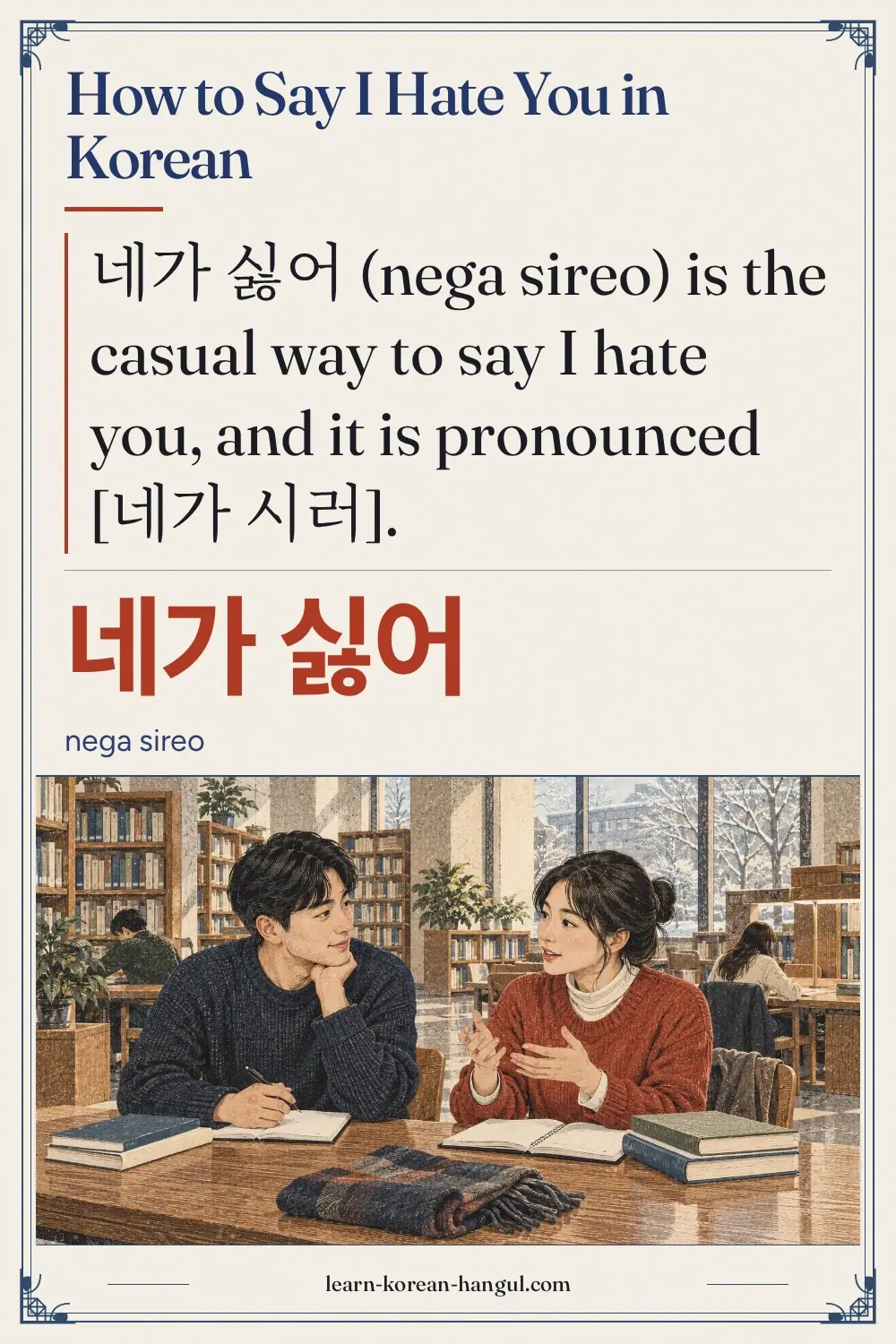
네가 싫어
네가 싫어
What you'll learn
- Say I hate you with 네가 싫어, 너 미워 or 증오해, and know which one fits.
- Understand why polite and formal forms are rare.
- Use safer phrases such as 섭섭해요 with elders and strangers.
- Pronounce 싫어 as [시러] without an h sound.
Before you start: it helps to know I don't like it in Korean, because 싫어 is the same word at a higher strength. Time: about 10 minutes.
How Do You Say I Hate You in Korean?
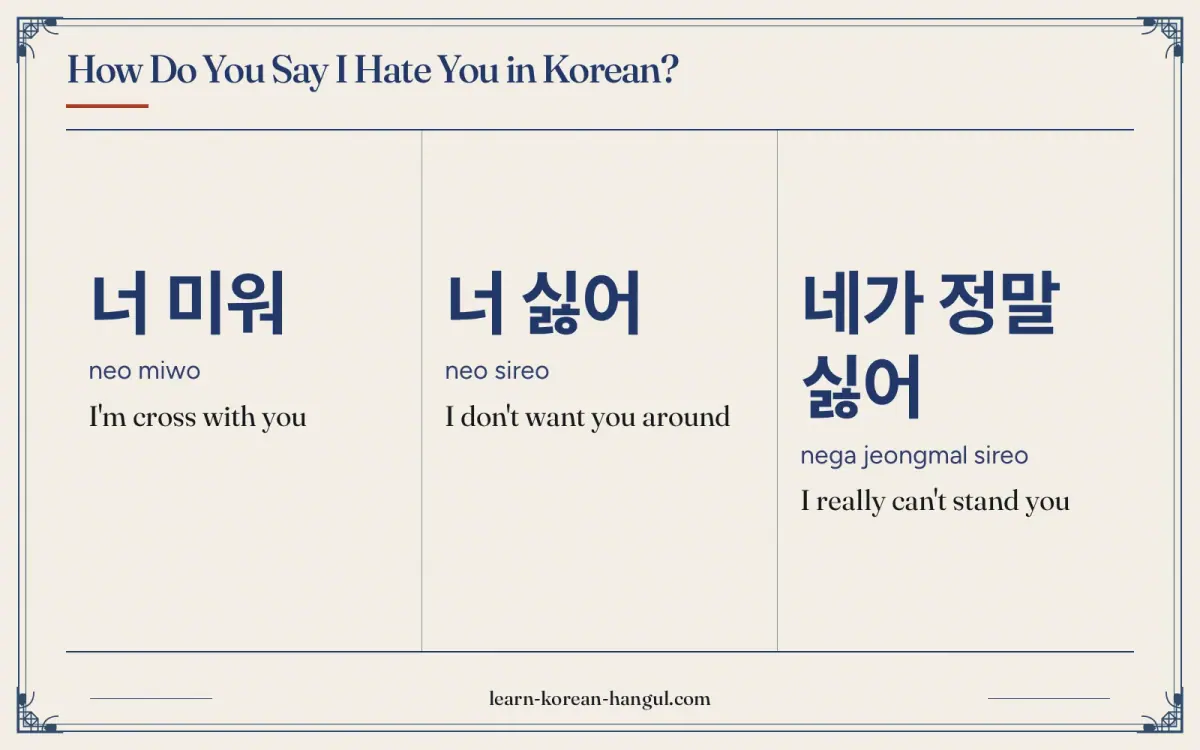
The standard way to say I hate you in Korean is 네가 싫어, which literally means "you are unwelcome to me". The adjective 싫다 (silta) works for things, and when the object is a person it becomes much stronger.
| Strength | Korean | Romanization | Meaning |
|---|---|---|---|
| Playful | 너 미워 | neo miwo | I'm cross with you |
| Medium | 너 싫어 | neo sireo | I don't want you around |
| Strong | 네가 정말 싫어 | nega jeongmal sireo | I really can't stand you |
| Very strong, literary | 증오해 | jeungohae | I loathe you |
| About a third person | 그 사람이 싫어요 | geu sarami sireoyo | I dislike that person |
Notice that 네가 uses the subject particle 가: "you" is the thing that is unwelcome, which is why the sentence looks like a statement about you. The next section shows what changes by level.
What Are the Casual and Polite Ways to Say I Hate You?
Korean has speech levels, the endings that change with the listener, covered in the guide to Korean speech levels. For this phrase the casual level is common and the others are rare.
Casual: 네가 싫어 (nega sireo)
Casual · 반말네가 싫어 is the standard casual form, and 너 싫어 is the faster spoken version. It is used between siblings, couples and close friends, usually in a quarrel. Between friends, it is often joking, not serious.
너 진짜 싫어!
neo jinjja sireo
I really can't stand you!
Casual: 너 미워 (neo miwo)
Casual · 반말미워 comes from 밉다, "to be hateful" or "to resent". It is gentler than 싫어: you are cross with someone for something they did. Couples and friends say it with a pout.
너 미워, 왜 안 왔어?
neo miwo, wae an wasseo
I'm cross with you, why didn't you come?
Polite: 당신이 싫어요 (dangsini sireoyo)
Polite · 해요체당신이 싫어요 is grammatically polite. In practice it sounds cold or dramatic, since 당신 is used mostly by spouses and in arguments. If you are learning Korean for travel, you will almost never need it.
Polite: 그 사람이 싫어요 (geu sarami sireoyo)
Polite · 해요체When you talk about a third person, the polite form is normal and clear. 그 사람이 싫어요 means "I don't like that person". You can use it with a colleague or friend who knows the story.
저는 그 사람이 싫어요.
jeoneun geu sarami sireoyo
I don't like that person.
Strong: 증오해 (jeungohae)
증오 (憎惡) is a Sino-Korean word for deep hatred. 증오해 or 증오합니다 appears in news, novels and dramas, not in daily talk. Using it in an ordinary quarrel sounds theatrical.
The spelling of 싫어 hides one important sound change.
How Do You Pronounce 네가 싫어?
네가 싫어 is pronounced [네가 시러], ne-ga si-reo, in four syllables. The only surprise is 싫어.
- 네 (ne): "neh".
- 가 (ga): a soft g and "ah".
- 싫 (si): the ㅎ is dropped and the ㄹ moves forward to the next syllable.
- 어 (eo): joins with ㄹ to sound like "ruh".
Sound Changes to Listen For
These changes follow the National Institute of Korean Language standard pronunciation rules (표준 발음법, Article 12):
- ㅎ is silent before a vowel. 싫어 is [시러]. The ㄹ in the cluster ㅀ jumps to the next syllable.
- 네가 often heard as [니가]. The standard pronunciation is [네가], but in everyday speech most people say [니가], partly so that 네가 (you) does not sound like 내가 (I). Expect to hear 니가 싫어 in dramas and songs.
- Stress with 진짜. 진짜 (jinjja, really) has a tense ㅉ, so it sounds strong. Add it before 싫어 to raise the force.
Sound is simple. The harder question is when, if ever, to use these words.
When Should You Use 네가 싫어, and When Should You Not?
Use 네가 싫어 only with people who are very close and in a safe, familiar fight. Do not use it with elders, colleagues, teachers or strangers.
Situations Where It Fits
- A sibling fight. 너 싫어! is common and quickly forgotten.
- A playful quarrel between partners. 너 미워 with a smile.
- Talking about a third person. 그 사람이 싫어요 to a friend.
Situations to Avoid
- Any workplace. Say 그 방식은 좀 불편해요 (that way feels uncomfortable) instead.
- An elder who hurt you. Say 조금 섭섭해요 (I feel a little hurt).
- A stranger. Say nothing, or say 그만하세요 (please stop).
Two short conversations show the difference between a playful and a serious tone.
What Does I Hate You Sound Like in a Real Conversation?
In real conversations, the phrase is rarely alone. People add a reason, a joke or an apology. Here are two examples.
A Sibling Quarrel
Younger
내 과자 먹었어?
nae gwaja meogeosseo?
Did you eat my snack?
Older
응, 미안.
eung, mian
Yes, sorry.
Younger
너 진짜 싫어!
neo jinjja sireo
I really can't stand you!
Older
다음에 사 줄게.
daeume sa julge
I'll buy you one next time.
What to notice: 진짜 싫어 is a joke between siblings, and the apology ends it.
Telling a Senior You Feel Hurt
Junior
선배님, 아까 말씀이 조금 섭섭했어요.
seonbaenim, akka malsseumi jogeum seopseopaesseoyo
Senior, I felt a little hurt by what you said earlier.
Senior
아, 그랬어요? 미안해요.
a, geuraesseoyo? mianhaeyo
Oh, did you? I'm sorry.
What to notice: 섭섭했어요 describes the feeling, not the person, so it keeps the relationship safe.
What Should You Know about the Culture behind I Hate You?
Korean values harmony and the relationship, which is why people soften anger. Expressing hate to someone's face can be a serious break, especially with elders, and silence or distance often takes its place. At the same time, Korean pop songs and dramas use 싫어 and 미워 for drama, so learners hear them often and may overestimate how common they are.
- Seniority. Strong feelings go down the ladder, not up. You rarely say 싫어 to someone older.
- Describe, don't accuse. 섭섭해요 and 불편해요 talk about feelings and actions.
- Silence is a message. Not replying can say more than a harsh word.
An expert tip: every quarrel needs a way back. If you want to learn to apologise after one, read sorry in Korean.
What Mistakes Do Learners Make with I Hate You in Korean?
Most mistakes come from using a very strong word with the wrong person, or from sound errors.
| Mistake | Why it is a problem | Fix |
|---|---|---|
| 너 싫어 to an older person | Rude | Say 섭섭해요 |
| 당신이 싫어요 in daily life | Cold, dramatic | Describe the feeling |
| Saying [실허] with an h | Not standard | Say [시러] |
| 증오해 in a small quarrel | Too literary | Say 너무 싫어 |
| Using 싫어 for a small annoyance | Too strong | Say 미워 or 좀 그래요 |
Learners often assume the English "I hate you" has an exact Korean copy. Actually, English "I hate you" is also said in jokes, and the Korean 미워 matches that playful use better than 싫어.
Is It the Same as Hate You or I Dislike You?
Close but not identical. The short answers below cover the other searches folded into this page.
- Hate you in Korean: 네가 싫어 or 너 싫어.
- I hate u in Korean: the same sentence as I hate you; the casual 너 is already as short as "u".
- I dislike you in Korean: 별로 안 좋아해요 (I don't like you very much), which is milder.
Now practise aloud.
Practice: Say It Aloud
Play the slow clip of 네가 싫어 three times and drop the ㅎ in 싫어. Then pick a phrase. Answers follow.
- Your sister ate your snack, and you are joking.
- Your boyfriend forgot a date, and you are teasing.
- A senior's remark hurt you.
- You dislike a colleague you are describing to a friend.
Answers
- 너 진짜 싫어!
- 너 미워.
- 조금 섭섭했어요.
- 그 사람이 싫어요.
The phrase flashcards drill the safer phrases with audio.
Related Phrases to Learn Next
Strong feelings need a way to calm down.
- I don't like it in Korean: 싫어요 at a lower strength.
- I'm angry in Korean: 화가 나요 and its friends.
- Sorry in Korean: how to repair a quarrel.
This guide belongs to the Korean feelings phrases collection. What this page does not cover: insults, swear words and the full vocabulary of anger. Choose the weakest phrase that is honest, and you can say I hate you in Korean without harming a friendship.
Frequently Asked Questions
How do you say I hate you in Korean?
The common casual way is 네가 싫어 (nega sireo) or 너 싫어 (neo sireo). A lighter version is 너 미워 (neo miwo). A much stronger and rarer word is 증오해 (jeungohae). Because these words hurt, Koreans avoid them with elders and strangers and instead say how they feel about an action.
Is there a polite way to say I hate you in Korean?
Technically, yes: 당신이 싫어요 (dangsini sireoyo). But it sounds cold and dramatic, because 당신 is used mostly between spouses or in arguments. In real life, people say 그 사람이 싫어요 about a third person, and with the person in front of them they describe the feeling: 섭섭해요 or 화가 나요.
What is the difference between 싫어 and 미워?
싫어 means I don't like you and don't want you near me. 미워 means I am cross with you for something you did, often with a hint of love or play, as in 너 미워, 왜 안 왔어? (I'm cross with you, why didn't you come?). So 싫어 is about the person, while 미워 is about the moment.
How do you say I dislike you in Korean?
A milder choice is 저는 당신을 좋아하지 않아요 (I don't like you) or 별로 안 좋아해요 (I don't like you very much). These are still direct. If you must say it, state it calmly and avoid insults. In many situations, it is wiser to say what behaviour bothers you, such as 그 말이 불편했어요 (that comment made me uncomfortable).
Do Koreans say I hate you often?
In daily life, the strong phrase is rarer than in dramas. Siblings and couples may say 너 싫어 or 미워 in jokes, but speaking it seriously ends friendships. Koreans usually go quiet, change the subject or use 좀 그래요 instead, so listen for tone and silence as well as words.
What is the most common mistake with I hate you in Korean?
Learners use 싫어해요 with 당신 in polite speech or say it to an older person. That sounds harsh and rude, and elders may feel insulted. Another mistake is to pronounce the ㅎ in 싫어, which should be [시러]. Choose a softer phrase unless you truly mean it.