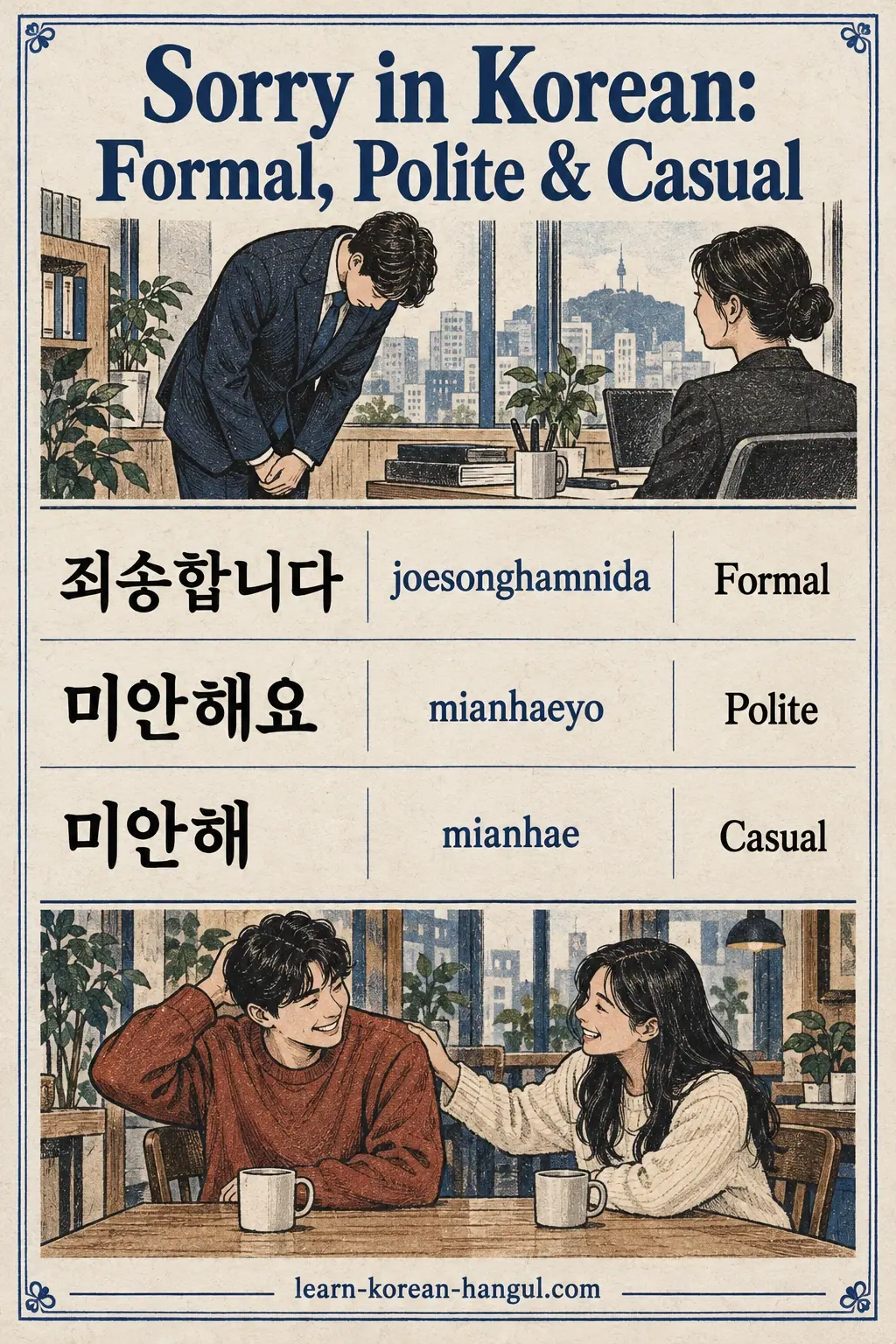
죄송합니다
죄송합니다
What you'll learn
- Say 죄송합니다 aloud as [죄송함니다].
- Choose between 죄송합니다, 죄송해요, 미안해요 and 미안해 for a senior, an equal and a friend.
- Explain the difference between 죄송 and 미안.
- Avoid using sorry where Korean needs a different phrase, such as sympathy or calling a waiter.
Before you start: knowing thank you in Korean helps, because sorry uses the same formal and polite endings. Time: about 12 minutes. Audio plays only when you press a button.
How Do You Say Sorry in Korean?
The safest way to say sorry in Korean is 죄송합니다, because it shows respect to anyone you are not close to. Korean has two apology words, 죄송 and 미안, and you choose between them by asking whether the listener is above you or beside you.
| Form | Romanization | Register | Say it to |
|---|---|---|---|
| 죄송합니다 | joesonghamnida | Formal (합쇼체) | Bosses, teachers, customers, elders, strangers |
| 죄송해요 | joesonghaeyo | Polite (해요체) | Seniors you know well, older acquaintances |
| 미안합니다 | mianhamnida | Formal (합쇼체) | Equals or juniors in formal settings |
| 미안해요 | mianhaeyo | Polite (해요체) | Equals you speak politely with |
| 미안해 | mianhae | Casual (반말) | Close friends, partners, siblings, children |
Both words come from Sino-Korean roots. 죄송 (罪悚) combines characters for guilt and fear, so it lowers the speaker before a respected listener. 미안 (未安) means "not at ease", a feeling you share with someone on your own level. The next section shows each form in use.
What Are the Formal, Polite and Casual Ways to Say Sorry?

Sorry follows the Korean speech levels, the endings that change with the listener, explained in the guide to Korean speech levels. Unlike thank you, sorry also changes its core word depending on status.
Formal: 죄송합니다 (joesonghamnida)
Formal · 합쇼체죄송합니다 is the formal apology. It is what staff say when a dish is late, what employees say to managers, and what anyone says to a stranger they have inconvenienced. Adding 정말 (really) makes it stronger: 정말 죄송합니다.
늦어서 죄송합니다.
neujeoseo joesonghamnida
I'm sorry for being late.
The pattern "verb + -아/어서 죄송합니다" means "I'm sorry for ...", and the late version has its own page, sorry I'm late in Korean.
Polite: 죄송해요 (joesonghaeyo)
Polite · 해요체죄송해요 keeps the respectful word 죄송 but uses the softer polite ending. It suits seniors you know well, such as a friend's older sibling or a professor you chat with often.
선배, 연락 못 해서 죄송해요.
seonbae, yeollak mot haeseo joesonghaeyo
Sorry I didn't get in touch, senior.
Polite: 미안해요 (mianhaeyo)
Polite · 해요체미안해요 is the polite sorry for equals: a colleague of the same rank, a classmate you met as an adult, or a neighbour your age. It is warm but not deferential.
기다리게 해서 미안해요.
gidarige haeseo mianhaeyo
Sorry for keeping you waiting.
Casual: 미안해 (mianhae)
Casual · 반말미안해 is the casual sorry, for close friends, partners, siblings and children. The very short 미안 is even more casual and suits small slips, like stepping on a friend's foot.
어제 일은 진짜 미안해.
eoje ireun jinjja mianhae
I'm really sorry about yesterday.
Formal: 미안합니다 (mianhamnida)
Formal · 합쇼체미안합니다 combines the equal-level word 미안 with the formal ending. You hear it from a senior apologising to juniors in a meeting, or from public figures to the public in some statements. Learners should rarely need it: to anyone above you, 죄송합니다 is expected.
제가 실수했습니다. 미안합니다.
jega silsuhaetseumnida. mianhamnida
I made a mistake. I'm sorry.
Five forms reduce to two decisions: 죄송 or 미안, then formal, polite or casual. Pronouncing the main form is next.
How Do You Pronounce 죄송합니다?
죄송합니다 is pronounced [죄송함니다], joesonghamnida, in five even syllables, with an m sound in the middle where the spelling shows ㅂ.
- 죄 (joe): a soft j and the vowel ㅚ, which most Seoul speakers say like "jweh".
- 송 (song): "sohng", ending in "ng" as in "sing".
- 함 (ham): written 합, said "hahm" with closed lips.
- 니 (ni): "nee".
- 다 (da): a soft d and "ah".
Sound Changes to Listen For
Three details from the National Institute of Korean Language Standard Pronunciation (표준 발음법) and natural speech matter here:
- Nasalization in 합니다. ㅂ before ㄴ becomes ㅁ, so 죄송합니다 is [죄송함니다] and 미안합니다 is [미안함니다]. The rule is explained in ㅂ-to-ㅁ nasalization.
- ㅚ as a glide. The standard rules allow ㅚ to be said as a single vowel or as [ㅞ]; most speakers today say 죄 like "jweh".
- The light ㅎ in 미안해요. In fast speech, the ㅎ after ㄴ weakens, so 미안해요 can sound close to "mi-a-nae-yo". Keep a soft h when speaking slowly.
A well-pronounced apology to the wrong person still causes trouble, so the next section covers who gets which form.
When Should You Use 죄송합니다, and When Should You Not?

Use 죄송합니다 with anyone above you in age or status and with anyone you do not know. Avoid it with close friends and family, where it sounds cold, and do not use it for sympathy or to call staff.
Situations Where It Fits
- Bumping into a stranger. A quick 죄송합니다 with a nod.
- Being late for a meeting with a manager. 늦어서 죄송합니다.
- Softening a request to a stranger. 죄송한데요, 사진 좀 찍어 주실 수 있어요? (Sorry, could you take a photo for me?)
- Working in service. Staff say 죄송합니다 when something is sold out or delayed.
Situations to Avoid
- A close friend. 죄송합니다 sounds sarcastic or icy; say 미안해.
- Calling a waiter. Say 저기요 or 여기요, covered in excuse me in Korean.
- Expressing sympathy. If a friend's pet died, 죄송해요 suggests you caused it. Say 정말 안타까워요 (that's really sad) instead.
- A senior with 미안해요. The equal-level word sounds as if you see yourself on their level.
The short conversations below show these rules at work.
What Does Sorry Sound Like in a Real Conversation?

A Korean apology exchange is usually short, and the person receiving it often replies with 괜찮아요 (it's okay). Notice how each speaker's form matches the other's status.
Late to a Meeting
Employee
부장님, 늦어서 죄송합니다.
bujangnim, neujeoseo joesonghamnida
I'm sorry I'm late, sir.
Manager
괜찮아요. 앉아요.
gwaenchanayo. anjayo
It's okay. Sit down.
What to notice: the employee uses 죄송합니다 with a title; the manager answers in simple polite speech.
Forgetting a Friend's Call
Ara
어제 전화 못 받아서 미안해.
eoje jeonhwa mot badaseo mianhae
Sorry I missed your call yesterday.
Ben
괜찮아. 바빴지?
gwaenchana. bappatji?
It's fine. You were busy, right?
What to notice: casual 미안해 gets a casual 괜찮아, explained in it's okay in Korean.
Bumping into Someone
Passer-By
아, 죄송합니다.
a, joesonghamnida
Oh, I'm sorry.
Other Person
아니에요, 괜찮아요.
anieyo, gwaenchanayo
No, it's fine.
What to notice: between strangers, both sides stay polite. The choice between 죄송 and 미안 reflects a cultural logic worth understanding.
What Should You Know about the Culture behind Sorry?

A Korean apology expresses where you stand in relation to the listener as much as regret. The word you choose shows that you understand the relationship.
- Status shapes the word. 죄송 lowers yourself before someone above you; 미안 treats the listener as an equal or someone close.
- Bowing. Apologies to seniors usually come with a bow; the more serious the mistake, the deeper and longer the bow.
- Apologising first. In workplaces, juniors often apologise quickly even for small delays, and a prompt 죄송합니다 smooths things over.
- Sympathy is separate. Korean keeps apology and sympathy apart, unlike English "sorry".
An expert insight: learners sometimes avoid 죄송합니다 because it feels too heavy for small slips. With strangers and staff, it is the normal everyday apology, not a dramatic one; a quick 죄송합니다 with a nod is the right size for a bump on the subway. The common mistakes below come from mixing up the two words.
What Mistakes Do Learners Make with Sorry in Korean?
Most sorry mistakes come from choosing the wrong apology word for the listener's status.
| Mistake | Why it is a problem | Fix |
|---|---|---|
| Saying 미안합니다 or 미안해요 to a boss or teacher | 미안 is for equals | Use 죄송합니다 |
| Saying 죄송합니다 to a close friend | Sounds cold or sarcastic | Use 미안해 |
| Using sorry for sympathy | Implies you caused the problem | Say 정말 안타까워요 |
| Saying 죄송합니다 to call a waiter | Sounds like an apology | Say 저기요 or 여기요 |
| Pronouncing a b in 합: "joesong-hab-nida" | ㅂ becomes ㅁ before ㄴ | Say [죄송함니다] |
Learners often assume that adding -요 to 미안해 makes it safe with seniors. Actually, 미안해요 is still the equal-level word; the polite ending does not change the core meaning, so seniors expect 죄송 regardless of ending.
Is It the Same as I'm Sorry?
Yes. Korean does not need a word for "I": 죄송합니다 already means "I'm sorry", because the speaker is understood. The short answers below cover the other ways people search for this phrase.
- I'm sorry / im sorry / I am sorry in Korean: 죄송합니다 (formal), 미안해요 (polite), 미안해 (casual).
- Sorry formal in Korean: 죄송합니다.
- Sorry informal or casual in Korean: 미안해, or very short 미안.
- Sorry romanized: joesonghamnida, mianhaeyo, mianhae, following the Revised Romanization of Korean.
- Sorry baby or babe in Korean: 자기야, 미안해.
- Sorry mom / sorry dad: 엄마, 미안해 or 아빠, 미안해 in most families.
- A deeper apology: 정말 죄송합니다, covered in I'm very sorry in Korean; asking forgiveness is in forgive me in Korean.
Now practise choosing the form aloud.
Practice: Say It Aloud

Play the slow clip of 죄송합니다 and repeat it three times, then try 미안해요 and 미안해. Then choose the form for each case. Answers follow.
- You spill water on a customer's table while working in a café.
- You forget your best friend's birthday.
- You arrive ten minutes late to a class with a strict professor.
- A colleague tells you their grandmother passed away. Is 죄송해요 right?
Answers
- 죄송합니다.
- 진짜 미안해.
- 늦어서 죄송합니다.
- No. 죄송해요 admits fault; say 정말 안타까워요 or a set condolence phrase.
The phrase flashcards drill all five sorry forms with audio.
Related Phrases to Learn Next
Sorry sits beside other phrases you use when something goes wrong or you need to interrupt.
- Excuse me in Korean: 실례합니다, 저기요 and 잠시만요 for attention and passing.
- I'm very sorry in Korean: stronger apologies for serious mistakes.
- It's okay in Korean: how to accept an apology.
This guide belongs to the polite Korean phrases collection. What this page does not cover: public apology statements, written apologies and funeral etiquette in depth. Choose 죄송 for people above you, 미안 for people beside you, and you can say sorry in Korean without making things worse.
Frequently Asked Questions
How do you say sorry in a Korean drama style?
Korean dramas mostly use 미안해 between couples and friends, and 죄송합니다 to bosses and parents-in-law. Male characters sometimes say 미안하다, the plain style (해라체), which sounds blunt and serious. Copy 미안해 with friends, but avoid 미안하다 in real life unless you are clearly older and close to the listener.
How do you say sorry to your mom or dad in Korean?
Most Korean families use casual speech with parents, so 엄마, 미안해 (sorry, Mum) or 아빠, 미안해 (sorry, Dad) is normal. In more traditional homes, children use 죄송해요 with parents, especially fathers. Follow what your family already uses; switching to formal 죄송합니다 at home can sound cold or dramatic.
How do you say sorry to a boyfriend or girlfriend in Korean?
Couples say 미안해 (sorry), often with a pet name: 자기야, 미안해 (sorry, honey). A stronger version is 진짜 미안해 (I'm really sorry). Using 죄송합니다 with a partner would sound strangely distant or sarcastic, so keep the casual form unless your relationship still uses polite speech.
Can 죄송합니다 mean excuse me?
Yes, in some situations. 죄송합니다 works as excuse me when you bump into someone or squeeze past, and 죄송한데요 (sorry, but) softens a request to a stranger. To call a waiter or get attention, though, Koreans say 저기요 or 여기요, not 죄송합니다.
How do you say I'm sorry for your loss in Korean?
죄송합니다 is wrong here, because it admits fault. At a funeral, the set phrase is 삼가 고인의 명복을 빕니다 (I pray for the deceased's happiness in the next world), usually written. Spoken sympathy for bad news uses 정말 안타까워요 (that is really sad). At the funeral hall itself, many visitors simply bow and say very little.