싫어요
싫어요
What you'll learn
- Say I don't like it with 싫어요, 싫습니다, 싫어, 안 좋아해요 or 별로예요, depending on the listener and the strength.
- Pronounce 싫어요 as [시러요] and 싫습니다 as [실씀니다].
- Soften a refusal so that it sounds kind.
- Avoid the double negative 안 싫어요.
Before you start: it helps to know I like it in Korean, because the two pages mirror each other. Time: about 10 minutes.
How Do You Say I Don't Like It in Korean?
The standard way to say I don't like it in Korean is 싫어요, which literally means "it is unwelcome (to me)". The adjective 싫다 (silta) describes a thing you do not want or enjoy, so it works for food, plans, weather and people's actions.
| Situation | Best form | Romanization | Why |
|---|---|---|---|
| A stranger offers food you dislike | 별로예요 | byeolloyeyo | Soft |
| A friend plans something you dislike | 싫어요 | sireoyo | Direct, polite |
| A close friend teases you | 싫어 | sireo | Casual |
| A manager asks for your view | 마음에 들지 않습니다 | maeume deulji anseumnida | Formal and careful |
| You avoid a food in general | 안 좋아해요 | an joahaeyo | Mild, names the thing |
Add the thing at the front when it is not clear: 이거 싫어요 (igeo sireoyo, I don't like this). The next section sorts the forms by strength.
What Are the Polite and Casual Ways to Say I Don't Like It?
The forms change with the listener and with how strongly you feel. The endings follow the Korean speech levels, explained in the guide to Korean speech levels. Here the ladder goes from strong to mild.
Polite: 싫어요 (sireoyo)
Polite · 해요체싫어요 is the form to learn first. It says clearly that you do not want or enjoy something. It suits friends, colleagues and family. With strangers or elders, use it with a reason.
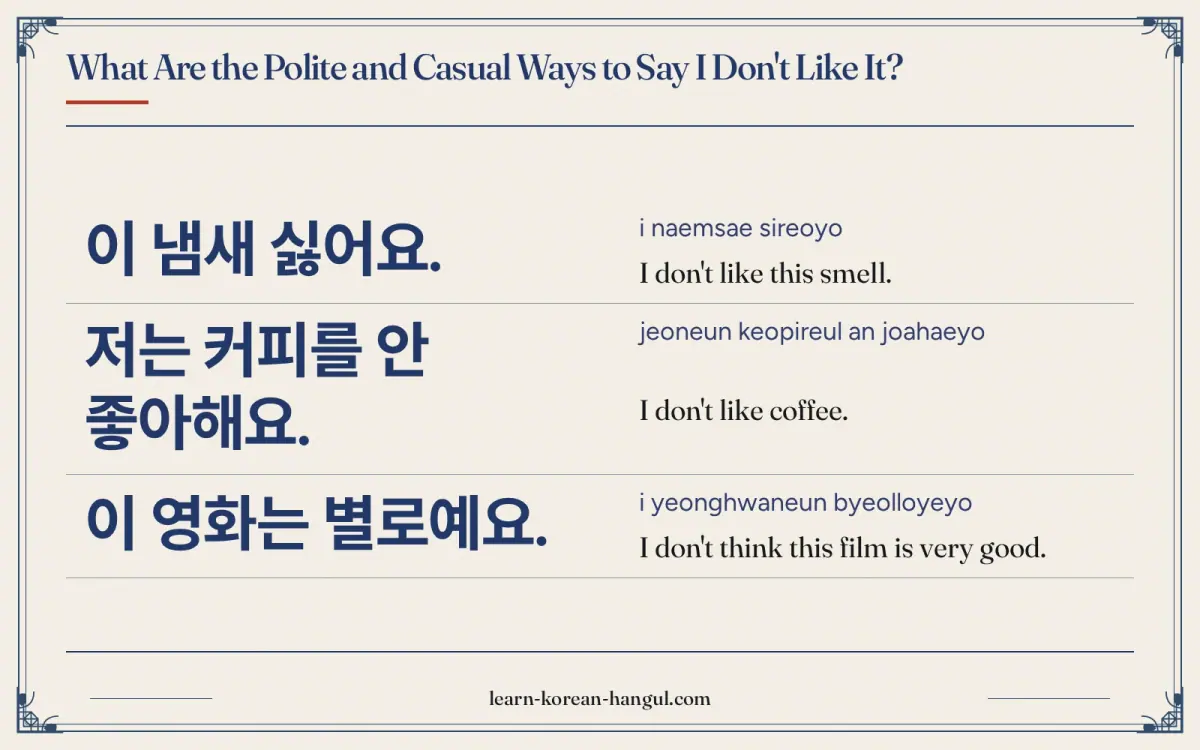
이 냄새 싫어요.
i naemsae sireoyo
I don't like this smell.
Polite: 안 좋아해요 (an joahaeyo)
Polite · 해요체안 좋아해요 puts 안 (not) in front of 좋아해요 (I like). It is milder than 싫어요 and fits a lasting preference, such as food. It usually names the thing you do not like, as in 저는 커피를 안 좋아해요 (I don't like coffee).
저는 커피를 안 좋아해요.
jeoneun keopireul an joahaeyo
I don't like coffee.
Polite: 별로예요 (byeolloyeyo)
Polite · 해요체별로예요 means "it is not really good". The word 별로 is used with a negative idea, so it softens the sentence. It is the safest way to dislike a gift, a dish or a film without hurting anyone.
이 영화는 별로예요.
i yeonghwaneun byeolloyeyo
I don't think this film is very good.
Polite: 마음에 안 들어요 (maeume an deureoyo)
Polite · 해요체마음에 안 들어요 is the opposite of 마음에 들어요: the thing does not suit your taste. Use it for something you can see or try, such as clothes or a room.
Casual: 싫어 (sireo)
Casual · 반말싫어 drops the polite ending. Use it with close friends, siblings and children. A drawn-out 싫어~ can sound playful, while a short, flat 싫어 sounds firm.
나는 그거 싫어.
naneun geugeo sireo
I don't like that.
Formal: 싫습니다 (silseumnida)
Formal · 합쇼체싫습니다 is the formal form. It is rare, because it sounds stern. In a formal setting people usually choose a polite sentence like 마음에 들지 않습니다 (I am not satisfied). Its sound is explained next.
The five forms also differ in strength, so it helps to see them side by side.
| Strength | Form | Feels like |
|---|---|---|
| Very mild | 별로예요 | Not really my taste |
| Mild | 안 좋아해요 | I'm not a fan |
| Medium | 마음에 안 들어요 | It doesn't suit me |
| Strong | 싫어요 | I don't want it |
| Very strong | 너무 싫어요 | I really can't stand it |
Pick the mildest row that is still honest. Koreans usually start mild and move up only if the other person keeps pushing. The sound of 싫어요 is the part that surprises most learners.
How Do You Pronounce 싫어요?
싫어요 is pronounced [시러요], si-reo-yo, in three syllables. The first syllable is written with a final ㅀ, a cluster of ㄹ and ㅎ, but only the ㄹ is heard, and it moves to the next syllable.
- 시 (si): "see".
- 러 (reo): the ㄹ from 싫 jumps over to join 어, and it sounds like a soft "ruh".
- 요 (yo): "yo".
Sound Changes to Listen For
These changes follow the National Institute of Korean Language standard pronunciation rules (표준 발음법, Article 12):
- ㅎ is silent before a vowel. 싫어요 is [시러요] and 싫어 is [시러]. Do not say an h sound.
- ㅎ + ㅅ becomes ㅆ. 싫습니다 is [실씀니다]: the ㅎ drops, the ㅅ becomes tense ㅆ, and ㅂ before ㄴ turns into ㅁ. See Korean tensification for tense sounds.
Once you can say it, the harder task is to choose a form that fits the moment.
When Should You Use 싫어요, and When Should You Not?
Use 싫어요 when you want to be clear and the listener is close enough to hear it. Do not use it alone with someone you must respect, because a bare refusal can sound harsh.
Situations Where It Fits
- A friend asks if you want to go hiking. Say 싫어요, 너무 힘들어요 (no, it is too hard).
- A child or sibling teases you. Say 싫어!
- A smell or a sound bothers you. Say 이 냄새 싫어요.
Situations to Avoid
- Someone cooked for you. Say 별로예요 gently, or say you are full, not 싫어요.
- A boss makes a suggestion. Say 다른 방법도 있을까요? (could there be another way?).
- Using 싫어요 about a person. It is much stronger when the object is a person. See I hate you in Korean before you use it.
Remember also that 싫어요 can describe a situation, not only an object: 비가 와서 싫어요 means "I don't like it because it is raining". Two short conversations show the contrast.
What Does I Don't Like It Sound Like in a Real Conversation?
In real speech, people add a reason or a softener, and they often start with 아니요 or 글쎄요 (well...). Notice how the reason makes the answer kind.
At a Friend's Table
Friend
이 반찬 어때요?
i banchan eottaeyo?
How is this side dish?
You
음, 저는 좀 별로예요. 너무 매워요.
eum, jeoneun jom byeolloyeyo. neomu maewoyo
Hmm, I don't like it very much. It is too spicy.
Friend
그럼 이거 드세요.
geureom igeo deuseyo
Then have this one.
What to notice: 좀 별로예요 is a gentle no, and 너무 매워요 gives the reason.
Between Siblings
Sister
오늘 청소해.
oneul cheongsohae
Clean up today.
Brother
싫어! 어제 내가 했잖아.
sireo! eoje naega haetjana
No way! I did it yesterday.
Sister
알았어, 내가 할게.
arasseo, naega halge
Okay, I'll do it.
What to notice: between siblings the bare 싫어 is normal, and it comes with a reason.
What Should You Know about the Culture behind I Don't Like It?
Korean culture values harmony, so people often avoid a direct no. A guest who dislikes a dish may say 괜찮아요 (I'm fine) or 조금만 먹을게요 (I'll just have a little) instead of 싫어요. The word 좀, meaning "a little", softens almost any complaint.
- Hedging is polite. 좀 그래요 (jom geuraeyo, literally "it's a bit like that") hints at a problem without naming it.
- Directness is for equals. 싫어요 is natural between friends and family and with children.
- Tone matters. A smile and a short reason change a sharp refusal into a normal answer.
An expert tip: 좀 별로예요 is the most useful phrase on this page. Two small words give an honest opinion and keep the relationship warm. Many learners only meet the bare 싫어요 in drama lines, which are usually dramatic.
What Mistakes Do Learners Make with I Don't Like It in Korean?
Most mistakes come from using the wrong strength or from negating twice.
| Mistake | Why it is a problem | Fix |
|---|---|---|
| 안 싫어요 for "I don't like it" | Double negative: "I don't dislike it" | Say 싫어요 |
| 싫어요 to a host | Too blunt | Say 별로예요 or give a reason |
| Saying [실허요] with an h | Not the standard sound | Say [시러요] |
| 싫어해요 for a reaction to something in front of you | 싫어하다 describes a lasting dislike, usually with a named object | Say 싫어요 for a reaction |
| 싫어요 about a person | Sounds like hate | Choose a gentler phrase |
Learners often assume 싫어요 is the Korean twin of "I don't like it". Actually, it is closer to "I don't want it" or "no way", and it carries more feeling than the English phrase. Use 별로예요 for a gentle opinion.
Is It the Same as Dislike or Hate?
Close, but not identical. The short answers below cover the other searches folded into this page.
- Dislike in Korean: 싫어하다 (sireohada), the verb, as in 저는 거짓말을 싫어해요 (I dislike lies). It needs an object.
- I hate it in Korean: 너무 싫어요 or 진짜 싫어요, with 너무 or 진짜 for strength.
- I don't like in Korean: 안 좋아해요 for a mild dislike, 싫어요 for a stronger one.
Now practise aloud.
Practice: Say It Aloud
Play the slow clip of 싫어요 three times and relax the ㅎ. Then choose a reply. Answers follow.
- A friend offers you a coffee, and you never drink coffee.
- A teacher asks if you like the textbook, and you want to be gentle.
- Your little brother wants your snack.
- How do you say that you dislike spicy food in general?
Answers
- 저는 커피를 안 좋아해요.
- 좀 별로예요.
- 싫어!
- 저는 매운 음식을 싫어해요.
The phrase flashcards drill these answers with audio.
Related Phrases to Learn Next
Say no gently and learn its positive twin.
- I like it in Korean: 좋아요 for the positive reaction.
- No thank you in Korean: 괜찮습니다 for declining offers kindly.
- I hate you in Korean: how strong dislike works when the object is a person.
This guide belongs to the Korean feelings phrases collection. What this page does not cover: formal complaints, reviews and every verb that means dislike. Choose the strength first, soften it when you can, and you can say I don't like it in Korean without surprising anyone.
Frequently Asked Questions
How do you say I don't like it in Korean?
Say 싫어요 (sireoyo) for a polite, direct answer. For a softer answer, say 별로예요 (not really good) or 마음에 안 들어요 (it does not suit me). With friends, say 싫어. In formal settings, say 싫습니다. Add the thing in front, as in 이거 싫어요, so the listener knows what you mean.
How do you pronounce 싫어요?
Say [시러요], si-reo-yo. The spelling ends the first syllable with ㅀ, a cluster of ㄹ and ㅎ. Before a vowel, the ㅎ is silent and the ㄹ moves to the next syllable, as the 국립국어원 standard pronunciation rules (표준 발음법, Article 12) say. So 싫어요 sounds like 시러요, with no h sound.
What is the difference between 싫어요 and 싫어해요?
싫어요 is an adjective: it says that something is unwelcome to you right now, as in 이거 싫어요. 싫어해요 is a verb and needs an object: 저는 매운 음식을 싫어해요 means I dislike spicy food. Use 싫어요 for a reaction and 싫어해요 for a lasting dislike.
Is 싫어요 rude?
It is not rude, but it is direct. Korean often prefers a softer answer, so a shop assistant or older person may feel a sharp 싫어요 is too strong. Use 별로예요 or 좀 그래요 when you want to be kind. Among friends, 싫어 is normal, and children say it all the time.
How do you say I hate it in Korean?
Add 너무 or 진짜 for strength: 너무 싫어요 or 진짜 싫어요 (I really don't like it). A stronger word, 혐오스러워요, exists but is rare in daily talk. Most people just stress 싫어요 with a rising voice, so a strong 너무 싫어요 is enough for ordinary speech.
What is the most common mistake with I don't like it in Korean?
Learners put 안 in front of 싫어요, as in 안 싫어요. That is a double negative and means I don't dislike it. To say I do not like it, use 싫어요 alone, or 안 좋아해요 for a milder choice. Another common slip is saying the ㅎ out loud instead of [시러요].