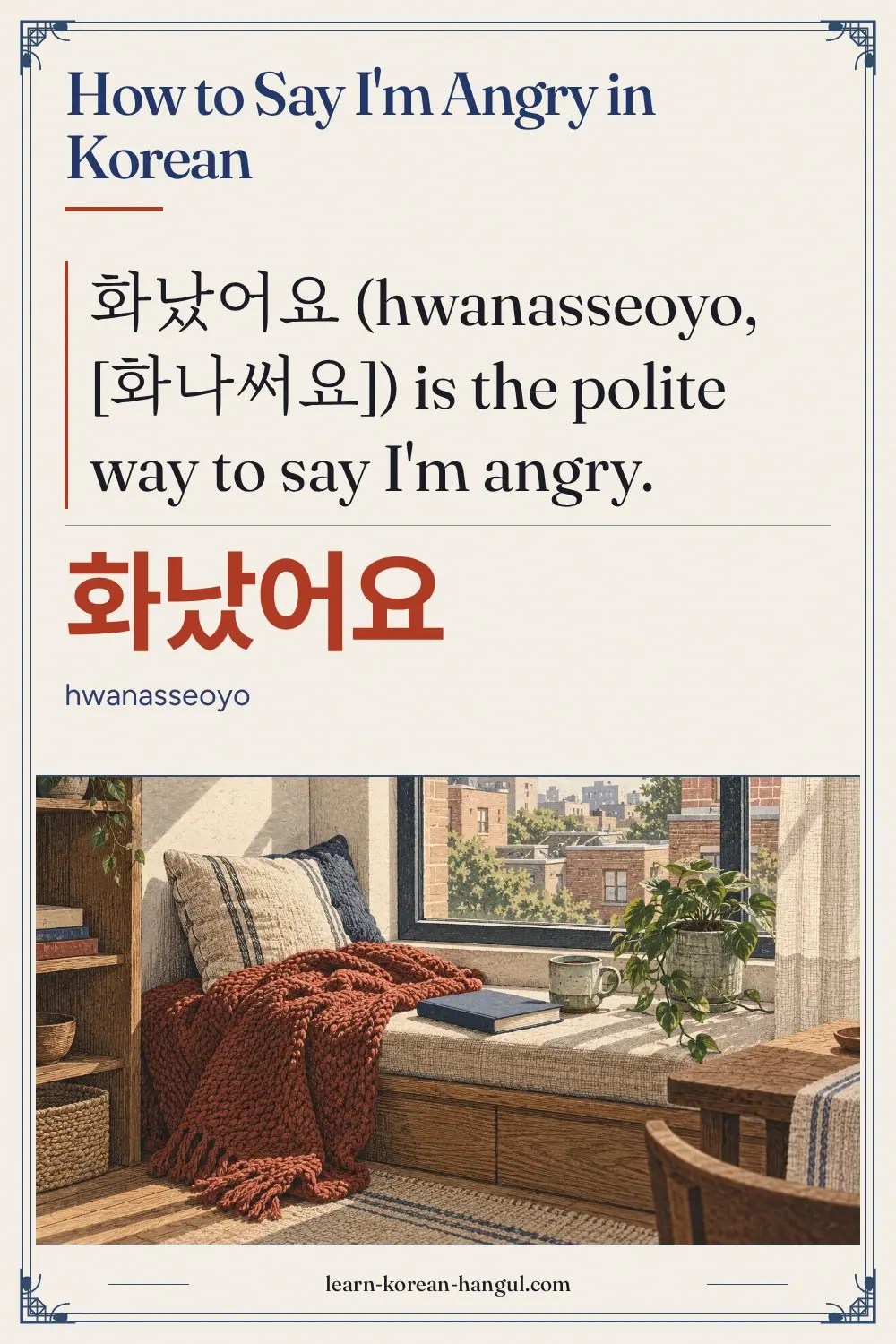
화났어요
화났어요
What you'll learn
- Say I'm angry with 화났어요 and 화났어, and I'm annoyed with 짜증 나요.
- Tell 화나다 (to feel angry) apart from 화내다 (to show anger at someone).
- Understand why a past form describes a feeling you have now.
- Pronounce 화났어요 as [화나써요].
Before you start: you only need to read Hangul. When the mood changes, learn I'm sad in Korean. Time: about 10 minutes. Audio plays only when you press a button.
How Do You Say I'm Angry in Korean?
The standard way to say I'm angry in Korean is 화났어요. The noun 화 is the everyday word for anger, and 분노 (bunno) is a formal noun for rage that you meet in news and writing. Korean usually drops "I", so 화났어요 alone is a full sentence.
| Situation | Best form | Romanization | Why |
|---|---|---|---|
| Telling a colleague or a stranger | 화났어요 | hwanasseoyo | Polite, natural |
| Telling a close friend | 화났어 | hwanasseo | Casual |
| A formal statement or a complaint letter | 화가 났습니다 | hwaga natseumnida | Formal |
| Annoyed, fed up | 짜증 나요 | jjajeung nayo | Milder than angry |
| Furious, very casual | 열받아요 | yeolbadayo | Slang |
The next section sorts these by listener.
What Are the Formal, Polite and Casual Ways to Say I'm Angry?
The forms follow the Korean speech levels, explained in the guide to Korean speech levels. Here the words stay close and the ending changes.
Polite: 화났어요 (hwanasseoyo)
Polite · 해요체화났어요 is the form to learn first. It suits coworkers, neighbours and people you do not know well. You can also say 화가 났어요 (hwaga nasseoyo), with the subject marker 가, which sounds a little fuller.
동생이 제 물건을 마음대로 써서 화났어요.
dongsaengi je mulgeoneul maeumdaero sseoseo hwanasseoyo
My younger sibling used my things without asking, so I'm angry.
Casual: 화났어 (hwanasseo)
Casual · 반말화났어 drops the polite ending. Use it with close friends, siblings and people younger than you. It can sound sharp, so use it only with people who know you well.
나 진짜 화났어. 말 걸지 마.
na jinjja hwanasseo. mal geolji ma
I'm really angry. Don't talk to me.
Formal: 화가 났습니다 (hwaga natseumnida)
Formal · 합쇼체화가 났습니다 is the formal form. It appears in complaints, statements and written replies. In daily life you will not need it often. It is pronounced [화가 낟씀니다].
Milder: 짜증 나요 (jjajeung nayo)
Polite · 해요체짜증 나요 means "I'm annoyed" or "I'm fed up". Use it when the feeling is irritation, not real anger. The dictionary spells 짜증 나다 with a space, although you will often see 짜증나다 written together online.
계속 기다리게 해서 짜증 나요.
gyesok gidarige haeseo jjajeung nayo
I'm annoyed that you keep making me wait.
The past ending in 화났어요 puzzles many learners, so here is the logic.
Why Is 화났어요 in the past Tense?
화나다 is made of 화 (anger) and 나다 (to come out, to arise). Literally, anger has come out. The past ending -았/었- here marks a change that has already happened and still holds, so 화났어요 means "I have become angry, and I still am". Korean does this with several words that describe a state after a change.
- 화가 나요 / 화났어요 (anger arose: I'm angry)
- 열이 나요 (a fever came out: I have a fever)
- 땀이 나요 (sweat came out: I'm sweating)
- 눈물이 나요 (tears came out: I'm tearing up)
Both 화나요 and 화났어요 are possible. 화났어요 is the more common way to say you are angry now, and 화나요 often describes a habit or a general reaction, as in 이런 일에는 화나요 (this kind of thing makes me angry). The same logic gives 짜증 났어요 (jjajeung nasseoyo) for being annoyed now. Next, the sounds.
How Do You Pronounce 화났어요?
화났어요 is pronounced [화나써요], hwa-na-sseo-yo, in four syllables. It sounds like it is written, with one connection: the final ㅆ of 났 moves onto the next syllable, so 어 is heard as 써.
- 화 (hwa): "hwah", with a light h.
- 나 (na): "nah".
- 써 (sseo): a tense s and "uh", with the lips relaxed.
- 요 (yo): "yo".
Revised Romanization writes hwanasseoyo with ss, because ㅆ is a written letter. In 짜증, the ㅉ is tense and the vowel ㅡ is unrounded: spread your lips and do not round them as for "oo".
Sound Changes to Listen For
These notes follow the National Institute of Korean Language standard pronunciation rules (표준 발음법):
- Liaison of the final ㅆ. 화났어요 is [화나써요] (Article 13). See Korean liaison.
- A final ㅆ before ㅅ. In 화가 났습니다, the ㅆ is pronounced as the stop ㄷ, and the ㅅ after it is tense, giving [화가 낟씀니다] (Articles 9 and 23). RR writes natseumnida.
- No change in 짜증 나요. The ㅇ in 증 and the ㄴ in 나 stay separate.
With the sound clear, here is when each form fits.
When Should You Use 화났어요, and When Should You Not?
Use 화났어요 when you want to be clear about your feeling and the listener is someone you can be direct with. With seniors, think twice.
Situations Where It Fits
- Telling a friend what happened. 오늘 너무 화났어요. 얘기 좀 들어 줄래요? (I'm so angry today. Will you listen to me?)
- Explaining a bad experience politely. 약속을 안 지켜서 화났어요. (I'm angry because they didn't keep the promise.)
- Complaining in service. 좀 화가 나요 with a calm tone.
Situations to Avoid
- Showing anger to elders or a boss. Saying 화났어요 to a senior is seen as rude. Soften it with 기분이 좀 안 좋아요 (I'm not feeling very good).
- Public arguments. Raising your voice can mean losing 체면 (face), so Koreans often wait and speak later.
- Using 열받아요 in polite settings. It is slang. Keep it for close friends.
Two short conversations show how it sounds.
What Does I'm Angry Sound Like in a Real Conversation?
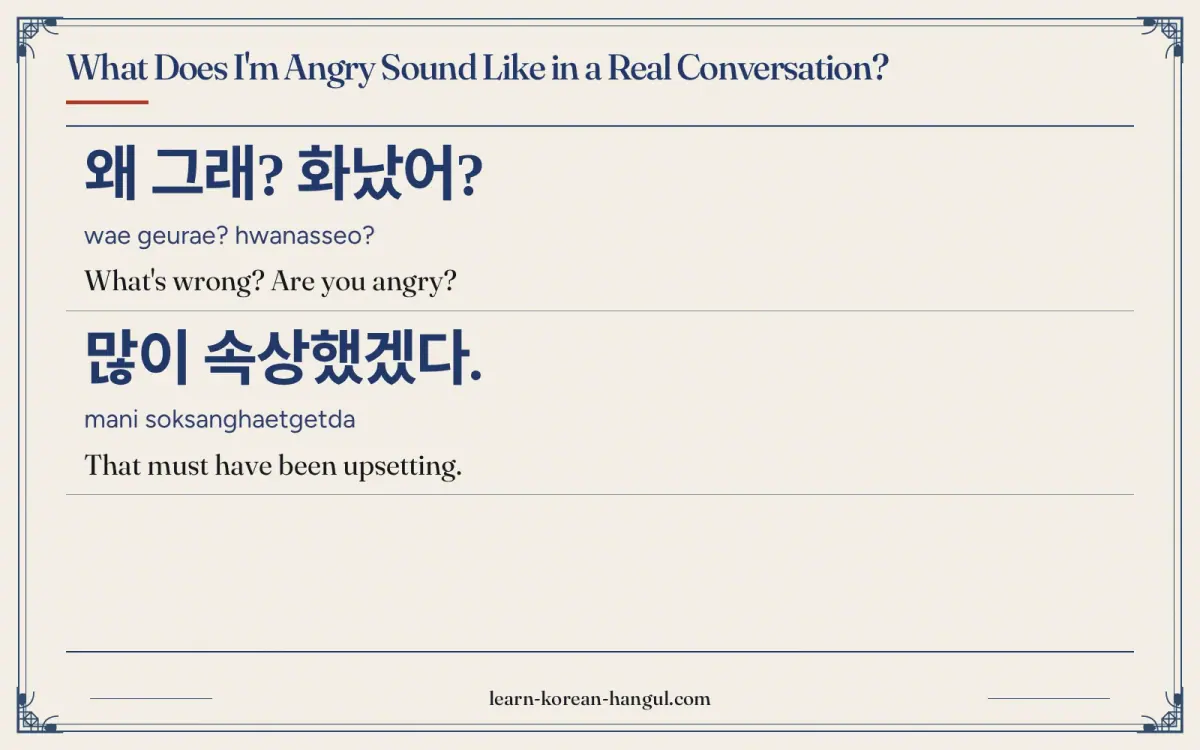
In real life, the line is followed by a reason and a little comfort. Notice the answers.
A Bad Afternoon
Dahye
왜 그래? 화났어?
wae geurae? hwanasseo?
What's wrong? Are you angry?
Junho
응, 아까 친구가 약속을 또 어겼어.
eung, akka chinguga yaksogeul tto eogyeosseo
Yes, a friend broke a promise again earlier.
Dahye
많이 속상했겠다.
mani soksanghaetgetda
That must have been upsetting.
What to notice: 화났어? is a question, so it rises at the end, and the friend answers with the reason. The comfort line 속상했겠다 guesses how he felt.
A Late Order
Customer
죄송한데, 주문한 지 한 시간이 지났어요. 좀 화가 나요.
joesonghande, jumunhan ji han sigani jinasseoyo. jom hwaga nayo
Sorry, but it has been an hour since I ordered. I'm a bit angry.
Staff
정말 죄송합니다. 바로 확인해 드리겠습니다.
jeongmal joesonghamnida. baro hwaginhae deurigetseumnida
I'm very sorry. I'll check right away.
What to notice: the customer opens with 죄송한데 and adds 좀, which keeps a complaint polite. The staff member uses the humble 드리겠습니다 and the formal ending.
What Should You Know about the Culture behind I'm Angry?
Showing open anger to elders, bosses or customers is generally seen as rude in Korea. Many people choose softer words that point to the feeling without blaming anyone. 속상해요 (soksanghaeyo) means "I'm upset or heartbroken", and 서운해요 (seounhaeyo) means "I feel let down or a little hurt", often said to a close person who forgot something. These are gentler than 화났어요.
- Soften for seniors. 조금 속상했어요 (I was a bit upset) invites talk instead of a fight.
- Wait and talk later. 나중에 얘기해요 (let's talk later) is a common pause line.
- Friends are different. 짜증 나 and 열받아 are everyday venting words among friends.
Knowing these shades helps you pick a word that fits the relationship, not only the feeling. The next section covers the mistakes learners make.
What Mistakes Do Learners Make with I'm Angry in Korean?
Most mistakes come from mixing 화나다 with 화내다 and from the register.
| Mistake | Why it is a problem | Fix |
|---|---|---|
| 화냈어요 for "I'm angry" | 화내다 means to show anger at someone | Say 화났어요 |
| 저는 화나요 about a specific event | Reads as a general habit | Say 화났어요 |
| [화낫서요] for the sound | The ㅆ moves to the next syllable | Say [화나써요] |
| 화났어 to an elder | Too casual and sharp | Say 기분이 좀 안 좋아요 |
| 화나세요 about yourself | The honorific is for others | Say 화났어요 |
The pair 화나다 and 화내다 matters most. 화나다 is the inner feeling, so no one needs to be present. 화내다 is an action aimed at a person, as in 저한테 화내지 마세요 (don't get angry at me) and 친구에게 화냈어요 (I lashed out at my friend). Use 화내다 only when the anger is shown.
How Do You Ask Someone If They Are Angry?
Let your pitch rise at the end, because this is a yes/no question. To a friend, say 화났어? (hwanasseo?). To a colleague, say 화났어요? (hwanasseoyo?). To an elder, the honorific 화나셨어요? (hwanasyeosseoyo?) is more polite, since it adds -(으)시- for the listener, but asking an elder this way can still feel direct. A softer version is 기분이 안 좋으세요? (gibuni an joeuseyo?), which means "are you in a bad mood?".
| Listener | Question | Romanization |
|---|---|---|
| Close friend | 화났어? | hwanasseo |
| Colleague | 화났어요? | hwanasseoyo |
| Elder or customer | 기분이 안 좋으세요? | gibuni an joeuseyo |
A kind follow-up is 무슨 일 있어요? (museun il isseoyo?), which means "is something wrong?". The answer can be 아무것도 아니에요 (it's nothing) if the person is not ready to talk.
Is It the Same as I Am Angry, I'm Mad or Angry?
Almost. The short answers below cover the other searches folded into this page.
- I am angry in Korean: 화났어요 or the formal 화가 났습니다.
- I'm mad in Korean: 화났어요 or, among friends, 열받아.
- Im mad in Korean: the same sentence; the apostrophe makes no difference in English.
- Angry in Korean: 화난 (hwanan) before a noun, as in 화난 얼굴 (an angry face).
- Annoyed in Korean: 짜증 나요.
Now practise aloud.
Practice: Say It Aloud
Play the slow clip of 화났어요 three times and connect the ㅆ to the next sound. Then choose a phrase. Answers follow.
- You tell a close friend you are really angry.
- You tell a coworker politely.
- You are only annoyed because of a long wait.
- You write a formal complaint.
Answers
- 나 진짜 화났어.
- 화났어요.
- 짜증 나요.
- 화가 났습니다.
The phrase flashcards drill these lines with audio.
Related Phrases to Learn Next
Anger often leads to sadness or an apology.
- I'm sad in Korean: 슬퍼요 for sadness.
- I hate you in Korean: 네가 싫어 for strong dislike.
- Shut up in Korean: a rude phrase to recognise, not to use.
This guide belongs to the Korean feelings phrases collection. What this page does not cover: swear words, long arguments and how to apologise. Remember that 화났어요 describes a state you have now, choose 짜증 나요 for mild annoyance, and soften things for seniors, and you can say i'm angry in Korean naturally.
Frequently Asked Questions
How do you say I'm angry in Korean?
Say 화났어요 (hwanasseoyo) in polite speech, 화났어 (hwanasseo) to a close friend and 화가 났습니다 (hwaga natseumnida) in formal speech. The verb 화나다 combines 화 (anger) and 나다 (to arise). The past ending describes a feeling you have now, so 화났어요 means "I am angry", not "I was angry".
How do I say I'm mad or annoyed in Korean?
For mild irritation, say 짜증 나요 (jjajeung nayo). For stronger, slangy anger among friends, say 열받아요 (yeolbadayo) or 열받아 in casual speech. 화났어요 is the neutral choice and works in most polite settings. Avoid slang with elders, bosses and customers.
What is the difference between 화나다 and 화내다?
화나다 is the feeling of anger inside you, and no one else has to be there. 화내다 is the action of showing anger at someone, such as shouting or snapping. So you say 화났어요 for "I'm angry" and 저한테 화내지 마세요 for "don't be angry at me". Learners often use 화냈어요 when they only mean they feel angry.
Why is 화났어요 in the past tense when I'm angry now?
The ending -았/었- marks a change that has happened and still holds. 화 (anger) has arisen, so you are angry now. Korean uses the same idea for 열이 나요 (I have a fever) and 땀이 나요 (I'm sweating). 화나요 also exists, but it often describes a general reaction, while 화났어요 describes the present moment.
How do you pronounce 화났어요?
It is pronounced [화나써요]. The final ㅆ of 났 moves onto the next syllable, so 어 is heard as 써 (Article 13, liaison). Revised Romanization writes hwanasseoyo. Do not stop at the ㅆ; connect it smoothly to the vowel after it.
Is it rude to say I'm angry in Korean?
It can be, with seniors. Saying 화났어요 to a boss, elder or customer sounds blunt. Use softer words such as 속상해요 (I'm upset), 서운해요 (I feel let down) or 기분이 좀 안 좋아요 (I'm not feeling great). With friends and family, 화났어 is fine and clear.