한국어로 어떻게 말해요?
한국어로 어떻게 말해요?
What you'll learn
- Say 한국어로 어떻게 말해요? aloud as [한구거로 어떠케 말해요].
- Choose between 말해요, 뭐예요, 읽어요 and 써요 for saying, naming, reading and writing.
- Swap the language word: 영어로 (in English), 일본어로 (in Japanese).
- Avoid the common confusion with 뭐라고 (what did you say).
Before you start: knowing Korean speech levels helps, because every question here uses the polite -요 ending. Time: about 11 minutes.
How Do You Say How Do You Say in Korean?
The standard way to ask how do you say in Korean is 한국어로 어떻게 말해요? (hangugeoro eotteoke malhaeyo). The parts are 한국어로 (in Korean), 어떻게 (how) and 말해요 (do you say). Korean usually drops "it" and "you" and understands them from context.
| Form | Romanization | Meaning | Use it when |
|---|---|---|---|
| 한국어로 어떻게 말해요? | hangugeoro eotteoke malhaeyo | how do you say it in Korean? | You want a phrase or sentence |
| 이거 한국어로 뭐예요? | igeo hangugeoro mwoyeyo | what's this in Korean? | You point at an object |
| 어떻게 읽어요? | eotteoke ilgeoyo | how do you read it? | You see written Korean |
| 어떻게 써요? | eotteoke sseoyo | how do you write it? | You want to see the spelling |
All four forms are polite, in the 해요체 style. Casual versions exist, but a polite question is always safe when you ask a stranger for help. The sections below take each form in turn.
What Are the Polite Ways to Ask How Do You Say?
Each question below ends in the polite -요 ending, the everyday style described in the guide to Korean speech levels. The four questions differ in the verb and in how much context they need, so the best one depends on what you are holding or hearing.
Polite: 한국어로 어떻게 말해요? (hangugeoro eotteoke malhaeyo)
Polite · 해요체한국어로 어떻게 말해요? is the general question. Say the English phrase first or point to it on your phone, then ask. It works for words, sentences and whole ideas. To ask about another language, change the first word: 영어로 어떻게 말해요? means "how do you say it in English?"
이 문장을 한국어로 어떻게 말해요?
i munjangeul hangugeoro eotteoke malhaeyo
How do you say this sentence in Korean?
Polite: 이거 한국어로 뭐예요? (igeo hangugeoro mwoyeyo)
Polite · 해요체이거 한국어로 뭐예요? is the question for objects. 이거 means "this thing", so the sentence needs no gesture words, and 뭐예요 means "what is it". Use 저거 (jeogeo, that over there) when the object is far from both of you, and 그거 (geugeo) for something near the listener.
저기요, 이거 한국어로 뭐예요?
jeogiyo, igeo hangugeoro mwoyeyo
Excuse me, what's this in Korean?
Polite: 어떻게 읽어요? (eotteoke ilgeoyo)
Polite · 해요체어떻게 읽어요? asks how to pronounce a written word. Point at the letters and ask. The verb 읽다 (ikda, to read) has a cluster ㄺ at its end, so 읽어요 is said [일거요]. A longer version names the thing: 이 글자는 어떻게 읽어요? means "how do you read this letter?"
이 글자는 어떻게 읽어요?
i geuljaneun eotteoke ilgeoyo
How do you read this letter?
Polite: 어떻게 써요? (eotteoke sseoyo)
Polite · 해요체어떻게 써요? asks how to write or spell a word. The verb 쓰다 (sseuda, to write) becomes 써요 in the polite style. Ask it when you hear a new word and want to see it in Hangul. For a more exact request, say 한글로 어떻게 써요? (hangeullo eotteoke sseoyo, how do you write it in Hangul?).
선생님, 이 단어는 어떻게 써요?
seonsaengnim, i daneoneun eotteoke sseoyo
Teacher, how do you write this word?
Four questions cover saying, naming, reading and writing. A fifth, more natural form completes the set.
Everyday Alternative: 한국어로 뭐라고 해요? (hangugeoro mworago haeyo)
Polite · 해요체한국어로 뭐라고 해요? literally asks "what do you call it in Korean?" and sounds very natural. Koreans use 뭐라고 해요 for names of things and 어떻게 말해요 for wording a thought. The two are almost interchangeable for learners.
Choosing the question is simple once you know what you are holding. Sounding clear depends on pronunciation, which comes next.
How Do You Pronounce 한국어로 어떻게 말해요?
한국어로 어떻게 말해요? is pronounced han-gu-geo-ro eo-tteo-ke mal-hae-yo, in ten syllables. Two sound changes apply, and a third happens in fast speech.
- 한국어로 (han-gu-geo-ro): the final ㄱ of 국 moves onto 어, giving "han-gu-geo-ro".
- 어떻게 (eo-tteo-ke): the ㅎ and ㄱ merge into an aspirated k.
- 말해요 (mal-hae-yo): the standard form keeps a light h, but in fast speech the ㅎ after ㄹ often fades, so it can sound like "ma-rae-yo".
Sound Changes to Listen For
These details follow the National Institute of Korean Language (국립국어원) Standard Pronunciation rules (표준 발음법):
- Liaison in 한국어로. The ㄱ of 국 joins the vowel of 어, so the word is [한구거로]. See Korean liaison.
- ㅎ + ㄱ becomes ㅋ. In 어떻게, the ㅎ merges with the following ㄱ, giving [어떠케]. See Korean aspiration.
- Weak ㅎ after ㄹ. The standard pronunciation of 말해요 is [말해요], but in everyday fast speech the ㅎ often fades and it sounds close to [마래요]. Both are understood.
- ㄺ before a vowel. In 읽어요, the ㄹ stays and the ㄱ moves, giving [일거요].
Combined, the whole question is [한구거로 어떠케 말해요], often heard as [한구거로 어떠케 마래요] in fast speech.
Even a perfect pronunciation does not help if you pick the wrong question for the situation, so the next section covers where each one fits.
When Should You Use 한국어로 어떻게 말해요?, and When Should You Not?
Use 한국어로 어떻게 말해요? when you need Korean wording, and use the other questions when you point at an object or at written text. Sentence questions suit teachers and language partners most.
Situations Where It Fits
- A language class. 선생님, 이 문장을 한국어로 어떻게 말해요?
- A café or street stall. 이거 한국어로 뭐예요? while you point.
- A menu or sign. 이건 어떻게 읽어요? with a finger on the line.
- A language exchange. 영어로 어떻게 말해요? when helping a Korean friend.
Situations to Avoid
- A noisy place. Long questions get lost; point and say 이거 뭐예요?
- A quick order. Staff are busy; ask later, or use the shortest form.
- A formal setting. For a speech or interview, use 한국어로 어떻게 말합니까? (the formal ending).
- A rude tone. Missing 저기요 or 죄송한데요 first can sound abrupt.
The short conversations below show how these questions sound in context.
What Does How Do You Say Sound Like in a Real Conversation?
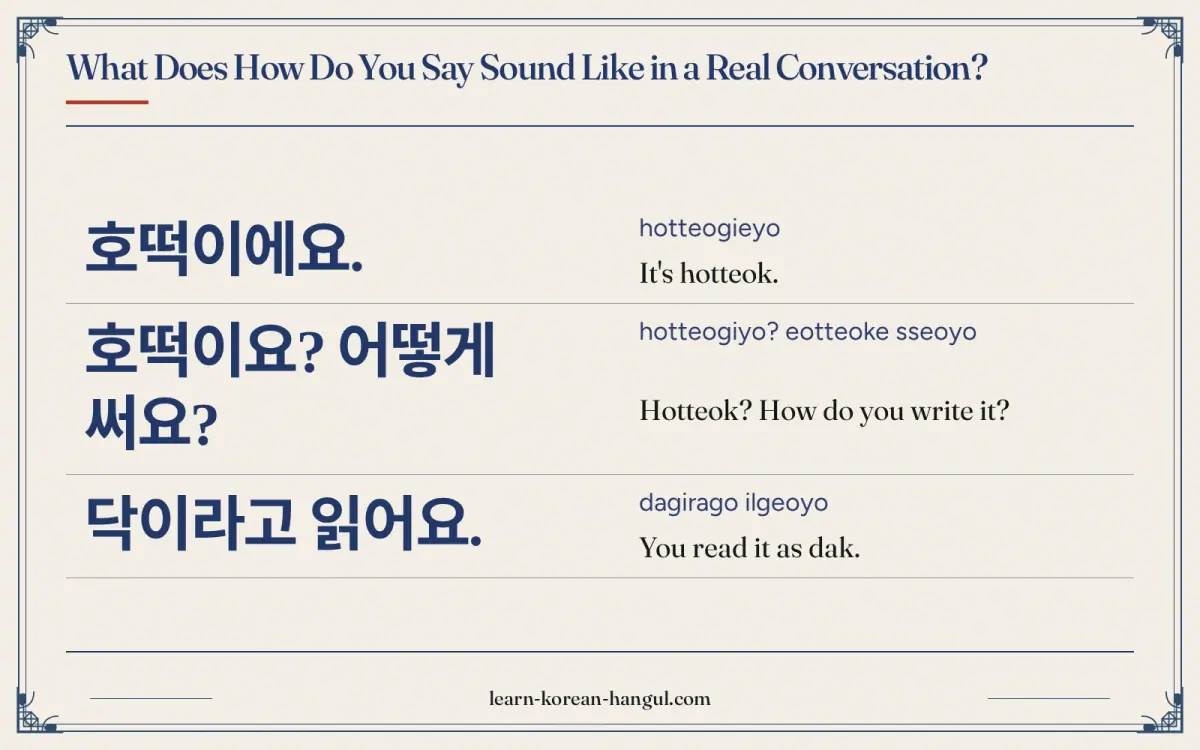
Real conversations about words are short: the question, the answer, and a follow-up. Notice how the learner adds a second question to check the spelling.
At a Street Food Stall
Learner
저기요, 이거 한국어로 뭐예요?
jeogiyo, igeo hangugeoro mwoyeyo
Excuse me, what's this in Korean?
Vendor
호떡이에요.
hotteogieyo
It's hotteok.
Learner
호떡이요? 어떻게 써요?
hotteogiyo? eotteoke sseoyo
Hotteok? How do you write it?
What to notice: the learner repeats the word with 이요 to confirm it, then asks for the spelling.
In Class
Student
선생님, 이 글자는 어떻게 읽어요?
seonsaengnim, i geuljaneun eotteoke ilgeoyo
Teacher, how do you read this letter?
Teacher
닥이라고 읽어요.
dagirago ilgeoyo
You read it as dak.
Student
아, 감사합니다.
a, gamsahamnida
Oh, thank you.
What to notice: the teacher answers with -(이)라고 읽어요, "you read it as", and the student closes with 감사합니다. A small grammar point sits behind these sentences, as the next section shows.
What Should You Know about 로 and the Language Word?
The ending 로 turns a language name into "in that language": 한국어 + 로 = 한국어로 (in Korean). Korean uses 로 here as a particle that marks the means or method, the same particle that appears in "by bus" and "with a pen".
| Language | Korean | "in this language" |
|---|---|---|
| Korean | 한국어 | 한국어로 |
| English | 영어 | 영어로 |
| Japanese | 일본어 | 일본어로 |
| Chinese | 중국어 | 중국어로 |
| Spanish | 스페인어 | 스페인어로 |
The pattern works with any word: 물은 영어로 뭐예요? asks "what is 물 in English?"
After a vowel or ㄹ, the particle is 로, as in 영어로 and 한글로. After any other consonant it is 으로, as in 책으로 (with a book). For a deeper look at the system, see Korean particles.
An expert insight: learners often say 한국어 어떻게 말해요 without 로, which is understandable but incomplete. The 로 is the part that says "in Korean". The common mistakes below follow from the same gap.
What Mistakes Do Learners Make with How Do You Say in Korean?
Most mistakes come from missing particles, wrong question words, or confusing "say" with "say again".
| Mistake | Why it is a problem | Fix |
|---|---|---|
| Saying 뭐라고? alone | It means "What did you say?" | Say 한국어로 뭐라고 해요? |
| Dropping 로 | Sounds incomplete | Say 한국어로 |
| Using 말해요 for reading | 말해요 means say, not read | Say 읽어요 |
| Using 뭐예요 for sentences | 뭐예요 asks for a thing's name | Say 어떻게 말해요 |
| Asking in English only | The listener may not follow | Add 한국어로 |
| Saying 어떻게 with a clear h and g | ㅎ + ㄱ merge | Say [어떠케] |
Learners often assume 뭐라고 means "how do you say". Actually, 뭐라고 alone is a reaction meaning "what did you say?", so you need 해요 after it, and 한국어로 뭐라고 해요? is the full question. The next section collects the other ways people search.
Is "How Do You Say" the Same as "How to Say"?
The question on this page is the spoken form, and "how to say in Korean" is the broader topic. The short answers below cover the other searches.
- How to say in Korean: use 한국어로 어떻게 말해요? to ask, and see the hub how to say in Korean for the answers by topic.
- How do you read in Korean: 어떻게 읽어요?
- How do you write in Korean: 어떻게 써요? or 한글로 어떻게 써요?
- How do you say this in Korean: 이거 한국어로 뭐예요?
- What does it mean in Korean: a different question, covered in what does it mean in Korean.
Now practise.
Practice: Say It Aloud
Play the slow clip of 한국어로 어떻게 말해요? and repeat it three times, then try 이거 한국어로 뭐예요? Next choose the question for each case. Answers follow.
- You point at a fruit and want its Korean name.
- You see Hangul on a sign and want its sound.
- You hear a word and want to see it written.
- You want to know how a sentence is said in English.
Answers
- 이거 한국어로 뭐예요?
- 이건 어떻게 읽어요?
- 어떻게 써요?
- 영어로 어떻게 말해요?
The phrase flashcards drill these questions with audio.
Related Phrases to Learn Next
Asking how to say things leads straight into questions about meaning and objects.
- What does it mean in Korean: 무슨 뜻이에요? for meaning.
- What is this in Korean: 이게 뭐예요? for identifying things.
- I have a question in Korean: 질문 있어요 to start asking.
This guide belongs to the how to say in Korean collection. What this page does not cover: translation tools, long sentences and grammar explanations. Choose 한국어로 어떻게 말해요? for wording and 이거 한국어로 뭐예요? for objects, and you can ask how do you say in Korean anywhere.
Frequently Asked Questions
How do you ask what a word means in Korean?
Ask 이게 무슨 뜻이에요? (ige museun tteusieyo, what does this mean?) when you want the meaning. The question on this page, 한국어로 어떻게 말해요?, asks for the Korean word itself. If someone says a word you do not know, say 무슨 뜻이에요? (what does that mean?), which is short and polite.
Can I use 한국말 instead of 한국어?
Yes. 한국말 (hangungmal) is the everyday spoken word for the Korean language, and 한국어 (hangugeo) is the neutral textbook word. Both work after 로: 한국말로 어떻게 말해요? sounds slightly more conversational. For asking about writing the letters, use 한글로 (hangeullo, in Hangul), as in 한글로 어떻게 써요?
How do you put a specific word into the question?
Put the word first, add the topic particle, then the question. For a Korean word: 감사합니다는 영어로 어떻게 말해요? (how do you say 감사합니다 in English?). For an English word, say the English word first and then ask 한국어로 뭐예요?, and a Korean listener will understand it from the context.
What is the difference between 말해요 and 이야기해요?
말해요 (malhaeyo) means "say" or "speak" and fits the question about wording. 이야기해요 (iyagihaeyo) means "talk" or "tell a story" and fits conversations. For translation questions, use 말해요 or 뭐예요. If you want to say "talk to me", use 이야기해요 instead.
Is it rude to ask a Korean stranger how to say something?
No. Most Koreans enjoy helping learners, especially with a polite opening such as 저기요 (jeogiyo, excuse me) or 죄송한데요 (joesonghandeyo, sorry to trouble you). Keep the question short, point at the object, and say 감사합니다 after the answer. In a busy shop, pick a quiet moment first.