무슨 뜻이에요?
무슨 뜻이에요?
What you'll learn
- Say 무슨 뜻이에요? aloud as [무슨 뜨시에요], with the linking ㅅ and a tight tense ㄸ.
- Choose between 무슨 뜻이에요?, 이게 무슨 뜻이에요?, 영어로 뭐예요? and 한국어로 뭐예요?.
- Tell 뜻 (meaning) apart from 말 (words), as in 무슨 말이에요? (what do you mean?).
- Understand the short answers a teacher or friend will give.
Before you start: you need to read Hangul; romanization is shown as an aid and can be hidden. Time: about 9 minutes. Audio plays only when you press a button.
How Do You Say What Does It Mean in Korean?
The standard question is 무슨 뜻이에요?. It joins 무슨 (what kind of), 뜻 (meaning) and 이에요 (it is). Four polite forms cover meaning questions and word-lookup questions, as the table shows.
| Form | Romanization | Register | Say it to |
|---|---|---|---|
| 무슨 뜻이에요? | museun tteusieyo | Polite (해요체) | Teachers, strangers, colleagues, anyone |
| 이게 무슨 뜻이에요? | ige museun tteusieyo | Polite (해요체) | Anyone, when you point at a sign, a menu or a screen |
| 영어로 뭐예요? | yeongeoro mwoyeyo | Polite (해요체) | Teachers, tutors and language partners |
| 한국어로 뭐예요? | hangugeoro mwoyeyo | Polite (해요체) | Teachers, shop staff and language partners |
The table lists the choices. The next section shows when each one fits.
What Are the Formal, Polite and Casual Ways to Say What Does It Mean?
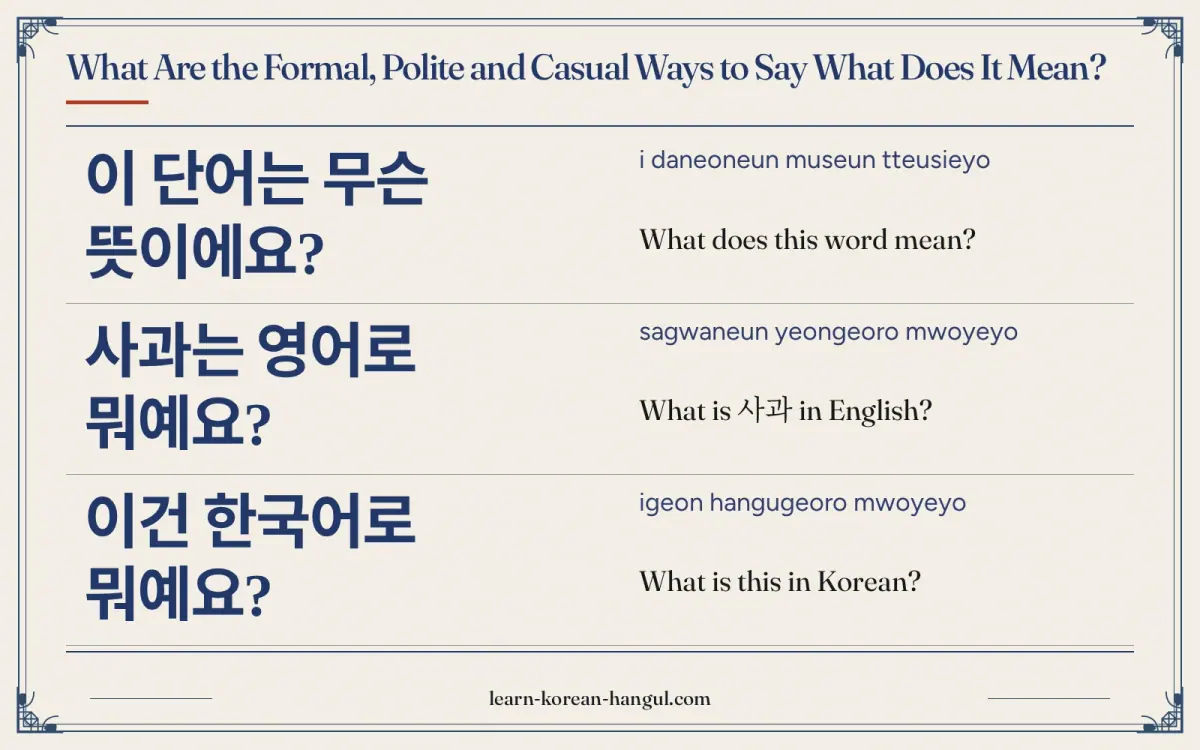
Korean changes the sentence ending to match the listener's age, status and closeness. These endings are called speech levels, and the guide to Korean speech levels explains them in full. With a close friend, drop -요 and say 무슨 뜻이야? (museun tteusiya). In a formal setting, such as a presentation, say 무슨 뜻입니까? (museun tteusimnikka). In class and daily life, the four polite forms below are what you need.
Polite: 무슨 뜻이에요? (museun tteusieyo)
Polite · 해요체무슨 뜻이에요? is the basic question. 뜻 is the native Korean word for meaning, and 이에요 is the polite "to be". Say the word first, then the question, so the listener knows what you mean: 근처가 무슨 뜻이에요? (what does 근처 mean?).
이 단어는 무슨 뜻이에요?
i daneoneun museun tteusieyo
What does this word mean?
Polite: 이게 무슨 뜻이에요? (ige museun tteusieyo)
Polite · 해요체이게 is the everyday short form of 이것이 (this thing). Use it when you point at something you cannot say aloud, such as a sign, a menu line or a message on your phone. The listener sees what you mean without you reading it.
선생님, 이게 무슨 뜻이에요?
seonsaengnim, ige museun tteusieyo
Teacher, what does this mean?
Polite: 영어로 뭐예요? (yeongeoro mwoyeyo)
Polite · 해요체영어로 뭐예요? asks for the English word. 영어 means English, 로 means "in" or "by means of", and 뭐예요 means "what is it". Use it when you hear a Korean word and want its English match.
사과는 영어로 뭐예요?
sagwaneun yeongeoro mwoyeyo
What is 사과 in English?
Polite: 한국어로 뭐예요? (hangugeoro mwoyeyo)
Polite · 해요체한국어로 뭐예요? is the reverse question: you know the thing, and you want the Korean word. It works well when you point at an object, such as a fruit at a market. The answer is usually one word.
이건 한국어로 뭐예요?
igeon hangugeoro mwoyeyo
What is this in Korean?
These four lines cover meaning and translation. Saying the main question cleanly comes next.
How Do You Pronounce 무슨 뜻이에요?
무슨 뜻이에요? is written with six syllables and spoken as [무슨 뜨시에요], museun tteusieyo. The spelling hides a link between 뜻 and 이.
- 무 (mu): "moo"
- 슨 (seun): the vowel ㅡ is unrounded: spread your lips, do not round them
- 뜻 (tteu-): a tense "tteu" with the final ㅅ moving forward
- 이 (-si-): the moved ㅅ lands here as "si"
- 에 (e): "eh"
- 요 (yo): "yoh"; with a question word the end usually falls
Sound Changes to Listen For
Three points matter here, from the National Institute of Korean Language Standard Pronunciation (표준 발음법) and everyday speech.
- Liaison in 뜻이에요. The final ㅅ of 뜻 moves onto the vowel 이, so you hear [뜨시에요]. See liaison (resyllabification).
- A tense ㄸ. The ㄸ is written as a tense consonant. You say it with a tight throat and no puff of air. It is not a sound change, so Revised Romanization writes tt as in the spelling. For the places where a plain consonant becomes tense, see Korean tensification.
- Question pitch. 무슨 is a question word, so the sentence usually ends with a fall or a rise-fall. Hold the first ㄸ tight and keep the rest even.
With the sounds set, the next question is who to ask.
When Should You Use 무슨 뜻이에요?, and When Should You Not?
Ask 무슨 뜻이에요? whenever you meet a word you do not know. It is polite for everyone, and it is the question teachers hear most from new learners.
Situations Where It Fits
- In class. 선생님, 이게 무슨 뜻이에요? is the classic.
- On a sign or menu. Point and ask 이게 무슨 뜻이에요?.
- Watching a drama with a friend. 무슨 뜻이야? is quick and natural.
- With a language partner. 영어로 뭐예요? gives you the match in one answer.
Situations to Avoid
- Leaving out the word. 무슨 뜻이에요? alone leaves the listener confused. Say or point to the word first.
- Using it to mean "what do you mean?" For that, ask 무슨 말이에요?.
- Reaching for 의미 in casual talk. 무슨 의미예요? is correct but a little more formal, and 뜻 is the everyday word.
These choices are easier to feel in real exchanges, so here are three.
What Does What Does It Mean Sound Like in a Real Conversation?
A meaning exchange has two parts: the learner names or points at the word, and the answer is a short Korean explanation.
In Class
Student
선생님, 근처가 무슨 뜻이에요?
seonsaengnim, geuncheoga museun tteusieyo
Teacher, what does 근처 mean?
Teacher
가까운 곳이라는 뜻이에요.
gakkaun gosiraneun tteusieyo
It means a place that is near.
What to notice: the teacher uses 뜻이에요 in the answer, so the same ending carries the question and the reply.
A Drama with a Friend
Hana
대박이 무슨 뜻이에요?
daebagi museun tteusieyo
What does 대박 mean?
Minho
정말 대단하다는 뜻이에요.
jeongmal daedanhadaneun tteusieyo
It means really amazing.
What to notice: the answer gives a short explanation with -다는 뜻이에요 (it means that ...).
At a Market
Customer
이건 한국어로 뭐예요?
igeon hangugeoro mwoyeyo
What is this in Korean?
Seller
사과예요.
sagwayeyo
It is an apple.
What to notice: the question uses 이건 (this one) and points at the fruit.
Behind these lines sits some language culture worth knowing.
What Should You Know about the Culture behind What Does It Mean?
Asking for a meaning is normal in Korea, and most people enjoy explaining their words.
- Short answers. Koreans usually answer with a synonym or an example sentence, not a dictionary definition.
- Slang changes quickly. Words such as 대박 spread fast, so asking a friend is often better than using a dictionary.
- Pointing is fine. Pointing at a menu or sign while asking is polite and normal.
- 뜻 has a second sense. It can also mean a person's will or intention, as in 뜻이 있다 (to have a purpose). Context makes the meaning clear.
An expert tip: 뜻 and 의미 both mean meaning. 뜻 is the native Korean word and is common in speech, and 의미 is the Sino-Korean word that appears more in writing and formal talk. This page covers asking for meanings in daily life. Grammar explanations and dictionary use are not covered here.
What Mistakes Do Learners Make with What Does It Mean in Korean?
Most mistakes come from leaving out the word, mixing 뜻 with 말 and the pronunciation of 뜻이.
| Mistake | Why it is a problem | Fix |
|---|---|---|
| Saying 무슨 뜻이에요? with no word | The listener does not know what you mean | Say or point at the word first |
| Stopping after 뜻, as [뜯 이에요] | The final ㅅ should move onto 이 | Say [뜨시에요] |
| Saying 뜻 with a plain ㄷ | ㄸ is tense, and a plain ㄷ sounds like 듯 | Tighten the throat |
| Asking 무슨 말이에요? for a word meaning | It asks what the speaker means | Use 무슨 뜻이에요? |
| Leaving out 로 in 영어로 뭐예요? | 영어 뭐예요 has no "in" and sounds incomplete | Say 영어로 뭐예요? |
Learners often think a question word needs the same word order as English. Korean puts the thing first and the question last: 근처가 무슨 뜻이에요?, not "what does 근처 mean".
Is It the Same as What Do You Mean?
No. The two questions look alike but ask for different things.
- 무슨 뜻이에요? (museun tteusieyo): asks for the meaning of a word or sign.
- 무슨 말이에요? (museun marieyo): asks "what do you mean?" or "what are you saying?" about something a person said. It is pronounced [무슨 마리에요].
- 무슨 소리예요? (museun soriyeyo): asks "what are you talking about?" and can sound sharp, so use it with care.
- Both with a friend: drop the ending, 무슨 뜻이야? and 무슨 말이야?.
Reading the forms is one thing; producing them on cue is another, so practise now.
Practice: Say It Aloud
Play the slow clip of 무슨 뜻이에요?, repeat it three times, then choose a form for each situation. Answers follow.
- You see a sign you cannot read and point at it.
- You hear 사과 and want the English word.
- You point at a fruit and want the Korean word.
- Why does 뜻이에요 sound like [뜨시에요]?
Answers
- 이게 무슨 뜻이에요?
- 사과는 영어로 뭐예요?
- 이건 한국어로 뭐예요?
- The ㅅ of 뜻 moves onto the vowel 이 (liaison).
The phrase flashcards drill all four lines with audio.
Related Phrases to Learn Next
Meaning questions sit with the other classroom phrases.
- How do you say in Korean: the question for asking how to say a word in Korean.
- I don't understand in Korean: the phrase to use before you ask for the meaning.
- What is this in Korean: the question for naming an object.
This guide belongs to the korean classroom phrases collection. What this page does not cover: grammar explanations and dictionary use. When in doubt, point and ask 이게 무슨 뜻이에요?, and you can ask what does it mean in Korean almost anywhere.
Frequently Asked Questions
How do you say what does it mean in Korean?
Say 무슨 뜻이에요? (museun tteusieyo). Name or point at the word first, or say 이게 무슨 뜻이에요? for "what does this mean?". To ask for the English word, say 영어로 뭐예요?.
How do you pronounce 무슨 뜻이에요?
It is [무슨 뜨시에요]. The ㅅ of 뜻 moves onto 이, and ㄸ is a tense consonant. Revised Romanization writes museun tteusieyo. The ending falls or rises and then falls, because 무슨 is a question word.
What is the difference between 무슨 뜻이에요? and 이게 무슨 뜻이에요?
무슨 뜻이에요? asks about a word you have already named. 이게 무슨 뜻이에요? points at something in front of you, such as a sign or a message. Both are polite.
Can I use 무슨 뜻이에요? with friends, elders and strangers?
Yes with all three, because -요 is polite. With a close friend you can say 무슨 뜻이야?. For a formal presentation, 무슨 뜻입니까? is the matching form.
What is the most common mistake with what does it mean in Korean?
The most common mistake is saying 무슨 뜻이에요? without naming or pointing at the word. The second is mixing it with 무슨 말이에요?, which asks "what do you mean?" about a speaker.