알레르기가 있어요
알레르기가 있어요
What you'll learn
- Say an allergy with 알레르기가 있어요, 있습니다 or 있어, depending on the listener.
- Name the trigger: 땅콩, 새우, 우유, 달걀, 밀 or 생선.
- Ask for an ingredient to be left out with 빼 주세요.
- Ask whether a dish contains something with 들어갔어요?
Before you start: you only need to read Hangul. This page teaches language, not medical advice. If you have a serious reaction, call 119, Korea's emergency number for ambulance and fire, and show your allergy to the staff. Time: about 10 minutes. Audio plays only when you press a button.
Key facts
- 알레르기가 있어요 (allereugiga isseoyo) is the polite way to say I have an allergy, pronounced [알레르기가 이써요].
- Put the trigger in front: 땅콩 알레르기가 있어요 means "I have a peanut allergy".
- 이 음식에 땅콩 들어갔어요? asks whether a dish has peanuts in it.
How Do You Say I Have an Allergy in Korean?
The standard way to say I have an allergy in Korean is 알레르기가 있어요. It is built from 알레르기 (allereugi, allergy), the subject marker 가 (ga) and 있어요 (isseoyo, there is). The literal meaning is "there is an allergy", and the speaker is understood to be you.
| Situation | Best form | Romanization | Why |
|---|---|---|---|
| Telling a waiter or a host | 알레르기가 있어요 | allereugiga isseoyo | Polite, the default |
| Naming the trigger | 땅콩 알레르기가 있어요 | ttanggong allereugiga isseoyo | Clear and specific |
| Telling a close friend | 알레르기가 있어 | allereugiga isseo | Casual |
| A formal form or letter | 알레르기가 있습니다 | allereugiga itseumnida | Formal |
| Saying you had one in the past | 알레르기가 있었어요 | allereugiga isseosseoyo | Past |
These are the core forms. The next section sorts them by level.
What Are the Formal, Polite and Casual Ways to Say I Have an Allergy?
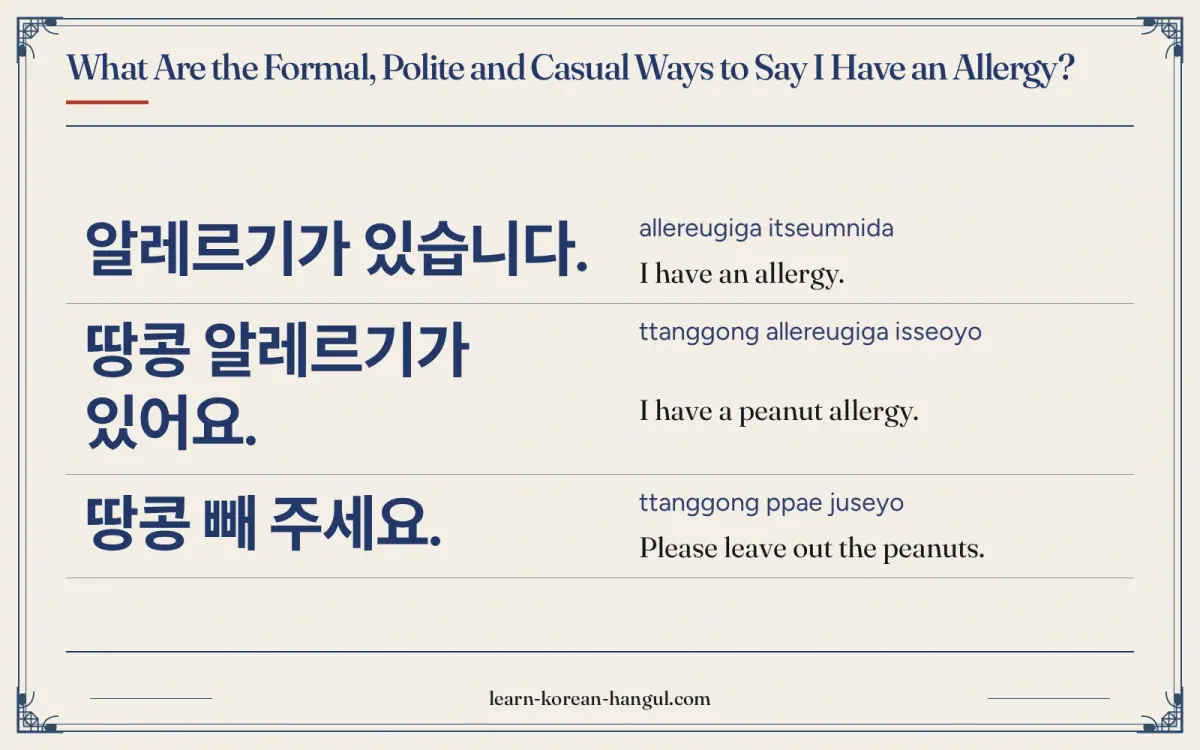
The forms follow the Korean speech levels, explained in the guide to Korean speech levels. Here we move from formal to casual.
Formal: 알레르기가 있습니다 (allereugiga itseumnida)
Formal · 합쇼체알레르기가 있습니다 uses the formal -습니다 ending. It fits a hotel form, a written note for a tour group or a spoken statement to staff. It is pronounced [알레르기가 읻씀니다].
알레르기가 있습니다.
allereugiga itseumnida
I have an allergy.
Polite: 알레르기가 있어요 (allereugiga isseoyo)
Polite · 해요체알레르기가 있어요 is the everyday default. It suits waiters, hosts, teachers and strangers. Name the trigger for the best result.
땅콩 알레르기가 있어요.
ttanggong allereugiga isseoyo
I have a peanut allergy.
Casual: 알레르기가 있어 (allereugiga isseo)
Casual · 반말알레르기가 있어 drops the polite 요. Use it with a friend or a classmate: 나 새우 알레르기가 있어, "I have a shrimp allergy".
Past: 알레르기가 있었어요 (allereugiga isseosseoyo)
Polite · 해요체알레르기가 있었어요 is pronounced [알레르기가 이써써요]. Use it for an allergy you used to have, or to explain a past reaction.
Leaving the Ingredient out: 땅콩 빼 주세요 (ttanggong ppae juseyo)
Polite · 해요체빼다 (ppaeda) means "to take out", and 빼 주세요 means "please take it out for me". It is a request, so it is the natural next sentence after the allergy statement.
땅콩 빼 주세요.
ttanggong ppae juseyo
Please leave out the peanuts.
Asking about the Dish: 들어갔어요? (deureogasseoyo?)
Polite · 해요체들어가다 (deureogada) means "to go in", and Koreans use the past 들어갔어요 to ask whether an ingredient has gone into a dish. It is pronounced [드러가써요]. This is a yes/no question, so it ends with a rise.
이 음식에 땅콩 들어갔어요?
i eumsige ttanggong deureogasseoyo?
Does this dish have peanuts in it?
Trigger Words to Keep Ready
| Trigger | Korean | Romanization |
|---|---|---|
| Peanut | 땅콩 | ttanggong |
| Shrimp | 새우 | saeu |
| Milk | 우유 | uyu |
| Egg | 달걀 | dalgyal |
| Wheat | 밀 | mil |
| Fish | 생선 | saengseon |
Each one fits the same slot: 새우 알레르기가 있어요, 우유 알레르기가 있어요 and so on.
How Do You Pronounce 알레르기가 있어요?
알레르기가 있어요 is pronounced [알레르기가 이써요], al-le-reu-gi-ga i-sseo-yo, in eight syllables. The only change is in 있어요, where the ㅆ moves onto the next syllable.
- 알 (al) and 레 (le): the ㄹ at the end of 알 meets the ㄹ at the start of 레, so you hear one long "l", like in "all lemons".
- 르 (reu): a light tap of ㄹ, then the vowel ㅡ with lips spread flat.
- 기 (gi): a soft "g" and "ee".
- 가 (ga): a soft "g".
- 있어요: [이써요]. The final ㅆ is carried over to 어, so you say i-sseo-yo.
Sounds to Listen For
These notes follow the National Institute of Korean Language standard pronunciation rules (표준 발음법):
- Double ㄹ. 알레르기 has ㄹ twice in a row (알레), pronounced as one long ㄹ.
- A final consonant moves to a vowel. 있어요 is [이써요] (Article 13).
- Formal ending. 있습니다 is [읻씀니다]: ㅆ is said as ㄷ at the end of a syllable (Article 9), the following ㅅ becomes tense ㅆ (Article 23), and ㅂ before ㄴ turns into ㅁ (Article 18). See Korean tensification.
Say the long word in two chunks: 알레르기가, then 있어요. This makes the eight syllables easy to manage.
When Should You Use 알레르기가 있어요, and When Should You Not?
Use 알레르기가 있어요 whenever food or a product could cause a reaction. Say it early, before the order is placed.
Situations Where It Fits
- Ordering in a restaurant. 저는 땅콩 알레르기가 있어요.
- Staying with a host family. 우유 알레르기가 있어요.
- Joining a group meal. 새우 알레르기가 있어서 못 먹어요, "I have a shrimp allergy, so I can't eat it".
Situations to Avoid
- A food you only dislike. Say 안 좋아해요 (an joahaeyo, I don't like it) or 별로예요 (byeolloyeyo, not really). Calling a dislike an allergy can cause extra worry in a kitchen.
- Dietary rules. Vegetarian or religious rules are a different message. See I'm vegetarian in Korean.
- A serious reaction. If you are ill, say 도와주세요 and call 119, instead of practising a sentence.
Two short conversations show how the phrase sounds.
What Does I Have an Allergy Sound Like in a Real Conversation?
In real life, the allergy statement is followed by a question about ingredients. Listen for the rise at the end of each yes/no question.
At a Restaurant
Customer
저는 땅콩 알레르기가 있어요.
jeoneun ttanggong allereugiga isseoyo
I have a peanut allergy.
Staff
아, 그래요? 이 음식에는 땅콩이 안 들어가요.
a, geuraeyo? i eumsigeneun ttanggongi an deureogayo
Oh, really? This dish has no peanuts in it.
Customer
새우도 안 들어가요?
saeudo an deureogayo?
Does it have no shrimp either?
Staff
네, 새우는 안 들어가요.
ne, saeuneun an deureogayo
Right, no shrimp.
What to notice: the staff member answers in the present, 안 들어가요, because the dish is made that way. The customer's 새우도 안 들어가요? is a yes/no question and rises at the end.
Dinner with a Host Family
Host
못 먹는 음식 있어요?
mot meongneun eumsik isseoyo?
Is there any food you can't eat?
Guest
네, 우유 알레르기가 있어요.
ne, uyu allereugiga isseoyo
Yes, I have a milk allergy.
Host
알겠어요. 우유 빼고 만들게요.
algesseoyo. uyu ppaego mandeulgeyo
Got it. I'll make it without milk.
Guest
감사합니다.
gamsahamnida
Thank you.
What to notice: the host says 만들게요 [만들께요] to promise an action. The guest answers with a short thank-you and no extra explanation.
What Should You Know about the Culture behind I Have an Allergy?
Restaurant staff in Korea are generally helpful, but menus do not always list every ingredient, and dishes are often shared. It helps to say your allergy before you order and to point to the dish you mean.
- Hidden ingredients. Kimchi often contains salted shrimp (새우젓, saeujeot) or fish sauce, and many dishes use sesame oil (참기름, chamgireum) or soy sauce (간장, ganjang). Name your trigger rather than assuming a dish is safe.
- Shared side dishes. Small side dishes (반찬, banchan) are placed in the middle of the table, so ask about them too: 이 반찬에 땅콩 들어갔어요?
- Packaged food. Check the label for the allergy notice, and use your phone to look up a word you don't know.
An expert tip: a short card on your phone with 저는 땅콩 알레르기가 있어요. 땅콩 빼 주세요. saves you from saying it again at every table. Show the card, then smile and say 감사합니다.
What Mistakes Do Learners Make with I Have an Allergy in Korean?
Most mistakes come from English grammar: "I am allergic" has no direct Korean copy.
| Mistake | Why it is a problem | Fix |
|---|---|---|
| 알레르기예요 | Means "it is an allergy", like a diagnosis | Say 알레르기가 있어요 |
| 저는 알레르기해요 | 알레르기 is not a verb | Use 있어요 |
| 알레르기가 아파요 | Means the allergy hurts | Use 있어요 |
| Only saying 알레르기 | No trigger named | Add 땅콩, 새우, 우유 |
| 알레르기가 있습니다 to a friend | Stiff and distant | Say 알레르기가 있어 |
Learners often assume 알레르기 has an English-style stress, as in "AL-er-jee". Actually, Korean says every syllable with even weight, so stress each part equally: al-le-reu-gi.
Is It the Same as Allergic, I'm Allergic or Food Allergy?
Mostly. The short answers below cover the other searches folded into this page.
- Allergic in Korean: there is no single word. Say 알레르기가 있어요, or 알레르기 반응이 있어요 (allereugi baneungi isseoyo, "I have an allergic reaction").
- I'm allergic in Korean: 알레르기가 있어요, ideally with the trigger in front.
- Food allergy in Korean: 음식 알레르기 (eumsik allereugi), or name the food, as in 우유 알레르기.
- For the word on its own: see allergy in Korean.
Now say them aloud.
Practice: Say It Aloud
Play the slow clip of 알레르기가 있어요 three times, then say it yourself in two chunks. Choose a phrase. Answers follow.
- You tell a waiter that you have a peanut allergy.
- You ask the waiter to leave out the peanuts.
- You ask whether this dish has shrimp in it.
- You tell a friend that you have a milk allergy.
Answers
- 땅콩 알레르기가 있어요.
- 땅콩 빼 주세요.
- 이 음식에 새우 들어갔어요?
- 나 우유 알레르기가 있어.
The phrase flashcards drill these lines with audio.
Related Phrases to Learn Next
An allergy statement leads to dietary phrases and to help if you are unwell.
- I'm vegetarian in Korean: 저는 채식주의자예요 for another dietary need.
- I need a doctor in Korean: for when you need medical help.
- I have a headache in Korean: 머리가 아파요 for another common problem.
This guide belongs to the Korean restaurant phrases collection. What this page does not cover: medical terms for reactions, treatment and ingredient lists. Remember that Korean says "an allergy exists", name the trigger, pick a level, and you can say i have an allergy in Korean safely and clearly.
Frequently Asked Questions
How do you say I have an allergy in Korean?
Say 알레르기가 있어요 (allereugiga isseoyo) in a polite setting and 알레르기가 있어 (allereugiga isseo) to a close friend. In a formal setting, say 알레르기가 있습니다. Add the trigger in front for a clear message: 새우 알레르기가 있어요, "I have a shrimp allergy". Korean has no separate word for "allergic".
How do you say I am allergic to peanuts in Korean?
Say 땅콩 알레르기가 있어요 (ttanggong allereugiga isseoyo), which means "I have a peanut allergy". Korean makes the trigger a noun in front of 알레르기. Replace 땅콩 with 새우 (shrimp), 우유 (milk), 달걀 (egg), 밀 (wheat) or 생선 (fish). You can add 못 먹어요, "I cannot eat it", to be clear.
How do I ask a restaurant to leave something out?
Say the ingredient and then 빼 주세요 (ppae juseyo), which means "please take it out". For example, 땅콩 빼 주세요 means "please leave out the peanuts". For a serious allergy, say 알레르기가 있어요 first, so the staff knows it is not a taste preference. Then ask 이 음식에 땅콩 들어갔어요?
How do you say food allergy in Korean?
Say 음식 알레르기 (eumsik allereugi), or name the food, as in 우유 알레르기. On packaged food, look for the allergy notice on the label. In speech, people simply say 알레르기가 있어요 and then name the food, so you rarely need a longer term.
Is 알레르기 a Korean word or an English word?
알레르기 (allereugi) is a loanword that Korean took from the German word Allergie. It is written in Hangul and used as an ordinary noun. In casual speech you may also hear 알러지 (alleoji), taken from English, but 알레르기 is the standard word. When you say it, keep the long ㄹㄹ in the middle and end with a clear 기.
What is the most common mistake with I have an allergy in Korean?
Learners say 알레르기예요, which means "it is an allergy" and sounds like a diagnosis, or they say 저는 알레르기해요, which is not a Korean verb. Use 알레르기가 있어요. A second slip is saying only 알레르기 without the trigger, so the staff cannot tell what to leave out.