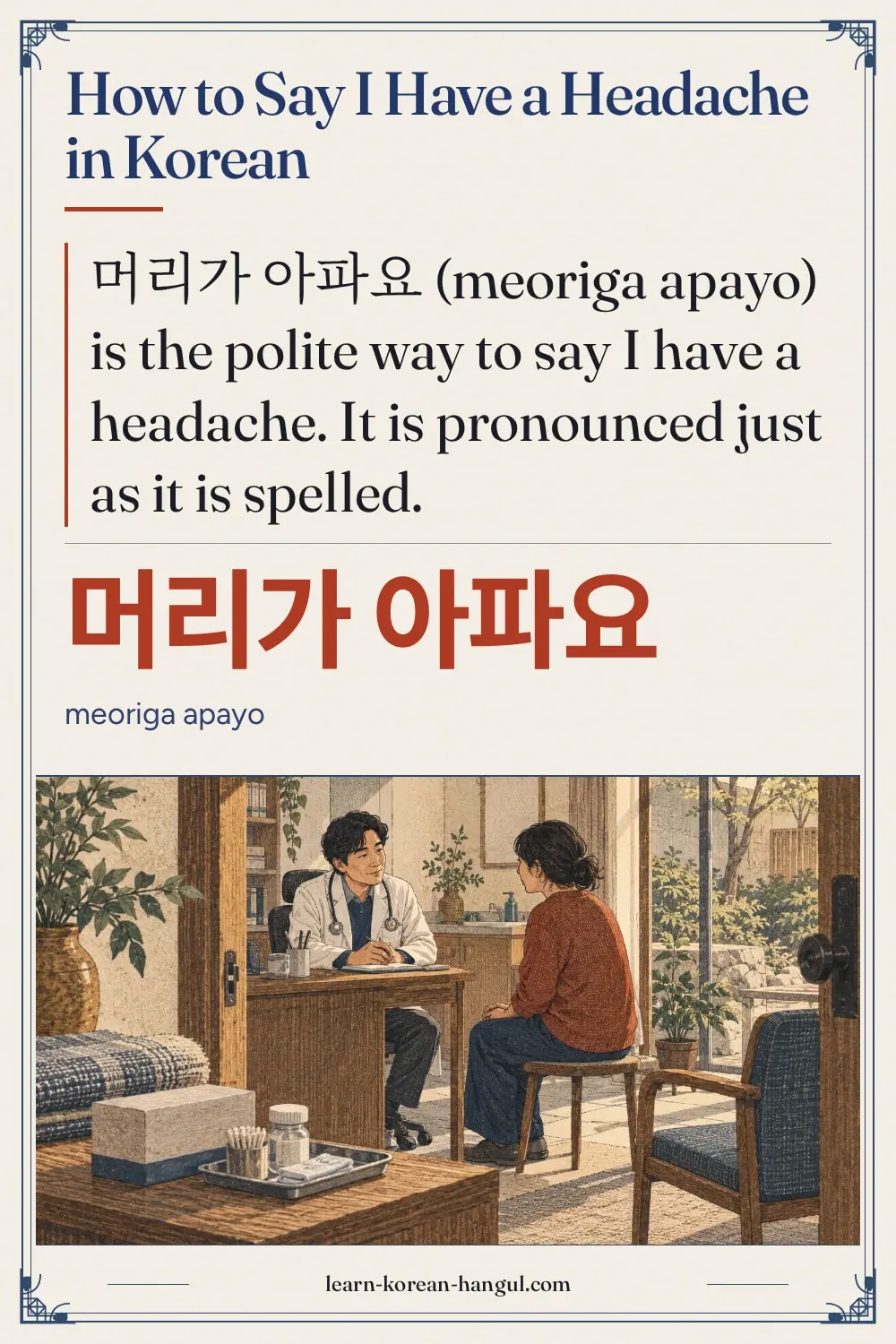
머리가 아파요
머리가 아파요
What you'll learn
- Say a headache with 머리가 아파요, 머리가 아픕니다 or 머리가 아파, depending on the listener.
- Understand why Korean says "my head hurts" and uses 가, not 를.
- Learn the ㅡ-drop that turns 아프다 into 아파요.
- Hear the difference between 아파 (hurts) and 아빠 (dad).
Before you start: you only need to read Hangul. This page teaches language, not medical advice. If pain is sudden or severe, call 119, Korea's emergency number for ambulance and fire. Time: about 10 minutes. Audio plays only when you press a button.
Key facts
- 머리가 아파요 (meoriga apayo) is the polite way to say I have a headache. It has six syllables and no sound change.
- Korean says "my head hurts" with the adjective 아프다 (to hurt) and the subject marker 가.
- 아프다 drops its ㅡ before -아요/-어요, and the ㅏ of 아 picks -아요: 아프 + 아요 becomes 아파요.
- 두통 (dutong) is the Sino-Korean noun for headache, used with 있어요 at a clinic.
How Do You Say I Have a Headache in Korean?
The standard way to say I have a headache in Korean is 머리가 아파요. It is built from three parts: 머리 (meori, head), the subject marker 가 (ga) and 아파요 (apayo, it hurts). Put together, they say "head hurts". Korean often drops "I", so the sentence is complete without it.
| Situation | Best form | Romanization | Why |
|---|---|---|---|
| Telling a pharmacist, a colleague or a host | 머리가 아파요 | meoriga apayo | Polite, the default |
| Telling a close friend or family member | 머리가 아파 | meoriga apa | Casual |
| A formal note or a report to a superior | 머리가 아픕니다 | meoriga apeumnida | Formal |
| Saying it hurt earlier | 머리가 아팠어요 | meoriga apasseoyo | Past |
| Naming the problem at a clinic | 두통이 있어요 | dutongi isseoyo | Medical wording |
The word 머리 can mean "head" or "hair", but with 아파요 it means the head. The next section sorts the forms by level.
What Are the Formal, Polite and Casual Ways to Say I Have a Headache?
The forms follow the Korean speech levels, explained in the guide to Korean speech levels. Here we move from formal to casual.
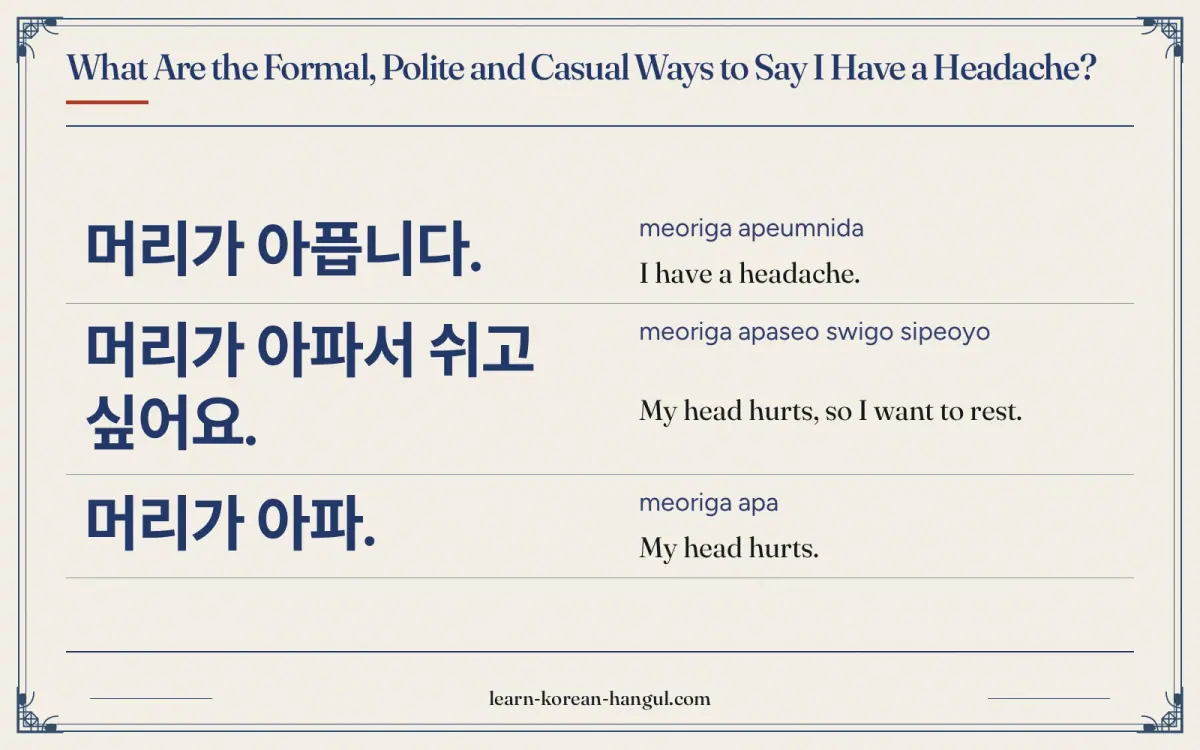
Formal: 머리가 아픕니다 (meoriga apeumnida)
Formal · 합쇼체머리가 아픕니다 uses the formal -ㅂ니다 ending. It fits a message to a boss, a doctor's form or a spoken report. It is pronounced [머리가 아픔니다], because ㅂ before ㄴ turns into ㅁ.
머리가 아픕니다.
meoriga apeumnida
I have a headache.
Polite: 머리가 아파요 (meoriga apayo)
Polite · 해요체머리가 아파요 is the everyday default. It suits a pharmacist, a teacher, a colleague, a host family or a stranger.
머리가 아파서 쉬고 싶어요.
meoriga apaseo swigo sipeoyo
My head hurts, so I want to rest.
Casual: 머리가 아파 (meoriga apa)
Casual · 반말머리가 아파 drops the polite 요. Use it with a friend, a sibling or someone younger. Friends often drop the particle too: 머리 아파.
머리가 아파.
meoriga apa
My head hurts.
Past: 머리가 아팠어요 (meoriga apasseoyo)
Polite · 해요체머리가 아팠어요 is pronounced [머리가 아파써요]. Use it when the pain is over or when you explain what happened: 어제 머리가 아팠어요, "My head hurt yesterday". If it still hurts, stay in the present.
머리가 아팠어요.
meoriga apasseoyo
My head hurt.
Medical Wording: 두통이 있어요 (dutongi isseoyo)
Polite · 해요체두통 is the Sino-Korean word for headache, and 두통이 있어요 means "there is a headache". It is pronounced [두통이 이써요]. It sounds a little more clinical than 머리가 아파요, so it suits a clinic or a form and is less common between friends.
The Grammar behind It: the ㅡ-Drop
아프다 is an adjective whose stem ends in ㅡ. Before the -아요/-어요 ending the ㅡ drops, and the vowel of the syllable before it picks the ending: 아 has ㅏ, so 아프 + 아요 becomes 아파요. The same rule gives 바빠요 (busy) and 예뻐요 (pretty). Once you know this one rule, many common words stop looking irregular. The sentence pattern is also worth keeping: a body part with 가, then 아파요. Replace 머리 with 배 (stomach) or 목 (throat) and the grammar stays the same.
How Do You Pronounce 머리가 아파요?
머리가 아파요 is pronounced [머리가 아파요], meo-ri-ga a-pa-yo, in six syllables, and nothing changes. Every syllable ends in a vowel, so no final consonant moves or merges.
- 머 (meo): the vowel ㅓ is said with unrounded lips, like "uh".
- 리 (ri): a quick, light tap of the tongue, between "r" and "l".
- 가 (ga): between vowels, ㄱ is soft, close to "g".
- 아 (a): the silent ㅇ gives a clean "a" with no consonant.
- 파 (pa): the ㅍ is aspirated, with a puff of breath.
- 요 (yo): "yo".
Sounds to Listen For
These notes follow the National Institute of Korean Language standard pronunciation rules (표준 발음법):
- Aspirated ㅍ versus tense ㅃ. 아파 (apa, it hurts) has a breathy ㅍ. 아빠 (appa, dad) has a tight, unaspirated ㅃ and a short pause before it. A learner who says 아빠 at the pharmacy sounds like they are announcing a father.
- Past tense. 아팠어요 is [아파써요]. The final ㅆ moves onto the next syllable (Article 13).
- Formal ending. 아픕니다 is [아픔니다]: ㅂ becomes ㅁ before ㄴ (Article 18).
For the mouth shapes, practise the three syllables 아-파-요 slowly, then link them. Because no syllable has a final consonant, the whole phrase flows as one smooth line.
When Should You Use 머리가 아파요, and When Should You Not?
Use 머리가 아파요 whenever you want someone to know that you have head pain. Korean listeners respond with concern and usually ask a follow-up, so be ready for one.
Situations Where It Fits
- At the pharmacy. 머리가 아파요. 두통약이 있어요? (dutongnyagi isseoyo?), pronounced [두통냐기 이써요].
- At work or school. 머리가 좀 아파요, "My head hurts a bit", is a polite way to explain why you need to rest.
- With a host family. 머리가 아파서 일찍 잘게요 is natural, though you can keep it simple with 머리가 아파요.
Situations to Avoid
- Dizziness. If you feel dizzy rather than in pain, say 어지러워요 (eojireowoyo).
- Everyday annoyance. For a problem that "gives you a headache", use 골치가 아파요 (golchiga apayo), which is the idiom for trouble.
- A medical emergency. If the pain is sudden and severe, call 119 rather than practising a sentence.
Two short conversations show how the phrase sounds.
What Does I Have a Headache Sound Like in a Real Conversation?
In real life, the phrase comes with a question about where it hurts and for how long. Listen for the fall in the wh-question.
At the Pharmacy
Pharmacist
어디가 아프세요?
eodiga apeuseyo?
Where does it hurt?
Mina
머리가 아파요. 어제부터 아팠어요.
meoriga apayo. eojebuteo apasseoyo
My head hurts. It has hurt since yesterday.
Pharmacist
열도 있어요?
yeoldo isseoyo?
Do you have a fever too?
Mina
아니요, 열은 없어요.
aniyo, yeoreun eopseoyo
No, I don't have a fever.
Pharmacist
이 약을 드세요.
i yageul deuseyo
Please take this medicine.
What to notice: 어디가 아프세요? is a wh-question, so the pitch does not climb at the end, while 열도 있어요? is a yes/no question and does rise. The pharmacist uses -세요, the honorific, for the customer.
A Colleague Notices
Jun
안색이 안 좋아요. 괜찮아요?
ansaegi an joayo. gwaenchanayo?
You look pale. Are you okay?
Hana
머리가 좀 아파요.
meoriga jom apayo
My head hurts a bit.
Jun
쉬세요. 물도 마시고요.
swiseyo. muldo masigoyo
Take a rest. And drink some water too.
What to notice: 좀 (jom, a bit) softens the complaint. It makes the sentence sound modest, which fits a workplace.
What Should You Know about the Culture behind I Have a Headache?
Koreans usually answer a complaint of pain with a practical offer. A colleague may fetch water, a friend may walk you to the pharmacy, and a family member may ask whether you have eaten. Pharmacies are easy to find in most towns, and the word for one is 약국 (yakguk), pronounced [약꾹]. Some basic over-the-counter medicines are also sold in a few other shops, but ask the pharmacist what is suitable for you.
- Say where and how long. After 머리가 아파요, a listener will probably ask 언제부터요? (since when?). Answer with 어제부터요 (since yesterday).
- Soften the request. Adding 좀 or 조금 makes a complaint sound polite.
- Work and study. A short 머리가 아파서 먼저 가 볼게요 is a common way to ask to leave early.
An expert tip: when you can name the cause, put it first with 서 (because): 머리가 아파서 못 갔어요, "My head hurt, so I couldn't go". Korean prefers the cause before the result.
What Mistakes Do Learners Make with I Have a Headache in Korean?
Most mistakes come from translating the English word "have".
| Mistake | Why it is a problem | Fix |
|---|---|---|
| 머리가 있어요 | Means "there is a head" | Say 머리가 아파요 |
| 머리를 아파요 | 를 marks an object, and 아프다 has none | Use 머리가 |
| 머리가 아프요 | Forgets the ㅡ-drop | Say 아파요 |
| Saying 아파 as 아빠 | A different word: dad | Use a breathy ㅍ |
| 머리가 아픕니다 to a friend | Stiff and distant | Say 머리가 아파 |
Learners often assume that "headache" is the noun to use. Actually, 두통 is the formal noun and 머리가 아파요 is the everyday sentence, so the noun is the less common choice outside a clinic.
Is It the Same as My Head Hurts or Headache?
Yes. The short answers below cover the other searches folded into this page.
- My head hurts in Korean: 머리가 아파요, the same sentence.
- Headache in Korean (the word): 두통 (dutong). For the full word entry, see headache in Korean.
- I have a bad headache: 머리가 너무 아파요 (meoriga neomu apayo).
- I feel dizzy: 어지러워요, which is a separate symptom.
Now say them aloud.
Practice: Say It Aloud
Play the slow clip of 머리가 아파요 three times, then say it yourself with a puff of air on 파. Choose a phrase. Answers follow.
- You tell a pharmacist your head hurts.
- You text a close friend that your head hurts.
- You write to your boss that you have a headache.
- You say that it hurt yesterday.
Answers
- 머리가 아파요.
- 머리가 아파.
- 머리가 아픕니다.
- 어제 머리가 아팠어요.
The phrase flashcards drill these lines with audio.
Related Phrases to Learn Next
A headache often leads to a pharmacy or a clinic.
- I have a stomachache in Korean: 배가 아파요 for another common pain.
- I need a doctor in Korean: for when the pain needs more than medicine.
- Where is the pharmacy in Korean: 약국이 어디예요? for finding help.
- I'm sick in Korean: 아파요 on its own, for general illness.
This guide belongs to the Korean medical phrases collection. What this page does not cover: describing the type of pain, medical history and instructions from a doctor. Remember that Korean says "my head hurts", pick a level, and you can say i have a headache in Korean clearly and politely.
Frequently Asked Questions
How do you say I have a headache in Korean?
Say 머리가 아파요 (meoriga apayo) in a polite setting and 머리가 아파 (meoriga apa) to a friend. In a formal setting, say 머리가 아픕니다. The phrase literally means "my head hurts". At a clinic you can also say 두통이 있어요, which means "I have a headache".
How do you say my head hurts in Korean?
Use the same sentence: 머리가 아파요. Korean treats the head as the subject and 아프다 as the thing it does, so there is no separate phrase for "my head hurts". To say it hurts a lot, add 너무 or 많이: 머리가 너무 아파요. To say it hurt earlier, say 머리가 아팠어요.
Why is it 아파요 and not 아프어요?
아프다 loses its final ㅡ before the -아요/-어요 ending. Once the ㅡ is gone, the vowel of the syllable before it decides the ending. 아 has ㅏ, so the stem takes -아요 and 아프 becomes 아파요. The same drop happens in 바쁘다 (바빠요) and 예쁘다 (예뻐요). Learn it as one rule, not as a list.
Do I use 머리가 or 머리를 with 아프다?
Use 머리가. The body part is the subject of the sentence, and 가 marks the subject. 머리를 아파요 is a common learner error, because 를 marks an object and 아프다 takes no object. If you want to mention yourself, add the topic: 저는 머리가 아파요, "As for me, my head hurts".
Is 머리가 아파요 also used for stress?
Sometimes. Friends say 머리 아파 about a confusing problem too, but the set idiom is 골치가 아파요 (golchiga apayo), "this problem gives me a headache". For real pain in your head, 머리가 아파요 is the normal sentence, and the context tells the listener whether you mean pain or trouble.
What is the most common mistake with I have a headache in Korean?
Learners translate "have" word for word and say 머리가 있어요, which means "there is a head". Use 아파요 for pain. A second slip is saying 아프요, which forgets the ㅡ-drop. A third is mixing up 아파요 (it hurts) with 아빠 (dad), because the two sounds are close.