저는 채식주의자예요
저는 채식주의자예요
What you'll learn
- Say I'm vegetarian with 저는 채식주의자예요, 채식주의자입니다 or 나는 채식주의자야.
- Say vegan, no meat and no fish.
- Ask whether a dish or broth contains meat.
- Pronounce 채식주의자 as [채식쭈의자].
Before you start: you only need to read Hangul. If you also need to mention a medical problem with food, learn I have an allergy in Korean. Time: about 10 minutes. Audio plays only when you press a button.
How Do You Say I'm Vegetarian in Korean?
The standard way to say I'm vegetarian in Korean is 저는 채식주의자예요. The word breaks into three parts you can learn: 채식 (chaesik) is "plant food", 주의 (juui) is "-ism", and 자 (ja) means "person". Together, 채식주의자 is "a person who follows a plant-food way of eating". The 저는 (jeoneun) at the start means "as for me", and it helps here because you are describing yourself.
| Situation | Best form | Romanization | Why |
|---|---|---|---|
| Telling a server or host | 저는 채식주의자예요 | jeoneun chaesikjuuijayeyo | Polite, clear |
| Telling a close friend | 나는 채식주의자야 | naneun chaesikjuuijaya | Casual |
| A form, talk or announcement | 채식주의자입니다 | chaesikjuuijaimnida | Formal |
| Saying you are vegan | 저는 비건이에요 | jeoneun bigeonieyo | Vegan |
| Saying what you avoid | 고기를 안 먹어요 | gogireul an meogeoyo | Plain and direct |
Because the long word is hard to hear, it is smart to pair it with the simple line about meat. The next section sorts the forms by level.
What Are the Formal, Polite and Casual Ways to Say I'm Vegetarian?
The forms follow the Korean speech levels, explained in the guide to Korean speech levels. The noun 채식주의자 stays the same, and the ending of the verb 이다 (to be) changes.
Polite: 저는 채식주의자예요 (jeoneun chaesikjuuijayeyo)
Polite · 해요체저는 채식주의자예요 is the form to learn first. It suits servers, hosts, colleagues and new friends. The ending is 예요 because the word ends in a vowel (자). After a consonant, it becomes 이에요, as in 비건이에요 (bigeonieyo). In everyday speech, 예요 is often pronounced [에요].
저는 채식주의자예요. 고기는 안 먹어요.
jeoneun chaesikjuuijayeyo. gogineun an meogeoyo
I'm a vegetarian. I don't eat meat.
Casual: 나는 채식주의자야 (naneun chaesikjuuijaya)
Casual · 반말나는 채식주의자야 drops the polite ending. Use it with close friends, family and classmates. Friends often shorten it to 나 채식주의자야.
Formal: 채식주의자입니다 (chaesikjuuijaimnida)
Formal · 합쇼체채식주의자입니다 is the formal form. It fits a written form, a booking message for a group or an announcement. The ㅂ before ㄴ turns into ㅁ, so it is pronounced [채식쭈의자임니다].
Vegan: 저는 비건이에요 (jeoneun bigeonieyo)
Polite · 해요체비건 (bigeon) is the loanword for vegan. It is understood in cities and in cafés that serve plant-based food. The noun 비건 ends in a consonant, so 이에요 is correct here, not 예요.
Plain: 고기를 안 먹어요 (gogireul an meogeoyo)
Polite · 해요체고기를 안 먹어요 names the thing you avoid and needs no hard word. The word 안 (an) comes before the verb to say "do not". Add the name of any other food you avoid, as in 고기와 생선은 안 먹어요.
고기와 생선은 안 먹어요.
gogiwa saengseoneun an meogeoyo
I don't eat meat or fish.
The verb 먹다 (to eat) gives 먹어요 in the polite style. Now the sounds.
How Do You Pronounce 저는 채식주의자예요?
저는 채식주의자예요 has nine syllables: jeo-neun chae-sik-ju-ui-ja-ye-yo. The long word 채식주의자 (five syllables) is easiest if you say it in two chunks, 채식 and 주의자.
- 채식 (chaesik): "chae" with a puff of air and a short "sik".
- 주 (ju): says "joo", but it is tense because of the ㄱ before it.
- 의 (ui): written 의, often said as 이 (ee) inside a word.
- 자예요 (jayeyo): "ja-ye-yo".
Sound Changes to Listen For
These changes follow the National Institute of Korean Language standard pronunciation rules (표준 발음법):
- Tense after ㄱ. 채식주의자 is [채식쭈의자]: the ㄱ in 식 makes the ㅈ of 주 tense (Article 23). See Korean tensification.
- The vowel 의 inside a word. The standard allows 의 to be pronounced [이] when it is not the first syllable (Article 5), so [채식쭈이자] is also correct.
- ㅂ before ㄴ becomes ㅁ. 채식주의자입니다 is [채식쭈의자임니다] (Article 18). See Korean nasalization.
- Silent ㅅ in a cluster. 없는 in 고기 없는 메뉴 is [엄는]: ㅄ is said as ㅂ (Article 10), and then ㅂ becomes ㅁ before ㄴ.
Revised Romanization writes chaesikjuuija and does not show the tensing, because the tensing comes from a sound change. With the sounds clear, here is how to use the phrase at a table.
What Can You Say at a Restaurant after You Say You're Vegetarian?
Saying you are vegetarian is only the first step. In Korea, you also have to ask about the food itself, because plant dishes may be cooked with meat-based broth. These lines cover most situations.
| You want to say | Korean | Romanization |
|---|---|---|
| Please leave out the meat | 고기 빼 주세요 | gogi ppae juseyo |
| Do you have a menu without meat? | 고기 없는 메뉴 있어요? | gogi eomneun menyu isseoyo |
| Does the broth also have meat? | 육수에도 고기가 들어가요? | yuksuedo gogiga deureogayo |
| Is there meat in this soup? | 이 국에 고기가 들어갔어요? | i guge gogiga deureogasseoyo |
| I eat eggs and milk | 달걀과 우유는 먹어요 | dalgyalgwa uyuneun meogeoyo |
The verb 빼다 (to leave out) gives 빼 주세요, a polite request. The word 육수 (yuksu, broth) is pronounced [육쑤]. For the full ordering pattern, see I'd like to order in Korean.
이 국에 고기가 들어갔어요?
i guge gogiga deureogasseoyo
Is there meat in this soup?
The question ends with a rise because it is a yes-or-no question. Next, two short conversations.
What Does I'm Vegetarian Sound Like in a Real Conversation?
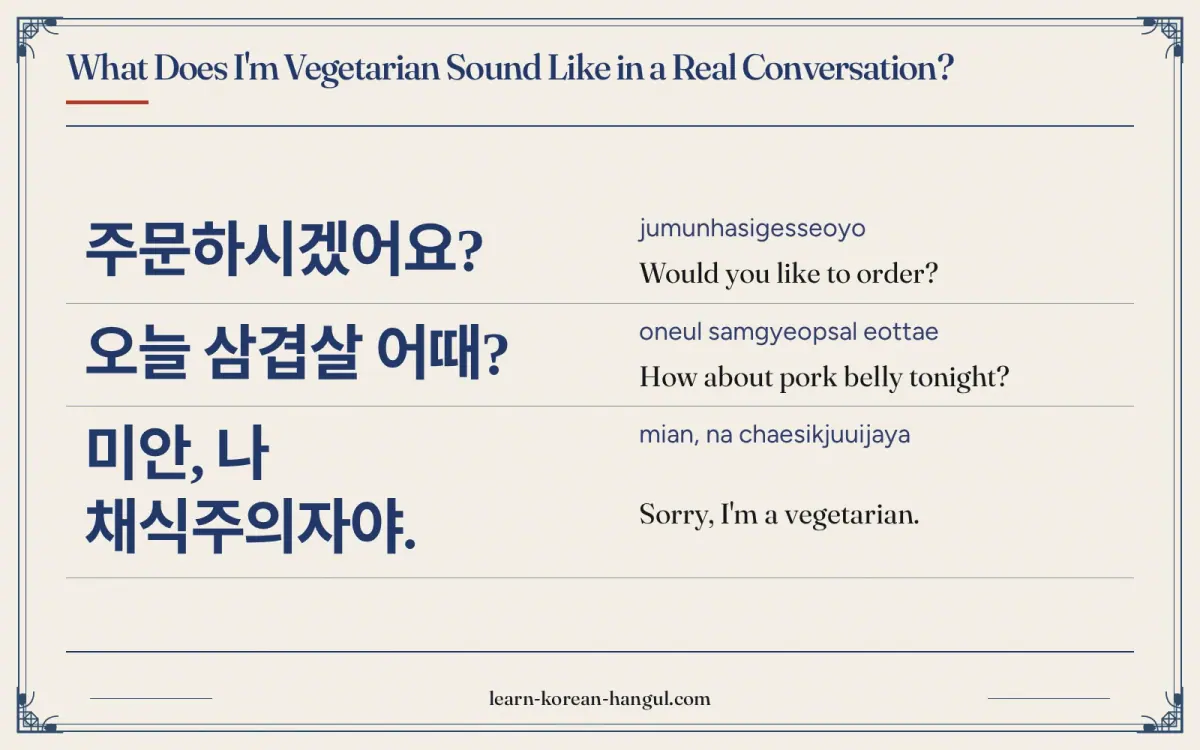
In real life, the line leads to a negotiation about the menu.
Ordering at a Restaurant
Server
주문하시겠어요?
jumunhasigesseoyo
Would you like to order?
Guest
저는 채식주의자예요. 고기 없는 메뉴 있어요?
jeoneun chaesikjuuijayeyo. gogi eomneun menyu isseoyo
I'm a vegetarian. Do you have a menu without meat?
Server
비빔밥은 고기를 빼 드릴 수 있어요.
bibimbabeun gogireul ppae deuril su isseoyo
For the bibimbap, I can leave out the meat.
What to notice: the server uses the honorific 주문하시겠어요, and the guest uses the plain polite style. The offer 빼 드릴 수 있어요 means "I can leave it out for you".
Friends Planning Dinner
Jimin
오늘 삼겹살 어때?
oneul samgyeopsal eottae
How about pork belly tonight?
Sua
미안, 나 채식주의자야.
mian, na chaesikjuuijaya
Sorry, I'm a vegetarian.
Jimin
아, 맞다! 그럼 비빔밥 먹자.
a, matda! geureom bibimbap meokja
Oh, right! Then let's eat bibimbap.
What to notice: friends use the casual 채식주의자야. The word 어때 (how about) is a casual way to suggest a plan, and 먹자 means "let's eat".
Where Can Meat Hide in Korean Food?
Many dishes that look plant-based are not. This section helps you decide what to ask. It is a general guide, so ask at each restaurant.
- Broths. 국 (guk, soup) and 찌개 (jjigae, stew) are often made with beef broth or anchovy broth (멸치 육수, myeolchi yuksu).
- Kimchi. Many kinds of kimchi use salted shrimp or fish sauce (젓갈, jeotgal), although some are made without them.
- Rice dishes. 비빔밥 usually has beef and egg, but it can be ordered without the meat.
- Instant noodles. The soup powder often contains meat extract.
The cooking of Buddhist temples, called 사찰 음식, avoids meat and fish, and many temple-food restaurants serve it to visitors. Look for 채식 식당 (chaesik sikdang, vegetarian restaurant) on map apps when you plan a meal.
What Should You Know about the Culture behind I'm Vegetarian?
Vegetarian dining has grown in Korean cities, especially in cafés and in neighborhoods with many young people and visitors. Even so, a meal in Korea is often shared, and a table may be built around meat and soup. A clear, friendly sentence helps everyone.
- Say it early. When you book or sit down, say 저는 채식주의자예요 before ordering.
- Explain with food words. People understand 고기 (meat) and 생선 (fish) better than the long word 채식주의자.
- Shared dishes. At a group meal, ask 이거 고기 들어갔어요? (does this have meat?) before you eat from a shared pot.
- Be kind about refusals. A host may press you to try a meat dish. Say 죄송해요, 고기는 못 먹어요 (I'm sorry, I can't eat meat) with a smile.
An expert tip: the particle 는 in 고기는 안 먹어요 sets meat apart from other food, so it sounds like "as for meat, no".
What Mistakes Do Learners Make with I'm Vegetarian in Korean?
Most mistakes come from the long word and from the meaning of 고기.
| Mistake | Why it is a problem | Fix |
|---|---|---|
| 저는 채식이에요 | 채식 is a way of eating, not a person | Say 저는 채식주의자예요 |
| 채식주의자이에요 | The vowel ending takes 예요 | Say 채식주의자예요 |
| 비건예요 | A consonant ending takes 이에요 | Say 비건이에요 |
| 고기 없어요 | Sounds like "there is no meat" | Say 고기를 안 먹어요 |
| Assuming 고기 includes fish | Fish is 생선 | Add 생선도 안 먹어요 |
| 채식주의자야 to a server | Too casual | Say 채식주의자예요 |
How Do You Ask Someone If They Are Vegetarian?
You can turn the same words into a question by raising your voice at the end. To a friend, say 채식주의자야? (chaesikjuuijaya?). To a colleague, say 채식주의자예요? (chaesikjuuijayeyo?). To a guest or an elder, a gentler way is 고기 드세요? (gogi deuseyo?), which means "do you eat meat?" and uses the honorific verb 드시다 (to eat). For a host, ask 못 드시는 음식 있으세요? (mot deusineun eumsik isseuseyo?), which means "is there food you can't eat?". That question shows respect and makes a menu easy to plan.
Is It the Same as Vegan, No Meat or Vegetarian Food?
Not exactly. The short answers below cover the other searches folded into this page.
- Vegetarian in Korean: 채식주의자 for the person and 채식 for the diet.
- Vegan in Korean: 비건 (bigeon), as in 비건 메뉴 (a vegan menu).
- No meat in Korean: 고기 없이 (gogi eopsi, without meat), as in 고기 없이 주세요.
- I don't eat meat in Korean: 고기를 안 먹어요.
- Vegetarian food in Korean: 채식 음식 or 채식 메뉴.
Now practise aloud.
Practice: Say It Aloud
Play the slow clip of 저는 채식주의자예요 twice and keep the ㅈ in 식쭈 tense. Then choose a phrase. Answers follow.
- You tell a server politely that you are vegetarian.
- You tell a close friend you are vegan.
- You ask if the soup has meat in it.
- You ask a server to leave out the meat.
Answers
- 저는 채식주의자예요.
- 나 비건이야.
- 이 국에 고기가 들어갔어요?
- 고기 빼 주세요.
The phrase flashcards drill these lines with audio.
Related Phrases to Learn Next
A diet statement leads to health, ordering and taste.
- I have an allergy in Korean: 알레르기가 있어요 when food is a medical issue.
- Not spicy please in Korean: a request for milder dishes.
- I'd like to order in Korean: the pattern for ordering any dish.
This guide belongs to the Korean restaurant phrases collection. What this page does not cover: the full food vocabulary, religious diets and strict allergy rules. Remember to say 채식주의자예요, add what you avoid in plain words and ask about the broth, and you can say i'm vegetarian in Korean with confidence.
Frequently Asked Questions
How do you say I'm vegetarian in Korean?
Say 저는 채식주의자예요 (jeoneun chaesikjuuijayeyo) in polite speech. In formal speech, say 채식주의자입니다, and to a close friend, say 나는 채식주의자야. The word 채식주의자 is long, so many people add the simpler line 고기를 안 먹어요 (I don't eat meat) to make sure the listener understands.
How do I say I'm vegan in Korean?
Say 저는 비건이에요 (jeoneun bigeonieyo). 비건 is the English word vegan written in Hangul and it is widely understood in cities. If you want to be clear, add 달걀이랑 우유도 안 먹어요 (I don't eat eggs or milk either). Many restaurants know 채식, but fewer know every vegan detail.
How do I say I don't eat meat in Korean?
Say 고기를 안 먹어요 (gogireul an meogeoyo). The word 고기 means meat, and 안 makes the verb negative. Because 고기 does not always include fish in a server's mind, add 생선도 안 먹어요 (saengseondo an meogeoyo, I don't eat fish either) when you avoid fish, and name other foods such as 해산물 (seafood) if needed.
Is Korean food easy for vegetarians?
It can be done with care. Many side dishes are vegetable-based, but broths are often made with beef or anchovy, and kimchi may contain salted fish or shrimp. Ask 육수에도 고기가 들어가요? (does the broth have meat too?) and look for 채식 식당 (vegetarian restaurants) or temple food. Staff usually try to help once you explain.
What is the difference between 채식주의자 and 비건?
채식주의자 (chaesikjuuija) is the general word for a vegetarian, and 비건 (bigeon) is a vegan who avoids all animal products. In Korea, the word 채식 (plant-based food) is used loosely, and a place that calls itself 채식 may still use eggs or dairy. Say exactly what you avoid to be safe.
What mistake do learners make when saying I'm vegetarian in Korean?
Learners often say 저는 채식이에요 or only the English word vegetarian. 채식 means a plant-based diet, not a person, so the person word is 채식주의자. Another mistake is saying 고기 없어요, which means there is no meat, and sounds like a statement about the food, not about you. Say 저는 고기를 안 먹어요 instead.