좋아요
좋아요
What you'll learn
- Say I like it with 좋아요, 마음에 들어요, 좋아 or 좋습니다, depending on the listener.
- Tell 좋아요 (it is good) apart from 좋아해요 (I like something).
- Pronounce 좋아요 as [조아요] without an h sound.
- Understand why 좋아요 can also mean yes.
Before you start: you only need to read Hangul. If you want the wider picture first, see the Expressing Feelings collection. Time: about 10 minutes.
How Do You Say I Like It in Korean?
The standard way to say I like it in Korean is 좋아요, which literally means "it is good". Korean often shows liking by calling a thing good rather than by naming a feeling, so one short word covers "I like it", "it is good" and "sounds good".
| Situation | Best form | Romanization | Why |
|---|---|---|---|
| Tasting food a stranger cooked | 좋아요 | joayo | Polite, safe |
| Trying on a jacket | 마음에 들어요 | maeume deureoyo | It suits my taste |
| Reacting to a friend's idea | 좋아 | joa | Casual |
| Answering your manager | 좋습니다 | joseumnida | Formal |
| Saying you like a singer | 좋아해요 | joahaeyo | Needs an object |
You can put the thing in front when it is not obvious: 이거 좋아요 (igeo joayo, I like this). The next section sorts the forms by listener.
What Are the Polite and Casual Ways to Say I Like It?
The forms differ by speech level, the endings that change with the listener. The guide to Korean speech levels explains all three levels. For this phrase, you need one formal form, two polite forms and one casual form.
Polite: 좋아요 (joayo)
Polite · 해요체좋아요 is the form to learn first. Use it with strangers, colleagues, shop staff and older people. It answers the question "Do you like it?" and it also agrees with a plan.
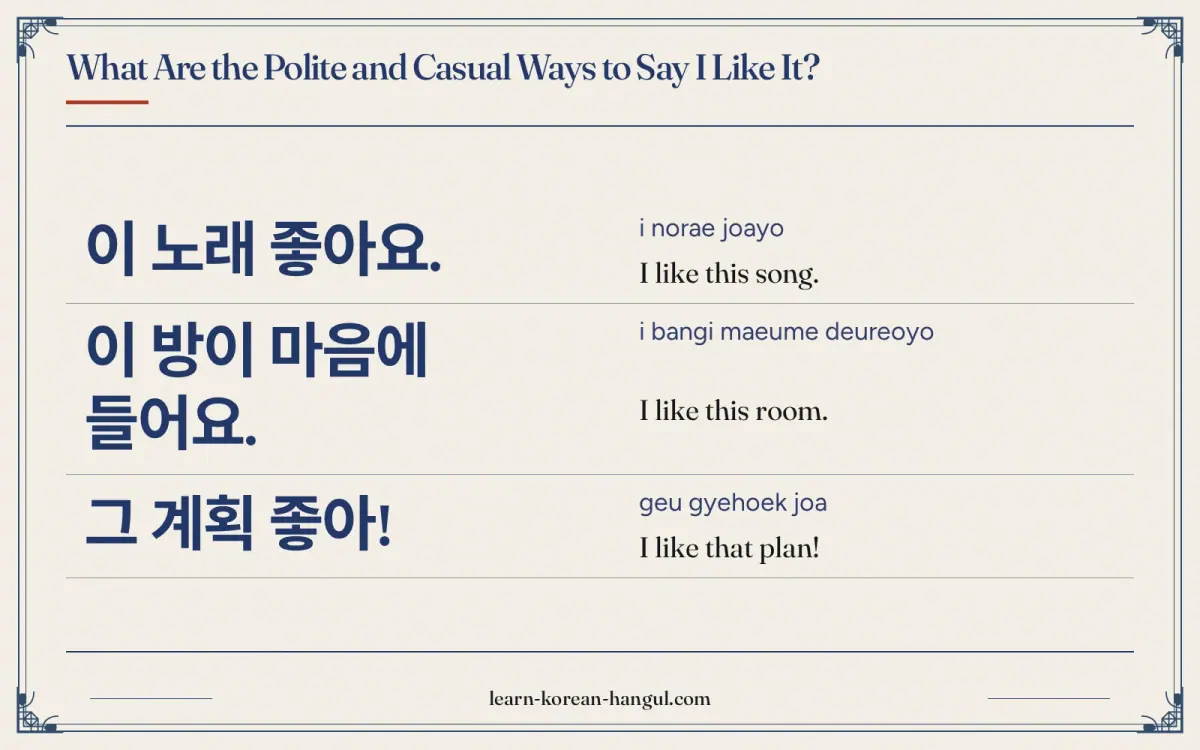
이 노래 좋아요.
i norae joayo
I like this song.
Polite: 마음에 들어요 (maeume deureoyo)
Polite · 해요체마음에 들어요 literally means "it enters my heart". Use it when you have looked at, tried or chosen something and it fits your taste, such as clothes, a flat or a gift. It sounds a little more considered than 좋아요.
이 방이 마음에 들어요.
i bangi maeume deureoyo
I like this room.
Notice the particle 이 after 방: with 마음에 들어요, the thing you like is the subject, not the object.
Casual: 좋아 (joa)
Casual · 반말좋아 drops the polite ending -요. Use it with close friends, siblings and people younger than you. It sounds flat if you say it quietly, and warm if you say it with a smile. 오, 좋다 (o, jota) is a common reaction to something new.
그 계획 좋아!
geu gyehoek joa
I like that plan!
Formal: 좋습니다 (joseumnida)
Formal · 합쇼체좋습니다 uses the formal -습니다 ending. It fits meetings, presentations, announcements and talking to a client. It is pronounced [조씀니다], which is explained below.
Polite: 좋아해요 (joahaeyo)
Polite · 해요체좋아해요 is a different verb, 좋아하다, meaning "to like". It takes an object with 을/를 and says what you like in general, such as a food or a singer. 저는 김치를 좋아해요 means "I like kimchi".
저는 김치를 좋아해요.
jeoneun gimchireul joahaeyo
I like kimchi.
These forms look close on paper, but the spoken sound hides a surprise.
How Do You Pronounce 좋아요?
좋아요 is pronounced [조아요], jo-a-yo, in three syllables. The spelling has a ㅎ at the bottom of the first syllable, but you do not say it.
- 좋 (jo): a soft j and a clear "o". The ㅎ stays silent.
- 아 (a): "ah", with no break after 조.
- 요 (yo): "yo", light and short.
Sound Changes to Listen For
These changes follow the National Institute of Korean Language standard pronunciation rules (표준 발음법, Article 12):
- ㅎ is silent before a vowel. 좋아요 is [조아요], and 좋아해요 is [조아해요]. Do not say an h sound.
- ㅎ + ㅅ becomes ㅆ. 좋습니다 is [조씀니다]: the ㅎ drops, the ㅅ becomes tense ㅆ, and ㅂ before ㄴ turns into ㅁ. See Korean tensification for tense sounds.
Knowing the sound is half the task. The other half is knowing when each form fits.
When Should You Use 좋아요, and When Should You Not?
Use 좋아요 when you react to something in front of you, when you agree to a plan, or with 이/가 for a general liking (영화가 좋아요). With 을/를, a general liking needs the verb 좋아해요.
Situations Where It Fits
- A host asks if the food is good. Say 네, 좋아요, or 정말 맛있어요 (it is really tasty).
- A friend suggests meeting at seven. Say 좋아요, 일곱 시에 봐요 (okay, see you at seven).
- You hold up a shirt in a shop. Say 마음에 들어요 when it suits you.
Situations to Avoid
- Naming a hobby with the wrong particle. 영화를 좋아요 mixes two patterns. Say 영화가 좋아요 or 영화를 좋아해요.
- Close friends. 좋아요 is fine, but 좋아 sounds more natural and warmer.
- Strong disagreement. 좋아요 can be taken as a yes. If you do not want to go, say it clearly.
Here is how these forms sound in two short conversations.
What Does I Like It Sound Like in a Real Conversation?
A real conversation uses the short form and a follow-up, so you do not need long sentences. Watch how the speaker adds a reason.
A New Cafe
Friend
어때요? 커피 괜찮아요?
eottaeyo? keopi gwaenchanayo?
How is it? Is the coffee okay?
You
네, 좋아요. 분위기도 마음에 들어요.
ne, joayo. bunwigido maeume deureoyo
Yes, I like it. I like the atmosphere too.
Friend
다행이에요.
dahaengieyo
I'm relieved.
What to notice: 좋아요 answers the question and 마음에 들어요 adds a detail about the atmosphere (분위기).
Weekend Plan
Minji
주말에 같이 영화 볼까?
jumare gachi yeonghwa bolkka?
Shall we watch a film this weekend?
Jun
좋아! 어떤 영화?
joa! eotteon yeonghwa?
Sure! Which film?
Minji
새로 나온 코미디.
saero naon komidi
The new comedy.
What to notice: between friends the casual 좋아 means "sure". Nobody says they like the film yet.
What Should You Know about the Culture behind I Like It?
In Korea, 좋아요 is also a way to say yes. A Korean friend may say 좋아요 when you invite them to dinner, and they do not mean the food is good; they mean they accept. The same word is the like button on Korean social media, so you will see 좋아요 under many posts.
- Agreeing with warmth. Saying 좋아요 to a plan is a social signal as much as an opinion.
- Praise is often understated. A quiet 좋아요 can be stronger praise than it sounds.
- Taste words come with reasons. After 마음에 들어요, people often name what they like, such as the colour or the size.
Korean workplaces show the same pattern. A colleague who says 좋아요 to a lunch plan is agreeing, and a colleague who wants a different place usually proposes one instead of saying no, for example 저는 국수가 더 좋아요 (I would prefer noodles). So listen for the follow-up, not only the first word.
An expert tip: because 좋아요 doubles as yes, the phrase is easy to say but hard to read. If you really mean "I like it", add a detail, such as 정말 좋아요 (really good) or 색이 좋아요 (the colour is nice).
What Mistakes Do Learners Make with I Like It in Korean?
Most mistakes come from mixing 좋아요 with 좋아해요, or from skipping the ㅎ rule.
| Mistake | Why it is a problem | Fix |
|---|---|---|
| 영화를 좋아요 for "I like films" | 좋아요 takes 이/가, not 을/를 | Say 영화가 좋아요 or 영화를 좋아해요 |
| Saying [조하요] with a clear h | Not the standard sound | Say [조아요] |
| 좋아 to an older person | Too casual | Say 좋아요 |
| Using 마음에 들어요 for a plan | It fits things you can see or try | Say 좋아요 |
| Agreeing with 좋아요 when you mean no | Heard as yes | Say a clear refusal |
Learners often assume 좋아요 always means "I like it". Actually, it also means "it is good", "okay" and "yes", so context decides. That is why it is useful to learn the difference early.
Is 좋아요 the Same as "Like" or "Good"?
Almost. In Korean, "good" and "like" share a root, and the short answers below cover the queries folded into this page.
- Like in Korean: the verb 좋아하다 (to like), as in 좋아해요. The lesson on like in Korean covers the verb in detail.
- Good in Korean: 좋다 (jota), the adjective, in the polite form 좋아요.
- I like this in Korean: 이거 좋아요 for "this is good" or 이거 마음에 들어요 for "this suits me".
Now say them aloud.
Practice: Say It Aloud
Play the slow clip of 좋아요 three times, then say it with your mouth relaxed on the ㅎ. Then pick a reply. Answers follow.
- Your host asks if the soup is good.
- Your friend suggests a walk, and you are on casual terms.
- Your manager asks for your view of a plan, in a formal meeting.
- You want to say you like dogs in general.
Answers
- 네, 좋아요.
- 좋아!
- 좋습니다.
- 저는 강아지를 좋아해요.
The phrase flashcards drill these answers with audio.
Related Phrases to Learn Next
Liking sits beside its opposite and beside food and people.
- I don't like it in Korean: 싫어요 for the opposite feeling.
- Delicious in Korean: 맛있어요 for food you like.
- I like you in Korean: 좋아해요 with a person as the object.
This guide belongs to the Korean feelings phrases collection. What this page does not cover: the full conjugation of 좋다, long compliments and writing a review in Korean. Learn 좋아요, listen for the silent ㅎ, and you can say I like it in Korean with confidence.
Frequently Asked Questions
How do you say I like it in Korean?
Say 좋아요 (joayo) to a stranger, a colleague or anyone you speak politely to. It means both I like it and it is good. With a friend, say 좋아. In formal settings such as a presentation or a meeting, say 좋습니다. Add the thing in front, as in 이거 좋아요 (I like this), when the object is not clear.
How do you pronounce 좋아요?
Say [조아요], jo-a-yo, with three short syllables. The ㅎ at the end of 좋 is not pronounced when a vowel follows, which is the rule in the 국립국어원 standard pronunciation rules (표준 발음법, Article 12). Do not add an h sound. Listen to the audio and copy the smooth, light flow from 조 to 아.
What is the difference between 좋아요 and 마음에 들어요?
좋아요 is a general reaction: it is good, I like it, or yes. 마음에 들어요 means it fits your taste, so you use it after you have seen, tried or chosen something, such as a jacket, a flat or a gift. For a coat you are about to buy, 마음에 들어요 is more precise.
Is 좋아요 formal or casual?
좋아요 is polite, in the 해요체 style, and sits in the middle. It is safe with strangers, colleagues and older people in daily life. For very formal speech use 좋습니다, and for close friends or younger people use the casual 좋아. If you are unsure, 좋아요 is almost never wrong.
Can I use 좋아요 with friends, elders and strangers?
Yes, with all three. 좋아요 is the safe everyday choice. Friends will often say 좋아 or 오, 좋다 instead, and you can too. With elders, keep 좋아요 and add 정말 (really) for warmth. With a boss or a customer, 좋습니다 sounds more formal. Never use the casual 좋아 with someone older unless they invite you to.
What is the most common mistake with I like it in Korean?
Learners mix up the particles. 좋아요 takes 이/가, as in 저는 영화가 좋아요, while 좋아해요 takes 을/를, as in 저는 영화를 좋아해요; both mean I like films. 영화를 좋아요 mixes the two patterns and sounds wrong. To react to something in front of you, 좋아요 is the natural answer.