길을 잃었어요
길을 잃었어요
What you'll learn
- Say I'm lost with 길을 잃었어요, 길을 잃어버렸어요 or 길을 잃었습니다, depending on the listener.
- Ask 여기가 어디예요? (where is this?) and ask for help with 도와주세요.
- Understand why Korean uses the past tense 잃었어요 for being lost.
- Pronounce 잃었어요 as [이러써요] and 서울역에 as [서울려게].
Before you start: you only need to read Hangul. For the next words you will need, learn Help in Korean. Time: about 10 minutes. Audio plays only when you press a button.
Key facts
- 길을 잃었어요 (gireul ireosseoyo) is the polite way to say I'm lost, pronounced [기를 이러써요].
- 길을 잃어버렸어요 (gireul ireobeoryeosseoyo) means I got lost, and 길을 잃었습니다 (gireul ireotseumnida) is formal.
- Being lost is a completed state, so use the past 잃었어요, not the present 잃어요.
- 여기가 어디예요? (yeogiga eodiyeyo?) asks where this is, and 도와주세요 asks for help.
- Add your destination with 가고 싶어요, as in 서울역에 가고 싶어요.
How Do You Say I'm Lost in Korean?
The standard way to say I'm lost in Korean is 길을 잃었어요. The word 길 (gil) means road or way, 을 marks it as the object, and 잃다 (ilta) means to lose. So the literal meaning is "I lost the road". Korean usually drops "I", so 길을 잃었어요 alone is a full sentence. It has six syllables: gi-reul i-reo-sseo-yo.
| Situation | Best form | Romanization | Why |
|---|---|---|---|
| Telling staff or a passer-by | 길을 잃었어요 | gireul ireosseoyo | Polite, natural |
| Telling the story of what happened | 길을 잃어버렸어요 | gireul ireobeoryeosseoyo | Complete, a little regretful |
| Asking where you are | 여기가 어디예요? | yeogiga eodiyeyo | Wh-question |
| A formal setting or announcement | 길을 잃었습니다 | gireul ireotseumnida | Formal |
| Telling a close friend | 길 잃었어 | gil ireosseo | Casual |
The next section sorts the forms by the person you are talking to.
What Are the Formal and Polite Ways to Say I'm Lost?
The forms follow the Korean speech levels, explained in the guide to Korean speech levels. The stem 잃- stays the same, and the ending changes the level.
Polite: 길을 잃었어요 (gireul ireosseoyo)
Polite · 해요체길을 잃었어요 is the form to learn first. It suits taxi drivers, station staff, shop clerks and any stranger. Start with 저기요 (jeogiyo, excuse me) to get attention, then say what you need.
저기요, 길을 잃었어요. 도와주세요.
jeogiyo, gireul ireosseoyo. dowajuseyo
Excuse me, I'm lost. Please help me.
Polite: 길을 잃어버렸어요 (gireul ireobeoryeosseoyo)
Polite · 해요체길을 잃어버렸어요 adds 버리다 (beorida, to finish off). It shows that the loss is complete and slightly regretful, like "I've gone and got lost". It is pronounced [기를 이러버려써요]. Use it when you tell what happened.
휴대폰이 없어서 길을 잃어버렸어요.
hyudaeponi eopseoseo gireul ireobeoryeosseoyo
I have no phone, so I got lost.
Polite: 여기가 어디예요? (yeogiga eodiyeyo?)
Polite · 해요체여기가 어디예요? means "where is this?", which is the natural way to ask "where am I?". 여기 (yeogi) is "here", and 어디예요 is "where is it". It is a wh-question, so it does not end with a sharp rise. It is pronounced [여기가 어디예요].
여기가 어디예요?
yeogiga eodiyeyo?
Where is this?
Formal: 길을 잃었습니다 (gireul ireotseumnida)
Formal · 합쇼체길을 잃었습니다 is the formal form. It appears in announcements, reports and formal speech, and you will rarely need it for yourself. It is pronounced [기를 이럳씀니다]: the final ㅆ turns into ㄷ before ㅅ, the ㅅ becomes tense, and the ㅂ turns into ㅁ before ㄴ.
Casual: 길 잃었어 (gil ireosseo)
Casual · 반말길 잃었어 drops both the particle 을 and the polite 요. Use it with close friends and family. It is pronounced [길 이러써]. The grammar behind these phrases comes next.
Why Do We Say 길을 잃었어요 in the past Tense?
잃다 means "to lose". Losing the way is an event that has happened, and you now stay in the result. Korean uses the past tense for the result: 잃었어요, not 잃어요. The present 잃어요 would mean "I lose" as a habit or a process, which is not what you want to say.
- 잃다 → 잃었어요 (I lost / I am lost)
- 잃어버리다 → 잃어버렸어요 (I lost completely / I got lost)
- 모르다 → 몰랐어요 (I did not know)
The past marker is -았/었-. The stem vowel of 잃- is ㅣ, not ㅏ or ㅗ, so the marker is 었, giving 잃 + 었 + 어요 → 잃었어요. The auxiliary verb 버리다 adds a sense of completion, and its past is 버렸어요. A related phrase is 길을 몰라요 (gireul mollayo), which means "I don't know the way". Next, the pronunciation.
How Do You Pronounce 길을 잃었어요?
길을 잃었어요 is pronounced [기를 이러써요] and has six syllables: gi-reul i-reo-sseo-yo. It sounds quite different from how it is written, so go step by step.
- 길을 (gireul): the ㄹ of 길 moves onto 을, so you hear [기를].
- 잃 (i): the spelling ㅀ has two final letters. Before a vowel, the ㅎ is silent and the ㄹ moves onto the next syllable, so 잃었 sounds like [이럳].
- 었 (reo): it now starts with that ㄹ. The ㅓ is unrounded, so keep your lips relaxed.
- 어요 (sseoyo): the ㅆ of 었 moves onto 어 and gives [써요], so the whole word is [이러써요].
Sound Changes to Listen For
These changes follow the National Institute of Korean Language standard pronunciation rules (표준 발음법):
- Liaison. A final consonant moves onto a following vowel, so 길을 is [기를] (Article 13). In 잃어, the ㅎ is silent and the ㄹ moves (Article 12 and Article 14 for double finals).
- Final ㅆ and ㄷ. 잃었습니다 is [이럳씀니다]: ㅆ is pronounced ㄷ (Article 9), the ㅅ is tense (Article 23), and ㅂ becomes ㅁ (Article 18). RR writes ireotseumnida. See Korean tensification.
- The dictionary form. 잃다 is [일타], where ㅎ and ㄷ merge into ㅌ.
With the sound clear, here is when to use each form.
When Should You Use 길을 잃었어요, and When Should You Not?
Use 길을 잃었어요 when you truly cannot find your way and want help. Then name your place, so people can answer quickly.
Situations Where It Fits
- A subway station. 길을 잃었어요, 서울역에 가고 싶어요. (I'm lost, I want to go to Seoul Station.)
- A street in a new city. 저기요, 길을 잃었어요. (Excuse me, I'm lost.)
- A shopping mall or market. 길을 잃어버렸어요. 출구가 어디예요? (I got lost. Where is the exit?)
Situations to Avoid
- Present tense. Say 잃었어요, not 잃어요.
- Road wording. 길이 없어요 means "there is no road".
- No destination. Without a place name, people may not know how to help. Add 가고 싶어요 and a name.
Here is the key line for naming a place.
서울역에 is pronounced [서울려게]. Korean inserts an ㄴ before 여 (서울 + 녁), and an ㄴ after ㄹ is pronounced as ㄹ, so 서울역 sounds like [서울력]. With 에, the final ㄱ moves forward and gives [서울려게]. RR shows this as Seoullyeoge. A similar example is 지하철역이 (jihacheollyeogi), pronounced [지하철려기]. See Where is the subway station in Korean for the full question.
Two short conversations show how it sounds.
What Does I'm Lost Sound Like in a Real Conversation?
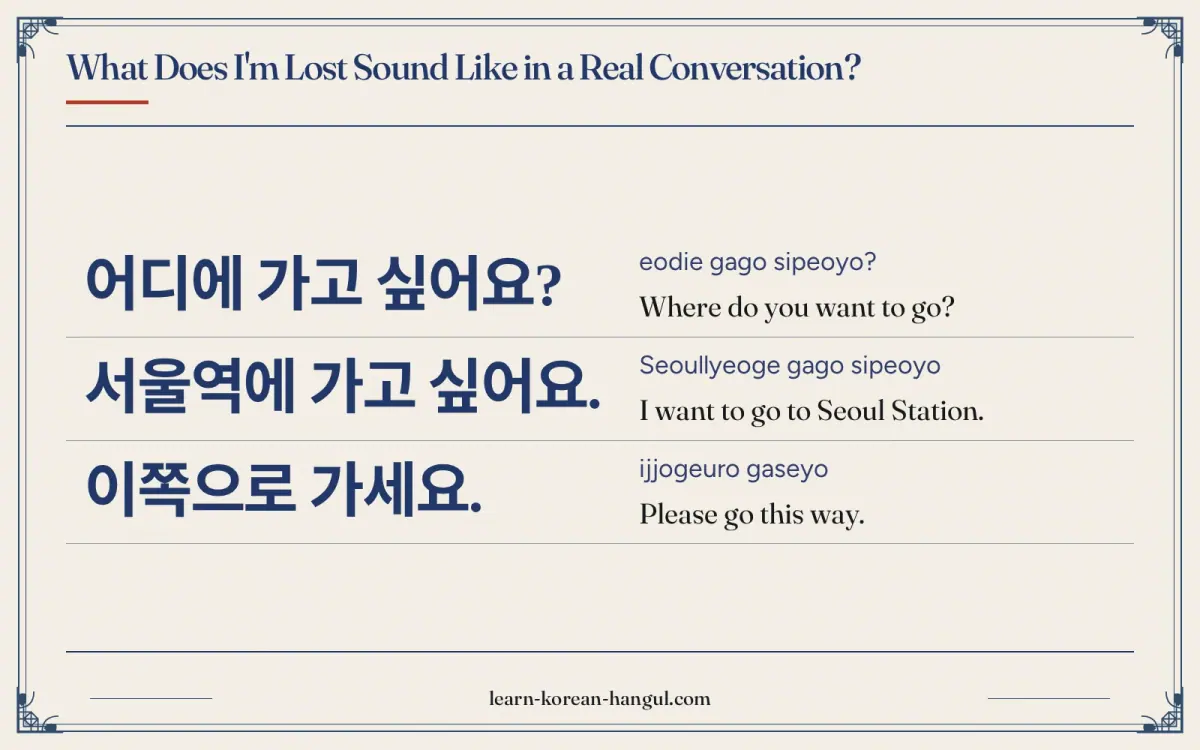
In real life, the line is followed by a question about where you want to go. Notice the answers.
At a Subway Station
Traveller
저기요, 길을 잃었어요. 도와주세요.
jeogiyo, gireul ireosseoyo. dowajuseyo
Excuse me, I'm lost. Please help me.
Staff
어디에 가고 싶어요?
eodie gago sipeoyo?
Where do you want to go?
Traveller
서울역에 가고 싶어요.
Seoullyeoge gago sipeoyo
I want to go to Seoul Station.
Staff
이쪽으로 가세요.
ijjogeuro gaseyo
Please go this way.
What to notice: the traveller states the problem, then asks for help, and then names the destination. The staff member answers with the honorific 가세요.
Calling a Friend
Jiho
나 길 잃었어. 여기가 어디야?
na gil ireosseo. yeogiga eodiya?
I'm lost. Where is this?
Suyeon
주변에 뭐가 보여?
jubyeone mwoga boyeo?
What can you see around you?
Jiho
편의점이 있어.
pyeonuijeomi isseo
There's a convenience store.
Suyeon
거기서 기다려. 내가 갈게.
geogiseo gidaryeo. naega galge
Wait there. I'll come.
What to notice: the casual 길 잃었어 comes with 어디야, and the friend answers with a question about what Jiho can see, then promises to come with 갈게.
What Should You Know about the Culture behind Being Lost?
Station and shop staff in Korea will often point on a map or walk you part of the way, and many people happily help a visitor who asks politely. Showing a screenshot of your destination in Korean makes it easier, because place names are written in Hangul on signs and maps.
- Navigation apps. Many visitors find that Naver Map and Kakao Map give more detailed directions in Korea than Google Maps, which has limited features there. App features change, so check them before you travel.
- Show the Korean name. Save the destination name in Hangul, such as 서울역, on your phone.
- Landmarks. Locals often give directions with landmarks like a convenience store (편의점) or a subway exit (출구, chulgu).
For emergencies, learn Help in Korean and Excuse me in Korean. These are general habits rather than rules, and situations differ.
What Mistakes Do Learners Make with I'm Lost in Korean?
Most mistakes come from tense and word choice.
| Mistake | Why it is a problem | Fix |
|---|---|---|
| 길을 잃어요 | Present tense sounds like a process | Say 길을 잃었어요 |
| 길이 없어요 | It means "there is no road" | Say 길을 잃었어요 |
| 길을 몰라요 for "I'm lost" | It means "I do not know the way" | Use it only to say that |
| Reading 잃었어요 letter by letter | The real sound is [기를 이러써요] | Practise the liaison |
| 길 잃었어 to staff | Too casual | Say 길을 잃었어요 |
Learners also forget the destination. A short message such as 길을 잃었어요, 서울역에 가고 싶어요 is much easier to answer than a bare "I'm lost".
Is It the Same as I Am Lost, Lost, I Got Lost, Lost in Seoul or Where Am I?
Mostly. The short answers below cover the other searches folded into this page.
- I am lost in Korean: 길을 잃었어요 or the formal 길을 잃었습니다.
- Lost in Korean: 길을 잃은 (gireul ireun) before a noun, as in 길을 잃은 사람 (a person who is lost).
- I got lost in Korean: 길을 잃어버렸어요.
- Lost in Seoul in Korean: 서울에서 길을 잃었어요 (Seoureseo gireul ireosseoyo), pronounced [서울에서 기를 이러써요].
- Where am I in Korean: 여기가 어디예요? (Where is this?)
Now practise aloud.
Practice: Say It Aloud
Play the slow clip of 길을 잃었어요 three times and link the sounds into [기를 이러써요]. Then choose a phrase. Answers follow.
- You tell a station attendant you are lost.
- You ask where you are.
- You tell a friend by phone that you are lost.
- You say you do not know the way.
Answers
- 길을 잃었어요.
- 여기가 어디예요?
- 길 잃었어.
- 길을 몰라요.
The phrase flashcards drill these lines with audio.
Related Phrases to Learn Next
Being lost leads to asking for help and for directions.
- Help in Korean: 도와주세요 and other urgent words.
- Where is the subway station in Korean: the next question to ask.
- Excuse me in Korean: 저기요 to get attention.
- Take me to the airport in Korean: 공항에 가 주세요 in a taxi.
This guide belongs to the Korean travel phrases collection. What this page does not cover: reading maps, bus numbers and emergency calls. Remember the past tense, the [이러써요] sound and the destination, and you can say i'm lost in Korean naturally.
Frequently Asked Questions
How do you say i'm lost in Korean?
Say 길을 잃었어요 (gireul ireosseoyo) in polite speech. It literally means I lost the road, and it is the standard way to say you are lost. In a formal setting, say 길을 잃었습니다. With a friend, say 길 잃었어. Add 도와주세요 (dowajuseyo) if you need help.
How do you pronounce 길을 잃었어요?
It is written 길을 잃었어요 but pronounced [기를 이러써요]. The ㄹ of 길 moves onto 을, the ㅎ in 잃 is silent before a vowel, the ㄹ moves onto the next syllable, and 었 sounds like 써. It has six syllables: gi-reul i-reo-sseo-yo. Say it as a smooth phrase.
What is the difference between 길을 잃었어요 and 길을 잃어버렸어요?
Both mean I'm lost. 길을 잃었어요 is the neutral phrase. 길을 잃어버렸어요 adds 버리다, which shows the loss is complete and a bit regretful, like I've gone and got lost. Use it when you are telling the story. In an emergency, the shorter phrase is quicker.
Is 길을 잃었어요 formal or casual?
It is polite, which sits in the middle. Formal speech uses 길을 잃었습니다 (gireul ireotseumnida), pronounced [기를 이럳씀니다]. Casual speech uses 길 잃었어. In a station or street, polite 길을 잃었어요 is the right level for staff and passers-by.
Can I use 길을 잃었어요 with friends, elders and strangers?
Yes, with strangers and elders it is polite and safe. With friends, drop the ending and say 길 잃었어. In all cases, follow it with what you need: 도와주세요 for help, or the name of your destination with 가고 싶어요. That makes it easy for people to help you.
What is the most common mistake with i'm lost in Korean?
Learners say 길이 없어요, which means there is no road, or the present 길을 잃어요, which sounds like you are losing your way over and over. Being lost is a result, so use the past 길을 잃었어요. Also remember the sound [이러써요], and do not read 잃었어요 letter by letter.